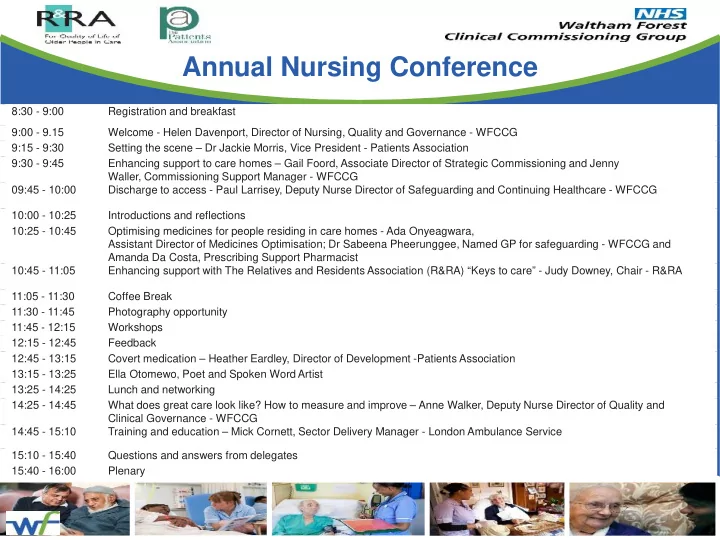
Annual Nursing Conference Programme 8:30 - 9:00 Registration and - - PowerPoint PPT Presentation

annual nursing conference
SMART_READER_LITE
LIVE PREVIEW

Annual Nursing Conference Programme 8:30 - 9:00 Registration and - - PowerPoint PPT Presentation

Annual Nursing Conference Programme 8:30 - 9:00 Registration and breakfast 9:00 - 9.15 Welcome - Helen Davenport, Director of Nursing, Quality and Governance - WFCCG 9:15 - 9:30 Setting the scene Dr Jackie Morris, Vice President -


slide-1
SLIDE 1

Annual Nursing Conference

Programme

8:30 - 9:00 Registration and breakfast 9:00 - 9.15 Welcome - Helen Davenport, Director of Nursing, Quality and Governance - WFCCG 9:15 - 9:30 Setting the scene – Dr Jackie Morris, Vice President - Patients Association 9:30 - 9:45 Enhancing support to care homes – Gail Foord, Associate Director of Strategic Commissioning and Jenny Waller, Commissioning Support Manager - WFCCG 09:45 - 10:00 Discharge to access - Paul Larrisey, Deputy Nurse Director of Safeguarding and Continuing Healthcare - WFCCG 10:00 - 10:25 Introductions and reflections 10:25 - 10:45 Optimising medicines for people residing in care homes - Ada Onyeagwara, Assistant Director of Medicines Optimisation; Dr Sabeena Pheerunggee, Named GP for safeguarding - WFCCG and Amanda Da Costa, Prescribing Support Pharmacist 10:45 - 11:05 Enhancing support with The Relatives and Residents Association (R&RA) “Keys to care” - Judy Downey, Chair - R&RA 11:05 - 11:30 Coffee Break 11:30 - 11:45 Photography opportunity 11:45 - 12:15 Workshops 12:15 - 12:45 Feedback 12:45 - 13:15 Covert medication – Heather Eardley, Director of Development -Patients Association 13:15 - 13:25 Ella Otomewo, Poet and Spoken Word Artist 13:25 - 14:25 Lunch and networking 14:25 - 14:45 What does great care look like? How to measure and improve – Anne Walker, Deputy Nurse Director of Quality and Clinical Governance - WFCCG 14:45 - 15:10 Training and education – Mick Cornett, Sector Delivery Manager - London Ambulance Service 15:10 - 15:40 Questions and answers from delegates 15:40 - 16:00 Plenary

slide-2
SLIDE 2

{

Dr Jackie Morris MB FRCP Vice President of the Patients Association

The case for care home medicine

slide-3
SLIDE 3

{

Adelaide Tambo

18 July 1929 – 31 January 2007

slide-4
SLIDE 4

432,000 people live in care

homes

slide-5
SLIDE 5

Average number of diagnoses – 6.2

Median number of medications – 8

2/3 had some form of behavioural symptom

30% malnourished •

56% at risk of malnutrition

75%cognitive impairment

66% have behavioural problems

Average life expectancy – 1 year for nursing homes –

2 years for residential homes

Headline figures

slide-6
SLIDE 6  Effective healthcare responses will have :...  have expertise in management of: –

Multiple diagnoses –

 Immobility  Skin care  Bowel and bladder care  Frailty  Swallowing/Mouth care  Challenging behaviour ( Behavioural and Psychological

aspect of Dementia

Polypharmacy

 Medication review 

Malnutrition / Dehydration

End-of-life care

 Comprehensive geriatric assessment and review

Health status of UK care home residents Adam Gordon et 2013

& JEM

slide-7
SLIDE 7

 GP’s deliver care as part of GMS....although  sometimes they don’t(!) ฀

GP:care home ratios vary 1:1-1:50 ฀ Variation in number of GPs 1-35 visit

What happens now?

slide-8
SLIDE 8

 Reactive care models predominate

Multidisciplinary team access is limited

 Roles and responsibilities aren’t clearly

specified

What happens now?

slide-9
SLIDE 9

What should happen?

Resident focused- What matters to you? Life stories Staff competencies? Staff supported Staff empowered Team work/Care plans with resident/NOK Proactive work Identification of sick residents/ frailty No assumptions about Dementia and or old age Dignity and humanity ( Behind closed doors) Pain and distress identified End of life care/ Emergency care plans /CPR/DNAR Match care to needs(Slide 4)

slide-10
SLIDE 10

 Vanguard care improvement project  Enhanced GP care  ? Comprehensive geriatric assessment  Community linked geriatrician  Skilled care home staff  Supported technology  End of life care  Care home pharmacist  Crisis response service

Better care Hertfordshire

slide-11
SLIDE 11

{

Adelaide Tambo

18 July 1929 – 31 January 2007

slide-12
SLIDE 12

 Gordon AL, Franklin M, Bradshaw L et al.

Health status of UK care home residents: a cohort study. Age Ageing 2014; 43: 97–103. http:// dx.doi.org/10.1093/ageing/aft077

 AL Gordon What is the case for care home

medicine? The geriatrician’s perspectiveJ R Coll Physicians Edinb 2015; 45: 148–53

References

slide-13
SLIDE 13

Care Homes Pilot

Annual Nursing Conference 28th November

Gail Foord – Associate Director Commissioning Jenny Waller – Commissioning Support Manager

slide-14
SLIDE 14

National Context

The 5-year forward plan proposes a new care model - enhanced health in care homes that could be developed by increased partnership working with the local authority and other stakeholders. 6 Vanguard sites are developing new shared models of in-reach support, including medical reviews and/or full geriatric assessment, medication reviews and rehabilitation services. Enhanced health in care homes (EHCH) has developed a framework to support implementation of the recommendations.

14

slide-15
SLIDE 15

15

The EHCH framework outlines how to implement the recommendations together in a coordinated, sustainable way, at scale to deliver person-centred care that promotes independence. Based on the experiences of the vanguards, the new care models programme has developed an indication of the pace of implementing each element. Nationally there is a push for an immediate action on the ‘core’ elements of the EHCH framework, and work towards implementation of the ‘enhanced’ elements as soon as practicable thereafter.

slide-16
SLIDE 16

Local Provision

The current care homes market in Waltham Forest is a composite of local authority, private sector and not for profit organisations with 64 care homes in the borough providing nursing and personal care accommodation for people who may not be able to live

  • independently. 218 beds in Nursing Homes, with a total capacity of 1064 beds across

the borough. The CCG set out a proposal to develop an enhanced service model to support care homes in the borough in conjunction with the development of a sustainable training programme for care home staff, the focus was on improving the quality of life and safety for residents living within the ‘care home’ setting. The pilot took learning from the 6 vanguard’s to develop the model. Rapid Response The Rapid Response services (NELFT) provides open referral for triage advice or visit prior to escalating concerns to primary or secondary care to a limited number of care

  • homes. This includes first response and care of minor injuries, assessment diagnostics

and support for palliative care.

16

slide-17
SLIDE 17

The Pilot

17

The pilot consists of a dedicated GP to the residents of individual care homes with a structured and pro-active approach to care with the residents and their families at the centre of decision making about their care, combined with pharmacy intervention and training for Care Workers. In practice this looks like;

Enhanced GP Pharmacy Intervention Training

MDT

slide-18
SLIDE 18

January 16 – Significant 7 Training begins April 16 – Pharmacy Intervention begins August 16 – Enhanced GP Support begins March 17 – Pilot Ends

February 17 – Evaluation of Pilot

Milestones

slide-19
SLIDE 19

19

12 of 64 registered care homes were selected for the 12-month pilot in Waltham Forest

Waltham Forest Care Homes Pilot

16 full medical reviews have taken place in September

Enhance GP

174 care workers have been trained to recognise the early warning signs of deterioration in residents.

Training

180 medication reviews have taken place to date. Following the reviews 154 medications have been changed. Actual savings £2,371. By making these interventions £20,663 has been avoided.

Pharmacy Intervention

84 fewer A+E attendances compared with 15/16. 69 fewer non-elective admissions compared with 15/16.

Impact

Estimated of savings £276,566 identified through reduced A+E attendances and non-elective admissions.

slide-20
SLIDE 20

Significant 7 Training

20

Significant 7 programme developed by BHR & NELFT for level 1 care workers and helps staff to recognise, manage and reduce avoidable deterioration and improves communications with the care home. The training nurse was funded to begin delivering the Significant 7 training from

  • January. Early indications were that the training was having a positive impact on care

home staff skill level empowering them to keep residents in the home and in turn reduce non-elective admissions. The training was well received by all participants. Prior to Sig 7 training, one home had very high incidence of pressure ulcers. I invited Tissue Viability Nurse to come and teach on pressure ulcer prevention and advise. This has led to a significant reduction in pressure ulcer related incidence.

Anita Tagoe, Significant 7 Training Nurse, NELFT

slide-21
SLIDE 21

Pharmacy Intervention

21

In April the pharmacist began to review the medication policies of care home and undertake medication review on all residents. Linking with the registered GP 180 visits have been made with over 150 medications being changed. In one home blood tests had not completed for more than 1 year in

  • ver 50% of the patients. This

included patients with diabetes, CVD and patients on antipsychotic drugs. Discussed Community Matron. The blood forms for all the patients were prepared. A session was at the NH to obtain blood sample. Patients on multiple analgesia Patients on multiple laxatives Analgesia reviewed with GP and nursing staff and rationalised Optimisation of laxatives after discussion with nursing staff and GP

slide-22
SLIDE 22

Enhanced GP Support

22

Enhanced GPs began visiting the care homes to complete medical reviews on the residents, some GPs were including family members in the medical reviews from the outset. The Care Home Pilot Scheme has proven to be a great success at Aspray House. We are now in receipt of regular visits and support, from our GP practice, pharmacist and community matrons, which has resulted in our Service Users receiving medical assistance and support, in a timely

  • manner. We have received positive feedback from some of
  • ur family members, as their relatives have not had to wait

too long for a visit, and the GP has took time to discuss any concerns they may have into their relatives medical diagnosis.

  • Sharon Osbourne, Aspray House Manager

The home have been inviting the family to our planned meetings, this has really helped in completing DNAR form.

  • Pilot GP, Waltham Forest

The pilot has allowed me protected time to completed ‘ward rounds’ in the care home rather than using time over lunch.

  • Pilot GP, Waltham Forest
slide-23
SLIDE 23

What is the data telling us?

23

Early results look promising however it is acknowledged that there are quality issues with the source of admission and destination codes which makes analysis difficult. The data is generated using care home post codes to identify non-elective admissions and A&E attendance.

Note: A small number of nursing and residential homes have the same post code e.g. Ross Wyld NH and Aston Grange RH and there is the potential to identify non care home related activity – a full audit trail has been maintained.

slide-24
SLIDE 24

24

20 25 30 35 40 45 50 Apr May Jun Jul Aug Sep

LAS call outs (8/12 homes)

15/16 16/17

Data – LAS

  • Albany Nursing Home
  • Aspray House
  • Waterside Lodge Recovery Centre
  • Parkview House

LAS records data for 8 of the 12 homes;

  • Peartree House Care Home
  • Ross Wyld Care Home
  • Spinney (The)
  • St Francis Residential Care Home

LAS call outs by 25 or 10%

slide-25
SLIDE 25

25

Data – LAS

  • 1.6
  • 2

+0.3

20 40 60 80 100 120 Apr-16 May-16 Jun-16 Jul-16 Aug-16 Sep-16

LAS Incidents Care Homes WFCCG trendline

Linear (All Care Homes) Linear (IC Care Homes) Linear (Non IC care homes)

slide-26
SLIDE 26

Data – Significant 7

Significant 7 Training – A+E Attendances & Non-elective admissions January – March 15 vs 16

26

20 40 60 80 100 120 140 £0 £20,000 £40,000 £60,000 £80,000 £100,000 £120,000 £140,000 £160,000 £180,000 £200,000

Activity Estimated Cost WFCCG Care Homes QIPP 2015 vs. 2016

2015 estimated cost 2016 estimated cost 2015 activity 2016 activity

Significant 7 training had a positive impact on performance, in both January and February there was a significant reduction in activity. March saw an slight increase in admissions and attendances. (although it is not clear this could be

attributed to a change of trainer and a reduced number of training sessions)

Sheltered/ Supported Housing Unit benefitted far greater, these Care Homes have little training beyond the mandatory courses where as Nursing and Residential Homes have a much wider portfolio or training programmes on offer and qualified nurses on site.

A+E Attendances by 35 or 23% Non-elective Admissions by 33

  • r 35%
slide-27
SLIDE 27

Data – Pilot

Combined non-elective admissions and A+E attendances have seen a decrease in activity every month since the pilot began.

10 20 30 40 50 60 £0 £50,000 £100,000 £150,000 £200,000 £250,000

Activity Estimated Cost WFCCG Care Homes QIPP - FY 2014/15 vs. FY 2015/16

2015/16 - estimated cost 2016/17 - estimated cost 2015/16 - activity 2016/17 - activity

A+E Attendances by 84 Non-elective Admissions by 69

slide-28
SLIDE 28

What’s going well

Reduction in A&E attendance and unplanned admission WF Care Home Market Position – greater

understanding of the range of care homes, bed numbers and performance of care homes in the borough

Engagement – there has been a significant

development in the relationships between the CCG and Care Homes.

Newsletter – there will be a monthly newsletter

shared between GP for best practice

Sharing – Care Homes Managers and GPs have

been willing to share ideas and templates already developed

Quality Improvement – it has been reported

how happy the residents family are with improve service

Interoperability – with GPs covering care

homes where the residents are not registered with the same GP there have been IT difficulties

Low data number – low numbers has meant

that data cannot be reported from the outset

LAS – lack of communication, neighbouring

CCG’s integrate LAS into their joint care homes meetings, WF to adopt this approach.

Phlebotomy – 4 month wait for community

phlebotomy service. GPs lack skills in taking bloods, nursing staff not signed off on competencies, not within rapid response remit.

Paperless – Care home use faxing to share

information with General Practice, explore use of NHS mail.

28

Lessons Learnt

slide-29
SLIDE 29

Next Steps

29

  • Continued data

collection

  • Support learning of

Care Homes

Resulting in clarity of data and benefits to pilot

  • Expand significant 7

training to care homes in need

  • Develop the detail of

‘community GP’ role

Resulting in a tailored pilot to support the needs of WF residents

  • Commission, mobilise

and monitor of enhanced support to care homes service

Resulting in improved quality and financial savings

slide-30
SLIDE 30

30

slide-31
SLIDE 31

A Journey to no delays in Hospital Discharge

Moving from Discharge to Care Transition Paul Larrisey

slide-32
SLIDE 32

What is a Delayed Transfer of Care (DToC)

A delayed transfer of care is defined as a person who is occupying an acute hospital bed that is “medically optimised” i.e. no longer requires the care of an acute hospital care

32

slide-33
SLIDE 33

What is the impact?

It is more likely that DToC Patients are Older

  • People. We know that Older People decondition

by being in hospital both physically & cognitively they longer they stay.

33

By not ensuring that people are discharged when ready, hospital beds are blocked for more acutely unwell patients, which has a knock-on impact across services

slide-34
SLIDE 34

34

Local Context

Costing WF £1.838m annually

slide-35
SLIDE 35

Local Context

  • Helping people to transfer smoothly and appropriately through

the health and care system is one of the most complex tasks that the system faces.

  • Frontline care and health staff have been dealing with this challenge for many

years, but the pressure is increasing as our population ages and resources are

  • stretched. And of course many of us have personal experience of the stress that

avoidable hospital admissions and delays in transferring to the next level of care can cause.

  • Last Year in Whipps Cross Hospital Waltham Forest residents used almost 15,000

bed days waiting to be discharged to another setting. This means 41 acute hospital beds are in constant use for people who don’t need to be in hospital.

35

slide-36
SLIDE 36

STOP!

We Need to Change Our thinking and Approach

slide-37
SLIDE 37

Discharge to Assess

  • NHSE have identified Discharge to Assess Pathways as part of Eight High

Impact Changes that supports patient flow across services;

  • In essence discharge to assess in Waltham Forest incorporates the ethos

that reablement and rehabilitation should not be delivered from a hospital bed, and decisions about long term care needs are not made whilst an individual is in an acute hospital setting. The aims of discharge to assess are to:

  • Minimise hospital stay;
  • maximise independence and wherever possible support a return to home

for individuals.

37

Right patient, right place, right time! Discharge to Assess

slide-38
SLIDE 38

Discharge to Assess Pathways

38

slide-39
SLIDE 39

Patient & System Benefits

Anticipated Benefits;

  • Increasingly joined up care/more seamless for patients/patients in the right

place right time;

  • Reduction in dependency on one part of the system;
  • Integrated roles and workforce working across the unified system not in
  • rganisational silos i.e. have therapists following patients across the system

and where most needed;

  • Aim to improve effective use of pooled resources;

39

slide-40
SLIDE 40

Next steps

  • Evaluate
  • Identify system changes required
  • Commission
  • Monitor
  • Improve

40

slide-41
SLIDE 41

Optimising medicines for people residing in care homes

Ada Onyeagwara- Assistant Director, Medicines Optimisation Dr Sabeena Pheerunggee- Named GP for safeguarding Amanda Da Costa- Prescribing Support Pharmacist

slide-42
SLIDE 42

National Guidance

  • NICE Managing medicines in care homes, Social care guideline [SC1]

Published date: March 2014 Recommendations for good practices for systems and process for managing medicines in care home

  • The Royal Pharmaceutical Society

“better utilisation of pharmacists’ skills in care homes will bring significant benefits to care home residents, care homes providers and the NHS.”

42

slide-43
SLIDE 43

Residents in care homes:

  • Have the same rights and responsibilities in

relation to NHS care as those who do not live in care homes;

  • More likely to be older and frail
  • Have multiple health problems
  • Prescribed many medicines
  • Increased risk from errors with medicines

43

slide-44
SLIDE 44

Patient centred care

Helping residents to look after and take their own medicines is important in enabling residents to retain their independence.

  • When a person moves into a care home, staff

should assume that the person can look after and manage their own medicines, unless indicated

  • therwise.
  • Each resident should have an individual risk

assessment to determine the level of support they need to manage their own medicines.

44

slide-45
SLIDE 45

What is Medicines Optimisation?

45

Evidence Based

  • Medicines Policies
  • Implementation of national

guidance

  • Local approved prescribing

guidance

Safe administration of Medicines

  • Education and Training
  • Medicines Policies

MDT approach to providing care

  • Inclusion of pharmacist

Patient Information

  • Supporting patients to make

informed decisions

slide-46
SLIDE 46

Principles of safe and appropriate handling of medicines (1)

  • People who use social care services have freedom of choice in

relation to their provider of pharmaceutical care and services including dispensed medicines.

  • Care staff know which medicines each person has and the social

care service keeps a complete account of medicines.

  • Care staff who help people with their medicines are competent.
  • Medicines are given safely and correctly, and care staff preserve

the dignity and privacy of the individual when they give medicines to them.

46

slide-47
SLIDE 47

Principles of safe and appropriate handling of medicines (2)

  • Medicines are available when the individual needs them and

the care provider makes sure that unwanted medicines are disposed of safely.

  • Medicines are stored safely.
  • The social care service has access to advice from a

pharmacist.

  • Medicines are used to cure or prevent disease, or to relieve

symptoms, and not to punish or control behaviour.

47

slide-48
SLIDE 48

Role of the pharmacist

Support Medicines Optimisation by:

  • Medication reviews
  • Education and Training
  • Quality assurance visits
  • Reviewing medication errors
  • MDT membership
  • Clinical Advice
  • Signposting to other services

48

slide-49
SLIDE 49

Care Home work in Waltham Forest

The Medicines Optimisation team have supported

  • A local Nursing Home
  • The CCG commissioned care home service

49

slide-50
SLIDE 50

Care Home work in Waltham Forest- The Team

50

Dr Sabeena Pheerunggee Amanda Da Costa

slide-51
SLIDE 51

Care Home work in Waltham Forest- Case Study

The work includes:

  • Working as a part of the MDT
  • Review of all medicines related policies
  • Clinical and safety audits
  • Joint wards rounds with GPs and other healthcare

professionals

  • Covert administration reviews

51

slide-52
SLIDE 52

Outcomes for the local enhanced care home service

52

Total (April to September 2016) No of Visits

34

No of Medication Reviews undertaken

305

No of Medications Changed

412

No of Medication issues

1491

Total Savings TBC

slide-53
SLIDE 53 NICE Quality Statement Completed Statement 1. People who transfer into a care home have their medicines listed by the care home on the day that they transfer.  Statement 2. Providers of health or social care services send a discharge summary, including details of the person's current medicines, with a person who transfers to or from a care home.  Statement 3. People who live in care homes are supported to self‑administer their medicines if they wish to and it does not put them or others at risk.  Statement 4. Prescribers responsible for people who live in care homes provide comprehensive instructions for using and monitoring all newly prescribed medicines.  Statement 5. People who live in care homes have medication reviews undertaken by a multidisciplinary team.  Statement 6. Adults who live in care homes and have been assessed as lacking capacity are only administered medicine covertly if a management plan is agreed after a best interests meeting. 

Compliance with NICE quality standards

53

Review of Medicines Policies:

  • Ensure appropriate

information is available in the policies

  • Align it to the NICE

guidelines

  • Review repeat prescribing

process

MDT approach to reviewing patients:

  • Weekly MDT rounds
  • Ensure prescribing is in

line with local policies and guidelines

Education and Training

  • Provided training on

nutritional supplements

  • Support to understand

medicines and policies

Covert Administration

  • Is covert administration

necessary

  • Confirm consent
  • Regular review of covert

administration

Communication

  • Patient and carers
  • GP
  • Pharmacists
  • Other healthcare

professionals

  • Care Home Staff
slide-54
SLIDE 54

Best practice for Medicines Optimisation for Care Homes

  • Collaborative working between all healthcare

professionals

  • Joint ward rounds
  • Robust medicines policies
  • MDT approach to delivering care

Difficult Conversations and identifying patients for End of Life Care 54

slide-55
SLIDE 55

Useful links

  • NICE guidance: The NICE Guidance; Management of medicines in care homes (March 2014) clearly states how

commissioners, managers of care homes and other healthcare professionals involved in care homes should work in a standardised format with clear consideration for process and safety : https://www.nice.org.uk/guidance/sc1

  • Royal Pharmaceutical Society The Handling of Medicines in Social Care sets out principles of good practice and legislation

governing the handling of medicines applicable to providers of care services, managers and care workers in many social care settings : https://www.rpharms.com/social-care-settings-pdfs/the-handling-of-medicines-in-social-care.pdf

  • Care Quality Commission The Care Quality Commission (CQC) regulates the management of medicines in care homes.

The Essential Standards guide is designed to help providers of health and adult social care comply with the Health and Social Care Act 2008 (Regulated Activities) Regulations 2010 and the Care Quality Commission (Registration) Regulations 2009 CQC Essential standards of quality and safety

55

slide-56
SLIDE 56

Further queries

Medicines Optimisation Team NHS Waltham Forest Clinical Commissioning Group Telephone: 020 3688 2654 E-mail: wfccg.medicinesoptimisation@nhs.net

Difficult Conversations and identifying patients for End of Life Care 56

slide-57
SLIDE 57

The Relatives & Residents Association

Judy Downey Chair

With thanks to Comic Relief who financed “Keys to Care”

Enhancing support with R&RA’s ‘Keys to Care’

57

slide-58
SLIDE 58
  • National charity founded in 1993
  • We support, inform and campaign on behalf
  • f older people in care
  • We employ the unique perspective of

residents and their relatives to help improve services for all those thinking about or living in care homes

R&RA Who we are

58

slide-59
SLIDE 59

What we do

  • Helpline
  • Campaigning
  • Resources
  • Publications & Projects

59

slide-60
SLIDE 60

R&RA’s Helpline

Offers accurate, up-to-date information about the transition to residential care. For example about

  • Who pays? What to pay? Whether to pay?
  • Advocacy and support
  • Concerns about care

As well as a sympathetic and compassionate response Our Helpline empowers callers with the information they need 0207 359 8136 open from Monday to Friday 9.30am – 4.30pm

60

slide-61
SLIDE 61

R&RA Campaigns

To improve the quality of life for older people needing care. We argue for:

  • Higher status for care workers
  • Mandatory training for all care staff
  • Minimum staff ratios
  • Better regulation

61

slide-62
SLIDE 62

WHY WE NEED HIGHER STATUS FOR HEALTH AND CARE WORKERS?

  • Because of the increasing needs of those needing care
  • Because people at the end of life deserve the best care
  • Because the workforce deserves better pay and

conditions

  • Because this won’t happen without a better career

structure

All these depend on having a national mandatory, recognised and transferable qualification, which will increase pay and job satisfaction, reduce turnover and promote the status care needs and deserves

62

slide-63
SLIDE 63

TRAINING IN THE SECTOR IS SIMPLY INADEQUATE

  • Almost 50% of the adult social care workforce have “no

relevant social care qualifications”*

  • Over 90% of care home workers are not working

towards any qualification**

  • Fewer than half have any training in medication

handling and awareness, mental capacity and deprivation of liberty or dementia care*

  • Only 10% have received training in malnutrition care

and assistance with eating**

*Skills for Care – State of the Adult Social Care Sector and Workforce in England, 2016 **Skills for Care - National Minimum Data Set for Social Care, November 2016

63

slide-64
SLIDE 64

WHY THE CURRENT SITUATION IS JUST NOT GOOD ENOUGH

The latest “Safeguarding Adults” Annual Report* showed that people in care homes are more vulnerable than any other group in the adult population. The total number of adults at risk for whom safeguarding concerns were investigated and concluded came to 124,940. This number does not include separate referrals to

  • ther agencies.

* Safeguarding Adults Annual Report, England 2015-16

64

slide-65
SLIDE 65

WHY THE CURRENT SITUATION IS JUST NOT GOOD ENOUGH

The vast majority of referrals about a risk of abuse concerned people over 65 i.e. 63% - 6 out of every 10 referrals. The largest group within this were over 85 i.e. 29,760 Adults aged 75-84 were three times more likely, and Those aged 85 and over were more than 10 times more likely to have a Section 42 Enquiry than the England average.

65

slide-66
SLIDE 66

WHY THE CURRENT SITUATION IS JUST NOT GOOD ENOUGH

  • The place of risk was most frequently the home of

the adult at risk (43%) or the care home (36%).

  • Over 9 million people over 65 live in their own

homes.

  • 45,897 were concluded referrals affecting individuals

in care homes.

  • Fewer than 400,000 older people live in care homes.

66

slide-67
SLIDE 67

R&RA Campaigns

We need CQC to be:

  • More efficient and effective
  • More focused on improvement
  • More vigilant with more frequent inspections

using trained and experienced inspectors

  • More accessible with signed and readable

reports which avoid jargon AND a return to investigating complaints

67

slide-68
SLIDE 68

WHY DID WE PRODUCE KEYS TO CARE?

Their development was prompted by the worries and distress of residents, relatives and others to our Helpline about poor or rushed care. And the obvious need for more support for staff and those in the front line of caring for frail, elderly people. Our team has produced this practical training resource with the benefit of specialist advice and the help of people who live and work in a range of care settings, with charitable funding and the endorsement of Skills for Care and the Department of Health

68

slide-69
SLIDE 69

Keys to Care

The Keys to Care - 12 little cards on a keyring covering topics, ranging from the practicalities of the Care Plan, Continence Care and Mouth & Teeth Care to the deeply sensitive issues of Dementia and End of Life Care. The key things to Think about Ask Do It is more an aide-memoire, a checklist, a reminder of what matters and yes, a reassurance that you’re doing the right thing.

69

slide-70
SLIDE 70

Keys to Care

The Keys to Care resource was designed primarily for care workers and healthcare assistants and also found useful for relatives and others. Jargon free, practical, easy to read and use.

“A brilliant idea and so well executed.” Sharon Allen, CEO of Skills for Care

70

slide-71
SLIDE 71

The Keys to Care resource is unique because it is:

  • Designed for the busy health and

care worker

  • Easy to read and use
  • Attractive and durable
  • Flexible in use

Keys to Care

71

slide-72
SLIDE 72

Keys to Care Evaluation* – Impact on Quality

How has Keys to Care resource impacted the quality of care you provide? More than 50% of care workers agreed or strongly agreed with these statements: I seek more advice and guidance about doing my job I look for ways to improve what I do I am more involved in deciding how to care for people I know better what I and others should be doing I care more about the person and/or my job I am better at my job

72

*University of Worcester, Association for Dementia Studies, Evaluation of the Keys to Care Resource, February 2016

slide-73
SLIDE 73

Keys to Care Evaluation – Association for Dementia Studies

 89% of care workers used the ‘Keys’ all the time, frequently

  • r sometimes

 The flexibility of the ‘Keys’ was reflected in the multiple ways they were used by care workers

73

slide-74
SLIDE 74

Feedback from Care Workers

“I like the fact you can

look up more

  • information. I feel that

the more information you can get, the better.”* “These should be given to everyone who is going to work to support people. You can tell they are written by people who are receiving or giving care.”* “It’s all a really good guide for care planning.”* “They are good for reminding people what they should be doing, particularly for new and agency staff.”* “Reminds me that it is so important to do my job well.”* “Great prompts and reminders. Nice to have the information at hand - saves time.”*

74

* Quotes from the Royal Hospital Chelsea, The Orders of St John Care Trust and The Extra Mile Care Company

slide-75
SLIDE 75

Designed for Care Workers

‘It is so easy to slip in to a routine, and they (the Keys to Care) remind you to think about the person and look after people as individuals’ ‘They help us focus and remember what is important to caring, as people can become complacent and forget’

by the care sector

75

slide-76
SLIDE 76

Keynotes

Each Key has a complementary Keynote. The Keynotes expand and develop each topic with hints, tips, practical examples and the underpinning Regulations. Each one helps to bring the topic to life. See examples here today.

76

slide-77
SLIDE 77

The National Care Certificate

Keys to Care

The Social Care Com m itm ent

Understand Your Role ALL Working co-operatively Personal Developm ent ALL Continuing to learn Duty of Care Safeguarding Adults Handling Inform ation Listening & Talking The Care Plan Em ergencies Working responsibly Equality & Diversity Working in a Person Centred way Daily life Fam ily & Friends ALL Treating people fairly

Links across the sector

slide-78
SLIDE 78

R&RA Membership

  • YOU care about

residents’ quality of life

  • YOU are committed to

improving standards

  • YOU care about your

workforce

Joining The Relatives & Residents Association shows that:

78

www.relres.org info@relres.org 020 7359 8148

slide-79
SLIDE 79

Workshop 2 – Key issues

  • 1. Personal reflections on key issues (yellow post it

notes)

  • 2. Table discussion on Key issues (themes)
  • Patients
  • Relatives
  • Care homes staff
  • Others
  • 3. What needs to be in place for good quality care?

79

slide-80
SLIDE 80

Medicines related care of residents with dysphagia in care homes

Heather Eardley, Development Director

slide-81
SLIDE 81

The Patients Association

  • Long established national independent charity
  • Non-disease specific
  • Campaigning on patients’ and carers’ issues
  • National Helpline
  • Working with NHS trusts, providers and

regulators on patient improvement project

slide-82
SLIDE 82

Basis for report

  • Reports to our helpline of swallowing

difficulties being a challenge

  • Telephone survey of 30 care homes based on

structured questionnaire

  • Care homes had between 20 and 90 residents
slide-83
SLIDE 83

Major findings

  • Incidence of swallowing difficulties varied - 1

manager reported that 50% of her residents had some form of difficulty in swallowing.

  • Over 100 people had profound swallowing

difficulties

  • In over two thirds of homes crushing, melting,

dispersing or splitting medication happening daily

  • In over two thirds of homes mixing

medication with food happening daily

slide-84
SLIDE 84

Major findings 2

  • Many managers referred to advantages of

liquid forms of medication but

  • Over two thirds of homes reported GP

concerns about the cost of liquid medication and this was a factor in prescribing practice

  • Holding off doses due to difficulty in

administering medication was an increasing issue

slide-85
SLIDE 85

Issues presented

  • Swallowing problems can lead to residents

choking or having coughing fits

  • Changing structure of medication alters

normal arrangement for absorption

  • Common cause of administration error
  • Crushing = greater liability to prescriber,

dispenser and administer of medication

  • Risk of residents being covertly treated with

medication disguised in food

slide-86
SLIDE 86

Training

  • Most managers had limited detailed

understanding of legal position or problems with crushing medication

  • Significant minority unaware of circumstances

under which acceptable to give drugs covertly

  • Only one fifth of homes had received training

in admin of drugs to people with dysphagia in last 5 years

slide-87
SLIDE 87

Assessment

  • Problems with Deprivation of Liberty

Assessments for covert administration

  • Representation of private fee payers
  • Variable delay for assessments of swallowing

by a Speech and Language Therapist

slide-88
SLIDE 88

Good practice

  • No instances of blanket authority for crushing

– decision on ‘case by case’ basis

  • 27 homes had a specific protocol for covert

administration

  • Vast majority of homes taking advice from

pharmacists

  • Local Enhanced Serviced in Sheffield offers

useful model for GP involvement in care homes

slide-89
SLIDE 89

Recommendations

  • 21 recommendations in total directed at care

homes, CCGs and CQC include:

– risks of crushing medication covered in induction + refresher training for all staff – The best form of treatment rather than cost should be primary consideration – DoLS assessments should be prioritised for instances of possible covert medication – CQC should review medication practices for people with dysphagia in targeted inspections

slide-90
SLIDE 90

Media

  • New report highlights ‘worrying trends’ in care of the elderly - The

Patients Association

  • Medication training urged as study shows care home residents struggle

swallowing - BT News

  • New dysphagia recommendations for care homes - Dispensing Doctors’

Association

  • 50% of care home residents affected by swallowing difficulties - Care

Industry News

  • Concerns over medication crushed into food - QCS
  • New Report Highlights Worrying Trend in Care Homes – Care News Today
  • Medication training urged as study shows care home residents struggle

swallowing - Care Appointments

slide-91
SLIDE 91

Interviews

  • BBC Radio 5 Live’s Morning Reports
  • Sky News Radio
  • BBC1 Breakfast
  • 5 Live Breakfast
  • Nine regional BBC radio stations
slide-92
SLIDE 92

Next steps

  • Report from Round table
  • Commitments from CQC & Waltham Forest CCG
  • Individual briefings
  • Dysphagia Advisory group
  • Resident and Relatives Association conference
  • Patient safety groups
  • Look at other aspects of swallowing – e.g. food
slide-93
SLIDE 93

Advisory group

  • Advisory Group met three times since the report

– May, September and November 2016

  • Martin Vernon, National Clinical Director for

Older People and Integrated Person Centred Care, NHS England and Acosia Nyanin, Head of Inspection, Care Quality Commission both attended last meeting to hear from group

  • Advisory Group developing framework for

dysphagia and medicines management in care homes- includes patient expectations and staff information.

slide-94
SLIDE 94

In development….

  • Protocol/ resource pack for ‘dysphagia and

medicines in care homes’. Will include:

  • Information and advice about swallowing

difficulties

  • Legal implications of covert medication
  • Importance of decision specific capacity
  • Charter re use of medication in care homes.
  • Care home networks to share good practice to

help prevent isolation and facilitate collaboration.

slide-95
SLIDE 95

Other projects with WFCCG

  • Reaching for a gold standard
  • Patients Participation Groups in GP practices
  • Care academy with Leyton Sixth Form College

And with other trusts:

  • Complaints handling improvement – peer

review, patient review panels, staff training , independent investigation

  • Others
slide-96
SLIDE 96

The Patients Association

PO BOX 935, Harrow, Middlesex, HA1 3YJ Email: mailbox@patients-association.com Telephone: 020 8423 9111 Fax: 020 8423 9119 Email: helpline@patients-association.com

slide-97
SLIDE 97

Reflections of the past

Ella Otomewo, Poet and Spoken Artist

slide-98
SLIDE 98

What Does Great Care Look Like?

How to Measure and Improve Anne Walker - Deputy Nurse Director Quality and Clinical Governance

slide-99
SLIDE 99

2/1/2017 Nursing Conference WF CCG November 2016 99

Good news does not sell newspapers!

slide-100
SLIDE 100

Providing Healthcare That is Great!

 Often choosing a home happens at pace, families working under pressures and stresses of moving a loved one to a new home.  Health care is high credence and intangible, you can not see what great care looks like, so how do you instill confidence in patients and families and help them make the right decision?  What one perceives as good is different to another?  What can you see?

2/1/2017 Nursing Conference WF CCG November 2016 100

slide-101
SLIDE 101

What Can You See?

2/1/2017 Nursing Conference WF CCG November 2016 101

Mans face

  • r ?

Man on a horse in a cave? Young Woman? Old Woman? 3 Prongs? 2 Prongs?

slide-102
SLIDE 102

Who is Quality Important to?

Patient/Resident Staff Clinical Commissioning Groups Local Authority Care Quality Commission

2/1/2017 Nursing Conference WF CCG November 2016 102

slide-103
SLIDE 103

How the CQC Reviews Quality

2/1/2017 Nursing Conference WF CCG November 2016 103

slide-104
SLIDE 104

So What Can You Measure?

2/1/2017 Nursing Conference WF CCG November 2016 104

CQC Domains Possible Measures Safe Falls, pressure ulcers, safeguarding, risk assessments, medicines optimisation, oral and aural hygiene, incident reporting, staffing levels. Safeguarding, reporting of incidents with evidence of learning. Effective Staff Meetings, Supervision, Mental Capacity Act assessments, cultural needs, access to GP and dentist, access to appropriate varied food. Appropriate care. Caring Staff with caring attitude, room personalisation, access to therapies, end of life care. Privacy and dignity promoted. Responsive Person centered care plans that are reviewed regularly and involve the family and patient, access to suitable activities, complaints and concerns with evidence of learning. Patient and family experience

slide-105
SLIDE 105

Remember

 What is important to you may not be to someone else.  What gets measured gets done.  Make sure you and your staff talk about quality every day.  Don’t underestimate the value of patient and family feedback about quality and experience.  Quality improvement is never ending.  Quality measurement is important for you and your staff as much as it is for external bodies.  Next steps – why not talk to colleagues in the room, set up peer reviews – “Fresh Eyes”

2/1/2017 Nursing Conference WF CCG November 2016 105

slide-106
SLIDE 106

Great Care – Happy People

2/1/2017 Nursing Conference WF CCG November 2016 106

Thank you – Questions

“We are what we repeatedly do. Excellence, then, is not an act but a habit.” Aristotle