Announcements ICS 6B Regrades for Quiz #3 and Homeworks #4 & 5 - - PDF document

announcements ics 6b
SMART_READER_LITE
LIVE PREVIEW

Announcements ICS 6B Regrades for Quiz #3 and Homeworks #4 & 5 - - PDF document

Announcements ICS 6B Regrades for Quiz #3 and Homeworks #4 & 5 are due Today Boolean Algebra & Logic Lecture Notes for Summer Quarter, 2008 Michele Rousseau Set 8 Ch. 8.6, 11.6 2 Lecture Set 8 - Chpts 8.6, 11.1 Todays


slide-1
SLIDE 1

1

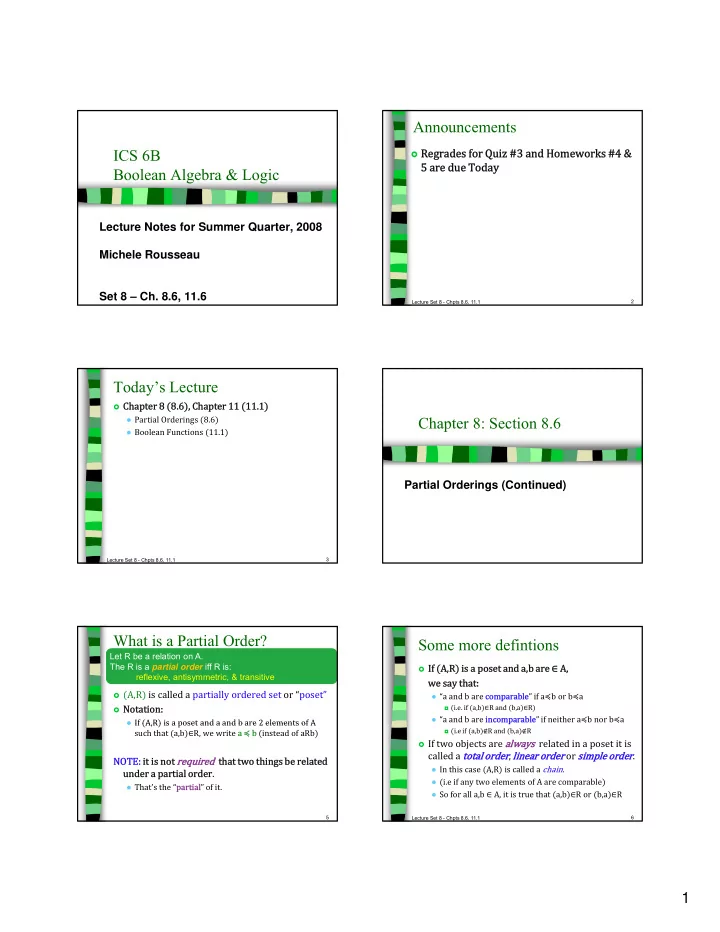
ICS 6B Boolean Algebra & Logic

Lecture Notes for Summer Quarter, 2008 Michele Rousseau Set 8 – Ch. 8.6, 11.6

Announcements

Regrades for Quiz #3 and Homeworks #4 &

5 are due Today

Lecture Set 8 - Chpts 8.6, 11.1 2

Today’s Lecture

Chapter 8 8.6, Chapter 11 11.1

  • Partial Orderings 8.6
  • Boolean Functions 11.1
Lecture Set 8 - Chpts 8.6, 11.1 3

Chapter 8: Section 8.6

Partial Orderings (Continued)

What is a Partial Order?

A,R is called a partially ordered set or “poset” Notation:

  • If A R is a poset and a and b are 2 elements of A

Let R be a relation on A. The R is a partial order iff R is: reflexive, antisymmetric, & transitive

  • If A,R is a poset and a and b are 2 elements of A

such that a,bR, we write a b instead of aRb

NOTE: it is not required that two things be related under a partial order.

  • That’s the “partial” of it.
5

Some more defintions

If A,R is a poset and a,b are A,

we say that:

  • “a and b are comparable” if ab or ba

◘ i.e. if a,bR and b,aR

  • “a and b are incomparable” if neither ab nor ba

p

◘ i.e if a,bR and b,aR If two objects are always related in a poset it is

called a total order, linear order or simple order.

  • In this case A,R is called a chain.
  • i.e if any two elements of A are comparable
  • So for all a,b A, it is true that a,bR or b,aR
Lecture Set 8 - Chpts 8.6, 11.1 6
slide-2
SLIDE 2

2

Now onto more examples…

Let Aa,b,c,d and let R be the relation

  • n A represented by the diagraph

a b

The R is reflexive, but not antisymmetric a,c &c,a and not

Lecture Set 8 - Chpts 8.6, 11.1 7

c

d

and not transitive d,cc,a, but not d,a

More Examples

Let A0,1,2,3 and Let R0,01,1, 2,0,2,2,2,33,3 We draw the associated digraph: It is easy to check that R is

1

  • Refl. , antisym. & trans.

So A,R is a poset. The elements 1,3 are incomparable because 1, 3 R and 3, 1 R so A,R is not a total ordered set.

Lecture Set 8 - Chpts 8.6, 11.1 8

2

3

1

More Examples (3)

Let Aa,b,c,d and let R be the related Matrix:

[ ]

1 1 1 0 0 1 1 0 0 0 1 1 1 1 0 1 To check properties more easily lets convert a b

We see that R is reflexive loops at every vertex and antisymmetric no double arrows It is not transitive eg. c,d & d,a, but no c,a

Lecture Set 8 - Chpts 8.6, 11.1 9

[ ]

it to a diagraph

d c

Another example

Aall people Rthe relation “a not taller than b” Then R is reflexive a is not taller than a R i i i R is not antisymmetric

  • If “a is not taller than b” and “b is not taller than a”,

then a and b have the same height, but a is not necessarily equal to b – it could be 2 people of the same height. Not a poset!

Lecture Set 8 - Chpts 8.6, 11.1 10

Lexicographic Order

Lexicographic order is how we order words

in the dictionary

  • It is AKA dictionary order or alphabetic order
  • First, we compare the 1st letters, if they are

equal then we check the 2nd pair and etc. equal then we check the 2 pair and etc.

◘ E.g Let S1,2,3 ◘ The lexicographical order of PS ,1,1,2,1,2,3,1,3,2,2,3,3 We can apply this to any poset

  • On a poset it is a natural order structure on the

Cartesian product.

11

Lexicographic Order

Suppose that A1.1 and A2,2 are two posets. We construct a partial ordering on the Cartesian product A1x A2. Given 2 elements a1, a2 and b1, b2 in A1x A2 We say that a1, a2 b1, b2 Iff a1 b1 but a1b1

  • r a1b1 and a2 b2 .

In other words, a1, a2 b1, b2 iff

  • 1. the first entries of a1, a2 the first entries of b1, b2
  • r
  • 2. the first entries of a1, a2 and b1, b2 ,

and the 2nd entries of a1, a2 the 2nd entries of b1, b2 entry

12
slide-3
SLIDE 3

3

Examples

  • EX. A1 A2; R1 R2

Then 1,3 1,4 ; 1,3 2,0; 1, 3 1, 3 In general, given a1, a2 and b1, b2, g g 1

2

  • 1

2

compare a1 and b1 If a1 b1 then a1, a2 b1, b2 ElseIf a1 b1 , then If b1 b2 then a1, a2 b1, b2

Lecture Set 8 - Chpts 8.6, 11.1 13

Example (2)

Which of the following are true? 3,5 4,8 4,4 2,8 3,8 4,5 True False True , , 1,2,4,10 1,2,5,8 2,4,5 2,3,6 1,5,8 2,3,4

Lecture Set 8 - Chpts 8.6, 11.1 14

True False True

Strings

We apply this ordering to strings of symbols where

there is an underlying 'alphabetical' or partial

  • rder which is a total order in this case.

Example:

Let A a, b, c and suppose R is the natural

alphabetical order on A: p a R b and b R c. Then

  • Any shorter string is related to any longer string comes

before it in the ordering.

  • If two strings have the same length then use the induced

partial order from the alphabetical order: aabc R abac

15

Well Ordered Set

Let A,R be a poset

We say that A is a well‐ordered set if any non‐empty subset BA has a least element.

In other words, aB is a least element if ab for all bB. recall that R is denoted by recall that R is denoted by

Example , is well ordered

  • Any subset B which is not empty has a least element.
  • Eg if B2,3,4,5,27,248,1253 then the least element is

a2, because a b for all bB.

, is not well ordered

  • Choose B, there is no least element
16

Hasse Diagram

To every poset A,R we associate a Hasse diagram

  • A graph that carries less info than the diagraph

To construct a Hasse diagram:

1 Construct a digraph representation of the poset A, R so that all arcs point up except the loops. A, R so that all arcs point up except the loops. 2 Eliminate all loops

  • R is reflexive – SO we know they are there

3 Eliminate all arcs that are redundant because of transitivity

  • Keep a,b and b,c remove a,c

4 Eliminate the arrows at the ends of arcs since everything points up. and it is antisymmetric so arrows go only 1 way

17

Example

Construct the Hasse diagram of A1, 2, 3, R

Thus R1,1,1,2,1,3,2,2,2,3,3,3

Step 1:Draw the Digraph With arrows pointing up Step 2: Remove loops

Lecture Set 8 - Chpts 8.6, 11.1 18

1

2

3

p g p Step 4: Remove arrows Step 3: Eliminate redundant transitive arcs

slide-4
SLIDE 4

4

Example (2)

Construct the Hasse diagram of Pa, b, c,

The elements of Pa, b, c are

  • a, b, c

a, b, a, c, b, c

{a, b, c}

a, b, c

Basically, it shows

a hierarchy

Lecture Set 8 - Chpts 8.6, 11.1 19
  • {a}

{b}

{c} {a, c} {a, b} {b, c}

Example (3)

Given the Hasse diagram write down all

the ordered pairs in R

d c

Okay, so what do we know about

this diagram

We know it is antisymmetric

Lecture Set 8 - Chpts 8.6, 11.1 20

a

b We know it is antisymmetric

  • and that the arrows point up

We know it is reflexive We also know it is transitive Now that we have the diagraph R

is easy to find Ra,a,a,b,a,c,a,d,b,b,b,c, b,d,c,c,d,d

Maximal and Minimal Elements

Let S, be a poset An element a S is called maximal if there is no b such that a b. In other words a is not less than any element in the poset. Similarly, An element B S is called minimal if there is no b such that b a.

Lecture Set 8 - Chpts 8.6, 11.1 21

These are easy to find in a Hasse diagram Because they are the “top” and “bottom” elements

Example

In this diagram

What is the maximal element? What is the minimal element?

{a, b, c}

M i l

Lecture Set 8 - Chpts 8.6, 11.1 22 22
  • {a}

{b}

{c} {a, c} {a, b} {b, c}

Maximal Minimal

Note: there can be more than 1 minimal and maximal element in a poset

Example (2)

3 Maximal elements

Note: Every poset h 1

Lecture Set 8 - Chpts 8.6, 11.1 23

2 Minimal elements

has 1 or more maximal elements and 1 or more Minimal elements

Greatest and Least Elements

aS is called the greatest element of poset S, , if b a , b S

If there is only 1 maximal element then it

is the greatest. aS is called the least element of poset S, , if a b , b S

If there is only 1 minimal element then it

is the least

Lecture Set 8 - Chpts 8.6, 11.1 24

Note: The greatest and least may not exist

slide-5
SLIDE 5

5

Examples

No Greatest Greatest

Lecture Set 8 - Chpts 8.6, 11.1 25

No least least

Upper and Lower Bounds

Let S be a subset of A in the poset A, R. Let A S – be any subset

An element bS is an upper bound for A

if a b , a S Note: B is not necessarily in A

b is a lower bound for A

if b a , a S

Lecture Set 8 - Chpts 8.6, 11.1 26

Not : B is not n c ssarily in A Note: There can be more than 1 upper or lower bound

Example

In this diagram

What is the upper bound for all subsets? What is the lower bound for all subsets?

{a, b, c}

U b d

Lecture Set 8 - Chpts 8.6, 11.1 27 27
  • {a}

{b}

{c} {a, c} {a, b} {b, c}

Upper bound Lower bound

Note: Because we are dealing with subsets the bounds don’t necessarily have to be in the subset

Example (2)

A c,d Upper bound: g Lower bound: a A a

f g

A a Upper bounds: a,c,d,f,g Lower bound: a

Lecture Set 8 - Chpts 8.6, 11.1 28

a b c e d

Note: It must be reachable From all elements in the subset

Example (2)

A a,b,c Upper bound: e, f, h Lower bound:

d e g f h

a A a, c, d, f Upper bounds: h,f Lower bound: a

Lecture Set 8 - Chpts 8.6, 11.1 29

a b c

Least Upper Bound & Greatest Lower Bound

xS is called the least upper bound of A iff 1 – x is an upper bound for A 2 – x is less than any other upper bound of A xS is called the greatest lower bound of A iff 1 – x is an lower bound for A 2 – x is greater than any other upper bound of A

Lecture Set 8 - Chpts 8.6, 11.1 30

Note: These bounds may not exist if they do they are unique

slide-6
SLIDE 6

6

Example (2)

A b, d, g Upper bound: g, h, I, k Lower bound: b

g f h i k

b, a Least upper bound: g Greatest lower bound: b

Lecture Set 8 - Chpts 8.6, 11.1 31

a d b e c

Example (2)

S, , | ‐‐‐ assume 0 A3,9,12

Upper bounds: common multiples of 3,9,12 any positive integer which is divisible by 3 9 12 any positive integer which is divisible by 3,9,12 any positive integer which is divisible by 36 Lower bounds: 3,1 common divisors of 3,9,12 Least upper bound: 36 least common multiple of 3,9,12 Greatest lower bound: 3 greatest common divisor of 3,9,12

Lecture Set 8 - Chpts 8.6, 11.1 32

Lattices

A poset S, is called a lattice if every pair

  • f elements a, b S has both a greatest

lower bound and a least upper bound E l Example

33

a b c d e

Is this a lattice? what is the glb of a,b? None – not a lattice

More Examples

a b c d e

Is this a lattice? what is the lub of b,c? None – not a lattice

Lecture Set 8 - Chpts 8.6, 11.1 34

e b f h c d a g

Is this a lattice? Yes

  • {b}

{a, b} {a}

Is this a lattice? Yes

Homework for 8.6

1c‐d3a‐d,5,7,9,11,19,21,23b‐c,

25,33 a‐h,35a‐h,43a‐c

Lecture Set 8 - Chpts 8.6, 11.1 35

Chapter 11: Section 11.1

Boolean Functions

slide-7
SLIDE 7

7

Bit Operations

Boolean Sum ‐ denoted by , OR, or 101, 01 1, 111 000 Boolean Product‐ denoted by · , AND, or

Only time it =s 0

  • y ,

,

  • 1 · 11

1 · 00, 0 · 1 0, 0 · 00 Complement notated by , –NOT, or 0 1 1 0

Lecture Set 8 - Chpts 8.6, 11.1 37

Only time it =s 1

_ _ _

Boolean Functions

A l bl b b d

  • B for 1in is the

if it assumes values only from B Let B={0,1}. Then Bn ={x1, x2,…, xn} |B for 1in is the set of all possible n‐tuples of 0s and 1s. The variable x is called a Boolean variable if it assumes values only from B A function form Bn to B is called a Boolean Function of degree n.

A Boolean variable x is a bit binary digit – accepts values 0 and 1. So x 0,1. A Boolean function of degree 1 is a function of 1 Boolean variable with the values in 0,1 F: 0,10,1, x Fx

Lecture Set 8 - Chpts 8.6, 11.1 38

Examples

For Example: F1x x F2x x x F1x x 1 1 x ¬x F2x x 1 1 1

Lecture Set 8 - Chpts 8.6, 11.1 39

Gx x x G(x)=x 1 1

Notice these are = If G(x) takes exactly the same value as F2. We say F2 and G are the same function Even if they are defined by different expressions!

Examples (2)

A Boolean function of degree 2 is a function of two variables with values in 0,1 Example: F1x,y xy

x y F1x,y x+y 1 1

F1x,y xy

Lecture Set 8 - Chpts 8.6, 11.1 40

1 1 1 1 1 x y F1x,y xy 1 1 1 1 1

Order of Operations

In order to evaluate these we need to

understand the order of preference

  • Things in Parenthesis come first
  • Then

l ◘ 1 – Complement ◘ 2 – Product ◘ 3 – Sum

Lecture Set 8 - Chpts 8.6, 11.1 41