Announcements ICS 6B Quiz schedule online * Will allow you to drop - - PDF document

announcements ics 6b
SMART_READER_LITE
LIVE PREVIEW

Announcements ICS 6B Quiz schedule online * Will allow you to drop - - PDF document

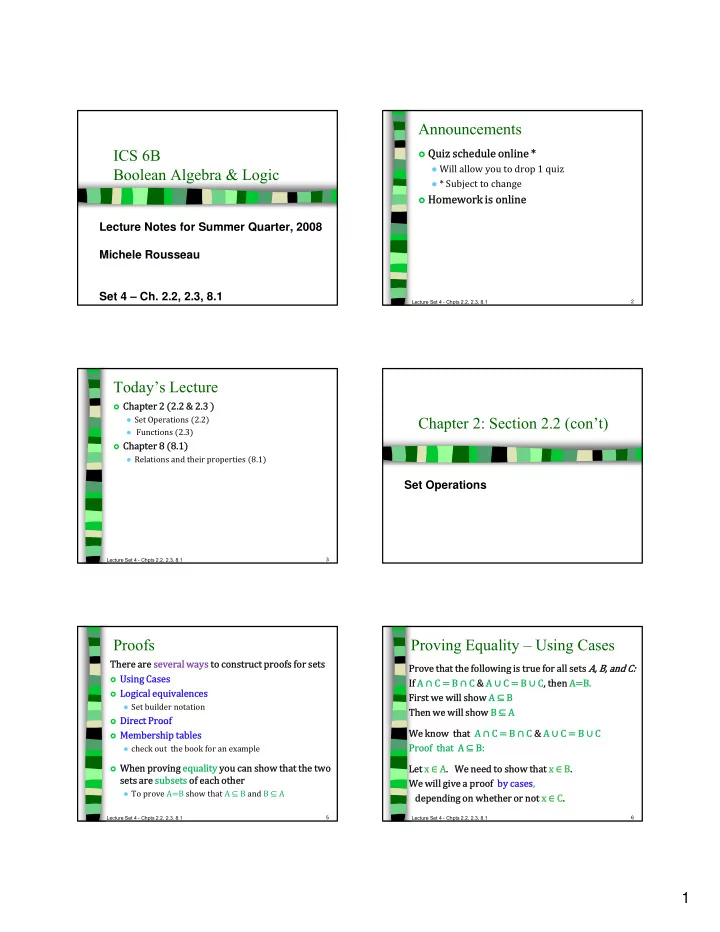
Announcements ICS 6B Quiz schedule online * Will allow you to drop 1 quiz Boolean Algebra & Logic * Subject to change Homework is online Lecture Notes for Summer Quarter, 2008 Michele Rousseau Set 4 Ch. 2.2, 2.3, 8.1 2


slide-1
SLIDE 1

1

ICS 6B Boolean Algebra & Logic

Lecture Notes for Summer Quarter, 2008 Michele Rousseau Set 4 – Ch. 2.2, 2.3, 8.1

Announcements

Quiz schedule online *

  • Will allow you to drop 1 quiz
  • * Subject to change

Homework is online

Lecture Set 4 - Chpts 2.2, 2.3, 8.1 2

Today’s Lecture

Chapter 2 2.2 & 2.3

  • Set Operations 2.2
  • Functions 2.3

Chapter 8 8.1

  • Relations and their properties 8.1

Lecture Set 4 - Chpts 2.2, 2.3, 8.1 3

Chapter 2: Section 2.2 (con’t)

Set Operations

Proofs

There are several ways to construct proofs for sets

Using Cases Logical equivalences

  • Set builder notation

Direct Proof Direct Proof Membership tables

  • check out the book for an example

When proving equality you can show that the two

sets are subsets of each other

  • To prove AB show that A B and B A

Lecture Set 4 - Chpts 2.2, 2.3, 8.1 5

Proving Equality – Using Cases

Prove that the following is true for all sets A, B, and C: If A C B C & A C B C, then AB. First we will show A B Then we will show B A We know that A C B C & A C B C Proof that A B: Let x A. We need to show that x B. We will give a proof by cases, depending on whether or not x C.

Lecture Set 4 - Chpts 2.2, 2.3, 8.1 6

slide-2
SLIDE 2

2

Case 1: x C

In this case x A C. Because A C B C, we have x B C, and hence x B.

Case 2: x C

In this case x A C because x A. Because A C B C, we have x B C. But x C. Therefore we must have x B.

Cases 1 and 2 show that

If x A, then x B, or A B.

A similar proof can be given to show that B A. Because A B and B A, A B.

7

Proof using Logical Equivalence

Prove that A B C A B A C Solution: We begin with A B C and show that this is the same as A B A C A B C x | x A x B C x | x A x B x C x | x A x B x A x C x | x A B x A C A B A C

Lecture Set 4 - Chpts 2.2, 2.3, 8.1 8

definition of intersection definition of union distributive law definition of intersection definition of union

Direct Proof

Prove: If A Bc, then B Ac. Solution: Suppose A Bc. We must show that B Ac. To show that B Ac, assume that x B and show that x Ac. Suppose x B. Therefore x Bc. Therefore x A because A Bc. Therefore x Ac.

Lecture Set 4 - Chpts 2.2, 2.3, 8.1 9

Generalized Unions & Intersections

Lecture Set 4 - Chpts 2.2, 2.3, 8.1 10

A B C A B C Because of the associative laws we don’t need parenthesis

Generalized Unions & Intersections

Notation: A1 A2 … An

Ai

The union of a collection of sets is the set that contains those elements that are members of at least one set in the collection.

  • n

i1

Notation: A1 A2 … An

Ai

Lecture Set 4 - Chpts 2.2, 2.3, 8.1 11

The intersection of a collection of sets is the set that contains those elements that are members

  • f all the sets in the collection.
  • n

i1

Homework for Section 2.2

1,3,7,9,15,21,27,31,33,37

Lecture Set 4 - Chpts 2.2, 2.3, 8.1 12

slide-3
SLIDE 3

3

Chapter 2: Section 2.3

Functions

What is a function?

Notations:

Let A & B be sets (non-empty). A function f from A to B is an assignment of exactly one element of B to each element of a.

F is a function from A to B or

f :AB

Lecture Set 4 - Chpts 2.2, 2.3, 8.1 14

Domain

F is a function from A to B or F maps A to B

Codomain

f :AB Can also be defined a s a relation from A to B. f b

More Notations

b is the unique element of Remember: A relation is a subset of A x B where there is one order pair for every element a A and b B. fab a,b is the unique ordered pair The range of f is the set of all images of points in A under f. We denote it by fA.

15

q B assigned by the function f to A

b Is the image of a a is the preimage of b

Functions - Examples

If S is a subset of A then fS fs | s in S f :AB

fa The image of d is Domain of f is X

A B Z Z A = {a b c d}

Domain of f is The codomain is fA The preimage of Y is The preimages of Z are fc,d

Lecture Set 4 - Chpts 2.2, 2.3, 8.1 16

a

X

b c d

Y Z

A = {a, b, c, d} B={X, Y, Z} {Y, Z} B a, c and d {Z}

Definitions

Let f be a function from A to B. f :AB

f is one‐to‐one or injective if preimages are unique.

  • Note: this means that if a b then fa fb.
  • Notation: 1‐1

f is onto or surjective if every y in B has a preimage f is onto or surjective if every y in B has a preimage.

  • Note: this means that for every y in B there must be an

x in A such that fx y. f is bijective or one‐to‐one correspondence if it is

surjective and injective

Lecture Set 4 - Chpts 2.2, 2.3, 8.1 17

One to One or Injection Example

f is one‐to‐one or injective if preimages

are unique

Functions that never assign the same

value to two different domain elements Which are 1‐1? Domain: Z fxx fxx2

  • f‐1 f1

fx|x|

18

a

X

b c d

Y Z

A B

W V

but not a surgection

slide-4
SLIDE 4

4

f is onto or surjective if every y in B has a

preimage.

Every element in the codomain is the

image of some element in the domain.

A B

Onto or Surjection Example

Which are onto? Domain: Z f(x)=x f(x)=x2

When does x2=-1?

f(x)=|x|

Lecture Set 4 - Chpts 2.2, 2.3, 8.1 19

a

X

b c d

Y Z

A B

but not an injection

Bijection (one-to one and onto)

f is bijective if it is surjective and

injective

A B

a

V

Lecture Set 4 - Chpts 2.2, 2.3, 8.1 20

X

b c d

Y W

Note: Whenever there is a bijection from A to B, the two sets must have the same number of elements or the same cardinality.

What about this one?

a

X

A B

not a surgection

Lecture Set 4 - Chpts 2.2, 2.3, 8.1 21

b c d

Y Z

not an injection

What about this one?

a

X

A B

Lecture Set 4 - Chpts 2.2, 2.3, 8.1 22

b c d

Y Z

not a function

Inverse Functions

Notation: f‐1

Let f be a bijection from A to B. Then the inverse of f, is the function from B to A That assigns to an element b the unique element Such that f(a)=b.

Notation: f In other words...

f‐1b a when fa b

Lecture Set 4 - Chpts 2.2, 2.3, 8.1 23

Inverse Functions (Example)

a b c d

A B

f

X W V

a b c d

A B

X W V

f‐1

Lecture Set 4 - Chpts 2.2, 2.3, 8.1 24

d

Y

d

Y

A bijection is called invertible because you can define the inverse function. To be invertible it must be a bijection.

slide-5
SLIDE 5

5

Composition

Apply ga then fga

Let g: A B, f: B C. The composition of the functions f and g, denoted f g, is the function from A to C defined By f g (a)=f(g(a))

Apply ga then fga The range of g must be a subset of the

domain of f.

Lecture Set 4 - Chpts 2.2, 2.3, 8.1 25

Composition Example

If fxx2 and gx2x1 Then fgxf 2x1

a b c d

A B C

X Y W V

g f

j i h

2x1 2 2x21

26

Y

a b c d

j i h

A C

f g

Floors & Ceilings

Notation: x or floorx

The floor function assigns to the real number x the largest integer that is < x. The ceiling function assigns to the real number x

Notation: x or ceilingx

Examples:

3.5 3.5

Lecture Set 4 - Chpts 2.2, 2.3, 8.1 27

The ceiling function assigns to the real number x the smallest integer that is > x. 3, 4

Homework for Section 2.3

3, 5, 11, 13, 15, 19

Lecture Set 4 - Chpts 2.2, 2.3, 8.1 28

Chapter 8: Section 8.1

Relations and their properties

Binary Relations

In other words: It is the ordered pair of elements in two sets. Let A and B be sets. A binary relation from A to B is a subset of A x B. A binary relation then from A to B is a set R of ordered pairs a,b such that a A and b B . R A x B

Lecture Set 4 - Chpts 2.2, 2.3, 8.1 30

There are no constraints on ordered pairs (like there are on functions)

slide-6
SLIDE 6

6

Binary Relation - Example

Let A and B be sets:

A 1, 2, 3 B a, b, c A x B Set A Binary Relation

1,a,1,b,1,c, 2,a,2,b,2,c, 3,a, 3,b, 3,c

Let A anb B be sets:

A a, b, c B 1, 2, 3, 4 R is defined by the ordered pairs or edges a, 1, a, 2, c, 4

Lecture Set 4 - Chpts 2.2, 2.3, 8.1 31

Set B R

Binary Relation

Binary Relations don’t adhere to the same

constraints as functions

a

X

A B

Lecture Set 4 - Chpts 2.2, 2.3, 8.1 32

a

X

b c d

Y Z

Reflexive Property

In other words

xx Ux x R

R for every element a A. Let A be a set and R be a relation on set A. R is reflexive if (a, a) R for every element a A.

xx Ux, x R

Lecture Set 4 - Chpts 2.2, 2.3, 8.1 33

Reflexive Property Example

Consider the relations on 1,2,3,4 Which are reflexive? R11,1,1,2,2,1,2,2,3,4,4,1,4,4 R21,1,1,2,2,1 R 1 1 1 2 1 4 2 1 2 2 3 3 4 1 4 4 R31,1,1,2,1,4,2,1,2,2,3,3,4,1,4,4 R42,1,3,1,3,2,4,1,4,2,4,3 R51,1,1,2,1,3,2,1,2,2,2,3,3,3,4,4 R63,4

Lecture Set 4 - Chpts 2.2, 2.3, 8.1 34

3 & 5 3 & 5 because they contain ( 1, 1 ), ( 2, 2 ), ( 3, 3 ), & ( 4, 4 )

Relations on a Set to itself

Example: A a, b, c

A x A or a relation from A to A. Let A be a set. A binary relation R on a set A is a subset of A x A or a relation from A to A.

, , R a, a, a, b, a, c

Lecture Set 4 - Chpts 2.2, 2.3, 8.1 35

a b c

Loop

Symmetric Property

In other words: R is symmetric iff

  • (

) Let A be a set and R be a relation on set A. R is symmetric if (b, a) R whenever (a, b) R. for all (a,b) A.

x yx, y R y, x R

Lecture Set 4 - Chpts 2.2, 2.3, 8.1 36

Note: If there is an arc (x, y) there must be an arc (y, x).

slide-7
SLIDE 7

7

Antisymmetric Property

In other words: R is antisymmetric iff

x y x y R y x R xy

  • y

Let A be a set and R be a relation on set A. For all (a,b) A, if (a, b) R and (b, a) R then a=b is called antisymmetric. x y x, y R y, x R xy You should be able to show that logically: If x, y is in R and x y, then y, x is not in R.

Lecture Set 4 - Chpts 2.2, 2.3, 8.1 37

Note: If there is an arc from x to y (x,y), then there can’t be one from y to x (y, x) if x ≠ y

Symmetric/Antisymmetric Example

Consider the relations on 1,2,3,4 Which are symmetric? Which are antiymmetric? R11,1,1,2,2,1,2,2,3,4,4,1,4,4 R21,1,1,2,2,1 R 1 1 1 2 1 4 2 1 2 2 3 3 4 1 4 4 2 & 3 R31,1,1,2,1,4,2,1,2,2,3,3,4,1,4,4 R42,1,3,1,3,2,4,1,4,2,4,3 R51,1,1,2,1,3,2,1,2,2,2,3,3,3,4,4 R63,4

Lecture Set 4 - Chpts 2.2, 2.3, 8.1 38

2 & 3 because for every pair that is not the same they have the reverse pair only need to check ( 1, 2 ), ( 2, 2 ), ( 1, 4 ), & ( 4, 1 ) The rest are antisymmetric

Transitive Property

In other words: R is transitive iff

  • Let A be a set and R be a relation on set A.

R is transitive if whenever (x, y) R and (y, z) R then (x,z) R for all x, y, z A

x y zx, y R y, z R x, z R

This is the most difficult one to check.

Lecture Set 4 - Chpts 2.2, 2.3, 8.1 39

Note: If there is an arc from x to y (x,y) and one from y to z then there must be one from x to z