Announcement SGI on-campus Image-Based Graphics: Tuesday, May 11 - - PDF document

announcement
SMART_READER_LITE
LIVE PREVIEW

Announcement SGI on-campus Image-Based Graphics: Tuesday, May 11 - - PDF document

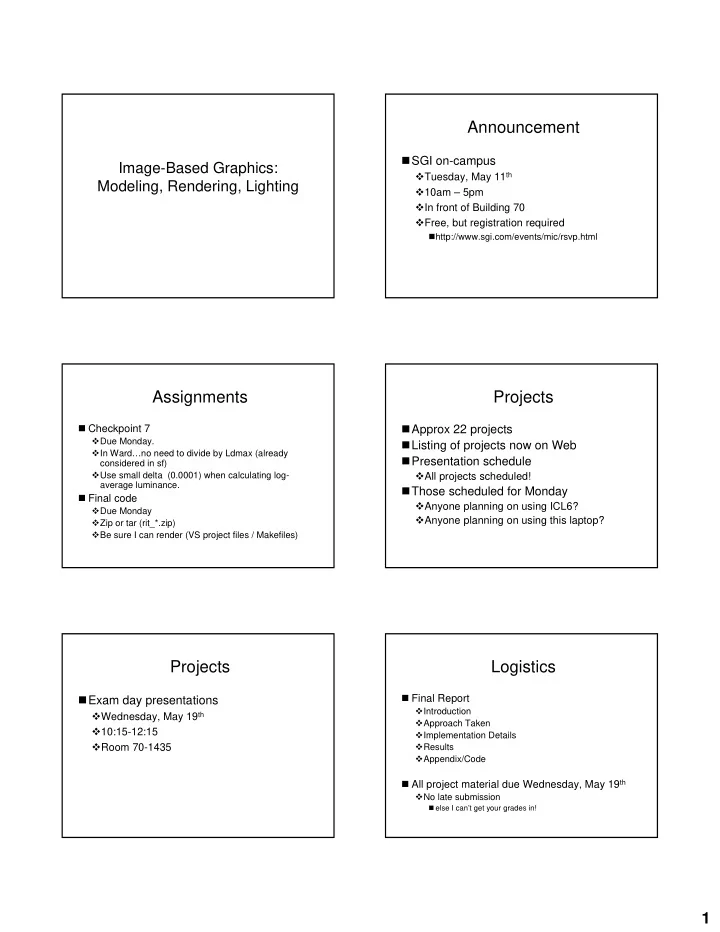
Announcement SGI on-campus Image-Based Graphics: Tuesday, May 11 th Modeling, Rendering, Lighting 10am 5pm In front of Building 70 Free, but registration required http://www.sgi.com/events/mic/rsvp.html Assignments


slide-1
SLIDE 1

1

Image-Based Graphics: Modeling, Rendering, Lighting

Announcement

SGI on-campus

Tuesday, May 11th 10am – 5pm In front of Building 70 Free, but registration required

http://www.sgi.com/events/mic/rsvp.html

Assignments

Checkpoint 7

Due Monday. In Ward…no need to divide by Ldmax (already considered in sf) Use small delta (0.0001) when calculating log- average luminance.

Final code

Due Monday Zip or tar (rit_*.zip) Be sure I can render (VS project files / Makefiles)

Projects

Approx 22 projects Listing of projects now on Web Presentation schedule

All projects scheduled!

Those scheduled for Monday

Anyone planning on using ICL6? Anyone planning on using this laptop?

Projects

Exam day presentations

Wednesday, May 19th 10:15-12:15 Room 70-1435

Logistics

Final Report

Introduction Approach Taken Implementation Details Results Appendix/Code

All project material due Wednesday, May 19th

No late submission

else I can’t get your grades in!

slide-2
SLIDE 2

2

Computer Graphics as Virtual Photography

camera (captures light) synthetic image camera model (focuses simulated lighting)

processing

photo processing tone reproduction real scene 3D models Photography: Computer Graphics: Photographic print

Much of the material that follows is from web pages by or SIGGRAPH courses organized by Paul Debevec, at USC. He was awarded SIGGRAPH’s first “Significant New Researcher Award” for his IBR work in 2001. www.debevec.org

Image-Based Graphics

Use of a set of realistic images to interpolate new images from a novel point of view; i.e.., reuse of photos

  • r previously rendered imagery

Earliest usage:

Texture mapping Environment mapping Morphing

Synthetic scene creation based on other images (rather than geometry)

Volume Visualization IBR

Lighting

Lumigraph Light Fields HDRI

Image-Based

Techniques using from 2D images include

Texture Mapping Morphing Volume Visualization Image-Based Modeling, Rendering, and Lighting Others

Morphing

Blended Morphed

Morphing

video

slide-3
SLIDE 3

3

Volume Visualization

Used to model the characteristics of a solid region in a 2D image. Example:The density of human/animal tissue computed at each 3D point through computer tomography (CT) from CAT or MRI scans

Volume Visualization

Application - Medical Imaging

MRI Allows zooming, rotating, and 360º viewing

  • f data

Parts of volume can be made transparent to facilitate view of other parts Surgical planning

Volume Visualization Volume Visualization

slide-4
SLIDE 4

4

Image-Based Modeling

Goal is to decouple rendering time and complexity; and to capture real-world complexity yet retain the advantages of 3D graphics Has a lot in common with computer vision but goals differ CG interested in texture and geometry.

But does have issues:

  • View interpolation and morphing
  • Occluded Areas
  • Often high amount of user

involvement

http://www.debevec.org/Chevette Imaged-Based Modeling & Rendering (Movie)

slide-5
SLIDE 5

5

The Chevette Project

Although (and perhaps because) the final model has flaws resulting from specularities, missing concavities, and imperfect image registration, it unequivocally evokes an uncanny sense

  • f the actual vehicle.
slide-6
SLIDE 6

6

Debevec’s Modeling Method

Introduced THREE new techniques! Photogrammetric modeling using model- based stereo algorithm

User represents scene as a collection of 3D primitives, e.g.,blocks. Computer solves for sizes and positions of blocks according to user-supplied edge correspondence.

Rendered using view dependent texture mapping

Issues include view dependent lighting, shadows, specular reflection May need to warp photo details to fit geometry

The Campanile Movie

Download the Movie!

Blurring the line between geometry and light

Our perception of object geometry is based on the light emitted from them Light stored as a 4D entity (lumigraph/light field)

Describes flow of light in all directions as precalculated and stored radiance Ray tracing utilizes these stored values

Independently discovered and published in 1996:

Lumigraph – Gortler, et al. Light Field Rendering – Levoy and Hanrahan

The lumigraph

All light from an object can be represented as if it were coming from a cube Each point on the cube has a number of rays coming from it

The lumigraph

Each wall of the cube is actually two parallel planes Rays are parameterized by where they intersect these planes Any point in the 4D Lumigraph is identified by it’s coordinates (s,t,u,v)

slide-7
SLIDE 7

7

The lumigraph

break

Image-Based Lighting

Related to environment and reflection mapping Uses light acquired in world (or thru photos) and its effects using global illumination

Probes (Debevec – http://www.debevec.org/Probes) HDRI

slide-8
SLIDE 8

8

http://www.debevec.org/RNL/ Imaged-Based Lighting (Movie) http://www.debevec.org/RNL/ Imaged-Based Lighting (Real time Movie)

slide-9
SLIDE 9

9

Radiance Maps

Environment mapping using physical lighting values. HDRShop Demo

http://www.debevec.org/FiatLux/ Imaged-Based Lighting Combined image-based modeling, rendering and lighting to place monoliths and spheres into a photorealistic reconstruction of St. Peter’s Basilica

slide-10
SLIDE 10

10

slide-11
SLIDE 11

11

High Dynamic Range Images

OpenEXR

Introduced by Industrial Light and Magic (ILM) for their computer imagery work. First used in

Harry Potter and Sorcerer’s Stone Men in Black II Gangs of New York Signs

Now used on all ILM film effects projects.

slide-12
SLIDE 12

12

High Dynamic Range Images

OpenEXR

Can encode

9 log units of dynamic range with no loss of precision

Also supports

Compression (lossless & lossy) Ability to store “metadata” Arbitrary number of image channels Compatable with Graphics hardware and Realtime Shader systems.

File format and tookit source is open source. http://www.openexr.org http://www.debevec.org/Campanile/

Live action compositing

Environment lighting in matte painting does not effect actor. Lightstage 3

Live action compositing

video

Image-Based Graphics

Summary

Texture Mapping Morphing Volume Visualization Image-Based Modeling Image-Based Rendering Image-Based Lighting Used in Cinema (and Art)

slide-13
SLIDE 13

13

That’s all folks

Next week:

Student Presentations

One last bit of business

Course evaluations.