Announcement Upcoming graphics courses: Color Computer Animation: - - PDF document

announcement
SMART_READER_LITE
LIVE PREVIEW

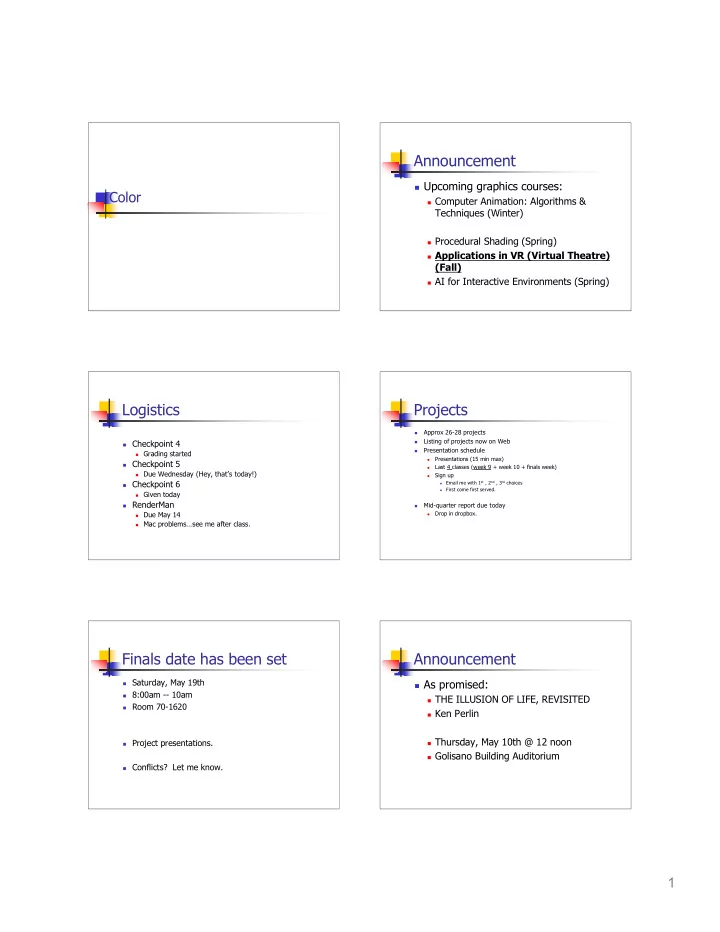
Announcement Upcoming graphics courses: Color Computer Animation: - - PDF document

Announcement Upcoming graphics courses: Color Computer Animation: Algorithms & Techniques (Winter) Procedural Shading (Spring) Applications in VR (Virtual Theatre) (Fall) AI for Interactive Environments (Spring) Logistics


slide-1
SLIDE 1

1 Color

Announcement

 Upcoming graphics courses:

 Computer Animation: Algorithms &

Techniques (Winter)

 Procedural Shading (Spring)  Applications in VR (Virtual Theatre)

(Fall)

 AI for Interactive Environments (Spring)

Logistics

 Checkpoint 4

 Grading started

 Checkpoint 5

 Due Wednesday (Hey, that’s today!)

 Checkpoint 6

 Given today

 RenderMan

 Due May 14  Mac problems…see me after class.

Projects

Approx 26-28 projects

Listing of projects now on Web

Presentation schedule

Presentations (15 min max)

Last 4 classes (week 9 + week 10 + finals week)

Sign up

Email me with 1st , 2nd , 3rd choices

First come first served.

Mid-quarter report due today

Drop in dropbox.

Finals date has been set

 Saturday, May 19th  8:00am -- 10am  Room 70-1620  Project presentations.  Conflicts? Let me know.

Announcement

 As promised:

 THE ILLUSION OF LIFE, REVISITED  Ken Perlin  Thursday, May 10th @ 12 noon  Golisano Building Auditorium

slide-2
SLIDE 2

2

Announcement

Many years ago Walt Disney spoke of the quest to create the “Illusion of Life”. In fact, in every era of human history this quest has evolved new kinds of literacy; from the first cave paintings to the written word, music, drama, cinema, animation and beyond. Recently it has become possible to create this illusion interactively. But what makes for an effective experience, once an audience can respond back? What makes us care about an interactive character? We will show some recently developed techniques for breathing life into interactive

  • characters. These techniques may point the way to a new era

where cinema intersects with interactive narrative and on-line community.

And we’re also going to make sheep waltz.

Computer Graphics as Virtual Photography

camera (captures light) synthetic image camera model (focuses simulated lighting)

processing

photo processing tone reproduction real scene 3D models Photography: Computer Graphics: Photographic print

Photography and Light

pho•tog•ra•phy, n., the process or art of producing images of objects by the action of light on a sensitized surface, e.g., a film in a camera.

Photography = writing with light

Photographic Pipeline (back in the day)

 Follow the path of light from scene to photo to

viewer! scene camera film enlarger print viewer

Photographic Pipeline (for the new millenium!)

Follow the path of light from scene to photo to viewer!

scene digital camera CCD array print viewer Post process JPEG

What we’re missing

 Lighting values

 Currently 0 - 1…what is 0? What is 1?

 Camera model

 Current a pinhole

 Color

 RGB…which RGB?

 No postprocessing

 Current directly from scene to image.

slide-3
SLIDE 3

3

Light -- What it is

 Electromagnetic radiation

power induction heating radio waves infrared ultra violet x-rays gamma rays 1016 1014 1010 108 1012 106 102 1 10-2 10-4 10-6 10-8 Wavelength (nm) 104 visible light secondary cosmic rays

Red

  • range

yellow green blue violet 700 nm 650 nm 600 nm 550 nm 450 nm 400 nm

Light and Color

 “Indeed rays, properly expressed,

are not colored”

  • - Sir Isaac Newton

 I.e., light rays are not colored; we

perceive them as colored!

Light - Color

 Color is the perceptual response to

light of wavelengths 400 - 700 nm hitting the retina.

 Spectral power distributions exist in

the physical world but color exists

  • nly in the eye and brain, e.g.,

there is no real white light!

Light – Spectral Density Functions (SDF)

 AKA spectral power distributions  Describes the distribution of the strengths

  • f light at given wavelengths emitted from

a source.

Light - Color

 Black Body Radiators

 Spectrum resulting from heating a standard

“body” to a given temperature

 Planck’s formula:

) 1 ( ) , (

/ 5 1

2

  • =
  • T

c

e c T M

16 1

10 7418 . 3

  • =

c

2 2

10 4388 . 1

  • =

c

Light - Color

 Black Body Radiators and daylight

 Daylight from the sun & total sky (5000K -

7000K)

 D65 - Average daylight (6504K)  Daylight w/occluded sun (> 7000K)  Daylight from sun alone (< 5000K)

slide-4
SLIDE 4

4

Light -- Color

 Black Body Radiators and other light sources

Light - Color

 Not all lighting sources have smooth SDFs

Light -- Color

 Light Filters

 Absorbs light at given

wavelengths

 Allows light at other

wavelengths through

 Using filters

 Actual SDF is determined

by multiply SDF of light by SDF of filter wavelength by wavelength. SDF for a filter

Light and color

 Absorption

 Material can absorb light on a wavelength by

wavelength basis

 Responsible for object color

Light and color

 The “color” of an object we see is a function

  • f:

 Spectral qualities of the material being viewed:

 Absorption  Reflection  Diffraction  Etc.

 Spectral qualities of the illuminating light.

Light and color

 Color appearance applets

http://www.cs.rit.edu/~ncs/color/a_spectr.html http://www.cs.brown.edu/exploratories/freeS

  • ftware/repository/edu/brown/cs/exploratorie

s/applets/spectrum/reflection_guide.html

slide-5
SLIDE 5

5

Light and Color

 Color is the perceptual response to light

  • f wavelengths 400 - 700 nm hitting the

retina.

 When rendering, spectrum must be

sampled.

 Color vision is inherently trichromatic.

Light and Color

 CIE Experiments – used X,Y,Z values to quantify

chromatic characteristics of color stimuli

Who is the CIE?

 International Commission on Illumination

 In French

 Commission internationale de l'éclairage  Thus, CIE

 an organization devoted to international

cooperation and exchange of information among its member countries on all matters relating to the science and art of lighting.

 Founded 90 years ago…  Headquartered in Vienna, Austria

Light and Color

 Color matching applet

http://www.cs.rit.edu/~ncs/color/a_game.html

 There are lots of color spaces and most of the

time we can convert between them, but not always.

Light and Color

 CIE RGB curves

  • 20
  • 10

10 20 30 40 3 7 5 4 4 2 5 4 5 4 7 5 5 5 2 5 5 5 5 7 5 6 6 2 5 6 5 6 7 5 7 7 2 5 7 5 Wavelength R G B

Light and Color

 CIE XYZ color matching curves

50 100 150 200 3 7 5 4 4 2 5 4 5 4 7 5 5 5 2 5 5 5 5 7 5 6 6 2 5 6 5 6 7 5 7 7 2 5 7 5 Wavelength y x z

slide-6
SLIDE 6

6

Light and Color

 Chromaticity coordinates (X,Y,Z have no

perceptual correlates, although Y is luminance, and x and z provide hue information) Z Y X X x + + = Z Y X Y y + + = Z Y X Z z + + =

1 = + + z y x

Chromaticity Coordinates

 often given in xyY  xy give the

chromaticity

 Y gives brightness

x y

Light and Color

 RGB (or any primary set) can be

determined from XYZ

 Need chromaticies of primaries and white

point.

 Primaries generally determined by

device.

 RGB values are incomplete without

specification of primaries & white point.

Light and Color

 sRGB

 Standard proposed by Microsoft and HP  Based on ITU-R 709.BT  It is a lighting model for “many” CRTs

Z Y X B Z Y X G Z Y X R 0570 . 1 2040 . 0556 . 0416 . 8760 . 1 9692 . 4986 . 5374 . 1 2410 . 3 +

  • =

+ +

  • =
  • =

Light and Color

 sRGB

http://www.cs.rit.edu/~ncs/color/a_chroma.html

Light and Color

 Other color spaces

 HSV (hue-saturation-value)  CMYK (printing)  CIELAB / CIELUV (perceptual)

 Why does CG use RGB?

 Convenience

slide-7
SLIDE 7

7

Light -- Color

 Full spectral renderers are hard to

find

 Expensive in time and memory  Most renderers specify color using RGB

triplet (red, green, blue)

 For accuracy, must convert from SDF

to RGB

 Full spectral rendering going on at

RIT Munsell Color Lab (Mark Fairchild)

Light - Color

 Converting from SDF to RGB.

  • 20
  • 10

10 20 30 40 3 7 5 4 4 2 5 4 5 4 7 5 5 5 2 5 5 5 5 7 5 6 6 2 5 6 5 6 7 5 7 7 2 5 7 5 Wavelength R G B

Light - Color

 Converting from SDF (S) to RGB

  • =
  • d

S r R ) ( ) (

  • =
  • d

S g G ) ( ) (

  • =
  • d

S b B ) ( ) (

Light - Color

 Converting from SDF to RGB

* * * = R = G = B Based on how “average” eye works

Light - Color

 Problems with direct conversion to RGB

 Negative values  Which RGB? (may not match RGB of

monitor)

 Solution: Use XYZ space

Light - Color

 Converting SDF to XYZ

50 100 150 200 3 7 5 4 4 2 5 4 5 4 7 5 5 5 2 5 5 5 5 7 5 6 6 2 5 6 5 6 7 5 7 7 2 5 7 5 Wavelength y x z

slide-8
SLIDE 8

8

Light - Color

 Converting SDF to XYZ

  • =
  • d

S x X ) ( ) (

  • =
  • d

S y Y ) ( ) (

  • =
  • d

S z Z ) ( ) (

Light - Color

 Converting from SDF to XYZ

* * * = X = Y = Z

Light - Color

 Problems with using XYZ

 Non-intuitive  Not an abundance of XYZ renderers

 Good if you are starting with SDFs  Good as an interchange space

Light - Color

 Converting XYZ -> RGB

 need definition of your primaries (R, G, B)

in terms of XYZ coordinates

Z r Y r X r R

Z Y X

+ + = Z g Y g X g G

Z Y X

+ + = Z b Y b X b B

Z Y X

+ + =

Light - Color

 Converting XYZ -> RGB

 Construct the following matrix:

=          

Z Z Z Y Y Y X X X

b g r b g r b g r M Light - Color

 Converting from XYZ->RGB

          =           Z Y X B G R

         

Z Z Z Y Y Y X X X

b g r b g r b g r

slide-9
SLIDE 9

9

Light - Color

 Converting from RBG -> XYZ

 Invert matrix  For any color (R, G, B) we can calculate (X,Y,Z)

          =           B G R Z Y X

         

Z Z Z Y Y Y X X X

b g r b g r b g r

  • 1

Light - Color

 White Point

 Chromaticity of point (1, 1, 1)

          =           1 1 1 Z Y X

         

Z Z Z Y Y Y X X X

b g r b g r b g r

  • 1

White Point

Wikipedia

Light -- Color

 A SDF will result in a single RGB triplet.  However, an RGB triplet can be the result of

many SDFs.

 Metamer -- Separate SDFs that produce the

same sensation of color.

 Interestingly though, reflectance and

transmission reactions are not necessarily the same, nor need the response be the same under different light sources!

Light - Color

 Example of Metamers (perceived the same)

Light - Color

 Metamers applet

http://www.cs.brown.edu/exploratories/freeSoft ware/repository/edu/brown/cs/exploratories/a pplets/spectrum/metamers_guide.html

slide-10
SLIDE 10

10

Light – Color Summary

 In order to produce photorealistic images, we

really need to know a lot about light, color and perception!

 Physical world -- light expressed using SDFs

 Standards based on physics  Filters

 Perceptual World - color triplets

 RGB / XYZ  Metamers

Break The 2nd half

 Color Devices  More color perception

Display Devices

 Two Problems to be addressed by

display models

 Gamma

 Luminances from simulation are on a linear

  • scale. Most display devices are non linear

 Gamut

 Chromaticities calculated may not be

reproducible on a given device due to a limited color gamut.

CRT Raster Display

scan controller frame buffer (6 planes) x x y electron- beam guns DACs deflection coils R G B

Display Devicßes

 Luminances from observer model are based on a

linear scale.

 Most display devices are non linear.

slide-11
SLIDE 11

11

Display Devices

 CRTs respond non-linearly to voltage  This non-linearity is described by gamma  where

 Ld is the actual display luminance  Ldmax is the maximum display luminance  V is the voltage [0,1]

γ

) (

maxV

L L

d d =

Display Devices

 CRTs are non-linear Sample input to monitor Graph of input Output from monitor Graph of output

Display Devices

 Gamma correction Sample input to monitor Graph of input Gamma correction Graph of Gamma correction Output from monitor Graph of output

Display Devices

 Most displays/video cards now have

gamma control as part of their OS.

 If we can correct so that gamma is 1.0 then,

getting using Ldmax from specs, the voltage V is given by

max d d

L L V =

1/γ

Display Devices

 Gamut

 Range of chromaticities reproducible by a

device

Display Devices

 Different Devices have different gamuts

slide-12
SLIDE 12

12

Display Devices

 Perceptual color spaces

 CIELAB (L*a*b*)  Distances between color values

corresponds to difference in perception

 Computed from X,Y,Z values and X,Y,Z of a

reference white.

CIELAB

 L*a*b*

 L* represents luminance  a* represents position between green and red  b* represents position between green and blue

 Perceptual color space.  Standardized by CIE

CIELAB

where Xn, Yn and Zn are the CIE XYZ tristimulus values

  • f the reference white point.

for

  • therwise

Display Devices

 Handling out of gamut colors

http://www.cs.rit.edu/~ncs/color/a_spaces.html

Display Devices

 Display Models must address

 Gamma / non-linearity of device  Gamut

 Usually dealt with by Color Management

Systems.

 Questions?

Viewing Environment

 Viewing environment can affect image perception  Adaptation

 The process by which the visual mechanism adjusts to the

conditions under which the eyes are exposed to radiant energy.

 General brightness adaptation

 Adjustments in response to the overall level of stimulus

exposed

 Lateral brightness adaptation

 Adjustments in response due to stimulus in adjacent areas of

the retina

 Chromatic adaptation

 Adjustments in response to the average chromaticity in the

stimulus.

slide-13
SLIDE 13

13

General Brightness Adaptation

 Note also…differences in acuity

[Ferwerda 1996]

Lateral Brightness / Chromatic Adaptation

Chromatic Adaptation Applet Lateral Brightness (Surround Effect) Surround demos

Color and Image Appearance Models

 Color Appearance Models

 Used to predict color appearance  Accounts for changes in viewing enviornment

 Color of illuminant  Illumination level  Surround luminance

 Image Appearance Models

 Incorporates spatial and temporal properties of

human vision.

 iCAM (Munsell Color Science Lab)

Color

 Color is perceptual  Depends upon

 Spectral Density Functions  Devices  Environment

 Questions?