Annotation & I nference New genom es, New functions Maybe - - PowerPoint PPT Presentation

annotation i nference
SMART_READER_LITE
LIVE PREVIEW

Annotation & I nference New genom es, New functions Maybe - - PowerPoint PPT Presentation

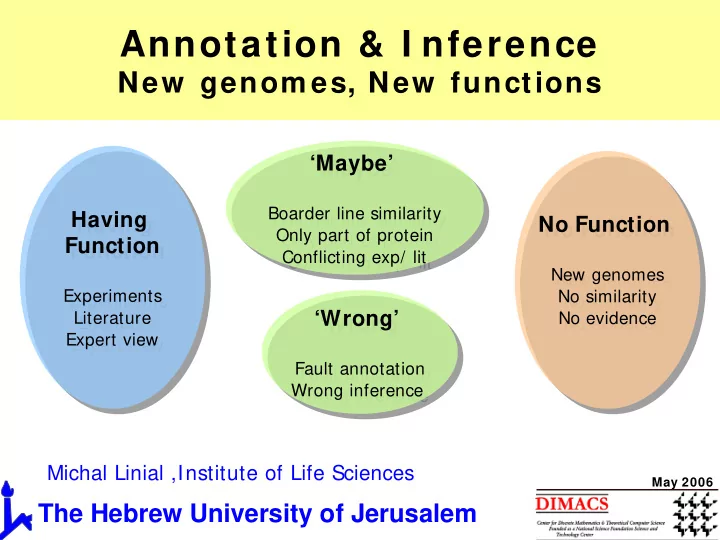
Annotation & I nference New genom es, New functions Maybe Maybe Boarder line similarity Having Boarder line similarity Having No Function No Function Only part of protein Only part of protein Function Function


slide-1
SLIDE 1

Annotation & I nference

New genom es, New functions

‘Maybe’

Boarder line similarity Only part of protein Conflicting exp/ lit

‘Maybe’

Boarder line similarity Only part of protein Conflicting exp/ lit

Having Function

Experiments Literature Expert view

Having Function

Experiments Literature Expert view

No Function

New genomes No similarity No evidence

No Function

New genomes No similarity No evidence

‘Wrong’

Fault annotation Wrong inference

‘Wrong’

Fault annotation Wrong inference

The Hebrew University of Jerusalem

Michal Linial ,Institute of Life Sciences

May 2006

slide-2
SLIDE 2

Annotation & I nference

New genom es, New functions

Dom ain fam ilies by EVEREST Automatic identification of Protein Domain Performance and analysis w.r.t to other resources New Annotation by I nference A method for inference – testing on a new genome New Function to Disserted Proteins High level functionality – story of the toxin like proteins

May 2006

slide-3
SLIDE 3

W hy dom ain fam ilies?

w hat is w rong w ith protein classification

Motivation

Nothing is wrong, But:

  • Reducing false transitivity.
  • Exposing Mix and Match evolution
  • I m m ediate relevance to structural domain-families
  • Suggesting evolutionary ‘robust units’

W hy autom atic?

Overcoming large amounts of data

Unbiased identification of new families (even without an

identified seed)

slide-4
SLIDE 4

EVEREST : A dom ain fam ilies resource

A com parative quality tool for other resources

Autom atic / de-novo identification and classification of

protein dom ains in all know n sequences

Rigorous evaluation against manually / automated & structurally based domain- family resources

  • Scoring methods for a ‘quality control’
  • Exposing any (interesting) relationships within ‘the

world’ of domains

  • Web interactive tool

www.everest.cs.huji.ac.il

slide-5
SLIDE 5

The Modular Nature of Proteins

Method

K6A1 MOUSE CSKP HUMAN DLG3 MOUSE MPP3 HUMAN

Serine/Threonine protein kinase family active site Protein kinase C-terminal domain PDZ domain SH3 domain Guanylate kinase

slide-6
SLIDE 6

8e-78 2e-47 9e-41 1e-42

False Transitivity of Local Alignment

CSKP HUMAN DLG3 MOUSE MPP3 HUMAN K6A1 MOUSE

BLAST values Pairwise similarities better than 1e-40 EScore If we cluster these proteins, assuming transitivity of local alignment scores, we will cluster K6A1_MOUSE with MPP3_HUMAN

input

slide-7
SLIDE 7

Working With Segments

Method

Each BLAST alignment defines two segments.

DLG3 MOUSE 429-844 K6A1 MOUSE 399-678 CSKP HUMAN 12-295 CSKP HUMAN 515-916 CSKP HUMAN 365-920 MPP3 HUMAN 28-584 DLG3 MOUSE 378-849 MPP3 HUMAN 118-580

slide-8
SLIDE 8

Clustering Segments

input

DLG3 MOUSE 429-844 K6A1 MOUSE 399-678 CSKP HUMAN 12-295 CSKP HUMAN 515-916 CSKP HUMAN 365-920 MPP3 HUMAN 28-584 DLG3 MOUSE 378-849 MPP3 HUMAN 118-580

Two similarity measures between segments:

  • Sequence similarity if they

were found together by BLAST

  • Physical overlap if they are
  • n the same protein, and

they intersect

slide-9
SLIDE 9

The Easy Case

CSKP HUMAN

All segments on CSKP_HUMAN defined by alignments with e-score 1e-40 or better:

input We collect all Blast value that are < 100 ! ~ 14 million values

slide-10
SLIDE 10

EVEREST: Process Schem e

Pre-process Iterations post-process Evaluation and tests

1 2 3 4 5 6 7 8 9 10

Careful transitivity Putative domains Statistical model Machine learning Majority voting Clustering Putative families

EVolutionary Ensem bles of REcurrent Segm enTs

Method

slide-11
SLIDE 11 1 2 3 4 5 6 7 8 9 1

`

3 Years in one slide

( Elon Portugaly)

  • We apply average linkage hierarchical

clustering on the putative domains

  • Creates a binary tree of clusters
  • Each cluster is a putative dom ain fam ily
  • Machine learning & Scoring w.r.t. PfamA
  • Choosing good families (intrinsic properties) – training/ disjoin to test
  • Each family modelled by HMM, redefine EV fam ilies.
  • Iteration (3 times from 100K to 25K)
  • Jointing HMMs and voting for EV consensus family.
  • Cluster the segments into conservative

groups by overlap similarity

  • Each group is a putative dom ain

Method

slide-12
SLIDE 12

Quality & Evaluation

Method

Comparing with Pfam

Pfam is a domain signature DB, manual curation, covers 62% aa, 7500 signatures

Accuracy – how well a typical EVEREST domain family scores w.r.t

Pfam

O EV Pfam

EV of 10 instances matches Pfam with 10 with only 9 are overlapping Score: 0.81 Size of the intersection over the size of the union Scores range from 0 to 1.0 (Jaccard Score)

slide-13
SLIDE 13

Getting Better ( accuracy m easure)

0. 1 0. 3 0. 5 0. 7 0. 9

250 500 750 1,000 1,250 1,500 1,750 2,000

All Clusters Score wrt Pfam x 1,000 Clusters

0. 1 0. 3 0. 5 0. 7 0. 9

10 20 30 40 50 60

Chosen Clusters Score wrt Pfam x 1,000 Clusters

~ 2 million ~ 100, 000

. 1 . 3 . 5 . 7 . 9

3 5 8 10 13 15 18 20

Iteration 1 HMMs Score wrt Pfam x 1,000 Clusters

. 1 . 3 . 5 . 7 . 9

1 2 3 4 5 6

Iteration 3 HMMs Score wrt Pfam x 1,000 Clusters

~ 100, 000 ~ 25, 000

. 1 . 3 . 5 . 7 . 9

1 1 2 2 3 3 4

Final EVEREST Families Score wrt Pfam x 1,000 Clusters

~ 13, 570

slide-14
SLIDE 14

EVEREST – Evaluation vs Reference

  • EVEREST is evaluated against reference sets of known families (Pfam, SCOP,

CATH)

  • Score of EVERSET family w.r.t. Intersecting reference family:

– size of intersection / size of union

– Accuracy

  • Each EVEREST family scored
  • vs. best matching reference
  • Look at score profile across

EVEREST families

  • Ignore EVEREST families

unknown to reference set

– Coverage

  • Each reference family scored
  • vs. best matching EVEREST
  • Look at score profile across

interesting subsets of refrence set

  • Non-Trivial: family size> = 5
  • Hetero: non-trivial + appearing

in hetero-multi-domain proteins

slide-15
SLIDE 15

Evaluation – w rt Pfam EVEREST & ADDA ( Holm )

. 1 . 2 . 3 . 4 . 5 . 6 . 7 . 8 . 9 1

1 2 3 4 5 6 7 8 9

ADDA - Accuracy

x 1,000 Clusters

. 1 . 2 . 3 . 4 . 5 . 6 . 7 . 8 . 9 1

100 200 300 400 500 600 700 800

ADDA - Coverage

# families

. 1 . 2 . 3 . 4 . 5 . 6 . 7 . 8 . 9 1

1 1 2 2 3 3 4

EVEREST - Accuracy

x 1,000 Clusters

. 1 . 2 . 3 . 4 . 5 . 6 . 7 . 8 . 9 1

100 200 300 400 500 600 700 800

EVEREST - Coverage

# families

13,570 1,800

slide-16
SLIDE 16

EVEREST & ADDA

Evaluation vs Pfam

Hetero > 5

slide-17
SLIDE 17

Evaluation – Com pare w .r.t SCOP

m anual classification of structural dom ains

. 1 . 2 . 3 . 4 . 5 . 6 . 7 . 8 . 9 1

1 2 3 4 5 6 7 8 9 10

ADDA - Accuracy

x 100 Clusters

. 1 . 2 . 3 . 4 . 5 . 6 . 7 . 8 . 9 1

10 20 30 40 50 60

ADDA - Coverage

# families

. 1 . 2 . 3 . 4 . 5 . 6 . 7 . 8 . 9 1

3 5 8 10 13 15 18 20 23

EVEREST - Accuracy

x 100 Clusters

. 1 . 2 . 3 . 4 . 5 . 6 . 7 . 8 . 9 1

10 20 30 40 50 60

EVEREST - Coverage

# families

slide-18
SLIDE 18

EVEREST – Evaluation vs SCOP (family) coverage

slide-19
SLIDE 19

Evaluation – Com pare w rt CATH / SCOP superfam ily ( coverage)

slide-20
SLIDE 20

1 3 ,5 6 9 EV families were defined. Providing Joint HMMs.

Jointly cover 8 3 % of the aa in the SWP DB. The average (median) size of an EVEREST dom ain fam ily is 81 (41). The average (median) length of the dom ains is 117 (76) aa. Move to some examples (web based querying)

Overall Num bers

( for UniProt/ SW P)

slide-21
SLIDE 21

Exam ples: New Functional Annotation

EVEREST family 1017 PF04673 (Polyketide synthesis cyclase) PF04486 (SchA/CurD like protein)

  • PF04486 has no known function
  • Two of its members are known

to be in gene clusters involved in the synthesis of polyketide- based spore pigments.

  • Could these two families be

considered one?

slide-22
SLIDE 22

New Fam ily ( 1 )

  • EV02275 is unknown to Pfam
  • 54 out of its 55 domains appear 90 positions N-terminal to PF03171

(2OG-Fe(II) oxygenase superfamily)

  • Perhaps this is a new

domain family?

  • PDB 1UOG

– RED – EVEREST 2 2 7 5 – BLUE - PF0 3 1 7 1

slide-23
SLIDE 23

New dom ain fam ily ( 2 )

48 proteins – Pesticidial crystal protein cry5Aa (Insecticidal delta-endotoxin CryVA(a) (Crystaline entomocidal protoxin) EV covers the 48 proteins of PFAM (and SCOP / CATH) - perfectly

EVEREST SCOP 33-608

but another EV specifies the family – no OVERLAP and NO structure for this region (609-911)

slide-24
SLIDE 24

Tw o that becam e one

Exam ples in Pfam CLANs

PFAM (OLD) Taurine catabolism dioxygenase TauD, TfdA family Pfam (NEW) a composed entry: TauD

slide-25
SLIDE 25

Superfam ily

  • EVEREST family EV0 4 4 6 3 fully covers both PF00465 (Iron-containing

alcohol dehydrogenase) and PF01761 (3-dehydroquinate synthase).

  • ENZYME: PF00465 is EC1.1-
  • ENZYME: PF01761 is sometimes EC4.6 and sometimes EC1.1
  • SCOP / CATH: Same superfamily/ Homology group

PDB 1JQA (PF00465) PDB 1DQS (PF01761)

slide-26
SLIDE 26

Elongation Factor 3 ‘domain family’ : All support same proteins

SCOP CATH SCOP EVEREST Half C-terminal SCOP - two adjacent domains (yellow, blue) CATH – two separated (blue, red) spacer (green) EVEREST – one domain (pink)

Alternative Fam ily Definition

slide-27
SLIDE 27

On the W eb

slide-28
SLIDE 28

Display settings: Choose sequence databases Choose domain family systems

Evaluate any reference domain resources

Family page header: General statistics Download of HMMs Links to list of domains and to evaluation pages

slide-29
SLIDE 29

I s there any added value for The overlapping EV families? EV10564 / 100% - perfect match but 220 aa not 640 aa EV01875/ 87% cover / 3 new

slide-30
SLIDE 30

Family color code legend: Current family always in red Relationship of current family to other families Type refers to relationship between boundaries: same = similar boundaries subdomain superdomain C-terminal neighbor N-terminal neighbor Forward =“ how many of the member of the current family participate in the relationship Backward =“ how many of the member of the

  • ther family participate in the relationship
slide-31
SLIDE 31

79 proteins 30S ribosomal protein S4 Next Phase:

  • Improving EVEREST web
  • Evaluation of ALL used resources
  • Phylogenetic View
  • Enrich queries (according to

reference Resource)

  • Names for EVxxxx
  • Paste your protein
  • Domain boundaries
slide-32
SLIDE 32

Sum m ary:

  • We provide an automated framework for identification

and classification of new protein domains

– recovering 60% of difficult known Pfam families. – Suggests new families for 8% (with > 51% fidelity) – For 20% we suggest a new view on domain families

  • Manual inspection of families scoring low w.r.t. Pfam

suggested that many of those are valid families.

  • Enabling inspection of EVEREST families and additional

resources in http:/ / w w w .everest.cs.huji.ac.il

slide-33
SLIDE 33

EVEREST

Automatic (no pre-knowledge) Partition to ‘domains’ (no transitivity) Robustness (evaluate w.r.t others)

Annotation & I nference

New genom es, New functions

May 2006

Having Function

Experiments Literature Expert view

Having Function

Experiments Literature Expert view

No Function

New genomes No similarity No evidence

No Function

New genomes No similarity No evidence

slide-34
SLIDE 34

Annotation & I nference

New genom es, New functions

Dom ain fam ilies by EVEREST Automatic identification of Protein Domain Performance and analysis w.r.t to other resources New Annotation by I nference A method for inference – testing on a new genome-the BEE New Function to Disserted Proteins High level functionality – story of the toxin like proteins

May 2006

slide-35
SLIDE 35

Honey Bee Honey Bee

The brain & com plex neuronal behavior The brain & com plex neuronal behavior

Motivation

C Elegans ( w orm ) 3 0 2 1 9 ,0 0 0

  • Miniat. W asp

Drosophila ( fruit fly) 5 ,0 0 0 2 5 0 ,0 0 0 1 0 ,0 0 0 1 4 ,0 0 0 Apis ( honey bee) Hom o Sapiens 9 5 0 ,0 0 0 8 5 ,0 0 0 ,0 0 0 1 0 ,0 0 0 2 5 ,0 0 0 The number of neurons or genes is not indicative for the brain and behavior complexity.

The m akeup of a social behaving insect

slide-36
SLIDE 36

ProtoBee: Goal

  • Produce a hierarchical (functional) organization of the bee

proteome

  • Annotate the bee sequences
  • Systematically find putative instances of

– Bee gene-loss events – Bee-specific paralogs – Bee-specific functionality – Mis-predicted genes (FN/ FP)

Honey bee genome recently sequenced: ~ 200 MB

(by HGSC at Baylor College of Medicine)

10,157 predicted ORFs

slide-37
SLIDE 37

ProtoNet classifications

The Principles: A rem inder

  • Unsupervised
  • Only sequence information as input
  • All proteins involved (incl. hypothetical..)
  • Family definition is hierarchical
  • Only based on statistical significance of the similarity score
  • Clustering process after ALL mutual ‘distance’ information is computed

(Blast of All against All for 120 K proteins, E= 100)

Evaluation vs InterPro, GO etc Pfam , Prosite, SMART, PRI NTS, SCOP, CATH…

www.protonet.cs.huji.ac.il

slide-38
SLIDE 38

Clustering Method

First, each protein is considered a singleton (a cluster of its own).

slide-39
SLIDE 39

Clustering Method

  • Next, we iteratively merge the pairs of

clusters

  • We choose to merge the ‘most similar’ pair
  • f clusters.
slide-40
SLIDE 40

Clustering Method

The clustering process gradually generates a tree of clusters

Merging Scores

Pruning: Compact the tree to 12% of its size without Reduction in performance (w.r.t. InterPro)

slide-41
SLIDE 41

quality..

ProtoNet Hierarchical organization

Protein database:

– SwissProt ~ 133,000 proteins – Testing the ‘Matching Score’ for InterPro (combining all high quality domain based / structure base / knowledge based)

S C S C S C score ∪ ∩ = ) , (

slide-42
SLIDE 42

Annotation I nference for proteins in clusters

C- cluster C ; K - keyword

Annotation Score AS (C,K) =

specificity2 x sensitivity = 0.25

TP is the proteins in C that have the keyword K FN is the proteins not in C that have the keyword K FP is proteins in C that do not have the keyword K.

TP TP + FP ⎛ ⎝ ⎜ ⎞ ⎠ ⎟

2

× TP TP + FN

The high-confidence annotation threshold

ProtoNet > 20 pr

slide-43
SLIDE 43

Method for the Bee

Hierarchical organization

  • Protein database (200,000 pr)

– Predicted bee protein set: 10,157 pr – SwissProt (without bee) – ~ 133,000 proteins. – Drosophila proteome (insect) – 20,730 pr. – m ouse proteome (UniProt) – 35,199 pr.

  • All vs all BLAST
  • Clustering
  • Tree chopping
  • Tree pruning

similarity high low

slide-44
SLIDE 44

ProtoBee: results

Clustered into 5 0 9 5 fam ilies ( out of 1 8 ,5 0 0 )

927 (733) 185 (151) 439 (389) 596 (338)

159 (143)

Mouse

Fly

Unique 707 (500) 6779 (2539) 365 (302)

Other

slide-45
SLIDE 45

Bee annotation inference

high confidence For each cluster, calculate its annotations. Each annotation is required to:

(a) be assigned > 7 5 % of the proteins in the cluster (b) achieve p-value < = 0 .0 0 1 (hypergeometric distribution). Only clusters with > 5 proteins are considered For each bee protein, assign to it the annotations of its cluster and all parents.

slide-46
SLIDE 46

Annotation sum m ary

1000 2000 3000 4000 5000 6000 7000 8000 9000 Combined GO GO MF GO BP InterPro SwissProt EC Number of proteins

200 400 600 800 1000 Receptor activity Transcription Oxidoreuctase activity Signal transduction Cell communication Transferase activity Protein metabolism Transport Nucleotide metabolism Hydrolase activity Number of proteins

slide-47
SLIDE 47

How good is this method?

Pros (assuming negligible transitivity):

Any kind of external information source can be used for annotation.

“Robustness” reduces chance of false positives.

Potentially links biological properties to localized sequence features.

Cons:

Incorrect transitivity due to multiple domains.

Not as sensitive/specific as motif-based methods.

slide-48
SLIDE 48

Results overview

Clusters organized into 1 8 ,9 3 6 trees (roots).

5095 roots contain bee proteins.

Annotation: 70% of proteins are annotated (InterProScan covers ~ 72-78% ). Interesting biological information on the evolution

  • f the bee relative to other insects (different

talk)

slide-49
SLIDE 49

ProtoBee

Annotation Score (high confidence) Clusters leading to Retesting ORFs

Annotation & I nference

New genom es, New functions

May 2006

Having Function

Experiments Literature Expert view

Having Function

Experiments Literature Expert view

No Function

New genomes

No similarity No evidence

No Function

New genomes

No similarity No evidence