
SLIDE 1
1
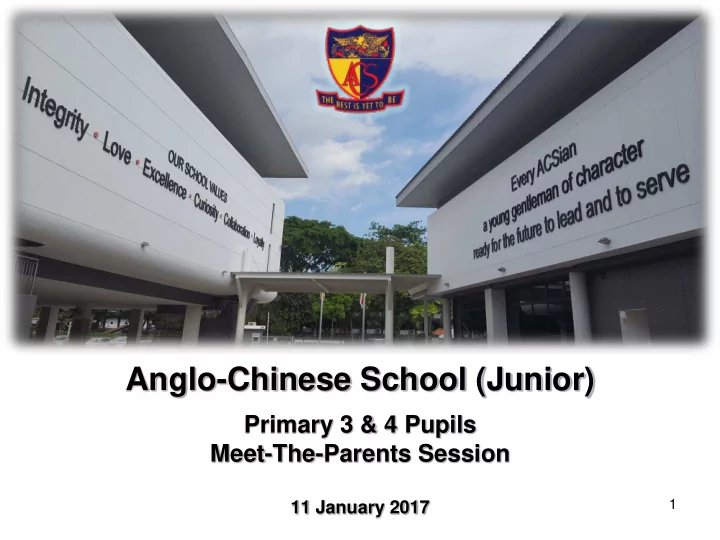
Anglo-Chinese School (Junior)
Primary 3 & 4 Pupils Meet-The-Parents Session
11 January 2017
Anglo-Chinese School (Junior) Primary 3 & 4 Pupils - - PowerPoint PPT Presentation
Anglo-Chinese School (Junior) Primary 3 & 4 Pupils Meet-The-Parents Session 1 11 January 2017 His Banner Over Me is Love 2 Sheltered Linkway from MPH to Teaching Blocks Joyful Cheers on Day One 3 Raising this generation for the
1
Anglo-Chinese School (Junior)
Primary 3 & 4 Pupils Meet-The-Parents Session
11 January 2017
2
3
Sheltered Linkway from MPH to Teaching Blocks
Joyful Cheers
Day One
Raising this generation for the future
– Build attitudes and values
than self
4
Train up a child in the way he should go: and when he is old, he will not depart from it. Proverbs 22:6
5
Our Vision
Every ACSian a young gentleman of character, ready for the future to lead and to serve
Our Mission
To nurture our Boys with a quality, holistic education, rooted in Christian values and strength of character, that allows each to reach his fullest potential, equipped with life skills to face the future and to serve God and Nation.
Our Values
Integrity, Love, Excellence, Curiosity, Collaboration, Loyalty
The ACSian embraces the future with an aspiring mindset.
The ACSian Gentleman of Character demonstrates love, integrity and loyalty at all times.
The ACSian works with
make a positive difference.
Aspiration
Curiosity Excellence
Service
Collaboration
Character
Love Integrity Loyalty
VALUE WHAT DOES IT MEAN? HOW IS IT DEMONSTRATED? Curiosity
Let the wise hear and increase in learning, and the one who understands obtain guidance Proverbs 1:5
Curiosity is the desire to know or learn something. Joy is experienced through the process of learning and acquiring new knowledge. I demonstrate curiosity when I am enthusiastic to gain new knowledge take responsibility for my own learning am willing to explore new ideas independently Excellence
And whatever you do, in word or deed, do everything in the name of the Lord Jesus, giving thanks to God the Father through him. Colossians 3:17
Excellence is to have an attitude that of ‘the best is yet to be’ in all endeavours. It speaks of having resilience and diligence in the face of challenges. I demonstrate excellence when I participate in all activities take pride all my work, regardless of my personal ability or talent consistently put my best effort in. Love
Be devoted to one another in love. Honour
Romans 12:10
Love is caring and showing compassion to those around us. It also speaks of forgiveness. I demonstrate Love when I care for myself
the community Integrity
Whoever walks in integrity will be delivered, but he who is crooked in his ways will suddenly fall. Proverbs 10:9
Integrity is the quality of being honest and having strong moral principles (moral courage?) in all situations and under all circumstances. I demonstrate Integrity when I consistently speak the truth do what is right keep my word Loyalty
For the LORD is good; his steadfast love endures forever, and his faithfulness to all generations Psalm 100:5
Loyalty speaks of a rootedness to family, school, and
results in action. I demonstrate Loyalty when I support my classmates my schoolmates my nation Collaboration
In the same way, let your light shine before others, that they may see your good deeds and glorify your Father in heaven Matthew 5:16
Collaboration is working with others in order to make a positive difference in the lives of others. Love and loyalty is the motivation to make this positive difference. I demonstrate Collaboration when I contribute to the class the school community my nation
ACSian Outcomes
Methodist schools in Singapore for 16 years, and is
schools to support different activities of each school.
school facilities and implementation of school-wide activities
INDIVIDUAL EFFORT ● CLASS SPIRIT ● LEVEL UNITY
25th March (Saturday) 7.15 – 10.30am ACJC
ACSJ P4
to 26 Jan 2017
9
Academic Development
Organisation of DI Competition
Enriching School Life
Spiritual Support
Fathers’ Prayer Group
10
Form and co-Form Teachers
1. Provide pastoral care and ensure well-being of students 2. Facilitate lifeskills lessons and one-to-one interaction time with students 3. Communicate with parents and undertake administrative matters
11
Mr Sathis Kumar
HOD Year Head (P3 & P4)
Holistic Support for your Child
Ms Ang An Lian
SH CCE / VIA
Ms Karen Tham
SH CCE / Student Leadership
Miss Noelle Selvadurai
HOD Character & Citizenship Education Mr Chen Jieming
SH Discipline
Mrs Kim Cheang
ST/ Special Needs
Enhancement to P3 and P4 Assessment 2017
Term 1 Term2 Term 3 Term 4
Pri 2 2016
5 Holistic Bite-sized assessment (50%) SA2 (50%)
Pri 3 2016
CA1 (10%) SA1 (30%) CA2 (10%) SA2 (50%) Term 1 Term2 Term 3 Term 4
Pri 3 2017
2 HA Bite-sized assessment (10%) SA1 (30%) 2 HA Bite-sized assessment (10%) SA2 (50%)
Pri 4 2017
2 HA Bite-sized assessment (10%) SA1 (30%) 2 HA Bite-sized assessment (10%) SA2 (50%)
Rationale:
management as well as for familiarization with Examination format.
2016 Assessment 2017 Enhanced Holistic Assessment
13
Academic Support
– Monday and Thursday, starting on Term 1 Week 4 – Hinch Programme : develop subject mastery and reinforce critical concepts – Thoburn Programme : develop intellectual depth and critical thinking skills
Day Subject Time Monday Mathematics 2 to 2.50pm Monday Science 2.55 to 3.45pm Thursday HMT/MT 2 to 2.50pm Thursday English 2.55 to 3.45pm
14
Selection Criteria for Thoburn Programme from P4
– Students who have been identified by MOE’s GE Branch for the GE Programme but chose to stay in ACS Junior will be automatically offered the programme every year – For English and Maths Thoburn Programme, students are identified through GEP screening tests if they exhibit high ability in English or Maths or English and Maths. They will be offered the corresponding subject/(s). – For Science and Mother Tongue Thoburn Programme, students are identified based on overall school results in respective subjects at the end of each year.
15
16
Non-Tamil Indian Languages (NTIL)
Based on MOE Guidelines SA1 SA2 30% 70%
language centres.
directly on matters pertaining to the subject.
17
Subject-based Banding at the end of P4
Rationale and Intent
subjects at different levels depending on their strength in these subjects.
capability to do it
18
4 Standard Subjects
Passes all 4 subjects
4 Std. subj. + HMT
Passes all 4 Subjects – done very well in MT Passes 3 subjects
4 Standard Subjects
Passes 2 subjects or less
3 Std. + 1 Foundn. 2 Std. + 2 Foundn. 1 Std. + 3 Foundn. 4 Foundation Subj.
19
course of study.
child’s ability (in the choice of HMT).
impacts the Secondary Course later on.
20
The school has the autonomy to decide on the level of the subjects to be taken by pupils in P6.
difficulty coping, may switch to take 1 or more Foundation subjects at P6.
21
Option Forms with school recommendation given after SA2
* Parents MUST submit option form to school
22
ahead
26
Level Programme Objectives 21st Century Competencies 3 Destination Imagination Project To provide equal opportunity to all to benefit from the DI learning journey in ACSJ To learn the Creative Process. To learn to work together in a team. To have confidence to put up a performance before an audience A class and level sharing of the solution at the end of Term 4.
Creativity
Communication & Collaboration
Information
Reasoning and Decision- Making
and Religious Sensitivity and Awareness 4 Code For Fun
century problem-solving &thinking skills. EL Literature Empathy Programme To use the literature “Stone Fox” as a platform to reflect and instil in the heart
To apply the Creative Process to create solutions for the less fortunate.
P3 & P4 THINKERS ALP Programme
may not hold formal leadership positions
collaboration, trust, foresight, listening and ethical use of power and empowerment
Leadership was bestowed upon a man who was by nature a servant. It was something given, not assumed, that could be taken away. His servant nature was the real man, not bestowed and not to be taken away. He was servant first. (Robert Greenleaf)
ACSians who are able to uphold the school values and serve as emissaries
Servant Leadership Attributes Behaviours Awareness Demonstrates understanding of what is morally right Able to state personal strengths and weaknesses Demonstrate awareness of what is going on around
Conceptualisation Demonstrate understanding of the meaning and purpose of things Put things in perspective (look at ‘the big picture’) Foresight Identify and express personal goals and work hard for it Develop self and
Encourage others to be their best and achieve more Teach good habits for learning and building relationships Empathy Able to recognise the impact of their actions on others Think of others before yourself Express concern and support for others
Servant Leadership Attributes Behaviours Kindness (Healing) Offer timely help to others Apply conflict resolution strategies Stewardship Cares enough to take on responsibilities to make things better Listening Listen to others with respect and not being judgemental Persuasion Convinces respectfully rather than by force Building the community Work together as a group and care for one another Identify the needs, understand how they can contribute and help the community
Target Groups Lessons that support development of Students Leadership attributes All Pupils
All Primary 1 Pupils FTGP (Awareness of what is going on) All Primary 2 Pupils FTGP (Understanding what is morally right) All Primary 3 Pupils
All Primary 4 Pupils
All Primary 5 Pupils
more)
All Primary 6 Pupils FTGP (Convincing respectfully rather than by force)
Primary 3 & Primary 4 Meet-the-Parents Session
EL HOD Mr Roger Teng
roger_teng@moe.edu.sg
EL Level Head Ms Jane Chen
chen_mun_hui_jane@moe.edu.sg
EL Level Head Mr Kelvin Lim
kelvin_lim_lye_lee@moe.edu.sg
From Primary 1 to Primary 3a (Semester 1)
From Primary 3b (Semester 2) to Primary 6
Paper Description Components Marks Weightage Duration (minutes) 1 Writing Continuous 20 20% 50 2 Language Use & Comprehension MCQ/S&T Cloze/Editing Comprehension 50 50% 75 3 Listening Comprehension Picture Matching/ Note taking/ Dictation 14 14% ~30 4 Oral Communication A) Reading Aloud B) Stimulus-based Conversation 16 16% Total 100 100%
Term 1 Term 2 Term 3 Term 4 Primary 3 Bite-size 1 & 2 (10%) Semestral Assessment 1 (30%) Paper 2 & 3 Bite-size 3 & 4 (10%)) Semestral Assessment 2 (50%) Paper 1,2,3 & 4 Primary 4 Bite-size 1 & 2 (10%) Semestral Assessment 1 (30%) Paper 1, 2 & 3 Bite-size 3 & 4 (10%) Semestral Assessment 2 (50%) Paper 1,2,3 & 4
NB: The percentages for the various assessments denote the weightage for promotion.
Example: Write a composition of at least 100 (P3) / 120 (P4) words about an accident. The pictures are provided to help you think about this topic. Your composition should be based on one or more of these pictures. Consider the following points when you plan your composition: A) What was the accident? B) Why was it an accident? You may use the points in any order and include
NB: If more than one picture is chosen, they do not need to follow any particular sequence
Paper 1 (Writing) – 1 Question Given
BOOKLET B
(Helping Words given)
Grammar
Matching, True/False, Sequencing, etc.) BOOKLET A
1. Always refer to the dictionary for definitions when you encounter unknown words 2. Check the thesaurus for synonyms and antonyms to expand your word range 3. If you really don’t know the word, make an intelligent guess based on your understanding of the sentence Tips for parents 1. Ensure that the home has a good dictionary and a good thesaurus 2. Ask your son to share new words (and their meanings) encountered every day
1. Know grammar rules by heart 2. Be aware of grammar rules being tested Tips for parents 1. Go through the optional MOE recommended Grammar Reference Book systematically
1. Read carefully and unhurriedly 2. Look out for contextual clues that come up in the different parts of the passage 3. Make sure answers are grammatically accurate Tips for parents 1. Expose your son to various text types so as to enhance familiarity with particular uses of language, figures of speech and expressions
1. Read widely to expand your word bank 2. Pause to look at / memorise the spelling of difficult words when you are doing your revision Tips for parents
misspelled words given by the school
1. Practice, practice, practice (especially in transforming sentences - reported speech, active to passive voice) Tips for parents 1. Get your son to go through the school-based worksheets systematically
1. Read carefully and unhurriedly 2. Read for understanding, not just for enjoyment (Remember your purpose!) 3. Using contextual clues to make sense of text 4. Inference & Prediction 5. Looking out for cause and effect relationships 6. Apply vocabulary skills for vocabulary items 7. Questioning Technique (5Ws - who, what, when, where, why &1H - how) 8. Accessing prior knowledge
3 parts 1. Picture Matching / Sequencing (4 Marks) 2. Note-taking (4 Marks) 3. Listening Comprehension (6 Marks)
explanation, narrative, recount, information)
advertisements etc. Tips for parents
series, television commercial etc. to check for understanding
– Pronunciation, Rhythm & Fluency, Expressiveness
– Based on a picture stimulus e.g. a drawing of a cereal carton, a picture of a treadmill etc. – Personal response, Clarity of Expression and Engagement in Conversation
52
Primary 3 & Primary 4 Meet-the-Parents Session
Mr Goh Chee Wei HOD Mathematics goh_chee_wei@moe.edu.sg Mr Chee Zhen Yi LH Mathematics chee_zhen_yi@moe.edu.sg
53
54
P3 Bite-sized Assessment Term 1
Paper Section Item Type
questions
per question Weighting Duration 1 A MCQ 5 1 and 2 32% B SA 5 1 and 2 32% C LA 3 3 36% Total 13 100% 45 min
55
P3 Bite-sized Assessment Term 3
Paper Section Item Type
questions
per question Weighting Duration 1 A MCQ 5 1 and 2 28% B SA 5 1 and 2 28% C LA 3 3 and 4 44% Total 13 100% 45 min
56
P4 Bite-sized Assessment
Paper Section Item Type
questions
per question Weighting Duration 1 A MCQ 5 1 and 2 28% B SA 5 1 and 2 28% C LA 3 3 and 4 44% Total 13 100% 45 min
57
P3 and P4 Mathematics Examination Format for SA1 and SA2
Paper Booklet Item Type
questions
per question Weighting Duration 1 A MCQ 20 2 40% B SA 20 2 40% LA 5 4 20% Total 45 100% 1 h 45 min
58
59
The rest of the questions test a range of competencies and skills including problem-solving proficiency.
60
be done mentally. The rest of the questions test a range of competencies including problem-solving proficiency.
61
62
Breakdown of Time required for each component (SA1 and SA2)
Paper Item type
Total time
A and B
MCQ (2m) 20 30 mins 30 min SA (2m) 20 20 x 2 mins 40 min LA (4m) 5 5 x 5 mins 25 min CHECKING 10 min TOTAL TIME FOR PAPER A and B 105 min
* This is a guide of the estimated timing a pupil need in an examination and it varies for different pupil
63
Content Whole Numbers (4 operations, Word Problems), Fractions Length, Mass, Volume, Area and Perimeter Geometry (Angles, Perpendicular and Parallel Lines), Graphs Money Time
64
Content Whole Numbers, Fractions, Decimals Geometry (Angles), Graphs Squares and Rectangles, Area and Perimeter Symmetry Time
65
Example:
a) The total number of marbles is 300 √ b) The answer is 300 √ c) 300 ×
answer.
statements.
66
Mark Deductions
= 30 ... inequality [- 1/2 m]
3 units = 30 … correct 1hr 10 min after 3:30 pm is …correct
3 4 3 4
Primary 3 & Primary 4 Meet-the-Parents Session
67
HOD Science Miss Hemalatha P
hemalatha_n_perumal@moe.edu.sg
LH Science Mdm Loi Huey Shing
loi_huey_shing@moe.edu.sg
68
Assessment Objectives Weighting(%) Knowledge with Understanding :
Demonstrate knowledge & understanding of scientific facts, concepts & principles 40
Application of Knowledge and Process Skills:
1. Apply scientific facts, concepts & principles to new situations 2. Use one or a combination of the following process skills:
60
Total
100
Theme Life Science Physical Science Weighting (%)
Diversity Living Things Non-living Things Materials 50 - 70 Systems Human : Digestive, respiratory & circulatory systems Plant and their parts 50 - 70 Weighting (%) 65 - 85 15 - 35 100
Themes Topics Term
Diversity •Classification: Living and non-living things
1 Diversity
2 Diversity •Exploring Material 3 Systems
3 Systems
4
Theme Life Science Physical Science * Weighting (%) Diversity Living Things Non-living Things Materials 10 – 15 Energy Forms & uses: Light & Heat 15 – 35 Systems Human : Digestive, respiratory & circulatory systems Plant and their parts 10 – 20 Cycles Life cycles of some animals Life cycles of plants Matter Water 20 – 35 Interactions Magnets 10 – 25 Weighting (%) 45 - 55 45 - 55 100
Themes Covered in Term
Diversity P3
P3
P4 1 Interactions P4 2 Energy P4 3 & 4
Item Type
Total Marks Multiple-choice 5 5 Structured 3 3 Open-ended 2 2 Total 10
Duration : 30 minutes
Questions Marks per Question Total Marks 4 2 – 4 10
Duration : 20 minutes
– Active engagement in skills and processes
– Science laboratory-based – During curriculum ~ 20mins to complete 4 questions (2, 3 marks per question) – Individual assessment
Booklet Item Type Number of Questions Number of marks per Question Total Marks Performance-Based Assessment 3 – 6 1 – 4 10 A Multiple- choice 25 2 50 B Open-ended 13 2 – 5 40 Total 100
Duration : 1hour 30minutes
– Test of Science concepts – Active engagement in skills and processes – During curriculum ~ 30mins – 3 to 6 questions – Assessed on individual performance
80
Primary 3 & Primary 4 Meet-the-Parents Session
Mdm Kuah Hui Hui Head of Department Mother Tongue
kuah_hui_hui@moe.edu.sg
Level Head Mother Tongue Mdm Lam Yuk Wing
lam_yuk_wing@moe.edu.sg
81
Assessment Items Marks & %
1 Term 1 Week 6 Bite-sized 1 Language Use( MCQ ), sentence expansion and Written Comprehension 20 marks 5 % 2 Term 1 Week 10 Bite-sized 2 20 marks 5 % 3 Term 3 Week 6 Bite-sized 3 20 marks 5 % 4 Term 3 Week 10 Bite-sized 4 20 marks 5 %
82
Assessment Items Marks & %
1 Term 1 Week 6 Bite-sized 1 Language Use( MCQ ) and Written Comprehension 20 marks 5 % 2 Term 1 Week 10 Bite-sized 2 20 marks 5 % 3 Term 3 Week 6 Bite-sized 3 20 marks 5 % 4 Term 3 Week 10 Bite-sized 4 20 marks 5 %
83
sized assessment will be announced to the students 2 weeks before they take the papers.
lessons are taught.
84
Paper Components SA1(%) SA2(%) 1 Paragraph Writing NA 15 2 General Paper 60 45 3 Listening Comprehension 10 10 4 Oral 30 30 Total 100 100
85
Paper Components % 1 Composition 15 2 General Paper 45 3 Listening Comprehension 10 4 Oral 30 Total 100
86
Paragraph Writing & Composition
Marking Scheme Marks 1 Content 7 2 Language 8 Total 15
Students are allowed to use approved electronic and paperback dictionary for Paper 1.
Approved E-dictionaries
TITLE PUBLISHER APPROVED PERIOD 1 HansVision PX2051 Creative Technology Ltd 2014 – 2018 2 HansVision PX2101 Creative Technology Ltd 2014 – 2018 3 HansVision PX2131 Creative Technology Ltd 2016 – 2020 4 Besta All Pass 1 Besta DigiTech Pte Ltd 2013 – 2017 5 Besta New All Pass 1 iKnow Pte Ltd 2015 – 2019 6 Besta All Pass 2 Besta DigiTech Pte Ltd 2017 – 2021 7 Besta All Pass 3 Besta DigiTech Pte Ltd 2017 – 2021
87
Approved Chinese Dictionaries
TITLE PUBLISHER ISBN Number APPROVE D PERIOD 1 规范汉语词典 联营出版(马) 有限公司
978-983-820- 627-3
2017 – 2021
2 新世纪学生华语词典 怡学出版社. 商务印书馆
978-981-4237- 75-8
2016 – 2020
3 新编小学实用词典 新亚出版设
981-274-954-3 978-981-274- 954-3
2014 – 2018
88
89
Items Booklet A MCQ Language Application
sentence, graphics stimulation Comprehension Booklet B Complete the dialogue Cloze Passage Language Application – Matching vocabulary Comprehension with written interaction
90
Listening Comprehension and Oral
Oral Components Marks 1 Reading Aloud 10 2 Picture Description with conversation 20 Total 30 Listening Comprehension Marks 1 10 Questions 10
91
Oral Components Marks 1 Reading Aloud 10 2 *Conversation (new exam format) 20 Total 30 Listening Comprehension Marks 1 10 Questions 10 (10%)
92
watching a short video clip
feelings after watching the video clip
93
after they have read a book or watched a show
from the book or the show)
94
1 学乐 Xue Le ( from MOE ) http://xuele.moe.edu.sg 2 听说e乐园 Oracy eland ( From MOE ) http://oracyeland.moe.edu.sg 3 P3 and 4 Chinese reading materials 《新天地》 www.ezhishi.net/ 4 Marshall Cavendish Online 《口试满分》《作文满分》《冠军王》 & Online Oral Exercise