SLIDE 6 10/15/2015 6
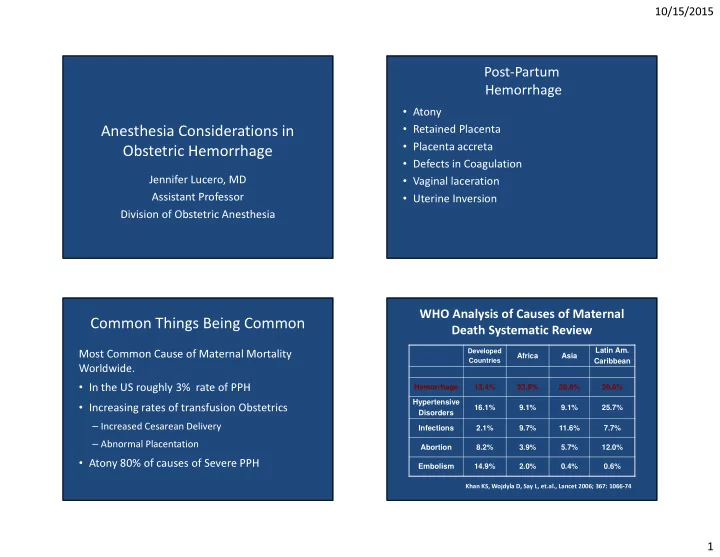
Principles to Reducing Maternal Hemorrhage
- Screen and identify patients at high risk
- Active management of 3rd stage
- Ongoing quantification of blood loss
- Ongoing evaluation of patient’s vital signs
- Sequential use of medications & procedures
- Timely request for blood products
- Massive transfusion protocol and team
- Periodic hemorrhage drills and simulations
Adapted from CMQCC California Maternal Quality Care Collaborative – OB Hemorrhage Task Force 22
Graphic Source: CMQCC California Maternal Quality Care Collaborative
Blood Loss: 1000-1500 ml
Stage 2
Sequentially Advance through Medications & Procedures
Pre- Admission Time of admission
Identify patients with special consideration: Placenta previa/accreta, Bleeding disorder, or those who decline blood products Follow appropriate workups, planning, preparing
- f resources, counseling and notification
Screen All Admissions for hemorrhage risk: Low Risk, Medium Risk and High Risk Low Risk: Draw blood and hold specimen Medium Risk: Type & Screen, Review Hemorrhage Protocol High Risk: Type & Crossmatch 2 Units PRBCs; Review Hemorrhage Protocol All women receive active management of 3rd stage Oxytocin IV infusion or 10 Units IM, 10-40 U infusion Standard Postpartum Management Fundal Massage Vaginal Birth: Bimanual Fundal Massage Retained POC: Dilation and Curettage Lower segment/Implantation site/Atony: Intrauterine Balloon Laceration/Hematoma: Packing, Repair as Required Consider IR (if available & adequate experience) Cesarean Birth: Continued Atony: B-Lynch Suture/Intrauterine Balloon Continued Hemorrhage: Uterine Artery Ligation To OR (if not there); Activate Massive Hemorrhage Protocol Mobilize Massive Hemorrhage Team TRANSFUSE AGGRESSIVELY RBC:FFP:Plts 6:4:1 or 4:4:1 Increased Postpartum Surveillance Definitive Surgery Hysterectomy Conservative Surgery B-Lynch Suture/Intrauterine Balloon Uterine Artery Ligation Hypogastric Ligation (experienced surgeon only) Consider IR (if available & adequate experience) Fertility Strongly Desired Consider ICU Care; Increased Postpartum Surveillance Verify Type & Screen on prenatal record; if positive antibody screen on prenatal
- r current labs (except low level anti-D
from Rhogam), Type & Crossmatch 2 Units PBRCs CALL FOR EXTRA HELP Give Meds: Hemabate 250 mcg IM -or- Misoprostol 600-800 SL or PO Cumulative Blood Loss >500 ml Vag; >1000 ml CS >15% Vital Sign change -or- HR ≥ 110, BP ≤ 85/45 O2 Sat <95%, Clinical Sx Ongoing Evaluation: Quantification of blood loss and vital signs Unresponsive Coagulopathy: After 10 Units PBRCs and full coagulation factor replacement, may consider rFactor VIIa HEMORRHAGE CONTINUES
Blood Loss: >1500 ml
Stage 3
Activate Massive Hemorrhage Protocol Blood Loss: >500 ml Vaginal >1000 ml CS
Stage 1
Activate Hemorrhage Protocol NO
Stage 0
All Births Transfuse 2 Units PRBCs per clinical signs Do not wait for lab values Consider thawing 2 Units FFP YES YES NO Ongoing Cumulative Blood Loss Evaluation Cumulative Blood Loss >1500 ml, 2 Units Given, Vital Signs Unstable YES Increase IV Oxytocin Rate Methergine 0.2 mg IM (if not hypertensive) Vigorous Fundal massage; Empty Bladder; Keep Warm Administer O2 to maintain Sat >95% Rule out retained POC, laceration or hematoma Order Type & Crossmatch 2 Units PRBCs if not already done Activate Hemorrhage Protocol CALL FOR EXTRA HELP Continued heavy bleeding Increased Postpartum Surveillance NO NO CONTROLLED INCREASED BLEEDING California Maternal Quality Care Collaborative (CMQCC), Hemorrhage Taskforce (2009) visit: www.CMQCC.org for details This project was supported by funds received from the State of California Department of Public Health, Center for Family Health; Maternal, Child and Adolescent Health Division
Obstetric Emergency Management Plan: Flow Chart Format
Release 2.0 7/9/2014
23
Graphic Source: CMQCC California Maternal Quality Care Collaborative
Blood Loss: 1000-1500 ml
Stage 2
Sequentially Advance through Medications & Procedures
Pre- Admission Time of admission
Identify patients with special consideration: Placenta previa/accreta, Bleeding disorder, or those who decline blood products Follow appropriate workups, planning, preparing
- f resources, counseling and notification
Screen All Admissions for hemorrhage risk: Low Risk, Medium Risk and High Risk Low Risk: Draw blood and hold specimen Medium Risk: Type & Screen, Review Hemorrhage Protocol High Risk: Type & Crossmatch 2 Units PRBCs; Review Hemorrhage Protocol All women receive active management of 3rd stage Oxytocin IV infusion or 10 Units IM, 10-40 U infusion Standard Postpartum Management Fundal Massage Vaginal Birth: Bimanual Fundal Massage Retained POC: Dilation and Curettage Lower segment/Implantation site/Atony: Intrauterine Balloon Laceration/Hematoma: Packing, Repair as Required Consider IR (if available & adequate experience) Cesarean Birth: Continued Atony: B-Lynch Suture/Intrauterine Balloon Continued Hemorrhage: Uterine Artery Ligation To OR (if not there); Activate Massive Hemorrhage Protocol Mobilize Massive Hemorrhage Team TRANSFUSE AGGRESSIVELY RBC:FFP:Plts 6:4:1 or 4:4:1 Increased Postpartum Surveillance Definitive Surgery Hysterectomy Conservative Surgery B-Lynch Suture/Intrauterine Balloon Uterine Artery Ligation Hypogastric Ligation (experienced surgeon only) Consider IR (if available & adequate experience) Fertility Strongly Desired Consider ICU Care; Increased Postpartum Surveillance Verify Type & Screen on prenatal record; if positive antibody screen on prenatal
- r current labs (except low level anti-D
from Rhogam), Type & Crossmatch 2 Units PBRCs CALL FOR EXTRA HELP Give Meds: Hemabate 250 mcg IM -or- Misoprostol 600-800 SL or PO Cumulative Blood Loss >500 ml Vag; >1000 ml CS >15% Vital Sign change -or- HR ≥ 110, BP ≤ 85/45 O2 Sat <95%, Clinical Sx Ongoing Evaluation: Quantification of blood loss and vital signs Unresponsive Coagulopathy: After 10 Units PBRCs and full coagulation factor replacement, may consider rFactor VIIa HEMORRHAGE CONTINUES
Blood Loss: >1500 ml
Stage 3
Activate Massive Hemorrhage Protocol Blood Loss: >500 ml Vaginal >1000 ml CS
Stage 1
Activate Hemorrhage Protocol NO
Stage 0
All Births Transfuse 2 Units PRBCs per clinical signs Do not wait for lab values Consider thawing 2 Units FFP YES YES NO Ongoing Cumulative Blood Loss Evaluation Cumulative Blood Loss >1500 ml, 2 Units Given, Vital Signs Unstable YES Increase IV Oxytocin Rate Methergine 0.2 mg IM (if not hypertensive) Vigorous Fundal massage; Empty Bladder; Keep Warm Administer O2 to maintain Sat >95% Rule out retained POC, laceration or hematoma Order Type & Crossmatch 2 Units PRBCs if not already done Activate Hemorrhage Protocol CALL FOR EXTRA HELP Continued heavy bleeding Increased Postpartum Surveillance NO NO CONTROLLED INCREASED BLEEDING California Maternal Quality Care Collaborative (CMQCC), Hemorrhage Taskforce (2009) visit: www.CMQCC.org for details This project was supported by funds received from the State of California Department of Public Health, Center for Family Health; Maternal, Child and Adolescent Health Division
Obstetric Emergency Management Plan: Flow Chart Format
Release 2.0 7/9/2014
Graphic Source: CMQCC California Maternal Quality Care Collaborative
CMQCC Obstetric Care Summary