An Overview of Oak Ridge National Laboratory and Early Career - - PowerPoint PPT Presentation

an overview of oak ridge national laboratory and early
SMART_READER_LITE
LIVE PREVIEW

An Overview of Oak Ridge National Laboratory and Early Career - - PowerPoint PPT Presentation

An Overview of Oak Ridge National Laboratory and Early Career Highlights Adams Alumni Presentation Heath Huckabay May 19, 2017 ORNL is managed by UT-Battelle for the US Department of Energy Approved for public release History of Oak Ridge


slide-1
SLIDE 1

ORNL is managed by UT-Battelle for the US Department of Energy
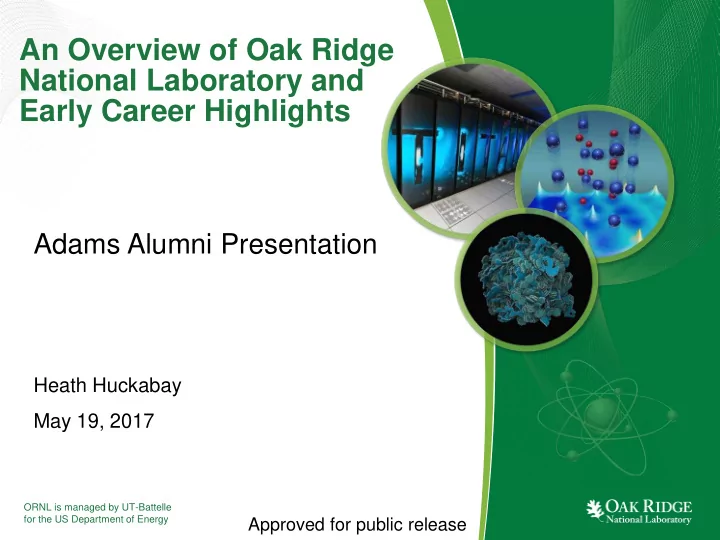
An Overview of Oak Ridge National Laboratory and Early Career Highlights

Heath Huckabay May 19, 2017

Adams Alumni Presentation

Approved for public release

slide-2
SLIDE 2

2 Presentation_name

History of Oak Ridge National Laboratory

  • Established in 1943 as part of the Manhattan Project

– Coded as X-10 – Nearby facilities were Y-12 (calutrons) and K-25 (gaseous diffusion)

  • Demonstrated the production and separation of plutonium for weapons development

The Clinton Pile was the world’s first continuously operated nuclear reactor Chemical processing techniques were developed to separate plutonium from irradiated fuel

slide-3
SLIDE 3

3 Presentation_name

Oak Ridge National Laboratory

  • ORNL is the Department of Energy’s largest science and

energy laboratory

– 4,559 staff members – 3,200 visiting scientists and users, per year

  • Major R&D activities include

– Neutron science – High performance computing – Materials research for energy applications – Nuclear power research – Biological, environmental, and earth sciences – National security

slide-4
SLIDE 4

4 Presentation_name

ORNL Highlights

  • Neutron Sciences

– High Flux Isotope Reactor (HFIR)

  • 85 MW research reactor

– Target irradiation

– Spallation Neutron Source

  • Most intense pulsed neutron source
  • n earth
  • High-Performance Computing

– Titan (in use)

  • Cray
  • 20+ petaflops (peaks at ~27

PFLOPS)

– 20,000+ trillion calculations/second

– Summit (in construction)

  • IBM
  • Estimated performance: 150-300

petaflops

  • Expected to go online in 2018
  • Center for Nanophase Materials

Science

– Vast array of fabrication and analysis tools

  • User facilities are free to use,

assuming you plan to publish

HFIR Core Refueling, 2015 Berkelium-249 Sample Mercury Target Used in SNS Spallation Neutron Source Center for Nanophase Materials Science

slide-5
SLIDE 5

5 Presentation_name

Research Project Highlights

Magnetic Resonance Force Microscopy for Small Scale Spectroscopy Red Oil Identification, Production Conditions, and Mitigation Strategies

Brightfield Channel Fluorescence Channel

Technology Development for Cotton Swipe Screening Radiation Detection Using Stimulated Emission

slide-6
SLIDE 6

6 Presentation_name

National Laboratories vs. Academia

  • All time is charged to an account

– Overhead =

  • Funding sources

– Verboten

  • National Institutes of Health
  • Most of NSF

– Funding through other agencies are available to national laboratories

  • Differs between science and weapons labs
  • Application cycle quite different
  • Research culture differences

– Academia

  • Faculty advisor serves as PI
  • Directs efforts of students/postdocs

– National Laboratories

  • Group leaders not directly responsible for funding
  • Researchers must work with peers to achieve project goals

– Multidisciplinary collaboration is necessary for our work

slide-7
SLIDE 7

7 Presentation_name

Obligatory Accomplishments Slide

  • Postdoctoral status from 2012-2014

– Nuclear forensics focused postdoctoral position – Sponsored by the Department of Homeland Security

  • Hired as permanent staff in 2014
  • Involved in ~18 separate projects since 2012
  • Roughly 2.5M in funding garnered since FY 2014

– National Nuclear Security Administration

  • University collaborations included!

– Internal ORNL funding mechanisms

  • Always looking for the next project…