An Object An Object- -Oriented Software Oriented Software - - PowerPoint PPT Presentation

an object an object oriented software oriented software
SMART_READER_LITE
LIVE PREVIEW

An Object An Object- -Oriented Software Oriented Software - - PowerPoint PPT Presentation

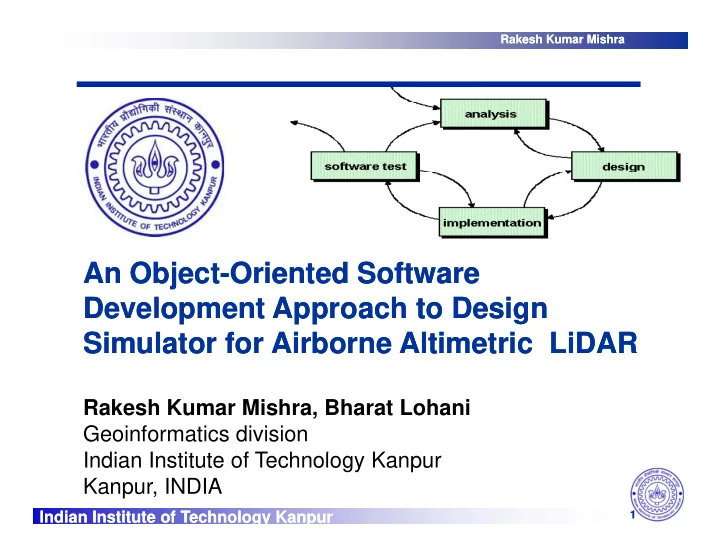
Rakesh Kumar Rakesh Kumar Mishra Mishra An Object An Object- -Oriented Software Oriented Software Development Approach to Design Development Approach to Design Development Approach to Design Development Approach to Design Simulator for


slide-1
SLIDE 1

Rakesh Kumar Rakesh Kumar Mishra Mishra

An Object An Object-

  • Oriented Software

Oriented Software Development Approach to Design Development Approach to Design Development Approach to Design Development Approach to Design Simulator for Airborne Altimetric LiDAR Simulator for Airborne Altimetric LiDAR

Rakesh Kumar Mishra, Bharat Lohani Geoinformatics division I di I tit t f T h l K

Indian Institute of Technology Kanpur Indian Institute of Technology Kanpur

1

Indian Institute of Technology Kanpur Kanpur, INDIA

slide-2
SLIDE 2

Rakesh Kumar Rakesh Kumar Mishra Mishra

P i i l f LiDAR P i i l f LiDAR Principle of LiDAR Principle of LiDAR

Laser transmitter

INS, GPS, Scanner

d (x,y,z, direction cosines) d

Indian Institute of Technology Kanpur Indian Institute of Technology Kanpur

2

X,Y,Z

slide-3
SLIDE 3

Rakesh Kumar Rakesh Kumar Mishra Mishra

LiDAR T h l LiDAR T h l LiDAR Technology LiDAR Technology

Provides accurate topographic data at high speed Data collection with higher density accuracy & less time Data collection with higher density, accuracy & less time Weather and light independent

Applications:

  • DEM generation
  • Flood hazard zonation

Indian Institute of Technology Kanpur Indian Institute of Technology Kanpur

3

  • Cellular networks etc.
slide-4
SLIDE 4

Rakesh Kumar Rakesh Kumar Mishra Mishra

Object Object-

  • Oriented Software

Oriented Software j Development Development

Indian Institute of Technology Kanpur Indian Institute of Technology Kanpur

4

slide-5
SLIDE 5

Rakesh Kumar Rakesh Kumar Mishra Mishra

Initial Investigation (Why simulator ?) Initial Investigation (Why simulator ?)

LiDAR Instrument is very costly LiDAR data is not available in most of the countries LiDAR data is not available in most of the countries LiDAR data is not available for teaching as required g q LiDAR data is not available for research as required Software for flight planning

Indian Institute of Technology Kanpur Indian Institute of Technology Kanpur

5

slide-6
SLIDE 6

Rakesh Kumar Rakesh Kumar Mishra Mishra

Requirements Requirements Requirements Requirements

User friendly GUI Simulation of generic as well as commercial sensors Simulation of earth like surfaces Flight trajectory as in case of actual flight Flight trajectory as in case of actual flight Possibilities of error introduction Output data in common format

Indian Institute of Technology Kanpur Indian Institute of Technology Kanpur

6

Help and tutorial

slide-7
SLIDE 7

Rakesh Kumar Rakesh Kumar Mishra Mishra

Feasibility study Feasibility study

Sufficient background is available for the system Sufficient background is available for the system development The system can be engineered using current technology Development can be done within the budget & time Developed system will be useful for the user group

Indian Institute of Technology Kanpur Indian Institute of Technology Kanpur

7

slide-8
SLIDE 8

Rakesh Kumar Rakesh Kumar Mishra Mishra

Object Object-

  • Oriented analysis

Oriented analysis

Surface Trajectory

User

Integration

Output

Sensor

Use case diagram

Indian Institute of Technology Kanpur Indian Institute of Technology Kanpur

8

slide-9
SLIDE 9

Rakesh Kumar Rakesh Kumar Mishra Mishra

Objects in the problem domain is identified Object relationships are made Object state table is developed Object state table is developed Inheritance diagram for objects is made

Indian Institute of Technology Kanpur Indian Institute of Technology Kanpur

9

slide-10
SLIDE 10

Rakesh Kumar Rakesh Kumar Mishra Mishra

Obj t Obj t ri nt d d i n ri nt d d i n Object Object-oriented design

  • riented design

INPUT Terrain Sensor Trajectory Integration Terrain component Sensor component Trajectory component OUTPUT

Indian Institute of Technology Kanpur Indian Institute of Technology Kanpur

10 10

slide-11
SLIDE 11

Rakesh Kumar Rakesh Kumar Mishra Mishra

Terrain components Terrain components Terrain components Terrain components

Terrain t component Raster surface Polynomial surface Fractal surface

Indian Institute of Technology Kanpur Indian Institute of Technology Kanpur

11 11 11 11

slide-12
SLIDE 12

Rakesh Kumar Rakesh Kumar Mishra Mishra

Sensor components Sensor components Sensor components Sensor components

Sensor t component ALTM Generic sensor ALS 50

Indian Institute of Technology Kanpur Indian Institute of Technology Kanpur

12 12 12 12

slide-13
SLIDE 13

Rakesh Kumar Rakesh Kumar Mishra Mishra

Trajectory components Trajectory components Trajectory components Trajectory components

Trajectory component Location Attitude

Acceleration Velocity

Indian Institute of Technology Kanpur Indian Institute of Technology Kanpur

13 13 13 13

slide-14
SLIDE 14

Rakesh Kumar Rakesh Kumar Mishra Mishra

Cl d i n Cl d i n Class design Class design

Identify classes from the components Identify classes from the components Identify subclass within each class Identify abstraction in each class Identify the common behaviour of classes

Indian Institute of Technology Kanpur Indian Institute of Technology Kanpur

14 14

slide-15
SLIDE 15

Rakesh Kumar Rakesh Kumar Mishra Mishra

S t m impl m nt ti n S t m impl m nt ti n System implementation System implementation

Java is used to realize the design Java is used to realize the design Each classes are implemented with its relationship Standard way of coding is used Methods are designed for each basic task

Indian Institute of Technology Kanpur Indian Institute of Technology Kanpur

15 15

slide-16
SLIDE 16

Rakesh Kumar Rakesh Kumar Mishra Mishra

C mpl iti h ndl d C mpl iti h ndl d Complexities handled Complexities handled

Efficient algorithms are designed Efficient algorithms are designed Threads are used to optimize software execution Special data structures are designed to handle memory problems New file formats are designed to improve I/O

Indian Institute of Technology Kanpur Indian Institute of Technology Kanpur

16 16

slide-17
SLIDE 17

Rakesh Kumar Rakesh Kumar Mishra Mishra

Software Software Screenshots Screenshots

Indian Institute of Technology Kanpur Indian Institute of Technology Kanpur

17 17

slide-18
SLIDE 18

Rakesh Kumar Rakesh Kumar Mishra Mishra

Polynomial surface Polynomial surface Indian Institute of Technology Kanpur Indian Institute of Technology Kanpur

18 18

slide-19
SLIDE 19

Rakesh Kumar Rakesh Kumar Mishra Mishra

Raster surface(City model) Raster surface(City model) Indian Institute of Technology Kanpur Indian Institute of Technology Kanpur

19 19

slide-20
SLIDE 20

Rakesh Kumar Rakesh Kumar Mishra Mishra

Fractal surface Fractal surface Indian Institute of Technology Kanpur Indian Institute of Technology Kanpur

20 20

slide-21
SLIDE 21

Rakesh Kumar Rakesh Kumar Mishra Mishra

Acceleration Acceleration Indian Institute of Technology Kanpur Indian Institute of Technology Kanpur

21 21

slide-22
SLIDE 22

Rakesh Kumar Rakesh Kumar Mishra Mishra

Sensor component Sensor component Indian Institute of Technology Kanpur Indian Institute of Technology Kanpur

22 22

slide-23
SLIDE 23

Rakesh Kumar Rakesh Kumar Mishra Mishra

System defined optimal flight lines System defined optimal flight lines System defined optimal flight lines System defined optimal flight lines

Indian Institute of Technology Kanpur Indian Institute of Technology Kanpur

23 23

slide-24
SLIDE 24

Rakesh Kumar Rakesh Kumar Mishra Mishra

User defined optimal flight lines User defined optimal flight lines User defined optimal flight lines User defined optimal flight lines

Indian Institute of Technology Kanpur Indian Institute of Technology Kanpur

24 24

slide-25
SLIDE 25

Rakesh Kumar Rakesh Kumar Mishra Mishra

Attitude Attitude Indian Institute of Technology Kanpur Indian Institute of Technology Kanpur

25 25

slide-26
SLIDE 26

Rakesh Kumar Rakesh Kumar Mishra Mishra

Error simulation Error simulation Indian Institute of Technology Kanpur Indian Institute of Technology Kanpur

26 26

slide-27
SLIDE 27

Rakesh Kumar Rakesh Kumar Mishra Mishra

Output generation Output generation Indian Institute of Technology Kanpur Indian Institute of Technology Kanpur

27 27

slide-28
SLIDE 28

Rakesh Kumar Rakesh Kumar Mishra Mishra

Software Software Results Results Software Software Results Results

Indian Institute of Technology Kanpur Indian Institute of Technology Kanpur

28 28

slide-29
SLIDE 29

Rakesh Kumar Rakesh Kumar Mishra Mishra

Altitude=210m

Overlap=4% Velocity=60m/s

3D Raster terrain (Displayed in Surfer) 3D Raster terrain (Displayed in Surfer)

Velocity=60m/s Sensor-ALS-50 Firing frequency=20KHz Scan frequency=48Hz Scan angle=40° Flight area=430m×430m Flight area 430m 430m

Indian Institute of Technology Kanpur Indian Institute of Technology Kanpur

29 29

slide-30
SLIDE 30

Rakesh Kumar Rakesh Kumar Mishra Mishra

Lidar data plot in plan Lidar data plot in plan

A A A-A B-B

Indian Institute of Technology Kanpur Indian Institute of Technology Kanpur

30 30

slide-31
SLIDE 31

Rakesh Kumar Rakesh Kumar Mishra Mishra

Profile A Profile A-

  • A with and without error

A with and without error

Indian Institute of Technology Kanpur Indian Institute of Technology Kanpur

31 31

slide-32
SLIDE 32

Rakesh Kumar Rakesh Kumar Mishra Mishra

Profile B Profile B-

  • B with respect to flight lines

B with respect to flight lines

Indian Institute of Technology Kanpur Indian Institute of Technology Kanpur

32 32

slide-33
SLIDE 33

Rakesh Kumar Rakesh Kumar Mishra Mishra

LiDAR data without error LiDAR data without error

Indian Institute of Technology Kanpur Indian Institute of Technology Kanpur

33 33

slide-34
SLIDE 34

Rakesh Kumar Rakesh Kumar Mishra Mishra

LiDAR data with error LiDAR data with error

Indian Institute of Technology Kanpur Indian Institute of Technology Kanpur

34 34

slide-35
SLIDE 35

Rakesh Kumar Rakesh Kumar Mishra Mishra

Data without attitude variation Data without attitude variation

Indian Institute of Technology Kanpur Indian Institute of Technology Kanpur

35 35

slide-36
SLIDE 36

Rakesh Kumar Rakesh Kumar Mishra Mishra

Data with attitude variation Data with attitude variation

Indian Institute of Technology Kanpur Indian Institute of Technology Kanpur

36 36

slide-37
SLIDE 37

Rakesh Kumar Rakesh Kumar Mishra Mishra

Fractal surface displayed in Surfer Fractal surface displayed in Surfer

Indian Institute of Technology Kanpur Indian Institute of Technology Kanpur

37 37

slide-38
SLIDE 38

Rakesh Kumar Rakesh Kumar Mishra Mishra

LiDAR data of fractal surface LiDAR data of fractal surface

Indian Institute of Technology Kanpur Indian Institute of Technology Kanpur

38 38

Bharat Lohani, IIT Kanpur India

slide-39
SLIDE 39

Rakesh Kumar Rakesh Kumar Mishra Mishra

Terrain with objects Terrain with objects

Indian Institute of Technology Kanpur Indian Institute of Technology Kanpur

39 39

slide-40
SLIDE 40

Rakesh Kumar Rakesh Kumar Mishra Mishra

Altitude=490m

Overlap=2% l / Velocity=60m/s Sensor-ALS-50 Firing frequency=20KHz Scan frequency=48Hz Scan angle=50° Flight area=640m×460m

LiDAR data of terrain with objects LiDAR data of terrain with objects

Flight area=640m×460m

Indian Institute of Technology Kanpur Indian Institute of Technology Kanpur

40 40

slide-41
SLIDE 41

Rakesh Kumar Rakesh Kumar Mishra Mishra

1 2

Profile view of buildings Profile view of buildings

Indian Institute of Technology Kanpur Indian Institute of Technology Kanpur

41 41

slide-42
SLIDE 42

Rakesh Kumar Rakesh Kumar Mishra Mishra

Eff t f diff t fli ht di ti Eff t f diff t fli ht di ti Effect of different flight direction Effect of different flight direction

Indian Institute of Technology Kanpur Indian Institute of Technology Kanpur

42 42

slide-43
SLIDE 43

Rakesh Kumar Rakesh Kumar Mishra Mishra

Indian Institute of Technology Kanpur Indian Institute of Technology Kanpur

43 43

slide-44
SLIDE 44

Rakesh Kumar Rakesh Kumar Mishra Mishra

Use of Simulator Use of Simulator Use of Simulator Use of Simulator

Indian Institute of Technology Kanpur Indian Institute of Technology Kanpur

44 44

slide-45
SLIDE 45

Rakesh Kumar Rakesh Kumar Mishra Mishra

Ed ti Ed ti Education Education

Process of LiDAR data generation Process of LiDAR data generation Effect of change in various parameters Effect of error in data Effect of different sensors on LiDAR data Generating data for known ground truth Conducting various lab exercises

Indian Institute of Technology Kanpur Indian Institute of Technology Kanpur

45 45

Conducting various lab exercises

slide-46
SLIDE 46

Rakesh Kumar Rakesh Kumar Mishra Mishra

R h R h Research Research

Evaluation of information extraction algorithms Evaluation of information extraction algorithms Assessing effect of error on performance of algorithms Study the effect of parameters on data Generate data of different specifications with no cost Finding optimal data specification for an application

Indian Institute of Technology Kanpur Indian Institute of Technology Kanpur

46 46

slide-47
SLIDE 47

Rakesh Kumar Rakesh Kumar Mishra Mishra

Fli ht l i Fli ht l i Flight planning Flight planning

Determine the optimal flight line Effect of sensor parameters on data Effect of data density Effect of data density Determine the optimal sensor parameters

Indian Institute of Technology Kanpur Indian Institute of Technology Kanpur

47 47 47 47

slide-48
SLIDE 48

Rakesh Kumar Rakesh Kumar Mishra Mishra

C l i C l i Conclusion Conclusion

Offers a user friendly GUI based interface Simulate the process of LiDAR data collection Freedom to set the sensor parameters M d t t b t d f th t i Many data sets can be generated for the same terrain Ideal software tool for LiDAR research and education Ideal software tool for LiDAR research and education OOSD makes it easily maintainable and scalable software

Indian Institute of Technology Kanpur Indian Institute of Technology Kanpur

48 48

slide-49
SLIDE 49

Rakesh Kumar Rakesh Kumar Mishra Mishra

Rakesh Kumar Mishra

  • Sr. Project Associate

Geoinformatics division Geoinformatics division Indian Institute of Technology Kanpur Kanpur, INDIA-208016 E M il k i h @iitk i

Indian Institute of Technology Kanpur Indian Institute of Technology Kanpur

49 49

E-Mail: rkmishra@iitk.ac.in