An Introduction to Employee Stock Ownership Plans (ESOPs) - - PowerPoint PPT Presentation

an introduction to employee stock ownership plans esops
SMART_READER_LITE
LIVE PREVIEW

An Introduction to Employee Stock Ownership Plans (ESOPs) - - PowerPoint PPT Presentation

An Introduction to Employee Stock Ownership Plans (ESOPs) Alexander L. Mounts, Partner Krieg DeVault LLP August 29, 2018 What is an Employee Stock Ownership Plan? Tool of CORPORATE FINANCE/SUCCESSION VEHICLE Tax-qualified

slide-1
SLIDE 1

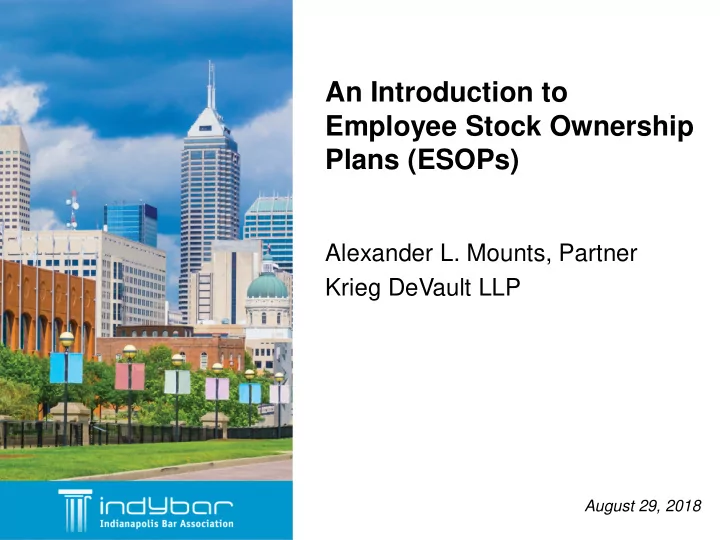
An Introduction to Employee Stock Ownership Plans (ESOPs)

Alexander L. Mounts, Partner Krieg DeVault LLP

August 29, 2018

slide-2
SLIDE 2

2

What is an “Employee Stock Ownership Plan”?

  • Tool of CORPORATE

FINANCE/SUCCESSION VEHICLE

  • Tax-qualified RETIREMENT PLAN
  • Invests “primarily” in EMPLOYER STOCK
  • Numerous Federal tax incentives encourage

implementation

slide-3
SLIDE 3

ESOPs in the U.S.

3

  • Common transition strategy:
  • Alternative to selling to an outsider
  • Gradual
  • Tax benefits

Common transition strategy:

  • Alternative to selling to an
  • utsider
  • Gradual
  • Tax benefits

*6,669 ESOPs 14 million employees $1.3 trillion in plan assets

*March 2018 National Center for Employee Ownership (www.nceo.org)

slide-4
SLIDE 4

National ESOPs

4

slide-5
SLIDE 5

Indiana ESOPs

5

slide-6
SLIDE 6
  • Closely held U.S. based company
  • Company can be a C-corp or an S-corp
  • At least 20 employees (companies with small payroll

bases may encounter problems under Code Sections 415 and 409(p))

  • Profitable
  • Debt capacity
  • Stable earnings
  • Supportive management

Good ESOP Candidates

6

slide-7
SLIDE 7
  • Identified ESOP objectives

– Create and realize employee retirement benefits, cultural improvements, and operational efficiencies – Protect the shareholders’ legacy and Company heritage while realizing liquidity – Company desiring to utilize corporate tax savings to increase growth and accelerate debt repayment – Reward employees and management who helped build the Company

Good ESOP Candidates

7

slide-8
SLIDE 8

8

Advantages ESOPs

Flexibility

  • Market for shareholders’ stock
  • Unlike most buyers, serves as source of funds to

purchase minority blocks

  • Low marketability discount (typically 5%) on value of

shares

  • Succession planning vehicle for gradual transfer of
  • wnership to next generation (often combined with

transfers of ownership to management – “sweat equity”)

  • “Financial” buyer with long term perspective
  • Easily combined with “401(k)” plan – use of “matching”

contributions to fund ESOP; some transactions allow employees to transfer 401(k) funds to ESOP

slide-9
SLIDE 9

9

Advantages of ESOPs

Tax

  • ESOP’s share of company’s income is not

subject to tax

  • Contributions to ESOP are tax deductible

(important if ESOP owns less than 100%)

  • ESOP’s share of “tax dividends” can be used to

repay loan, satisfy repurchase liability or pay expenses

  • Allocations to participants’ accounts are tax

deferred; distributions are eligible for tax-free rollover

  • Special tax treatment of “net unrealized

appreciation” on distribution of stock

slide-10
SLIDE 10

10

Effect on Employees (Well Communicated ESOPs)

  • Pride of ownership culture
  • Recruiting/retention tool
  • Increased commitment and enthusiasm
  • Material increase in value of corporation*

*See Key Studies on Employee Ownership and Corporate Performance at https://www.nceo.org/articles/studies-employee-ownership-corporate-performance

slide-11
SLIDE 11

11

Disadvantages of an ESOP

  • Cost and number of service providers
  • Complexity
  • Communication
  • Repurchase liability
  • Less diversification of retirement assets
  • Fiduciary responsibility/liability
slide-12
SLIDE 12

ESOP Valuation Considerations

  • ESOP Valuation vs. “Multiple of Book” – How should

ESOP shares be valued?

– Independent appraisal firm qualified and experienced with ESOP valuations – Appropriate methods of valuing companies – Weighting of methods – Use of publicly available information regarding non-publicly traded companies

  • Financial performance
  • Merger and acquisition activity

– Effect of cash and stock dividends on value – Effect of repurchase obligation on value

12

slide-13
SLIDE 13

Basic Structure of an ESOP Transaction (Bank Financing)

13

  • 4. Cash/Note
  • 5. Employer Stock

Employer Bank

  • 1. Bank Loan
  • 2. Pledge of Collateral

Step 1

Shareholders ESOP

slide-14
SLIDE 14

Basic Structure of an ESOP Transaction

14

Employer Bank

  • 3. Loan Payments
  • 1. Contributions

Dividends

Step 2

ESOP Stock

Seller

slide-15
SLIDE 15

15

Examples of Benefits of “S” Corporation ESOP Structure

Net Income of $5,000,000 with No ESOP

Corporate Tax

  • 0-

Individual Shareholder Tax:

  • n $5,000,000 @ 45% = $2,225,000

Total “Tax Dividends” = $2,225,000

Net Income of $5,000,000 with 50% ESOP

Corporate Tax

  • 0-

Individual Shareholder Tax:

  • n $2,500,000 @ 45% = $1,125,000

ESOP Shareholder Tax on $2,500,000 = $0 Total Tax Dividends = $2,225,000 ESOP’s Share = $1,125,000

Net Income of $5,000,000 with 100% ESOP

Corporate Tax -0- ESOP Shareholder Tax on $5,000,000 = $0 Additional cash flow = $2,225,000

slide-16
SLIDE 16

16

ESOP “Myths”

  • ESOP Trustee will become involved in running the

company

  • Employees or trustee must have seat on Board
  • Management structure will change; the ESOP will

become involved in management

  • Stock valuation, compensation and/or corporation’s

financial statements must be disclosed

  • Corporation will be less attractive to potential buyers
  • Corporation cannot “go public” later
slide-17
SLIDE 17

17

Characteristics of Well-Designed and Implemented ESOPs

  • “Sanity check” approach to implementation

a. Stock valuation b. Feasibility c. Financing d. Commitment of key managers

  • Independent, experienced advisors to ESOP

a. Counsel b. Financial Advisor c. Trustee

  • Well-educated ESOP “Committee”
  • Well-prepared feasibility analysis

a. Projections based on history b. “Cushion” for economic downturn

  • Repurchase Liability Study
slide-18
SLIDE 18

Disclaimers

  • These slides are for educational purposes only

and are not intended, and should not be relied upon, as legal or accounting advice.

  • Pursuant to Circular 230 promulgated by the

Internal Revenue Service, please be advised that these slides were not intended or written to be used, and that they cannot be used, for the purposes of avoiding federal tax penalties unless otherwise expressly indicated.

18

7524044.1

slide-19
SLIDE 19

Speaker Contact Information

Alexander L. Mounts, Partner Krieg DeVault LLP One Indiana Square, Ste. 2800 Indianapolis, IN 46204 E: amounts@kdlegal.com P: 317-238-6335

slide-20
SLIDE 20

Stay connected and visit us online!