An inquiry based approach in a first year undergraduate class - - PowerPoint PPT Presentation

an inquiry based approach in a first year undergraduate
SMART_READER_LITE
LIVE PREVIEW

An inquiry based approach in a first year undergraduate class - - PowerPoint PPT Presentation

An inquiry based approach in a first year undergraduate class Sheila Webber Department of Information Studies University of Sheffield, April 2008 With acknowledgement to others in the Inf106 teaching team (Andrew Cox, Philippa Levy, Peter


slide-1
SLIDE 1

Sheila Webber, 2008
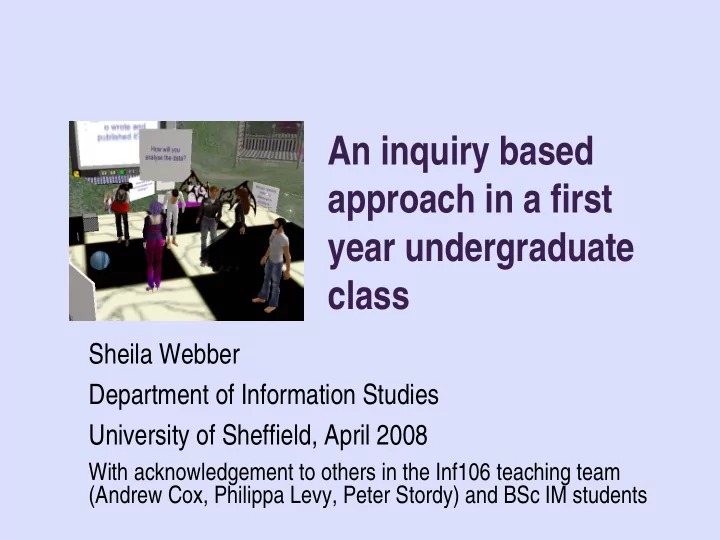
An inquiry based approach in a first year undergraduate class

Sheila Webber Department of Information Studies University of Sheffield, April 2008

With acknowledgement to others in the Inf106 teaching team (Andrew Cox, Philippa Levy, Peter Stordy) and BSc IM students

slide-2
SLIDE 2

Sheila Webber, 2008

Outline

  • Inquiry Based Learning at Sheffield University
  • BSc Information Management
  • Inf104 Information Literacy
  • Inf106 Inquiry in Information Management
  • Conclusion
slide-3
SLIDE 3

Sheila Webber, 2008

IBL

“IBL is a term used to describe approaches to learning that are based on a process of self-directed inquiry or research. Students conduct small or large-scale inquiries that enable them to engage actively and creatively with the questions and problems of their discipline, often in collaboration with others. IBL approaches include case-study and problem-based learning (PBL) methods as well as research projects of different kinds. It is a key characteristic of IBL that inquiry tasks facilitate exploration and investigation of issues or scenarios that are open-ended enough for different responses and solutions to be possible (Khan and O´Rourke, 2005)” cited http://www.shef.ac.uk/cilass/ibl.html

slide-4
SLIDE 4

Sheila Webber, 2008

IBL: a strategic focus

The ‘Sheffield Graduate’ “Studying at Sheffield will provide students with the

  • pportunity to… become involved in inquiry-based

learning, as a means of actively engaging with the questions and problems of their discipline and of developing a range of inquiry-related capabilities and skills” University of Sheffield Learning, Teaching and Assessment Strategy, 2005-10.

slide-5
SLIDE 5

Sheila Webber, 2008

Centre for Inquiry based Learning in the Arts and Social Sciences (CILASS)

“Modelling the process of research within the student learning experience”

slide-6
SLIDE 6

Sheila Webber, 2008

CILASS

  • Centre for Excellence in Teaching and Learning
  • Core community: Faculties of Arts, Social Sciences and Law
  • New teaching spaces, some core staff: but mostly focused
  • n developments with academics in modules (by February

2007 – 70 modules in 20 departments/schools.)

  • Aiming to make “a major contribution towards strengthening

the links between research and teaching at UoS”

  • CILASS Fellowships
  • http://www.shef.ac.uk/cilass/
slide-7
SLIDE 7

Sheila Webber, 2008

CILASS IBL framework

  • Collaborative inquiry and inquiry

communities

  • Information literacy

development

  • Networked learning
  • Interdisciplinary inquiry
  • Classrooms as research

environments (‘collaboratories’) Information literacy: “knowing when and why you need information, where to find it, and how to evaluate, use and communicate it in an ethical manner” (CILIP).

slide-8
SLIDE 8

Sheila Webber, 2008

BSc Information Management

slide-9
SLIDE 9

Sheila Webber, 2008

Background

  • Aims for strengthening IBL approach:

– Help students deepen their engagement with, and understanding of, Information Management (IM) as an academic discipline and professional practice – Give students an opportunity to develop their research understanding and skills

  • C. 20 students; Varied backgrounds; Predominantly

home students

slide-10
SLIDE 10

Sheila Webber, 2008

Issues with discipline/ course

  • Anyone here know what Information

Management is???

  • There are no IM A-levels or Highers in IM
  • Contested discipline
  • Investigations (NSS + our own) showed issues

with UG subject engagement & lack of awareness of research impact

slide-11
SLIDE 11

Sheila Webber, 2008

Departmental background

  • Blended learning: Use of WebCT (“MOLE”) for discussion

boards, student ppts, focus of class/lab exercises, class materials + other tools

  • Introduction of concept mapping in semester 1
  • Team teaching
  • Research experts teaching at level 1
  • Strong practitioner links
  • Already PBL and IBL approaches
  • Department is research led
  • Educational Informatics research group
slide-12
SLIDE 12

Sheila Webber, 2008

Individual mindmap Group mindmap, presented and discussed in class Copycam Photographed & uploaded to WebCT Copycam WebCT aka “MOLE” Blogs

slide-13
SLIDE 13

Sheila Webber, 2008

Evaluation

  • Student work (including reflective work & material

generated in class; inc. blogs, mindmaps, captures), marks & attendance records

  • Interviews/focus groups with tutors & (inf104 to be

completed) students

  • Tutors reflections (notes, blogs, emails & (Inf104) e-

portfolio)

  • Other evidence of various kinds (photos, transcripts

etc)

slide-14
SLIDE 14

Sheila Webber, 2008

Inf104: Information Literacy (core, level 1, semester 1)

slide-15
SLIDE 15

Sheila Webber, 2008

Second Life

  • 3-D Online Digital world
  • Most things created by SL residents: SL fashion designers,

architects, bakers, animal makers ….

  • Avatars- 3D representation of yourself – free to signup and

can live on freebies, but need Linden dollars if want to own land, buy clothes etc.

  • Communication through text chat, Voice and Instant

Messaging

  • No student had used virtual world before (nb SL main grid

is 18+ only)

slide-16
SLIDE 16

Sheila Webber, 2008

Inf104: Information literacy

  • Module aims

– to progress students' information literacy in key areas (working towards being an information literate citizen) – to develop their understanding of information literacy & information behaviour theories and practice

  • Assessment

– Website/article/book review – Analysis of & reflection on research interviews in Second Life – Reflection on their progress in relation to the SCONUL 7 Pillars of Information Literacy

slide-17
SLIDE 17

Sheila Webber, 2008

Specific project aims (changes for 2007/8)

  • Investigating SL as learning space
  • Focus in more depth on specific parts of research

process (data collection & analysis)

  • Strengthen theoretical element of module with

genuinely novel investigation

  • CILASS funded cost of SL island for 1 year and

provided support in evaluating use of SL

slide-18
SLIDE 18

Sheila Webber, 2008

Inquiry in SL

  • Students undertook critical incident interviews with SL residents

(a time when they had an information need relating to a SL activity) in SL itself

  • Assessment: Students analysed transcripts in relation to

models of RL information behaviour + audited interview technique

  • Class activity over 3 weeks – group research/ presentations on

whether SL was dangerous

  • Induction to basics of SL over several weeks
  • Practice interviewing in real life & SL
slide-19
SLIDE 19

Sheila Webber, 2008

*

* Photo Vicki Cormie,

  • thers by
slide-20
SLIDE 20

Sheila Webber, 2008

Reflections on changed elements

  • f Inf104
  • SL a learning (and play) space – more like a classroom space than a

website – with new possibilities

  • Students won’t automatically be engaged with SL: pedagogic

rationale needed

  • There is a learning curve, even for gamers (but does have fun factor)
  • Wider range of interviewees than possible in Real Life (students in

Canada, educators/librarians in various parts of world)

  • Reasonable to excellent analyses of interview transcripts
  • Some insightful comments on interviewing in SL; richer than for

previous year’s (RL) exercise

  • For me: stressful but enjoyable
slide-21
SLIDE 21

Sheila Webber, 2008

“I'd like to take this opportunity to say I *really* enjoyed doing the interview task

  • I'd say it made a great use of the

advantages of Second Life, connecting to people who might be geographically far, far away, and giving a more personal element to the interaction that plain chat would not have had.” (student email)

slide-22
SLIDE 22

Sheila Webber, 2008

Inf106: Inquiry in Information Management (core, level 1, semester 1)

slide-23
SLIDE 23

Sheila Webber, 2008

Inf106: Inquiry in IM (introduced 2006/7)

  • Module aims

– “This course will develop students’ understanding of Information Management, and through a small piece of real collaborative research they will explore the nature of research and scholarly communication in the field”

  • Assessment

– Group produced poster – Individual blog (last year was group blog) – Individual portfolio

slide-24
SLIDE 24

Sheila Webber, 2008

Information Management

  • Groups generate their own

research questions

  • Work together and with tutors on

these small-scale projects

  • Interacting with researchers and

practitioners

  • Collecting and analysing data
  • Students generate assessment

criteria for posters

  • Present posters at research

‘conference’

  • CILASS support in evaluation,

funding for TAs etc.

Does Facebook support students’ personal information management?

What does mobile phone user behaviour contribute to detrimental environmental effects and how can these be reduced?

slide-25
SLIDE 25

Sheila Webber, 2008

Inquiry at Level 1 – Information Management

“So in other words the idea is to give students a chance to teach themselves in some sense and the module staff was making an impression of rather a team of advisors and coordinators, rather than

  • rdinary lecturers.”
slide-26
SLIDE 26

Sheila Webber, 2008

Close of module research poster conference, May 2007 Inf106 ‘Inquiry in Information Management’

“What made us pick this particular topic was that we were all fascinated by something non-one within the department really knew the answer to. Although we were not actually carrying out original research, and someone out there had the facts we needed to successfully answer the question, it was the challenge of finding this that drew us to the idea of [the topic]…

slide-27
SLIDE 27

Sheila Webber, 2008

Reflections on Inf106 (2006/7)

“Overall evaluation pointed to positive impact in engaging students with both Information Management and the process of inquiry. The particular highlight, for us, was the quality of many students’ engagement with the inquiry task and the student work that was presented at the mini-

  • conference. Students had successfully defined a

research question, gathered primary or secondary data, analysed them and produced effective presentations of the results in poster form. This represented a rounded accomplishment and a level of engagement in research that we rarely demand before the third undergraduate

  • year. All the work was good, and several pieces were

excellent.” Cox et al (2008) in press.

slide-28
SLIDE 28

Sheila Webber, 2008

Reflections on Inf106 (2006/7)

“Student attendance on the module was high overall, and some

workshops in particular generated a high level of interaction amongst peers. Student feedback via a number of channels (focus group, feedback questionnaire, reflective portfolios) was positive, with the new module gaining high scores on questionnaires on every criterion.” Cox et al (2008) in press.

Response to question: How would you guage your level of

engagement and motivation in the module? Was it enjoyable?

“One student said it was about the same as other modules, but

  • thers said they liked the freedom to choose their own topic,

and mentioned again the assessment criteria exercise. They also said they liked the guest speakers who told what it’s like in the real world.” Summary of student focus group by CILASS researcher.

slide-29
SLIDE 29

Sheila Webber, 2008

Reflections on Inf106 (2006/7)

“The course has made me realise that there is a large possibility of me pursuing a career within the IM field eventually […] Guest speakers like […] have significantly enhanced my view of the subject and very possibly pressed me into creating a career out of it” (Reflective Portfolio).

slide-30
SLIDE 30

Sheila Webber, 2008

Conclusions

slide-31
SLIDE 31

Sheila Webber, 2008

Students as participants Students as audience Emphasis on research content Research based Curriculum emphasises students undertaking inquiry based learning Research tutored Curriculum emphasises learning focused on students writing & discussing papers or essays Emphasis on research processes and problems Research led Curriculum is structured around teaching subject content Research based Curriculum emphasises teaching processes of knowledge construction in the subject Diagram: Jenkins et al, 2007: 29

Curriculum design and the research-teaching nexus

Area we are focusing

  • n

Also this – and think we need more Also comes into curriculum I had felt this aspect needed more attention too in Inf104

slide-32
SLIDE 32

Sheila Webber, 2008

Conclusions

  • Strengthening IBL element does seem to have

increased students’ engagement with the subject

  • For both modules, improvements for next iteration
  • Value of progressing IBL
  • Need to address level 2 further as regards research

skills & maintaining interest in discipline

  • Wait to see impact on level 3 project
  • Scalability: physical constraints (rooms &

technology) more of a problem than staffing?

slide-33
SLIDE 33

Sheila Webber, 2008

Sheila Webber s.webber@shef.ac.uk http://information-literacy.blogspot.com/

http://adventuresofyoshikawa.blogspot.com/ Sheila Yoshikawa

Powerpoint at: http://www.slideshare.net/sheilawebber/

slide-34
SLIDE 34

Sheila Webber, 2008

References

  • Cox, A. et al (2008) “Inquiry-based learning in the first-year

Information Management curriculum.” Italics. In press.

  • Inquiry in Information Management case study:

http://www.shef.ac.uk/cilass/cases/informationmanagement.html

  • Jenkins, A., Healey, M. and Zetter, R. (2007) Linking teaching

and research in disciplines and departments. York: HEA.

  • Khan, P. and O´Rourke, K. (2005). “Understanding Enquiry-

based Learning”, In: Barrett, T., Mac Labhrainn, I., Fallon, H. (eds), Handbook of Enquiry and Problem Based Learning. Galway: CELT.