An Example Using Rocky Mountain Population Sandhill Cranes in the - - PowerPoint PPT Presentation

an example using rocky mountain population sandhill
SMART_READER_LITE
LIVE PREVIEW

An Example Using Rocky Mountain Population Sandhill Cranes in the - - PowerPoint PPT Presentation

Regional Conservation Planning for Migratory Birds: An Example Using Rocky Mountain Population Sandhill Cranes in the Intermountain West Colorado Chapter of The Wildlife Society Fort Collins February 6, 2014 Patrick Donnelly, IWJV Jim


slide-1
SLIDE 1

Regional Conservation Planning for Migratory Birds: An Example Using Rocky Mountain Population Sandhill Cranes in the Intermountain West

Photo: Patrick Donnelly, 2008
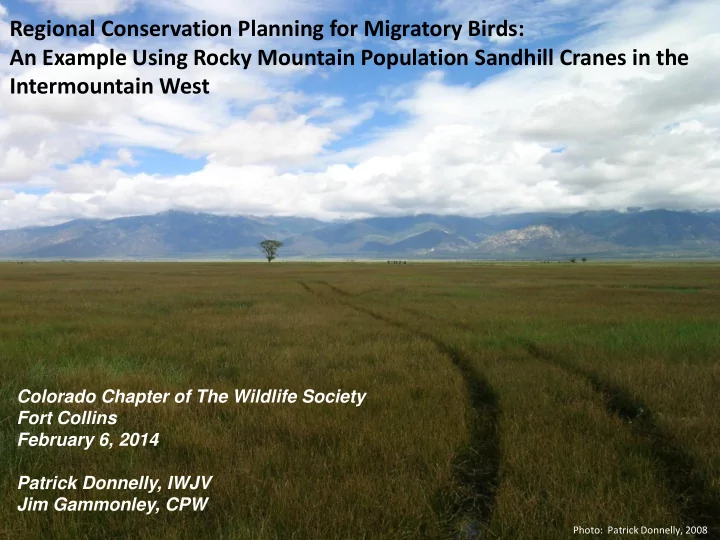
Colorado Chapter of The Wildlife Society Fort Collins February 6, 2014 Patrick Donnelly, IWJV Jim Gammonley, CPW

slide-2
SLIDE 2

Intermountain West Joint Venture (IWJV) Established in 1994 Largest U.S. Joint Venture

slide-3
SLIDE 3

Donnelly and Vest. (2012) Identifying Science Priorities 2013–2018

  • Principles and framework
  • Habitat prioritization
  • Wetland focal strategies
slide-4
SLIDE 4

Ownership: All Ownership: Palustrine wetland

slide-5
SLIDE 5

Leu et al. (2008), Donnelly and Vest (2012)

  • Disproportionate impact on wetland

dominated landscapes Hansen et al. (2002)

  • Dramatic human growth/development

in West over past 20 yrs.

  • Increased development reduces avian

viability even within adjacent reserves McWethy & Austin (2009)

  • Increased development pressures

negatively influencing breeding habitat quantity and quality Mitchusson 2003

  • Development pressure limiting foraging

and roosting habitat

slide-6
SLIDE 6

Beaverhead Valley, MT Humboldt River Valley, NV Yampa Valley, CO

slide-7
SLIDE 7

Measuring landscape change:

  • Quantify 30 years of spatio-temporal

trends in wetland habitats

  • Correlate changes in wetland habitat

availability to land use practice and water policy

  • Measure trends in subdivision and

project future subdivision risk

  • Measure changes in cropping patterns
slide-8
SLIDE 8
  • High spatial proximity - fall staging

and breeding sites (Drewien and Bizeau 1974)

  • 72 fall staging sites
  • San Luis Valley major staging site
  • Middle Rio Grande major wintering

site

slide-9
SLIDE 9

Phase 1: Define potential RMP habitat extent Phase 2: Characterize habitats by measuring near-term ecological condition and anthropogenic trends Phase 3: Identify distribution and magnitude of landscape stressors

Taking a top down approach to information needs: Detailed model identifying the extent and distribution of sandhill crane (RMP) habitats Spatially explicit evaluation of near- term (1984 – present) annual wetland condition and cumulative human impact within the RMP habitat extent. Identification and spatially explicit measure of magnitude and trend of landscape stressors affecting the RMP. A detailed GIS layer identifying existing and potential future habitat availability will be provided.

slide-10
SLIDE 10

Example: sage-grouse late brooding rearing habitat delineation (Donnelly et al. in review)

slide-11
SLIDE 11

Landsat TM NDVI Habitat sampling units

Example: crop inventory model completed for Middle Rio Grande Valley, New Mexico (Donnelly 2005).

USGS DOQ – acquired 1982 NAIP – acquired 2011

slide-12
SLIDE 12

Landsat TM NDVI Habitat sampling units

Example: exurbanization occurring in the Teton Basin, near Victor ID between 1982 and 2011. 1982 2011

slide-13
SLIDE 13

Exploring landscape stressors:

  • 30 satellite transmitters deployed

2014

  • Habitat configuration modeling
  • Resource selection parameters
slide-14
SLIDE 14

Closing the research information gap:

  • Local scale resource prioritization

tools

  • NRCS practitioners
  • Land trust
  • FWS Partners Program
  • TNC
  • Ducks Unlimited…
slide-15
SLIDE 15

Closing the research information gap:

  • Local scale resource prioritization

tools

  • NRCS practitioners
  • Land trust
  • FWS Partners Program
  • TNC
  • Ducks Unlimited…
  • Conservation planning
  • State Wildlife Agencies (SWAP)
  • USFS, BLM
  • CPW Wetlands Conservation

Program

slide-16
SLIDE 16

Contributing partners (to date):

slide-17
SLIDE 17

Funding overview: $100,000 IWJV Science $115,000 Webless funding/USFWS $20,000 Avian Science Center $10,000 APLIC

  • $30,000 Outstanding

$325,000 Total 190 million acres 2-3 year timeframe Cooperative Ecosystem Studies Unit (CESU) - Rocky Mountain Region

slide-18
SLIDE 18

Project Contacts: Patrick Donnelly PI - Breeding/Staging Areas IWJV / USFWS Division of Migratory Birds Missoula, MT 406.493.2539 – patrick_donnelly@fws.gov Dan Collins PI – Wintering Areas USFWS Division of Migratory Birds Albuquerque, NM 505.248.6881 – dan_collins@fws.gov

slide-19
SLIDE 19

Questions?