
Craig Chambers 114 CSE 401
An example typechecking operation
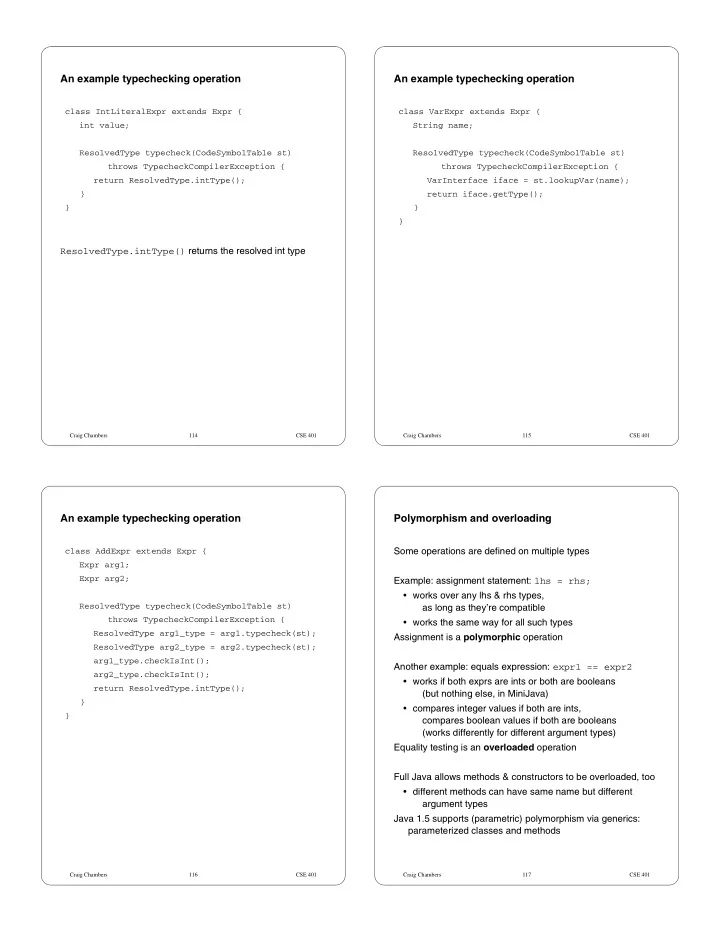
class IntLiteralExpr extends Expr { int value; ResolvedType typecheck(CodeSymbolTable st) throws TypecheckCompilerException { return ResolvedType.intType(); } }
ResolvedType.intType() returns the resolved int type
Craig Chambers 115 CSE 401
An example typechecking operation
class VarExpr extends Expr { String name; ResolvedType typecheck(CodeSymbolTable st) throws TypecheckCompilerException { VarInterface iface = st.lookupVar(name); return iface.getType(); } }
Craig Chambers 116 CSE 401
An example typechecking operation
class AddExpr extends Expr { Expr arg1; Expr arg2; ResolvedType typecheck(CodeSymbolTable st) throws TypecheckCompilerException { ResolvedType arg1_type = arg1.typecheck(st); ResolvedType arg2_type = arg2.typecheck(st); arg1_type.checkIsInt(); arg2_type.checkIsInt(); return ResolvedType.intType(); } }
Craig Chambers 117 CSE 401
Polymorphism and overloading
Some operations are defined on multiple types Example: assignment statement: lhs = rhs;
- works over any lhs & rhs types,
as long as they’re compatible
- works the same way for all such types
Assignment is a polymorphic operation Another example: equals expression: expr1 == expr2
- works if both exprs are ints or both are booleans
(but nothing else, in MiniJava)
- compares integer values if both are ints,
compares boolean values if both are booleans (works differently for different argument types) Equality testing is an overloaded operation Full Java allows methods & constructors to be overloaded, too
- different methods can have same name but different
argument types Java 1.5 supports (parametric) polymorphism via generics: parameterized classes and methods