An Almost Constructive Proof of Classical First-Order Completeness - - PowerPoint PPT Presentation

an almost constructive proof of classical first order
SMART_READER_LITE
LIVE PREVIEW

An Almost Constructive Proof of Classical First-Order Completeness - - PowerPoint PPT Presentation

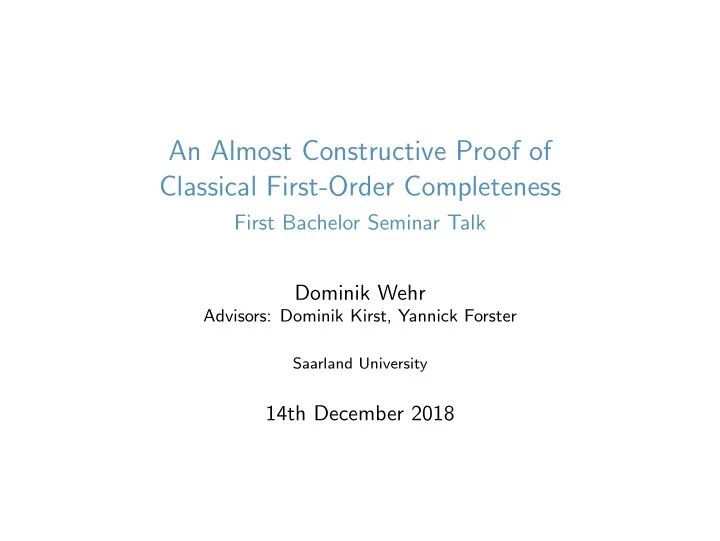
An Almost Constructive Proof of Classical First-Order Completeness First Bachelor Seminar Talk Dominik Wehr Advisors: Dominik Kirst, Yannick Forster Saarland University 14th December 2018 Syntax, Deduction, and Semantics Model Existence


slide-1
SLIDE 1

An Almost Constructive Proof of Classical First-Order Completeness

First Bachelor Seminar Talk Dominik Wehr

Advisors: Dominik Kirst, Yannick Forster

Saarland University

14th December 2018

slide-2
SLIDE 2

Syntax, Deduction, and Semantics Model Existence Completeness Outro

Partial History of First-Order Completeness

. . . 1928 First formal statement by Hilbert and Ackermann1 1929 First proven by G¨

  • del2

1947 Greatly simplified by Henkin3 2016 Constructive analysis by Herbelin and Ilik 4

1Ackermann and Hilbert. “Grundz¨ uge der theoretischen Logik” 2G¨

  • del. “¨

Uber die Vollst¨ andigkeit des Logikkalk¨ uls”

  • 3Henkin. “The Completeness of the First-Order Functional Calculus”

4Herbelin and Ilik. An analysis of the constructive content of Henkin’s proof of G¨

  • del’s completeness theorem

2 / 19

slide-3
SLIDE 3

Syntax, Deduction, and Semantics Model Existence Completeness Outro

Definition (Syntax)

s, t : T ::= e | f t | x | p x, p : N ϕ, ψ : F ::= ˙ ⊥ | P s t | ϕ → ˙ ψ | ˙ ∀x.ϕ x : N ˙ ¬ϕ := ϕ → ˙ ˙ ⊥ ˙ ∃x.ϕ := ˙ ¬˙ ∀x. ˙ ¬ϕ ϕ ˙ ∨ ψ := ˙ ¬ϕ → ˙ ψ

3 / 19

slide-4
SLIDE 4

Syntax, Deduction, and Semantics Model Existence Completeness Outro

Definition (Deduction system)

Ctx

ϕ ∈ A A ⊢ ϕ

II

ϕ :: A ⊢ ψ A ⊢ ϕ → ˙ ψ

IE

A ⊢ ϕ → ˙ ψ A ⊢ ϕ A ⊢ ψ

DN

A ⊢ ˙ ¬ ˙ ¬ϕ A ⊢ ϕ

AllI

A ⊢ ϕx

p

p fresh for ϕ and A A ⊢ ˙ ∀x.ϕ

AllE

A ⊢ ˙ ∀x.ϕ t closed A ⊢ ϕx

t

4 / 19

slide-5
SLIDE 5

Syntax, Deduction, and Semantics Model Existence Completeness Outro

Definition (Interpretation)

An interpretation I on a domain D consists of: eI : D fI : D → D · I : N → D P I : D → D → P

Definition (Evaluation)

Given ρ : N → D, we extend I to tI,ρ : D and ρ I ϕ : P: ρ I ˙ ⊥ = ⊥ ρ I P s t = P I sI,ρ tI,ρ ρ I ϕ → ˙ ψ = ρ I ϕ → ρ I ψ ρ I ˙ ∀x.ϕ = ∀d : D. ρ[x → d] I ϕ A ϕ := ∀I ρ. ρ I A → ρ I ϕ

5 / 19

slide-6
SLIDE 6

Syntax, Deduction, and Semantics Model Existence Completeness Outro

Definition (Theories)

We extend the previous notions to theories T : F → P: T ϕ := ∀I ρ. ρ I T → ρ I ϕ T ⊢ ϕ := A ⊢ ϕ∃A. A ⊆ T ∧ A ⊢ ϕ

Definition (Consistency)

We call T : F → P consistent if T ˙ ⊥ maximally consistent if T ˙ ⊥ and ϕ ∈ T if T ∪ {ϕ} ˙ ⊥

6 / 19

slide-7
SLIDE 7

Syntax, Deduction, and Semantics Model Existence Completeness Outro

Proof Outline

T consistent Model Existence ? ? T

A ϕ → A ⊢ ϕ

7 / 19

slide-8
SLIDE 8

Syntax, Deduction, and Semantics Model Existence Completeness Outro

Quantifier-free Model Existence

consistent closed T Lindenbaum maximally consistent Ω Herbrandt Ω model for T

8 / 19

slide-9
SLIDE 9

Syntax, Deduction, and Semantics Model Existence Completeness Outro

Definition

Given a consistent T , we fix an enumeration EF and define Ω0 = T Ωn+1 =

  • Ωn ∪ {EF n}

Ωn ∪ {EF n} consistent Ωn

  • therwise

Ω :=

  • Ωn

Lemma (Lindenbaum)

Ω is a maximally consistent extension of T .

9 / 19

slide-10
SLIDE 10

Syntax, Deduction, and Semantics Model Existence Completeness Outro

Quantifier-free Model Existence

consistent closed T Lindenbaum maximally consistent Ω Herbrandt Ω model for T

10 / 19

slide-11
SLIDE 11

Syntax, Deduction, and Semantics Model Existence Completeness Outro

Definition (Herbrandt model)

Given a theory Ω we define its Herbrandt model on closed terms Tc: tΩ,ρ := t P Ω s t := P s t ∈ Ω

Lemma (Model correctness)

Let Ω be maximally consistent and ϕ be closed and quantifier-free, then Ω ϕ ↔ ϕ ∈ Ω

Corollary (Model existence)

Let T be consistent and closed, then Ω T .

11 / 19

slide-12
SLIDE 12

Syntax, Deduction, and Semantics Model Existence Completeness Outro

Lemma (Maximally consistent membership)

Let Ω be maximally consistent. Then ϕ ∈ Ω ↔ Ω ⊢ ϕ.

Lemma (Model correctness)

Let Ω be maximally consistent and ϕ be closed and quantifier-free, then Ω ϕ ↔ ϕ ∈ Ω

Proof.

Proof per induction on the size of ϕ. There are three cases: P s t ∈ Ω ↔ P s t ∈ Ω ⊥ ↔ Ω ⊢ ˙ ⊥ (Ω ⊢ ϕ → Ω ⊢ ψ) ↔ Ω ⊢ ϕ → ˙ ψ

12 / 19

slide-13
SLIDE 13

Syntax, Deduction, and Semantics Model Existence Completeness Outro

First-Order Model Existence

consistent parameter-free closed T Henkin consistent not closed H

Lindenbaum Herbrandt Ω model for T

13 / 19

slide-14
SLIDE 14

Syntax, Deduction, and Semantics Model Existence Completeness Outro

Definition (Henkin axioms)

Let T be consistent and parameter-free. Then define H as follows: H0 = T Hn+1 =      Hn ∪ {ϕx

p →

˙ ˙ ∀x.ϕ} if EF n = ˙ ∀x.ϕ with p fresh in Hn Hn

  • therwise

H :=

  • Hn

Lemma (Henkin correctness)

H is consistent (∀t : Tc. H ⊢ ϕx

t ) ↔ H ⊢ ˙

∀x. ϕ

14 / 19

slide-15
SLIDE 15

Syntax, Deduction, and Semantics Model Existence Completeness Outro

Proof Outline

T consistent parameter-free closed Model Existence Ω T

A ϕ → A ⊢ ϕ

15 / 19

slide-16
SLIDE 16

Syntax, Deduction, and Semantics Model Existence Completeness Outro

Theorem (Strong quasi-completeness)

Let both T and ϕ be closed and parameter-free. T ϕ → ¬¬T ⊢ ϕ

Theorem (Refutation completeness)

T ⊢ ϕ ↔ T ∪ { ˙ ¬ϕ} ⊢ ˙ ⊥

16 / 19

slide-17
SLIDE 17

Syntax, Deduction, and Semantics Model Existence Completeness Outro

Theorem (Strong quasi-completeness)

Let both T and ϕ be closed and parameter-free. T ϕ → ¬¬T ⊢ ϕ

Definition (Stability of ⊢)

¬¬ A ⊢ ϕ → A ⊢ ϕ

Theorem (Completeness)

Assume the stability of ⊢. Let A and ϕ be closed and parameter-free. A ϕ → A ⊢ ϕ

17 / 19

slide-18
SLIDE 18

Syntax, Deduction, and Semantics Model Existence Completeness Outro

Future Work

Establish Soundness and use AutoSubst Completeness of an intuitionistic Gentzen system Cut free completeness of intuitionistic ND Multiple possibilities: Cut elimination for classical ND Game semantics ...

18 / 19

slide-19
SLIDE 19

Syntax, Deduction, and Semantics Model Existence Completeness Outro

References

Hugo Herbelin and Danko Ilik. An analysis of the constructive content of Henkin’s proof of G¨

  • del’s completeness theorem.
  • Draft. 2016.

George F. Schumm. A Henkin-style completeness proof for the pure implicational calculus. Vol. 16. 3. Duke University Press, July 1975, pp. 402–404. Melvin Fitting. First-Order Logic and Automated Theorem

  • Proving. Springer, 1996.

Yannik Forster, Dominik Kirst, and Gert Smolka. On Synthetic Undecidability in Coq, with an Application to the

  • Entscheidungsproblem. CPP’19. 2018.

19 / 19