SLIDE 1
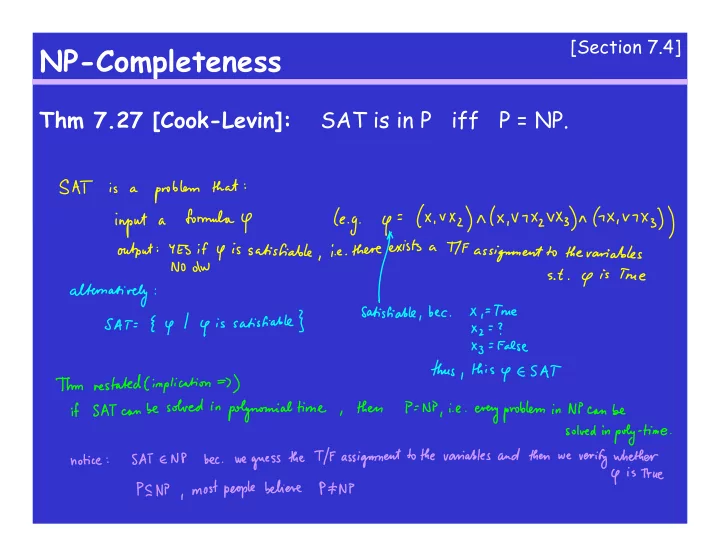
NP-Completeness Thm 7.27 [Cook-Levin]: SAT is in P iff P = NP. - - PowerPoint PPT Presentation
[Section 7.4] NP-Completeness Thm 7.27 [Cook-Levin]: SAT is in P iff P = NP. [Section 7.4] NP-Completeness Def 7.29: Language A is polynomial-time reducible to language B, written A P B, if a polynomial-time computable function f: *
SLIDE 2
SLIDE 3
NP-Completeness
[Section 7.4]
Thm 7.32: 3SAT is polynomial-time reducible to CLIQUE, where 3SAT = { <φ> | φ is a satisfiable 3-cnf formula }.
SLIDE 4
NP-Completeness
[Section 7.4]
Def 7.34: A language B is NP-complete if it satisfies both conditions:
- B is in NP, and
- every A in NP is polynomial-time reducible to B.
SLIDE 5
NP-Completeness
[Section 7.4]
Def 7.34: A language B is NP-complete if it satisfies both conditions:
- B is in NP, and
- every A in NP is polynomial-time reducible to B.
Thm 7.35: If B is NP-complete and B ∈ P, then P = NP.
SLIDE 6
NP-Completeness
[Section 7.4]
Def 7.34: A language B is NP-complete if it satisfies both conditions:
- B is in NP, and
- every A in NP is polynomial-time reducible to B.
Thm 7.36: If B is NP-complete and B ≤P C for some C ∈ NP, then C is NP-complete.
SLIDE 7
NP-Completeness
[Section 7.4]
Def 7.34: A language B is NP-complete if it satisfies both conditions:
- B is in NP, and
- every A in NP is polynomial-time reducible to B.