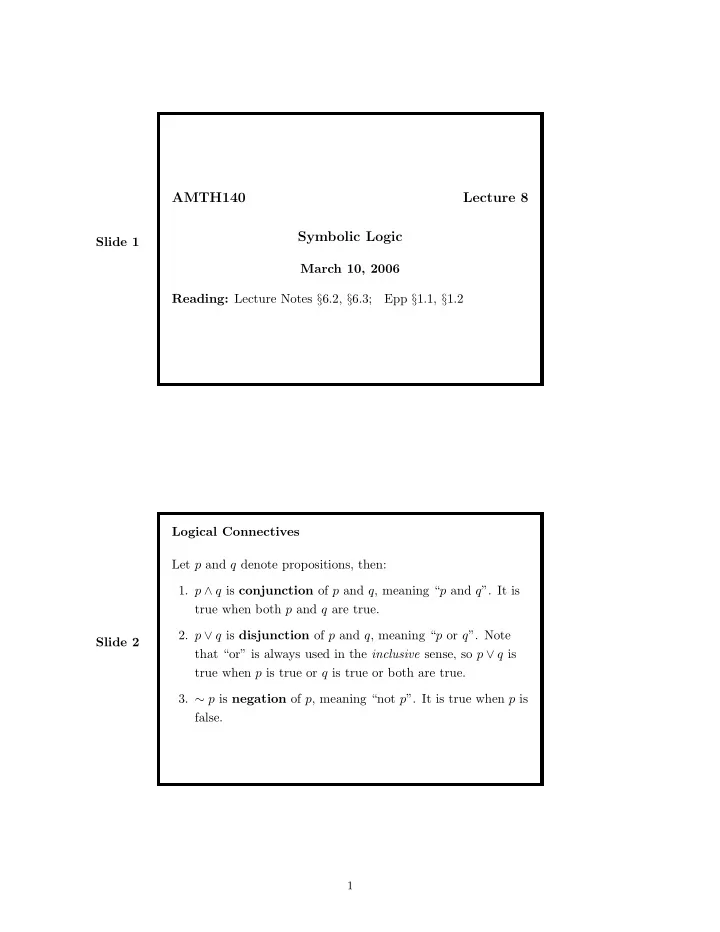
SLIDE 1 Slide 1
AMTH140 Lecture 8 Symbolic Logic
March 10, 2006 Reading: Lecture Notes §6.2, §6.3; Epp §1.1, §1.2 Slide 2 Logical Connectives Let p and q denote propositions, then:
- 1. p ∧ q is conjunction of p and q, meaning “p and q”. It is
true when both p and q are true.
- 2. p ∨ q is disjunction of p and q, meaning “p or q”. Note
that “or” is always used in the inclusive sense, so p ∨ q is true when p is true or q is true or both are true.
- 3. ∼ p is negation of p, meaning “not p”. It is true when p is
false.
1
SLIDE 2 Slide 3 Truth Tables p q p ∧ q p q p ∨ q p ∼ p T T T T T T T F T F F T F T F T F T F F T T F F F F F F Slide 4 Application Let p = John is healthy q = John is wealthy r = John is wise How do we express:
- 1. John is healthy, wealthy and wise.
- 2. John is not wealthy, but he is healthy and wise.
- 3. John is wealthy, but he is not both healthy and wise.
2
SLIDE 3 Slide 5 p = John is healthy, q = John is wealthy, r = John is wise
- 1. John is healthy, wealthy and wise.
p ∧ (q ∧ r)
- 2. John is not wealthy, but he is healthy and wise.
(∼ q) ∧ (p ∧ r)
- 3. John is wealthy, but he is not both healthy and wise.
q ∧ (∼ (p ∧ r)) Slide 6 Logical Equivalence Two compound propositions P and Q are logically equivalent, written P ≡ Q, if the two propositions have the same truth values for all possible truth values of the component propositions. Examples – De Morgan’s Laws ∼ (p ∧ q) ≡ (∼ p) ∨ (∼ q) ∼ (p ∨ q) ≡ (∼ p) ∧ (∼ q)
3
SLIDE 4 Slide 7 Applications What is the negation of −1 < x ≤ 4 Let p = the proposition −1 < x q = the proposition x ≤ 4 then p ∧ q = the proposition −1 < x ≤ 4 Slide 8 By De Morgan’s laws ∼ (p ∧ q) ≡ (∼ p) ∨ (∼ q) so ∼ (−1 < x ≤ 4) ≡ (∼ (−1 < x)) ∨ (∼ (x ≤ 4)) i.e. −1 ≥ x
x > 4
x ≤ −1
x > 4
4
SLIDE 5
Slide 9 p = John is healthy, q = John is wealthy, r = John is wise In symbols, John is wealthy, but he is not both healthy and wise is q ∧ (∼ (p ∧ r)) By De Morgan’s laws ∼ (p ∧ r) ≡ (∼ p) ∨ (∼ r) So q ∧ (∼ (p ∧ r)) ≡ q ∧ ((∼ p) ∨ (∼ r)) i.e. John is wealthy, and he is not healthy or he is not wise. Slide 10 Examples – Distributive Laws These are p ∧ (q ∨ r) ≡ (p ∧ q) ∨ (p ∧ r) p ∨ (q ∧ r) ≡ (p ∨ q) ∧ (p ∨ r) Thus John is wealthy or he is healthy and wise. is logically equivalent to John is wealthy or healthy and he is wealthy or wise.
5
SLIDE 6
Slide 11 p ∧ (q ∨ r) ≡ (p ∧ q) ∨ (p ∧ r)
p q r q ∨ r p ∧ q p ∧ r p ∧ (q ∨ r) (p ∧ q) ∨ (p ∧ r) T T T T T T T T T T F T T F T T T F T T F T T T T F F F F F F F F T T T F F F F F T F T F F F F F F T T F F F F F F F F F F F F
Slide 12 Conditional Statements If p and q are propositions then the conditional statement “if p then q” or “p implies q” is denoted by p → q. It is false when p is true and q is false, otherwise it true. In a conditional statement p → q, p is called the hypothesis and q is called the conclusion. A conditional statement which is true by virtue of its hypothesis being false is said to be true by default. The proposition “If 1 + 1 = 3 then I am the king of England” is true but uninformative.
6
SLIDE 7
Slide 13 Truth Table The proposition p → q is true if either p is false or both p and q are true. p q p → q T T T T F F F T T F F T Slide 14 Logical Equivalence p → q ≡ (∼ p) ∨ q p q ∼ p p → q (∼ p) ∨ q T T F T T T F F F F F T T T T F F T T T
7
SLIDE 8
Slide 15 Negation of a Conditional ∼ (p → q) ≡ p ∧ (∼ q) p q p → q ∼ q ∼ (p → q) p ∧ (∼ q) T T T F F F T F F T T T F T T F F F F F T T F F Slide 16 Example If John is wealthy then is not wise. is logically equivalent to John is not wealthy or he is not wise. The negation is John is wealthy and he is wise.
8
SLIDE 9
Slide 17 Contrapositives The contrapositive of a conditional statement p → q is the statement (∼ q) → (∼ p). These are logically equivalent. p → q ≡ (∼ q) → (∼ p) p q ∼ q ∼ p p → q (∼ q) → (∼ p) T T F F T T T F T F F F F T F T T T F F T T T T Slide 18 Example The contrapositive of If John is wealthy then is not wise. is If John is wise then is not wealthy.
9
SLIDE 10
Slide 19 The Biconditional If p and q are propositions then the biconditional of p and q is “p if and only if q” and denoted by p ↔ q. It is true when p and q have the same truth value and false if they have opposite truth values. p q p ↔ q T T T T F F F T F F F T Slide 20 Logical Equivalence p ↔ q ≡ (p → q) ∧ (q → p) In words – ‘p if and only if q’ is logically equivalent to ‘if p then q and if q then p’ or ‘p implies q and q implies p’. p q p → q q → p p ↔ q (p → q) ∧ (q → p) T T T T T T T F F T F F F T T F F F F F T T T T
10
SLIDE 11 Slide 21 Necessary and Sufficient Conditions If p and q are propositions then:
- 1. p is a necessary condition for q means that if q is true
then it is necessary that p is true. Logically, q → p.
- 2. p is a sufficient condition for q means that p being true
is sufficient for q to be true. Logically, p → q.
- 3. Thus p is a necessary and sufficient condition for q
means q → p and p → q, i.e. p ↔ q, Slide 22 Example
- 1. ‘John is wise is a necessary condition for John to be
wealthy’ means that he can’t be wealthy without being wise, i.e. ‘if John is wealthy then he is wise’.
- 2. ‘John is wise is a sufficient condition for John to be
wealthy’ means ‘if John is wise then he is wealthy’.
- 3. ‘John is wise is a necessary and sufficient condition for
John to be wealthy’ means ‘John is wise if and only if he is wealthy’ or ‘John is wise and wealthy or he is not wise and not wealthy’.
11