Amino acid disorders (PKU, MSUD, HT,HCU) Amino acid disorders (PKU, - - PowerPoint PPT Presentation

amino acid disorders pku msud ht hcu amino acid disorders
SMART_READER_LITE
LIVE PREVIEW

Amino acid disorders (PKU, MSUD, HT,HCU) Amino acid disorders (PKU, - - PowerPoint PPT Presentation

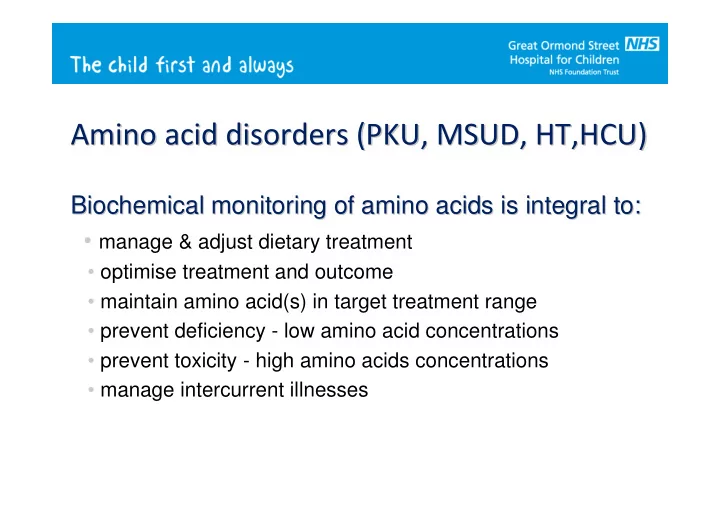
Amino acid disorders (PKU, MSUD, HT,HCU) Amino acid disorders (PKU, MSUD, HT,HCU) Biochemical monitoring of amino acids is integral to: Biochemical monitoring of amino acids is integral to: manage & adjust dietary treatment optimise


slide-1
SLIDE 1

Amino acid disorders (PKU, MSUD, HT,HCU) Amino acid disorders (PKU, MSUD, HT,HCU)

Biochemical monitoring of amino acids is integral to: Biochemical monitoring of amino acids is integral to:

  • manage & adjust dietary treatment
  • optimise treatment and outcome
  • maintain amino acid(s) in target treatment range
  • prevent deficiency - low amino acid concentrations
  • prevent toxicity - high amino acids concentrations
  • manage intercurrent illnesses
slide-2
SLIDE 2

Amino acid disorders (PKU, MSUD, HT,HCU) Amino acid disorders (PKU, MSUD, HT,HCU)

  • accumulation of precursor amino acid(s) in plasma
  • measure the accumulating amino acid(s)
  • normal reference ranges
  • target treatment reference ranges for amino acid(s)
  • target plasma reference range >normal reference range
  • measurement of uncertainty (MU)
  • adjust diet based on result and other factors
  • families informed of result by phone, letter, e-mail, text,

graph of results at clinic

slide-3
SLIDE 3

Home blood sampling and collection Home blood sampling and collection

  • blood spot on blood cards (PKU, Tyr, MSUD, HCU)
  • heel/finger prick
  • importance of good sample to obtain accurate results !
  • convenient, simple, achievable
  • enables regular, accurate monitoring of diet
  • blood in Sarstedt microvette tube
slide-4
SLIDE 4

Frequency of blood sampling: a guide Frequency of blood sampling: a guide

PKU, MSUD, HT(1,11,111)

  • weekly in infancy and early childhood
  • 2 weekly in toddlers, young children
  • monthly in older children

HCU:

  • less easy to monitor from home
  • hospital phlebotomy for prompt blood separation
  • dried blood spot for tHc (LC–MS/MS), methionine

(Adam Gerrard, Mary Anne Preece, BCH)

  • weekly in infants until stable, then 2 weekly
slide-5
SLIDE 5

Sampling time of day Sampling time of day – – standardise ? standardise ?

  • diurnal variation of amino acids
  • ideally sample at least 3½ hours after end of last meal,

avoid high aa’s due to postprandial absorption

Bachmann C, J Inher Metab Dis 2008

  • PKU - phenylalanine is highest after overnight fast

Macdonald A et al, Arch Dis Child 1997

  • aim is to at least collect at same time of day

eg: PKU bath time on a Sunday – warm, good blood flow

  • try to document time delay between last meal & sampling
slide-6
SLIDE 6

Tandem mass spectrometry (MS/MS) - blood spots for

  • for PKU, Tyrosinaemia
  • HCU (and paired plasma sample 1/mth)

Ultra High performance/pressure liquid chromatography

  • BCAA blood spot

Results

  • daily - phe, tyr, BCAA
  • weekly - tHc, methionine (BCH)
slide-7
SLIDE 7

Interpretation of amino acid results Interpretation of amino acid results

  • look at trends
  • adjust diet
  • repeat blood test to follow up dietary change
  • timing of sample in relation to food
  • consider clinical status
  • is child well ?
  • is child on ER ?
  • growth
  • age (puberty)
  • compliance with diet
  • no of days since last increased exchanges/protein
slide-8
SLIDE 8

Reasons for high concentrations of Reasons for high concentrations of amino acid(s) on treatment amino acid(s) on treatment

  • acute catabolism: infection, stress, surgery
  • chronic catabolism due to inadequate intake of:
  • precursor free aa’s
  • energy
  • too much natural protein
  • wrong protein substitute product or low protein foods
  • non-adherence
  • medicine (Betaine in HCU)
slide-9
SLIDE 9

Reasons for low concentrations of Reasons for low concentrations of amino acids (s) on treatment amino acids (s) on treatment

  • inadequate natural protein intake
  • inadequate protein substitute or single amino acids
  • increased requirement post illness
  • growth spurt
  • inadequate synthesis and supplementation
  • cysteine - HCU
  • tyrosine - PKU
slide-10
SLIDE 10

PKU

Age(years)

Treatment aim Phe range µmol/l

MRC Arch Dis Child 1993

Treatment aim Phe range µmol/l

European PKU Guidelines 2016 (unpublished)

0-4 120-360 (35-100 normal) 120-360 5-10 120-480 120-360 >11 120-700 120-600

slide-11
SLIDE 11

MSUD

Plasma reference ranges µmol/l normal target treatment range Leucine 65-220 200-400 75-200 < 5y 75-300 > 5y Isoleucine 26-100 200-400 Valine 90-300 200-400 Frazier DM et al, 2014

slide-12
SLIDE 12

MSUD MSUD -

  • age 4 mths

age 4 mths BCAA monitoring BCAA monitoring

slide-13
SLIDE 13

Tyrosinaemia type 1 Plasma reference ranges µmol/l normal blood spot treatment aims Tyrosine 30 -120 200 - 400 Phenylalanine 35 -100 35 -100

slide-14
SLIDE 14

HT1 – teenager age 13 years

Date Tyrosine aim 200-400µmol/l Phenylalanine 35-100µmol/l 14.11.09 am pm 557 398 34 75 05.12.09 am pm 747 589 64 53 05.01.10 am pm 986 925 100 70 16.01.10 am pm 458 361 51 36 23.01.10 am 388 33

Diet:13g natural protein, Tyr Cooler x 3 (45g aa’s)

slide-15
SLIDE 15

HCU Treatment aims plasma homocysteine

methionine

cysteine free total µmol/l µmol/l µmol/l µmol/l diet alone normal range normal range < 10 < 80 -100 betaine high up to 1000 normal range < 10 < 80 -100

  • Lifetime - free Hcy <10 µmol/l associated with good outcome
  • tHcy > 60µmol/l before observe free Hcy
  • Dried blood spot - apply a factor of x 4
slide-16
SLIDE 16

Summary Summary

  • biochemical monitoring is integral to dietetic management
  • monitoring both single and trends of results is important
  • repeated/regular monitoring to review interventions
  • cannot interpret in isolation need to consider other factors
  • clinical picture, growth, dietary intake, compliance
slide-17
SLIDE 17

Measurement of uncertainty Measurement of uncertainty

  • should MU be considered when interpreting results for

monitoring?

  • would it be helpful to have MU reported with results ?
  • is this more of a problem for higher results ?
  • apply same MU then greater range
  • Leuc 400mol/L (apply MU of 15) = 340 to 460
  • Leuc 800mol/L (apply MU of 15) = 680 to 920
slide-18
SLIDE 18