AM Gradiometer (AMG) Technology Underground Utility/Substructure - - PowerPoint PPT Presentation

am gradiometer amg technology underground utility
SMART_READER_LITE
LIVE PREVIEW

AM Gradiometer (AMG) Technology Underground Utility/Substructure - - PowerPoint PPT Presentation

AM Gradiometer (AMG) Technology Underground Utility/Substructure Detection Charbel Khoury, PhD, PE Geotechnical Practice SUE Association Conference 9/25/2019 AM Gradiometer (AMG) Technology Table for Operation & Visualization AMG


slide-1
SLIDE 1

SUE Association Conference 9/25/2019

Charbel Khoury, PhD, PE

Geotechnical Practice
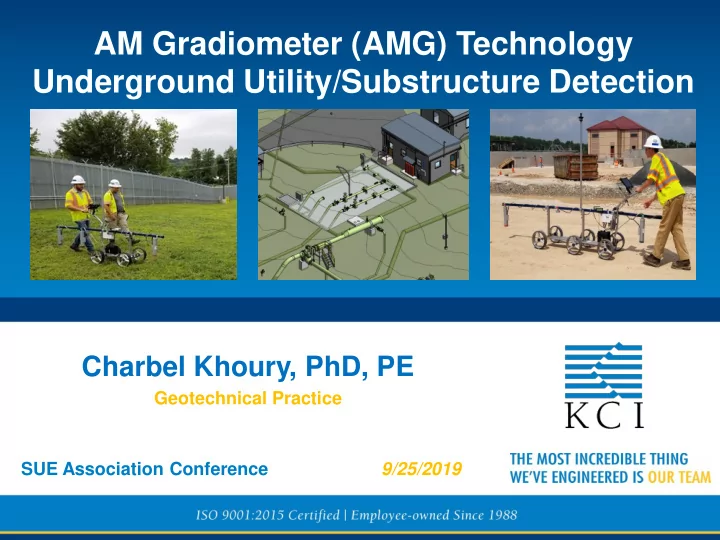
AM Gradiometer (AMG) Technology Underground Utility/Substructure Detection

slide-2
SLIDE 2

AM Gradiometer (AMG) Technology

Table for Operation & Visualization

slide-3
SLIDE 3

AMG Technology - Equipment

Cart System

slide-4
SLIDE 4

AMG Technology Equipment

Portable System

slide-5
SLIDE 5

AMG Technology Equipment

Total Station Setup

slide-6
SLIDE 6

AMG Technology - Transmitter

slide-7
SLIDE 7

Typical Peak Signal/Detection

slide-8
SLIDE 8

AMG Capabilities

In general, AMG can detect the following subsurface items:

  • Electrical conductors (any type)
  • Metal pipes regardless of contents
  • Non-metallic conduits (fluid filled)
  • Liquid or Air-Filled Void-Space
  • Natural gas or fuel lines
  • Brick/concrete sewer lines
  • Shielded fiber optics cable
  • Hydrocarbon or Saline Moisture Plumes
slide-9
SLIDE 9
  • Typical depths-of-detection range up to 30 feet.
  • Some large objects can be detected 30 to 50 feet with Antennas Adjustments

AMG is NOT able to do the following:

  • Identify the specific object detected
  • Evaluate the diameter of the object detected
  • Determine the contents of a pipe or conduit
  • Differentiate between objects stacked in vertical
  • Differentiate between two/multiple closely spaced Utilities; will “see” the bundle of

pipes as a signal complex conductor.

  • Provide accurate depth estimate for closely spaced utilities

AMG Capabilities/Limitations

slide-10
SLIDE 10

Can detect anomalies regardless of their material types (e.g., metallic, non- metallic, concrete)

Cannot penetrate through materials like surface reinforced concrete, moist/wet surfaces or when clay soils are encountered Not limited by built-up surface such as concrete, thin water, granite or subsurface soil with high clay

  • r moisture/water content

Operates passively at a very low frequency (200 KHz to 1 MHz) Operates at higher frequencies between 100 MHz to 2GHZ Typical depths-of-detection up to 10 feet

Typical depths-of-detection up to 30 feet; however, can detect at 30-50 foot depths with antenna configuration adjustments

Typically does not provide GPS locations

  • r depth data, but relies
  • n 3rd party surveying

Rarely detect non- conductive materials (i.e., plastics, ceramics)

Maps and provides detections with GPS coordinates/locations and depths, which are easily and readily available for underground 3D models

slide-11
SLIDE 11

Gospel Music 600KHZ

News/Talk radio: 1090 KHZ

Radio Stations AM Frequency - Transmittals

slide-12
SLIDE 12

Example Projects

  • Regulator Stations
  • Sinkhole @ Howard St. & Pratt St.
  • Gas Gate Station
  • KCI North Ave.
  • Electric Substations (Sinkhole & Utilities)
slide-13
SLIDE 13

Background

Sept 2018 Columbia Gas Incident – Merimack Valley, MA

  • System over-pressure damaged 131 structures
  • One person was killed and at least 21 individuals

taken to the hospital

Structures damaged by the incident Aerial view of damaged home

slide-14
SLIDE 14

Regulator Stations

Example of Typical Plan Drawing – Location 1

Control Lines

slide-15
SLIDE 15

KCI Objectives/Approach

  • Updated 2D drawing in “standard” Client’s format
  • 3D BIM model of utilities and structures
  • Augmented Reality (AR)

KCI Practices Involved 1.Environmental (Project Management) 2.Geotech (AMG Technology, GPR coordination) 3.Utility Design (2D drawings in “standard” format) 4.Survey (Traditional survey & LaserScan) 5.SUE (Traditional mark out) 6.MEP (3D Modeling) 7.Geospatial (AR)

slide-16
SLIDE 16

Pre-Field Work Activities

slide-17
SLIDE 17

Field Work / Data Collection

AMG LiDAR & Traditional Survey GPR SUE

slide-18
SLIDE 18

Regulator Station - 1

slide-19
SLIDE 19

AMG Data Collection Grid Pattern/ Transects – Location 1

slide-20
SLIDE 20

2D Deliverable - Regulator Station 1

slide-21
SLIDE 21

AMG - Regulator Station 1

slide-22
SLIDE 22

GPR Deliverable

GPR Results

slide-23
SLIDE 23

Combining All of the Data – 3D Model

slide-24
SLIDE 24

Test Pits – Regulator Station 1

1 2 3 4 2A 4A 5 6 7

slide-25
SLIDE 25

Comparisons – Location 1

Location ID Description

Client

Plan SUE AMG 1 16” C.I. Main 1.0 1.0 N/A ¹ 2 8” Water Main N/A N/A 0.5 2A 16” C.I. Main 0.5 3.6 0.0 3 1” Control Line 1.5 0.7 0.2 4 1” Control Line 0.7 1.5 0.5 4A 1” Control Line 3.3 2.0 0.5 5 2 x 1” Control Lines 0.5 - 3.0 1.3 – 1.5 0.6 – 0.9 6 2 x 1” Control Lines 0.8 - 1.2 2.5 - 2.8 0.6 – 0.9 7 1” Control Line 2.25 0.8 0.3

Variance (x,y) from surveyed utility as determined by Test Pits (feet)

¹ Outside the area of AMG scanning

slide-26
SLIDE 26

Location 1 – Variance Examples

4

Location ID Description Client Plan SUE AMG

3 1” Control Line 1.5 0.7 0.2 4 1” Control Line 0.7 1.5 0.5 4A 1” Control Line 3.3 2.0 0.5

Final Drawing Client Plan SUE Final Drawing Final Drawing AMG 3 4 4 A 3 4 4 A 3 4 4 A

slide-27
SLIDE 27

KCI Approach – AMG Benefits

Description SUE Mark Out Test Pits GPR AMG Identified known as well as unknown utilities No No Maybe Yes Not limited by site conditions such as moisture, clay, and concrete Yes Yes, but location must be known No Yes Not dependent on tracing wires or conductive materials No Yes, but location must be known Yes, if not limited by site conditions Yes Works on all types of utilities (cast iron, steel, Non-metallic with or without tracer) No Yes, but location must be known Maybe Yes Allows pinpointing of utilities for vacuum excavation No No Yes, if not limited by site conditions Yes

slide-28
SLIDE 28

SINKHOLE @ Howard St. & Pratt. St.

W Pratt St. W Camden St.

  • S. Howard St.

Sinkhole/Void Area

Monday Afternoon July 8, 2019

slide-29
SLIDE 29

SINKHOLE @ Howard St. & Pratt. St.

Monday Evening July 8, 2019

slide-30
SLIDE 30

SINKHOLE @ Howard St. & Pratt. St.

slide-31
SLIDE 31

SINKHOLE @ Howard St. & Pratt. St.

slide-32
SLIDE 32

SINKHOLE @ Howard St. & Pratt. St.

slide-33
SLIDE 33

GPR Scanning

GPR Survey Grid

slide-34
SLIDE 34

GPR Scanning

slide-35
SLIDE 35

GPR Scanning

In the Roadway

No underground or subsurface features were imaged below a depth of about 5 feet

slide-36
SLIDE 36

AMG - Sinkhole Investigation

Tuesday morning July 9, 2019

slide-37
SLIDE 37

AMG Transects

slide-38
SLIDE 38

AMG Findings

Wednesday morning July 10, 2019

slide-39
SLIDE 39

KCI SUE Plans

slide-40
SLIDE 40

CSX Tunnel

slide-41
SLIDE 41

AMG Technology

slide-42
SLIDE 42

AMG Technology & Test Pit

Test Pit

slide-43
SLIDE 43

Test Pit

Test Pit

22”

slide-44
SLIDE 44

Success Points

  • Rapid response to this emergency, and commitment of
  • ur

Team

  • Risk Mitigation: evidence that no significant void concerns are

present along the Howard Street that may impact the roadway

  • r the CSX Tunnel.
  • KCI

findings allowed

  • n-going
  • peration
  • f

emergency construction activities along the roadway

slide-45
SLIDE 45

Augmented Reality 3-D Field Visualization

slide-46
SLIDE 46
slide-47
SLIDE 47