AlzPED Challenge that Needs to be Addressed: Failure of - - PowerPoint PPT Presentation

alzped
SMART_READER_LITE
LIVE PREVIEW

AlzPED Challenge that Needs to be Addressed: Failure of - - PowerPoint PPT Presentation

The Alzheimers Disease Preclinical Efficacy Database Improving the Rigor, Reproducibility and Translatability of Preclinical Research for Alzheimers Disease: AlzPED Challenge that Needs to be Addressed: Failure of Alzheimers


slide-1
SLIDE 1

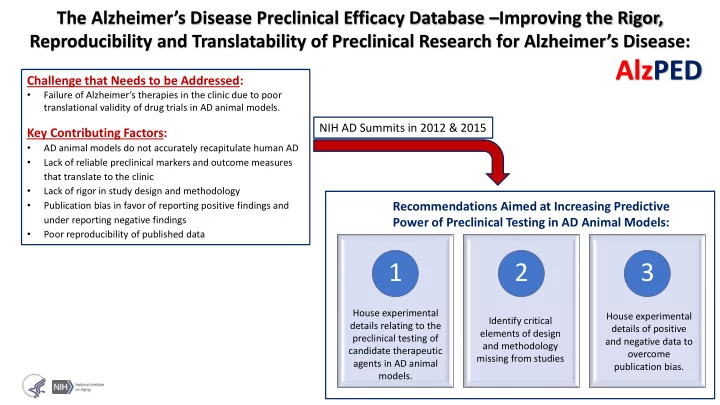
The Alzheimer’s Disease Preclinical Efficacy Database –Improving the Rigor, Reproducibility and Translatability of Preclinical Research for Alzheimer’s Disease:

Challenge that Needs to be Addressed:

  • Failure of Alzheimer’s therapies in the clinic due to poor

translational validity of drug trials in AD animal models.

Key Contributing Factors:

  • AD animal models do not accurately recapitulate human AD
  • Lack of reliable preclinical markers and outcome measures

that translate to the clinic

  • Lack of rigor in study design and methodology
  • Publication bias in favor of reporting positive findings and

under reporting negative findings

  • Poor reproducibility of published data

NIH AD Summits in 2012 & 2015

AlzPED

Recommendations Aimed at Increasing Predictive Power of Preclinical Testing in AD Animal Models:

1 2 3

House experimental details of positive and negative data to

  • vercome

publication bias. House experimental details relating to the preclinical testing of candidate therapeutic agents in AD animal models. Identify critical elements of design and methodology missing from studies

slide-2
SLIDE 2

Responding to the Recommendations: Alzheimer’s Disease Preclinical Efficacy Database

AlzPED: Overview of Scope and Capabilities

  • Provides researchers and information scientists with a facile way to survey

existing AD preclinical therapy development literature and raise awareness about the elements of rigorous study design and requirements for transparent reporting.

  • Currently hosts curated summaries from 917 preclinical efficacy studies

published between 1996 and 2019.

  • Searchable by:
  • Therapy Type (14 types)
  • Therapeutic Agents (804 agents)
  • Therapeutic Targets (167 targets)
  • Animal Model (174 models)
  • Principal Investigator
  • Funding Sources
  • Provides funding agencies with a tool for enforcement of requirements for

transparent reporting and rigorous study design.

  • Provides a platform for creating citable reports/preprints of unpublished

studies, including studies with negative data.

  • Reports on the rigor of each study by summarizing the elements of

experimental design.

  • Related Publications (PubMed)
  • Therapeutic Agents (PubChem/DrugBank)
  • Therapeutic Targets (Open Targets/Pharos)
  • Animal Models (Alzforum)
  • Related Clinical Trials (ClinicalTrials.gov)
  • Related Patents (Google Patents/USTPO)
slide-3
SLIDE 3

Elements of Rigorous Experimental Design and Analysis of Reporting Trends

Report on the rigor of a study curated in AlzPED: Summary of experimental design and methodology.

Reporting trends for the 24 recommended experimental design elements that improve reproducibility and translational value of preclinical studies. Data are presented as percentages calculated from 917 curated preclinical efficacy studies published between 1996 and 2019.

Join AlzPED at Poster No. 4

  • n Wednesday, March 4th from 5:00PM – 7:00PM

Detailed analytics available at: https://alzped.nia.nih.gov/alzped-analytics

slide-4
SLIDE 4

NIA

Shreaya Chakroborty Zane Martin Suzana Petanceska Lorenzo Refolo Ali Sharma Erika Tarver Jean Yuan

AlzPED Team

Contact Information

alzp lzped.nia ia.nih.gov @Alz lzheimers_NIH AlzP lzPED alzp lzped@nih ih.gov

NIH Library

Bridget Burns James King

Sage Bionetworks

Kenneth Daily Mette Peters

Partner Organizations