
SLIDE 1
Almond and the Influenza Pandemic
- J. Parman (College of William & Mary)
Global Economic History, Spring 2017 April 12, 2017 1 / 45
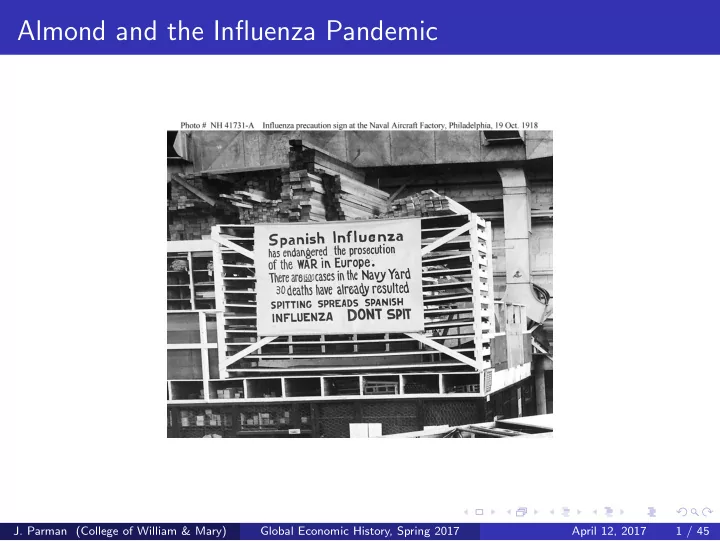
Almond and the Influenza Pandemic J. Parman (College of William - - PowerPoint PPT Presentation
Almond and the Influenza Pandemic J. Parman (College of William & Mary) Global Economic History, Spring 2017 April 12, 2017 1 / 45 Bleakley and Hookworm in the South J. Parman (College of William & Mary) Global Economic History,
Global Economic History, Spring 2017 April 12, 2017 1 / 45
Global Economic History, Spring 2017 April 12, 2017 2 / 45
Global Economic History, Spring 2017 April 12, 2017 3 / 45
FIGURE III Cohort-Specific Relationship Between Income and Pre-Eradication Hookworm These graphics summarize regressions of income proxies on pre-eradication hookworm-infection rates by state of bith. The y axis for each graphic plots the estimated cohort-specific coefficients on the state-level hookworm measure. The x axis is the cohort’s year of birth. Each year-of-birth cohort’s point estimate is marked with a dot. The dashed lines measure the number of years of potential childhood exposure to the Rockefeller Sanitary Commission’s activities. For the undertaking regressions, the dependent variables are constructed from the indi- cated income proxies (the Duncan Socioeconomic Indicator and the Occupational Income Score). For each year-of-birth cohort, OLS regression coefficients are estimated on the cross section of incomes by state of birth. In the basic specifica- tion, this state-of-birth average income is regressed onto hookworm infection, Lebergott’s measure of 1809 wage levels, and regional dummies. The “full con- trols” specification contains in addition the various controls variables described in the Appendix. The regressions are estimated using weight equal to the square root
Global Economic History, Spring 2017 April 12, 2017 4 / 45
FIGURE III Cohort-Specific Relationship Between Income and Pre-Eradication Hookworm These graphics summarize regressions of income proxies on pre-eradication
Global Economic History, Spring 2017 April 12, 2017 5 / 45
Global Economic History, Spring 2017 April 12, 2017 6 / 45
Global Economic History, Spring 2017 April 12, 2017 7 / 45
Global Economic History, Spring 2017 April 12, 2017 8 / 45
Global Economic History, Spring 2017 April 12, 2017 9 / 45
Global Economic History, Spring 2017 April 12, 2017 10 / 45
Figure 4.
Cohort-Specific Relationships: Income and Pre-Campaign Malaria Notes: These graphics summarize regressions of income on measures of malaria prior to
Global Economic History, Spring 2017 April 12, 2017 11 / 45
Global Economic History, Spring 2017 April 12, 2017 12 / 45
1
2
3
Global Economic History, Spring 2017 April 12, 2017 13 / 45
Global Economic History, Spring 2017 April 12, 2017 14 / 45
Global Economic History, Spring 2017 April 12, 2017 15 / 45
Global Economic History, Spring 2017 April 12, 2017 16 / 45
Public Health Improvements and Health Advances 11 Figure 2. Typhoid Fever Trends (Mortality per 100,000) and Sanitary Interventions, 1900-1936 Baltimore Chicago 45
5= Lake Michigan sewer 40
X
A
______
fas c
25
_ _ _
. .. :
35.~~
~~~~~~~~~~~~~~~~
4.
30
_
Filtration 35Chlorininonion 250.3
30
____
25.
20
< 20X
1 R>5 1c 59c ?9c ?9c ?9 c
r
r!,r>!? 35 . . . . 25
09 01._ ........ ..:.t. 9 O t s 9 p ?x 9
Cincinnati Cleveland 90. 120
80s Filtration Chlorination Thes E enddintake tunnel 70.~~~~~~~~~~~~0 70 ke togeheI the dtinTbeSasiniaettflrtonndchlorination wr
60
__ _ _ _ _
50
60
Filtration 40. 30. 40.\J
20. 20
___ _ _
10. Detroit Jersey Cityr 3525 30 Chlorination Filtration 2. Clrnto
25~~~~~~~~~~~~2
20. 15.
15. ie. 10
(continued)
chlorination alone had no detectable effect on mortality. The third row shows coefficient estimates for the interaction between filtration and chlorination. These coefficients are positive for typhoid fever mortality and total mortality, suggesting that filtration and chlo- rination were substitute
Taken together, the data in Table 5 also indicate that filtration and chlorination were jointly important in reducing mortality. Their combined effects are shown in the fifth row from the bottom, and the corresponding F statistic is shown immediately below. On aver- age, filtration and chlorination together reduced typhoid fever mortality by 25%, total
Global Economic History, Spring 2017 April 12, 2017 17 / 45
Global Economic History, Spring 2017 April 12, 2017 18 / 45
Global Economic History, Spring 2017 April 12, 2017 19 / 45
Global Economic History, Spring 2017 April 12, 2017 20 / 45
4.5 5 5.5 6 6.5
L og M M R
1920 1925 1930 1935 1940 1945 1950
Global Economic History, Spring 2017 April 12, 2017 21 / 45
1
L og m o rta lity ra te
1920 1925 1930 1935 1940 1945 1950
Global Economic History, Spring 2017 April 12, 2017 22 / 45
Global Economic History, Spring 2017 April 12, 2017 23 / 45
Global Economic History, Spring 2017 April 12, 2017 24 / 45
Public Health Improvements and Health Advances 19
Table 10. Social Rates of Return Point Estimate 95% CI Low 95% CI High % Mortality Reduction Due to Clean Water 0.1326 0.0373 0.2280 1915 Mortality Reduction per 100,000 Population 208 58 357 1915 Deaths Averted 1,484 418 2,551 1915 Person-Years Saved 57,922 16,301 99,543 1915 Annual Benefits in Millions
679 191 1,167 1915 Annual Costs in Millions
29 Social Rate
23:1 7:1 40:1 Cost per Person-Year Saved in 2003 Dollars 500 1,775 291
reprinted from life tables prepared by the Office of the Chief Actuary in the Social Security Administration.
the period of interest because although taken from late in the period, GDP was of course low during the Great
special.requests/cpi/cpiai.txt; GDP data were obtained from http://www.census.gov/prod/99pubs/99statab/ sec3 1 .pdf and the authors' calculations.
Global Economic History, Spring 2017 April 12, 2017 25 / 45
Global Economic History, Spring 2017 April 12, 2017 26 / 45
Global Economic History, Spring 2017 April 12, 2017 27 / 45
Global Economic History, Spring 2017 April 12, 2017 28 / 45
US - 1870 US - 1880 US - 1890 US - 1900 US - 1910 US - 1920 US - 1930 US - 1940 US - 1950 US - 1990
50 100 150 200 250 Infant mortality rate 20000 40000 60000 80000 GDP per capita (2005 US $)
Global Economic History, Spring 2017 April 12, 2017 29 / 45
US - 1870 US - 1880 US - 1890 US - 1900 US - 1910 US - 1920 US - 1930 US - 1940 US - 1950 US - 1990
50 100 150 200 250 Infant mortality rate 4 6 8 10 12 Log of GDP per capita (2005 US $)
Global Economic History, Spring 2017 April 12, 2017 30 / 45
US - 1870 US - 1880 US - 1890 US - 1900 US - 1910 US - 1920 US - 1930 US - 1940 US - 1950 US - 1990
40 50 60 70 80 Life expectancy 20000 40000 60000 80000 GDP per capita (2005 US $)
Global Economic History, Spring 2017 April 12, 2017 31 / 45
US - 1870 US - 1880 US - 1890 US - 1900 US - 1910 US - 1920 US - 1930 US - 1940 US - 1950 US - 1990
40 50 60 70 80 Life expectancy 4 6 8 10 12 Log of GDP per capita (2005 US $)
Global Economic History, Spring 2017 April 12, 2017 32 / 45
Global Economic History, Spring 2017 April 12, 2017 33 / 45
Global Economic History, Spring 2017 April 12, 2017 34 / 45
Global Economic History, Spring 2017 April 12, 2017 35 / 45
Global Economic History, Spring 2017 April 12, 2017 36 / 45
Global Economic History, Spring 2017 April 12, 2017 37 / 45
Global Economic History, Spring 2017 April 12, 2017 38 / 45
Notes: The data are from the Censuses of Manufactures, 1900-1939. Water refers to power created at the firm level with their own water wheels, steam refers to power created at the firm level in steam engines, and electricity refers to power created either at the firm level and that was converted to electricity, or purchased electricity.
0.1 0.2 0.3 0.4 0.5 0.6 0.7 0.8 0.9 1 1900 1910 1920 1930 1940 fraction of total HP year
electricity steam water combustionengines
Global Economic History, Spring 2017 April 12, 2017 39 / 45
Global Economic History, Spring 2017 April 12, 2017 40 / 45
Global Economic History, Spring 2017 April 12, 2017 41 / 45
http://www.dailymail.co.uk/news/article-2413664/Forget-darning-baking-fixing-car–skills-REALLY-need- 21st-century-setting-satnav-putting-rubbish-right-bin.html
Global Economic History, Spring 2017 April 12, 2017 42 / 45
TABLE I PREDICTIONS OF THE FRAMEWORK Technological change K/Q K/(Ls Lu ) Ls/(Ls Lu) (a) Shift from artisanal or hand trades (H) to factory production (F) >a ?b <c (b) Shift from factory (F) to assembly-line (A) production (Hicks-neutral technical change) < = = (c) Shift from assembly-line (A) to continuous- process (or batch) methods (C) > > >
K capital stock. Ls skilled or more-educated labor. Lu unskilled or less-educated labor.
k /H k ) [(1 F)/(1 H)] · (rH
* /rF *). That is, considering the restrictive case discussed in the text of equal r* for H and F, the prediction is correct only if the higher K*-intensity for the H technology is outweighed by the greater use of K in the creation of K* in the F technology.
(rH * /rF *) [(F/H)] · [(1 H)/(1 F)] · (F
1 /H 1 ).
Global Economic History, Spring 2017 April 12, 2017 43 / 45
Global Economic History, Spring 2017 April 12, 2017 44 / 45
Global Economic History, Spring 2017 April 12, 2017 45 / 45