Childhood Health, Sibling Outcomes and the and the 1918 Influenza - - PowerPoint PPT Presentation

childhood health sibling outcomes and the
SMART_READER_LITE
LIVE PREVIEW

Childhood Health, Sibling Outcomes and the and the 1918 Influenza - - PowerPoint PPT Presentation

Childhood Health, Sibling Outcomes Childhood Health, Sibling Outcomes and the and the 1918 Influenza 1918 Influenza Pandemic Pandemic John Parman John Parman College of William & Mary and NBER College of William & Mary and NBER


slide-1
SLIDE 1

Childhood Health, Sibling Outcomes and the 1918 Influenza Pandemic John Parman College of William & Mary and NBER Introduction Childhood health and adult

  • utcomes

The Pandemic of 1918 Dataset construction Estimation Results Conclusions

Childhood Health, Sibling Outcomes and the 1918 Influenza Pandemic

John Parman College of William & Mary and NBER July 11, 2013

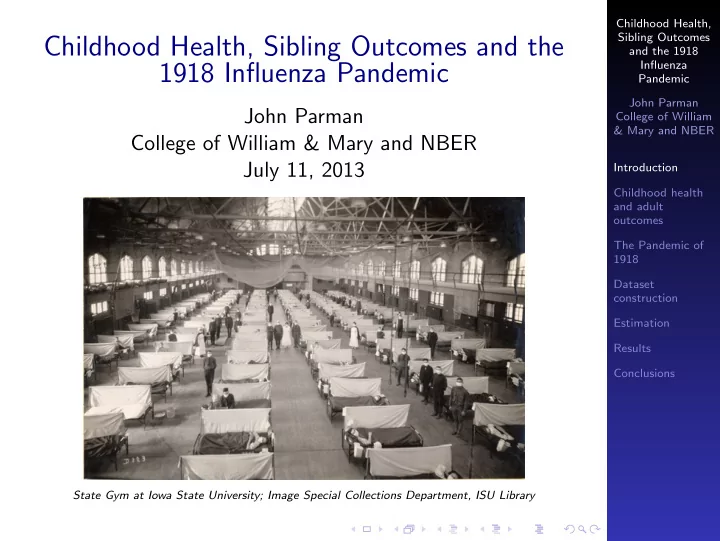
State Gym at Iowa State University; Image Special Collections Department, ISU Library

slide-2
SLIDE 2

Childhood Health, Sibling Outcomes and the 1918 Influenza Pandemic John Parman College of William & Mary and NBER Introduction Childhood health and adult

  • utcomes

The Pandemic of 1918 Dataset construction Estimation Results Conclusions

Motivation

There is an increasing body of evidence that poor health as a child has lasting impacts on educational and labor market outcomes A portion of this relationship is driven by biology, with poor infant and childhood health being correlated with adult health complications However, there is also an economic channel: poor childhood health changes the relative prices faced by parents when investing in children Raises the possibility that even healthy children will have their outcomes affected by unhealthy siblings

slide-3
SLIDE 3

Childhood Health, Sibling Outcomes and the 1918 Influenza Pandemic John Parman College of William & Mary and NBER Introduction Childhood health and adult

  • utcomes

The Pandemic of 1918 Dataset construction Estimation Results Conclusions

Brief overview of paper

I create a new dataset linking adult health and educational attainment to childhood household characteristics I estimate the effects of having a sibling in utero during the pandemic on educational and health outcomes Results suggest that parents shifted resources to older children when a child received a negative health shock The effects are large and suggest health shocks or interventions can dramatically alter the relative

  • utcomes of siblings
slide-4
SLIDE 4

Childhood Health, Sibling Outcomes and the 1918 Influenza Pandemic John Parman College of William & Mary and NBER Introduction Childhood health and adult

  • utcomes

The Pandemic of 1918 Dataset construction Estimation Results Conclusions

Childhood Health and Adult Outcomes

There is a growing body of empirical evidence linking childhood health to adult socioeconomic and health

  • utcomes

One strand of the literature looks at health differences between twins or siblings to control for household fixed effects Another strand focuses on shocks to childhood health that target specific birth cohorts The studies generally find that poor health in early childhood is associated with poor economic and health

  • utcomes as an adult
slide-5
SLIDE 5

Childhood Health, Sibling Outcomes and the 1918 Influenza Pandemic John Parman College of William & Mary and NBER Introduction Childhood health and adult

  • utcomes

The Pandemic of 1918 Dataset construction Estimation Results Conclusions

Childhood Health and Adult Outcomes

Possible mechanisms for the link between childhood health and adult outcomes: Direct effect of poor childhood health on school attendance and productivity Poor health hindering cognitive development In utero health affecting metabolism leading to later chronic health issues Parents altering investment decisions based on children’s health

slide-6
SLIDE 6

Childhood Health, Sibling Outcomes and the 1918 Influenza Pandemic John Parman College of William & Mary and NBER Introduction Childhood health and adult

  • utcomes

The Pandemic of 1918 Dataset construction Estimation Results Conclusions

Childhood Health and Adult Outcomes

Parents altering investment decisions implies sibling

  • utcomes may be affected:

Becker and Tomes framework predicts increased investment in less healthy child if health shock affects endowment but not price of increasing child quality Investment will reinforce sibling inequality if health shock leads to higher price of increasing child quality More recent models (Behrman et al., Ejrnæs & P¨

  • rtner,

Adhvaryu & Nyshadham) incorporate aversion to inequality in outcomes across children

slide-7
SLIDE 7

Childhood Health, Sibling Outcomes and the 1918 Influenza Pandemic John Parman College of William & Mary and NBER Introduction Childhood health and adult

  • utcomes

The Pandemic of 1918 Dataset construction Estimation Results Conclusions

The Influenza Pandemic of 1918

Credit: Office of the Public Health Service Historian (image at www.flu.gov)

slide-8
SLIDE 8

Childhood Health, Sibling Outcomes and the 1918 Influenza Pandemic John Parman College of William & Mary and NBER Introduction Childhood health and adult

  • utcomes

The Pandemic of 1918 Dataset construction Estimation Results Conclusions

The Timing of the Pandemic

slide-9
SLIDE 9

Childhood Health, Sibling Outcomes and the 1918 Influenza Pandemic John Parman College of William & Mary and NBER Introduction Childhood health and adult

  • utcomes

The Pandemic of 1918 Dataset construction Estimation Results Conclusions

The Timing of the Pandemic

45 50 10 15 20 25 30 35 40 Crude death rate 5 10 Jan-18 Feb-18 Mar-18 Apr-18 May-18 Jun-18 Jul-18 Aug-18 Sep-18 Oct-18 Nov-18 Dec-18 Jan-19 Feb-19 Mar-19 Apr-19 May-19 Jun-19 Jul-19 Aug-19 Sep-19 Oct-19 Nov-19 Dec-19 C

Deaths per 1,000 people by month, 1918-1919

slide-10
SLIDE 10

Childhood Health, Sibling Outcomes and the 1918 Influenza Pandemic John Parman College of William & Mary and NBER Introduction Childhood health and adult

  • utcomes

The Pandemic of 1918 Dataset construction Estimation Results Conclusions

The Distribution of Flu Deaths

2500 e 1918 500 1000 1500 2000 Specific death rate 1919-1921 1915-1917 Age Age

Deaths from influenza or pneumonia per 100,000 people by age group

slide-11
SLIDE 11

Childhood Health, Sibling Outcomes and the 1918 Influenza Pandemic John Parman College of William & Mary and NBER Introduction Childhood health and adult

  • utcomes

The Pandemic of 1918 Dataset construction Estimation Results Conclusions

The Distribution of Flu Deaths

0.12 0.13 0.14 0.15 0.16 0.17 0.18 0.19 0.20 1917.5 1918 1918.5 1919 1919.5 1920 1920.5 1921 Quarter of Birth Prevented From Work By a Disability

1980 male disability rate, Figure 7 from Almond (2006)

slide-12
SLIDE 12

Childhood Health, Sibling Outcomes and the 1918 Influenza Pandemic John Parman College of William & Mary and NBER Introduction Childhood health and adult

  • utcomes

The Pandemic of 1918 Dataset construction Estimation Results Conclusions

Placing the Pandemic in Context

ALB DZA ARM AZE BHR BGD BRB BLR BEL BLZ BTN BOL BWA BRA BGR KHM CPV CAF TCD CHL COL HRV CYP DJI DMA DOM SLV ERI EST FJI FIN GEO GHA GRC GRD GTM HUN ISL IDN IRQ IRL ISR ITA JAM JOR KAZ KEN KWT LVA LBN LSO LTU MYS MDV MLT MRT MUS MEX MDA MNG MAR NAM NZL NIC OMN PAK PAN PRY PER PHL POL PRT ROM WSM SAU SEN SRB SYC SVN SLB ESP SUR SWZ TJK THA TON TTO TUN TUR UKR GBR USA URY UZB VUT VNM 1880 1890 1900 1910 1920 1930 1940 1950 1960 1970 1980 1990 2000

10000 20000 30000 40000 50000 GDP per capita (2010 US $) 1 2 3 4 5 Total fertility rate Modern cross-country data US historical data

GDP per capita and total fertility rate by country for 2010 and by decade for the US

slide-13
SLIDE 13

Childhood Health, Sibling Outcomes and the 1918 Influenza Pandemic John Parman College of William & Mary and NBER Introduction Childhood health and adult

  • utcomes

The Pandemic of 1918 Dataset construction Estimation Results Conclusions

Placing the Pandemic in Context

ALB DZA ARM AZE BHR BGD BRB BLR BEL BLZ BTN BOL BWA BRA BGR BFA BDI KHM CPV CAF TCD CHL COL HRV CUB CYP DNK DJI DOM SLV GNQ ERI EST ETH FJI FIN GEO GHA GRC GRD GTM GIN HUN IDN IRQ IRL JAM JOR KAZ KWT LVA LBN LSO LTU LUX MWI MYS MDV MLI MLT MRT MUS MEX MDA MNG MAR MOZ NAM NLD NIC NER OMN PAK PAN PRY PER PHL POL PRT QAT ROM WSM SEN SRB SVN SLB SUR TJK THA TON TTOTUR UKR ARE GBR USA URY UZB VUT VNM 1890 1900 1910 1920 1930 1940 1950 1960 1970 1980 1990 2000

50 100 150 Infant mortality rate 40 50 60 70 80 Life expectancy Modern cross-country data US historical data

Infant mortality rates and life expectancy by country for 2010 and by decade for the US

slide-14
SLIDE 14

Childhood Health, Sibling Outcomes and the 1918 Influenza Pandemic John Parman College of William & Mary and NBER Introduction Childhood health and adult

  • utcomes

The Pandemic of 1918 Dataset construction Estimation Results Conclusions

Placing the Pandemic in Context

ALB DZA ARM AZE BHR BLR BOL BWA BRA BGR KHM CHL COL HRV CUB CYP DOM SLV GNQ EST GEO GRC GTM IDN IRQ ITA JAM JOR KAZ KEN KWT LVA LSO LTU MWI MYS MDV MLT MUS MEX MNG NAM NIC OMN PAN PER PHL QAT ROM STP SAU SRB SYC ESP SUR SWZ TJK THA TON TUN UKR URY VUT VNM 1870 1880 1890 1900 1910 1920 1930 1940 1950 1960 1970 1980

75 80 85 90 95 100 Literacy rate 60 70 80 90 100 Enrollment rate Modern cross-country data US historical data

Literacy rates and enrollment rates by country for 2010 and by decade for the US

slide-15
SLIDE 15

Childhood Health, Sibling Outcomes and the 1918 Influenza Pandemic John Parman College of William & Mary and NBER Introduction Childhood health and adult

  • utcomes

The Pandemic of 1918 Dataset construction Estimation Results Conclusions

The Influenza Pandemic of 1918 as a Natural Experiment

It arrived rapidly and unexpectedly, families weren’t making decisions in anticipation of the pandemic It was a massive health shock striking a quarter of the population and killing over 600,000 Americans but was short lived The flu had particularly severe effects for pregnant women that led to poor health outcomes for children in utero during the pandemic US fertility, health and education measures at the time

  • f the pandemic are comparable to those of modern

developing countries

slide-16
SLIDE 16

Childhood Health, Sibling Outcomes and the 1918 Influenza Pandemic John Parman College of William & Mary and NBER Introduction Childhood health and adult

  • utcomes

The Pandemic of 1918 Dataset construction Estimation Results Conclusions

Potential Data Sources

The basic idea is to look at how adult outcomes depend

  • n having a sibling affected by the influenza pandemic

This requires person-level data with adult outcomes (ideally income, occupation, education, health) that also have info on siblings Almond uses modern 1960/1970/1980 census data, Almond & Mazumder use SIPP data but these lack sibling info Historical census data allows for observing siblings but not adult outcomes Solution: combine childhood information from historical censuses with adult outcome data from military records

slide-17
SLIDE 17

Childhood Health, Sibling Outcomes and the 1918 Influenza Pandemic John Parman College of William & Mary and NBER Introduction Childhood health and adult

  • utcomes

The Pandemic of 1918 Dataset construction Estimation Results Conclusions

Constructing the Dataset

Individuals are sampled from World War II enlistment records These individuals are then matched to the 1930 federal census on the basis of name, birth year, and birth state If a match is found in the 1930 federal census, information on the individual’s siblings and parents is recorded Resulting variables for successfully linked individuals include:

Enlistment records: height, weight, educational attainment, civilian occupation,... Census records: siblings ages and genders, parents’

  • ccupations, house value, household location,...
slide-18
SLIDE 18

Childhood Health, Sibling Outcomes and the 1918 Influenza Pandemic John Parman College of William & Mary and NBER Introduction Childhood health and adult

  • utcomes

The Pandemic of 1918 Dataset construction Estimation Results Conclusions

Matching Enlistees to the Census

Field Title Value Meaning ARMY SERIAL NUMBER 35548336 35548336 NAME PARMAN#ROBERT#F## PARMAN#ROBERT#F## RESIDENCE: STATE 53 OHIO RESIDENCE: COUNTY 123 OTTAWA PLACE OF ENLISTMENT 5384 TOLEDO OHIO DATE OF ENLISTMENT DAY 23 23 DATE OF ENLISTMENT MONTH 2 2 DATE OF ENLISTMENT YEAR 43 43 GRADE: ALPHA DESIGNATION PVT# Private GRADE: CODE 8 Private BRANCH: ALPHA DESIGNATION BI# Branch Immaterial - Warrant Officers, USA BRANCH: CODE Branch Immaterial - Warrant Officers, USA FIELD USE AS DESIRED # # TERM OF ENLISTMENT 5 Enlistment for the duration of the War or other emergency, plus six months, subject to the discretion of the President or otherwise according to law LONGEVITY ### ### SOURCE OF ARMY PERSONNEL Civil Life NATIVITY 53 OHIO YEAR OF BIRTH 24 24 RACE AND CITIZENSHIP 1 White, citizen EDUCATION 4 4 years of high school CIVILIAN OCCUPATION 677 Semiskilled filers, grinders, buffers, and polishers (metal) MARITAL STATUS 6 Single, without dependents COMPONENT OF THE ARMY 7 Selectees (Enlisted Men) CARD NUMBER # # BOX NUMBER 957 957 FILM REEL NUMBER 5.19# 5.19#

slide-19
SLIDE 19

Childhood Health, Sibling Outcomes and the 1918 Influenza Pandemic John Parman College of William & Mary and NBER Introduction Childhood health and adult

  • utcomes

The Pandemic of 1918 Dataset construction Estimation Results Conclusions

Matching Enlistees to the Census

slide-20
SLIDE 20

Childhood Health, Sibling Outcomes and the 1918 Influenza Pandemic John Parman College of William & Mary and NBER Introduction Childhood health and adult

  • utcomes

The Pandemic of 1918 Dataset construction Estimation Results Conclusions

Obtaining Information for Matched Enlistees

slide-21
SLIDE 21

Childhood Health, Sibling Outcomes and the 1918 Influenza Pandemic John Parman College of William & Mary and NBER Introduction Childhood health and adult

  • utcomes

The Pandemic of 1918 Dataset construction Estimation Results Conclusions

The Resulting Sample

Matched to federal census Not matched to federal census Number of individuals 13, 173 14,139 Year of birth 1918.8 1918.7 (3.2) (3.2) Year of enlistment 1941.8 1941.8 (0.8) (0.9) Height 68.4 68.3 (2.7) (2.8) Weight 150.2 149.9 (21.3) (21.7) Body mass index 22.5 22.5 (2.9) (3.0) 3.0 2.8 (2.2) (2.3) Percentage who are white 94.4% 90.1% Percentage who migrated to a different state 13.5% 25.0% Percentage who are sons of the household head 90.1%

  • Years of secondary and post-

secondary schooling Summary statistics by census match status

slide-22
SLIDE 22

Childhood Health, Sibling Outcomes and the 1918 Influenza Pandemic John Parman College of William & Mary and NBER Introduction Childhood health and adult

  • utcomes

The Pandemic of 1918 Dataset construction Estimation Results Conclusions

The Resulting Sample

.1 .2 .3 5 10 5 10

Not matched to census Matched to census Percentage of individuals Years of secondary and post-secondary education

slide-23
SLIDE 23

Childhood Health, Sibling Outcomes and the 1918 Influenza Pandemic John Parman College of William & Mary and NBER Introduction Childhood health and adult

  • utcomes

The Pandemic of 1918 Dataset construction Estimation Results Conclusions

Estimation Strategy

Given the adult outcomes from the enlistment records and the childhood household data from the census, estimation of the effect of the pandemic is fairly straightforward: Yi,j = f (Xi, Zj, Fluj, εi,j) Yi,j: adult outcome of interest (educational attainment, height, weight, BMI) Xi: individual characteristics (age, race, birth order, birth order among brothers, state of birth) Zj: household characteristics (family size, parents’ income, spacing and gender of siblings, house value, state of residence) Fluj: indicator for sibling in utero during influenza pandemic

slide-24
SLIDE 24

Childhood Health, Sibling Outcomes and the 1918 Influenza Pandemic John Parman College of William & Mary and NBER Introduction Childhood health and adult

  • utcomes

The Pandemic of 1918 Dataset construction Estimation Results Conclusions

Estimation Strategy

The functional form will depend on the outcome of interest: Yi,j = f (Xi, Zj, Fluj, εi,j) Tobit model for years of education (over 20 percent of enlistees have zero years of secondary schooling) Logit models for binary education variables (attended HS, graduated HS) Linear models for health outcomes (height, weight, BMI)

slide-25
SLIDE 25

Childhood Health, Sibling Outcomes and the 1918 Influenza Pandemic John Parman College of William & Mary and NBER Introduction Childhood health and adult

  • utcomes

The Pandemic of 1918 Dataset construction Estimation Results Conclusions

Identifying Treated Siblings

The estimation strategy is based on identifying siblings in utero during the pandemic The severe months of the pandemic were October, November and December of 1918 The birth cohorts in utero during the pandemic were therefore born in late 1918 and the first half of 1919 Complicating things is the way age is reported in the federal census From the enumerator instructions: [Age at last birthday] calls for the age in completed years at last birthday. Remember, however, that the age question, like all other questions on the schedule, relates to April 1, 1930.

slide-26
SLIDE 26

Childhood Health, Sibling Outcomes and the 1918 Influenza Pandemic John Parman College of William & Mary and NBER Introduction Childhood health and adult

  • utcomes

The Pandemic of 1918 Dataset construction Estimation Results Conclusions

Identifying Treated Siblings

1 2 3 Months of in utero exposure August, 1918 September, 1918 October, 1918 November, 1918 December, 1918 January, 1919 February, 1919 March, 1919 April, 1919 May, 1919 June, 1919 July, 1919 August, 1919 September, 1919 October, 1919

Month of birth

First trimester Second trimester Third trimester

slide-27
SLIDE 27

Childhood Health, Sibling Outcomes and the 1918 Influenza Pandemic John Parman College of William & Mary and NBER Introduction Childhood health and adult

  • utcomes

The Pandemic of 1918 Dataset construction Estimation Results Conclusions

Identifying Treated Siblings

1 2 3 Months of in utero exposure A u g u s t , 1 9 1 8 S e p t e m b e r , 1 9 1 8 O c t

  • b

e r , 1 9 1 8 N

  • v

e m b e r , 1 9 1 8 D e c e m b e r , 1 9 1 8 J a n u a r y , 1 9 1 9 F e b r u a r y , 1 9 1 9 M a r c h , 1 9 1 9 A p r i l , 1 9 1 9 M a y , 1 9 1 9 J u n e , 1 9 1 9 J u l y , 1 9 1 9 A u g u s t , 1 9 1 9 S e p t e m b e r , 1 9 1 9 O c t

  • b

e r , 1 9 1 9

slide-28
SLIDE 28

Childhood Health, Sibling Outcomes and the 1918 Influenza Pandemic John Parman College of William & Mary and NBER Introduction Childhood health and adult

  • utcomes

The Pandemic of 1918 Dataset construction Estimation Results Conclusions

Summary Statistics for Regression Sample

Variable Mean Standard deviation Number of people in household 6.4 2.3 Number of siblings 3.0 2.2 Number of brothers 1.6 1.5 Number of older siblings 1.5 1.6 Number of older brothers 0.8 1.1 Percentage with an older sibling born in 1919 Percentage with a younger sibling born in 1919 Percentage with an older brother born in 1919 Percentage with a younger brother born in 1919 8.2% 6.9% 4.1% 3.4% Family characteristics of enlistees in regression sample

slide-29
SLIDE 29

Childhood Health, Sibling Outcomes and the 1918 Influenza Pandemic John Parman College of William & Mary and NBER Introduction Childhood health and adult

  • utcomes

The Pandemic of 1918 Dataset construction Estimation Results Conclusions

Outcomes of the Influenza Birth Cohort

Outcome 1960 Census 1970 Census 1980 Census High school graduate

  • 0.021***
  • 0.020***
  • 0.014***
  • 0.028***

(0.005) (0.003) (0.003) (0.001) Years of education

  • 0.150***
  • 0.176***
  • 0.117***
  • 0.132***

(0.038) (0.023) (0.019) (0.002) Never attended high school

  • 0.017***
  • (0.001)

Height

  • 0.035***
  • (0.007)

Weight

  • 0.371***
  • (0.040)

Body Mass Index

  • 0.034***
  • (0.006)

Observations 114,031 308,785 471,803 2,744,642 Departure of 1919 male birth cohort outcomes from 1912-22 trend Results from Almond (2006) Results using enlistee records

Results are the coefficient on an indicator for being in the influenza cohort included a linear regression controlling for birth year and birth year squared. Robust standard errors are given in parentheses. * significant at 10%, ** significant at 5%, *** significant at 1%
slide-30
SLIDE 30

Childhood Health, Sibling Outcomes and the 1918 Influenza Pandemic John Parman College of William & Mary and NBER Introduction Childhood health and adult

  • utcomes

The Pandemic of 1918 Dataset construction Estimation Results Conclusions

Effects of Sibling Health on Educational Attainment

Sibling measure: Includes individuals born in 1919: no yes no yes Has older sibling born in 1919 (1=yes)

  • 0.038
  • 0.072
  • 0.145
  • 0.167

(0.116) (0.117) (0.153) (0.148) Has younger sibling born in 1919 (1=yes) 0.267** 0.244** 0.244* 0.227* (0.113) (0.109) (0.142) (0.134) Number of older siblings

  • 0.172***
  • 0.169***
  • 0.196***
  • 0.196***

(0.021) (0.019) (0.031) (0.029) Number of younger siblings

  • 0.359***
  • 0.352***
  • 0.426***
  • 0.422***

(0.020) (0.017) (0.034) (0.030) Household head's log income 1.665*** 1.627*** 1.756*** 1.719*** (0.117) (0.111) (0.119) (0.113) Observations 8,743 9,865 8,743 9,865 Tobit regression results, years of secondary and post-secondary education as dependent variable Robust standard errors clustered by birth state in parentheses. Regressions include controls for race, state fixed effects, presence of the father and a cubic in age. * significant at 10%; ** significant at 5%; *** significant at 1% All siblings Brothers only

slide-31
SLIDE 31

Childhood Health, Sibling Outcomes and the 1918 Influenza Pandemic John Parman College of William & Mary and NBER Introduction Childhood health and adult

  • utcomes

The Pandemic of 1918 Dataset construction Estimation Results Conclusions

Effects of Sibling Health on Educational Attainment

Dependent variable: Includes individuals born in 1919: no yes no yes Has older sibling born in 1919 (1=yes)

  • 0.026
  • 0.053
  • 0.122
  • 0.148

(0.100) (0.102) (0.105) (0.105) Has younger sibling born in 1919 (1=yes) 0.355*** 0.333*** 0.233*** 0.223*** (0.104) (0.101) (0.085) (0.084) Number of older siblings

  • 0.124***
  • 0.123***
  • 0.131***
  • 0.123***

(0.018) (0.017) (0.021) (0.018) Number of younger siblings

  • 0.240***
  • 0.234***
  • 0.265***
  • 0.263***

(0.016) (0.015) (0.019) (0.017) Household head's log income 1.393*** 1.372*** 1.007*** 0.990*** (0.079) (0.078) (0.086) (0.082) Observations 8,743 9,865 8,743 9,865 Logit regression results, high school attendance or graduation as dependent variable Attended high school Graduated high school Robust standard errors clustered by birth state in parentheses. Regressions include controls for race, state fixed effects, presence of the father and a cubic in age. * significant at 10%; ** significant at 5%; *** significant at 1%

slide-32
SLIDE 32

Childhood Health, Sibling Outcomes and the 1918 Influenza Pandemic John Parman College of William & Mary and NBER Introduction Childhood health and adult

  • utcomes

The Pandemic of 1918 Dataset construction Estimation Results Conclusions

Effects of Sibling Health on Educational Attainment

Dependent variable: Attended high school Graduated high school Mean of dependent variable: 0.792 0.524 Has older sibling born in 1919

  • 0.005
  • 0.030

(0.018) (0.026) Has younger sibling born in 1919 0.056 0.058 (0.015) (0.021) Number of older siblings

  • 0.021
  • 0.032

(0.003) (0.005) Number of younger siblings

  • 0.042
  • 0.065

(0.003) (0.005) Household head's log income 0.241 0.249 (0.013) (0.021) Marginal effects (dP(y=1)/dx) of siblings on educational outcomes based on logit regressions

slide-33
SLIDE 33

Childhood Health, Sibling Outcomes and the 1918 Influenza Pandemic John Parman College of William & Mary and NBER Introduction Childhood health and adult

  • utcomes

The Pandemic of 1918 Dataset construction Estimation Results Conclusions

Effects of Sibling Health on Educational Attainment

Dependent variable: Height Weight Body mass index Includes individuals born in 1919: no no no Has older sibling born in 1919 (1=yes) 0.055 0.497 0.068 (0.110) (0.568) (0.096) Has younger sibling born in 1919 (1=yes) 0.081 0.182

  • 0.026

(0.089) (0.613) (0.093) Number of older siblings

  • 0.073***
  • 0.473***
  • 0.021

(0.028) (0.138) (0.017) Number of younger siblings

  • 0.129***
  • 0.756***
  • 0.019

(0.025) (0.103) (0.018) Household head's log income 0.192* 0.983 0.021 (0.103) (0.832) (0.113) Observations 8,743 8,624 8,624 OLS estimates of sibling health on own adult health outcomes Robust standard errors clustered by birth state in parentheses. Regressions include controls for race, state fixed effects, presence of the father and a cubic in age. * significant at 10%; ** significant at 5%; *** significant at 1%

slide-34
SLIDE 34

Childhood Health, Sibling Outcomes and the 1918 Influenza Pandemic John Parman College of William & Mary and NBER Introduction Childhood health and adult

  • utcomes

The Pandemic of 1918 Dataset construction Estimation Results Conclusions

Falsification Tests

The results suggest strong effects of having a younger sibling born during the pandemic However, there is the possiblity that this sibling variable is a proxy for something else related to family structure and the enlistee’s birth year Two approaches will help alleviate concerns:

Rerun everything with the inclusion of birth cohort dummies to more flexibly control for cohort trends Rerun analysis using placebo influenza cohorts by assuming influenza pandemic was earlier or later

slide-35
SLIDE 35

Childhood Health, Sibling Outcomes and the 1918 Influenza Pandemic John Parman College of William & Mary and NBER Introduction Childhood health and adult

  • utcomes

The Pandemic of 1918 Dataset construction Estimation Results Conclusions

Falsification Tests

Influenza birth year defined as: 1919 1917 1921 Includes individuals born in flu cohort: no no no Has older sibling born in flu cohort (1=yes)

  • 0.038

0.001

  • 0.139

(0.116) (0.102) (0.174) Has younger sibling born in flu cohort (1=yes) 0.267**

  • 0.061
  • 0.035

(0.113) (0.156) (0.087) Number of older siblings

  • 0.172***
  • 0.173***
  • 0.171***

(0.021) (0.017) (0.020) Number of younger siblings

  • 0.359***
  • 0.345***
  • 0.344***

(0.020) (0.021) (0.018) Household head's log income 1.665*** 1.617*** 1.626*** (0.117) (0.116) (0.111) Robust standard errors clustered by birth state in parentheses. Regressions include controls for race, state fixed effects, presence of father and a cubic in age. * significant at 10%; ** significant at 5%; *** significant at 1% Tobit sibling coefficients for placebo influenza cohorts

slide-36
SLIDE 36

Childhood Health, Sibling Outcomes and the 1918 Influenza Pandemic John Parman College of William & Mary and NBER Introduction Childhood health and adult

  • utcomes

The Pandemic of 1918 Dataset construction Estimation Results Conclusions

Falsification Tests

Influenza birth year defined as: 1919 1917 1921 Includes individuals born in flu cohort: no no no Has older sibling born in flu cohort (1=yes)

  • 0.026

0.008

  • 0.224

(0.100) (0.093) (0.170) Has younger sibling born in flu cohort (1=yes) 0.355***

  • 0.022
  • 0.043

(0.104) (0.119) (0.078) Number of older siblings

  • 0.124***
  • 0.127***
  • 0.120***

(0.018) (0.016) (0.019) Number of younger siblings

  • 0.240***
  • 0.223***
  • 0.216***

(0.016) (0.016) (0.014) Household head's log income 1.393*** 1.380*** 1.344*** (0.079) (0.083) (0.088) Logit sibling coefficients for placebo influenza cohorts (attended high school as dependent variable) Robust standard errors clustered by birth state in parentheses. Regressions include controls for race, state fixed effects, presence of father and a cubic in age. * significant at 10%; ** significant at 5%; *** significant at 1%

slide-37
SLIDE 37

Childhood Health, Sibling Outcomes and the 1918 Influenza Pandemic John Parman College of William & Mary and NBER Introduction Childhood health and adult

  • utcomes

The Pandemic of 1918 Dataset construction Estimation Results Conclusions

Falsification Tests

Influenza birth year defined as: 1919 1917 1921 Includes individuals born in flu cohort: no no no Has older sibling born in flu cohort (1=yes)

  • 0.122
  • 0.030
  • 0.161

(0.105) (0.084) (0.114) Has younger sibling born in flu cohort (1=yes) 0.233***

  • 0.106
  • 0.041

(0.085) (0.096) (0.062) Number of older siblings

  • 0.131***
  • 0.128***
  • 0.116***

(0.021) (0.016) (0.017) Number of younger siblings

  • 0.265***
  • 0.258***
  • 0.252***

(0.019) (0.017) (0.017) Household head's log income 1.007*** 0.978*** 0.979*** (0.086) (0.087) (0.081) Logit sibling coefficients for placebo influenza cohorts (graduated high school as dependent variable) Robust standard errors clustered by birth state in parentheses. Regressions include controls for race, state fixed effects, presence of father and a cubic in age. * significant at 10%; ** significant at 5%; *** significant at 1%

slide-38
SLIDE 38

Childhood Health, Sibling Outcomes and the 1918 Influenza Pandemic John Parman College of William & Mary and NBER Introduction Childhood health and adult

  • utcomes

The Pandemic of 1918 Dataset construction Estimation Results Conclusions

Conclusions, Future Work

The sibling data reveal significant reallocation of resources within families with a major health shock Results also suggest that effects on older siblings are quite different than effects on subsequent siblings These impacts are big: the gain in education from having a sick sibling is similar in magnitude to the gain associated with a 20 percent increase in parental income Several future directions for the work:

Household resource allocation models that can account for observed patterns Implications for intergenerational mobility Make use of the 1940 federal census (income,

  • ccupations, educational attainment for all siblings;

ability to include females in regressions)