Allocator Basics Pages too coarse-grained for allocating individual - - PowerPoint PPT Presentation

allocator basics
SMART_READER_LITE
LIVE PREVIEW

Allocator Basics Pages too coarse-grained for allocating individual - - PowerPoint PPT Presentation

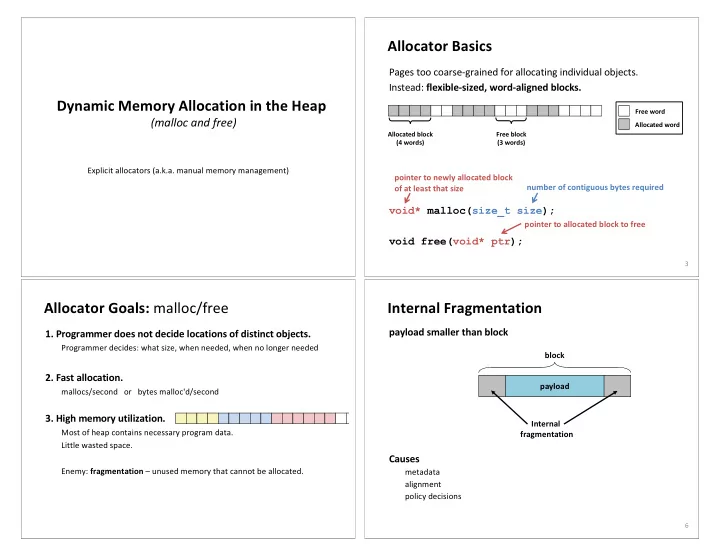
Allocator Basics Pages too coarse-grained for allocating individual objects. Instead: flexible-sized, word-aligned blocks. Dynamic Memory Allocation in the Heap Free word (malloc and free) Allocated word Allocated block Free block (4 words)


slide-1
SLIDE 1

Dynamic Memory Allocation in the Heap

(malloc and free)

Explicit allocators (a.k.a. manual memory management)

Allocator Basics

Pages too coarse-grained for allocating individual objects. Instead: flexible-sized, word-aligned blocks. void* malloc(size_t size); void free(void* ptr);

3

number of contiguous bytes required pointer to newly allocated block

  • f at least that size

pointer to allocated block to free

Allocated block (4 words) Free block (3 words) Free word Allocated word

Allocator Goals: malloc/free

  • 1. Programmer does not decide locations of distinct objects.

Programmer decides: what size, when needed, when no longer needed

  • 2. Fast allocation.

mallocs/second or bytes malloc'd/second

  • 3. High memory utilization.

Most of heap contains necessary program data. Little wasted space. Enemy: fragmentation – unused memory that cannot be allocated.

Internal Fragmentation

payload smaller than block Causes

metadata alignment policy decisions

6

payload block Internal fragmentation

slide-2
SLIDE 2

External Fragmentation (64-bit words)

Total free space large enough, but no contiguous free block large enough Depends on the pattern of future requests.

7

p1 = malloc(32); p2 = malloc(40); p3 = malloc(48); free(p2); p4 = malloc(48);

Implementation Issues

  • 1. Determine how much to free given just a pointer.
  • 2. Keep track of free blocks.
  • 3. Pick a block to allocate.
  • 4. Choose what do with extra space when allocating a structure

that is smaller than the free block used.

  • 5. Make a freed block available for future reuse.

8

Knowing How Much to Free

Keep length of block in header word preceding block

9

free(p0); p0 = malloc(32); p0 block size metadata data payload 48 Takes extra space!

Keeping Track of Free Blocks

Method 1: Implicit list of all blocks using length Method 2: Explicit list of free blocks using pointers

Method 3: Seglist

Different free lists for different size blocks

More methods that we will skip…

10 40 32 16 48 40 32 16 48

slide-3
SLIDE 3

Implicit Free List: Block Format

11

block size 1 word

payload

(application data, when allocated) a

  • ptional padding

16-byte aligned sizes have 4 zeroes in low-order bits 00000000 00010000 00100000 00110000 … Steal LSB for status flag. LSB = 1: allocated LSB = 0: free

Block metadata:

  • 1. Block size
  • 2. Allocation status

Store in one header word.

Implicit Free List: Heap Layout

12 16|0 32|1 64|0 32|1 0|1 Free word Allocated word Allocated word wasted

Start of heap Payloads start at 16-byte (2-word) alignment. Blocks sizes are multiples of 16 bytes. Block Header (metadata) block size | block allocated? Special end-heap word Looks like header of zero-size allocate block. Initial word can't be part of block. May force internal fragmentation.

Implicit Free List: Finding a Free Block

First fit:

Search list from beginning, choose first free block that fits

Next fit:

Do first-fit starting where previous search finished

Best fit:

Search the list, choose the best free block: fits, with fewest bytes left over

13 16

Implicit Free List: Allocating a Free Block

14 16 16 48 16 16 32

p = malloc(24);

p

Now showing allocation status flag implicitly with shading.

Block Splitting

Allocated space ≤ free space. Use it all? Split it up?

slide-4
SLIDE 4

Implicit Free List: Freeing a Block

15 16 16 32 16 p

malloc(40);

16 16 32 16

External fragmentation!

Enough space, not one block.

Clear allocated flag.

free(p);

Coalescing Free Blocks

16 32 16 32 16

free(p)

32 16 48 16

logically gone

p

Coalesce with following free block.

Coalesce with preceding free block?

Bidirectional Coalescing: Boundary Tags

17

Boundary tag (footer) 32 32 32 32 48 32 48 32 Header

block size

payload

(application data, when allocated) a

  • ptional padding

block size a [Knuth73]

Constant-Time Coalescing: 4 cases

19 m1 1 m1 1 n 1

Freed Block

n 1 m2 1 m2 1 m1 1 m1 1 n n m2 1 m2 1 m1 1 m1 1 n+m2 n+m2 m1 1 m1 1 n 1

Freed Block

n 1 m2 m2 m1 m1 n 1

Freed Block

n 1 m2 1 m2 1 n+m1 n+m1 m2 1 m2 1 m1 m1 n 1

Freed Block

n 1 m2 m2 n+m1+m2 n+m1+m2

slide-5
SLIDE 5

Summary: Implicit Free Lists

Implementation: simple Allocate: O(blocks in heap) Free: O(1) Memory utilization: depends on placement policy Not widely used in practice

some special purpose applications

Splitting, boundary tags, coalescing are general to all allocators.

20

Explicit Free Lists

Explicit list of free blocks rather than implicit list of all blocks.

21

Free block: Allocated block:

(same as implicit free list) block size

payload

(application data, when allocated) a

  • ptional padding

block size a block size a next pointer prev pointer block size a

Explicit Free Lists: List vs. Memory Order

Abstractly: doubly-linked lists Concretely: free list blocks in any memory order

22

A

B

C

32 32 32 32 48 48 32 32 32 32

Next Previous

A

B

C

Previous Next

List Order ≠ Memory Order

Explicit Free Lists: Allocating a Free Block

23

Before After = malloc(…) (with splitting)

slide-6
SLIDE 6

Explicit Free Lists: Freeing a Block

Insertion policy: Where in the free list do you add a freed block?

LIFO (last-in-first-out) policy Pro: simple and constant time Con: studies suggest fragmentation is worse than address ordered Address-ordered policy Con: linear-time search to insert freed blocks Pro: studies suggest fragmentation is lower than LIFO

LIFO Example: 4 cases of freed block neighbor status.

25

Freeing with LIFO Policy: between allocated blocks

Insert the freed block at head of free list.

26

free( ) Head Head Before After

Summary: Explicit Free Lists

Implementation: fairly simple Allocate: O(free blocks)

  • vs. O(all blocks)

Free: O(1)

  • vs. O(1)

Memory utilization:

depends on placement policy larger minimum block size (next/prev) vs. implicit list

Used widely in practice, often with more optimizations. Splitting, boundary tags, coalescing are general to all allocators.

36

Summary: Allocator Policies

All policies offer trade-offs in fragmentation and throughput. Placement policy:

First-fit, next-fit, best-fit, etc. Seglists approximate best-fit in low time

Splitting policy:

Always? Sometimes? Size bound?

Coalescing policy:

Immediate vs. deferred

41