ALLIED LAWS STUDY CIRCLE MEETING Topic- An Overview of Fugitive - - PowerPoint PPT Presentation

allied laws study circle
SMART_READER_LITE
LIVE PREVIEW

ALLIED LAWS STUDY CIRCLE MEETING Topic- An Overview of Fugitive - - PowerPoint PPT Presentation

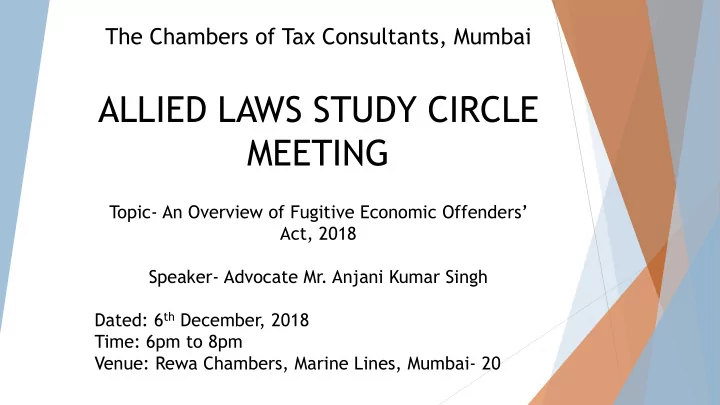
The Chambers of Tax Consultants, Mumbai ALLIED LAWS STUDY CIRCLE MEETING Topic- An Overview of Fugitive Economic Offenders Act, 2018 Speaker- Advocate Mr. Anjani Kumar Singh Dated: 6 th December, 2018 Time: 6pm to 8pm Venue: Rewa Chambers,


slide-1
SLIDE 1

ALLIED LAWS STUDY CIRCLE MEETING

The Chambers of Tax Consultants, Mumbai

Topic- An Overview of Fugitive Economic Offenders’ Act, 2018 Speaker- Advocate Mr. Anjani Kumar Singh Dated: 6th December, 2018 Time: 6pm to 8pm Venue: Rewa Chambers, Marine Lines, Mumbai- 20

slide-2
SLIDE 2

AN OVERVIEW OF FUGITIVE ECONOMIC OFFENDERS ACT , 2018

slide-3
SLIDE 3

Status, Prior to Enactment of the Fugitive Economic Offenders Act, 2018 (FEOA)

  • Prior to FEOA , in general

Prevention of Money Laundering Act, 2002 dealt with economic offenders .

  • Various

enactments were per se ineffective due to fugitives absconding from the country . There was no specific provision for absconders in the ‘scheduled acts’ as annexed with FEOA .

  • There were cumbersome

procedures to be followed to bring the fugitives therefore a general tendency was developing among the defaulters / accused to escape and abscond from the country to get away from the clutches of law in India .

  • Under the previous enactments, there was no authority available to monitor

the progress

  • n day to day basis and pass effective
  • rders against

the Fugitives . It was difficult to bring the absconders to face the prosecution/ litigations under the scheduled acts.

slide-4
SLIDE 4

Objectives of the Fugitive Economic Offenders Act, 2018

  • FEOA is enacted to plug in the loopholes in extradition

proceedings against the fugitives who have absconded and are staying abroad and have defaulted and /or committed scheduled offence/s for more than 100 crores .

  • The objectives
  • f FEOA, is to discourage

the absconding of accused / defaulters and also to provide measures to deter fugitive economic offenders from absconding abroad and to surrender and face the prosecution/ proceedings under the Indian Law.

slide-5
SLIDE 5

Objectives of the Fugitive Economic Offenders Act, 2018 (cont.)

  • It is anticipated

that the enactment of this act will cater to a speedy confiscation of fugitive’s properties earned out of the proceeds of crime, in India and abroad, that would further compel the fugitives to return India to submit to the jurisdictions of courts , to face the law in respect of scheduled

  • ffences allegedly committed by the Fugitive Economic Offender ( FEO) .
  • Recently, due to

the pressure of investigating agencies many heads of corporate houses have absconded to avoid the criminal proceedings in India .

  • Therefore

this act was necessitated. Few of the alleged absconders are Vijay Mallaya , Nirav Modi , Mehul Choksi etc.

slide-6
SLIDE 6

Important Provisions of ‘FEOA 2018’

  • A “Fugitive Economic Offender” (FEO) is a “person” defined under section

2 (1) (f) of FEOA 2018 , against whom an arrest warrant is issued for his/ her accusation of offences under the “scheduled acts” ( a list of acts is provided with the FEOA , which contains various acts ) for an amount , a “proceeds of crime” at least Rs 100 crore or more , and has absconded from India to any other country , so as to avoid prosecution/ proceedings.

  • Sec. 2 (1)(b):

“Benami Property” & “Benami Transaction” is defined in accordance with section 2 of Prohibition Of Benami Property Transaction Act, 1988.

slide-7
SLIDE 7

Important Provisions of ‘FEOA 2018’ (cont.)

  • Sec. 2 (1)(c):

“Contracting State” is defined as , “a country or place

  • utside India in respect of which,

arrangement have been made by the Central Government with the said country” .

  • Sec. 2 (d) & (e): Deputy Director & Director is defined in accordance with

sub section (I) of sec. 49 of Prevention Of Money Laundering Act 2002 .

  • Sec. 2 (1)(i) : “Person”

is defined as an individual, a company, a trust, a partnership, a Hindu Undivided Family, LLP , etc.

  • Sec. 2 (1)(k): “Proceeds of Crime”

is defined as “any property derived or

  • btained, directly or indirectly, by any person as a result of criminal activity

relating to scheduled offences” .

slide-8
SLIDE 8

Important Provisions of ‘FEOA 2018’ (cont.)

  • Sec. 2 (1) (m): “ Scheduled Offence” , an offence specified in schedule of the

FEOA 2018 , if the total value involved in such offence or offences is one hundred crore rupees or more.

  • Sec. 2 (1) (n):

“Special Court” court of session designated as a special court under sub section (I) of section 43 of Prevention Of Money Laundering Act 2002.

  • Sec. 4 : Application for declaration of “Fugitive

Economic Offender” ( FEO) and procedure therefor ,before Special Court.

slide-9
SLIDE 9

Important Provisions of ‘FEOA 2018’ (cont.)

  • Sec. 4 (1): The officer ( Director or deputy director authorized by the

Director) will have reason to believe ( he has to record the reasons in writing) that a “person” is Fugitive Economic Offender and will file the application before special court .

  • Sec. 4 (2): The application shall contain, a) Reason for belief, b) information

available about the whereabouts of FEO, c) a list of properties or value of such properties believed to be proceeds of crime including any property situated outside India, d) a list of properties or benami properties owned by the person in India or abroad . A list of persons who may have any interest in any of the property listed in column (C) mentioned herein above .

slide-10
SLIDE 10

Important Provisions of “FEOA 2018’ (cont.)

  • Sec 5: Attachment of Property ( by the order of the

Special Court or by

  • fficers

before filing application under section 4 under given circumstances.

  • Sec 6, 7, 8, 9

provide for Discovery, Inspection, Enforcing Attendance, Examination on Oath, Compelling to produce record, Receiving Evidence on Affidavit, Issuing commission for examination of witness and Documents. Search, Seizure, Survey and Search of a person etc.

  • Sec 10: Notice, stipulating with

failure clause resulting into exparte declaration as “ Fugitive Economic Offender” and “confiscation of property thereof ( This notice is to be issued subsequent to filing

  • f application

u/s section 4, for hearing to FEO and his/her accomplice , associates

  • etc. who are enjoying his / her properties /benami properties )
slide-11
SLIDE 11

Important Provisions of ‘FEOA 2018’ (cont.)

  • Sec 11: Procedure for hearing, before the Special Court. ( the proceeding

can be terminated forthwith

  • n appearance of

FEO before the special court) if FEO does not appear and file appearance through advocate , he will get opportunity to defend by filing reply to application u/s 4 of the act.

  • Sec 12: Declaration of Fugitive Economic Offender, after hearing the matter

before the Special Court or on non appearance, the ex prate declaration as FEO may follow or on appearance by authorized advocate , after hearing ,a person can be declared FEO and all his/ he properties, including benami properties etc. can be ordered to be confiscated by the special court.

  • Sec 14: Power to disallow Civil Claims and defending any case , under the

act , after the person is declared “FEO” .

  • Sec 15: Appointment of administrator

for managing confiscated property with the power to dispose of the same.

slide-12
SLIDE 12

Role & Power of the Officer( Director)

 U/S 4, 5 (2), 6, 7, 8, 9 and 13 of the act gives exemplary powers to the

Director / Deputy Director .

On the basis of available evidences they can form a “reason to believe” that any “person” is a fugitive economic offender and accordingly the

  • fficer may file an application under section 4 of FEOA 2018 .

Application should refer:-

 Reasons of belief that an individual is an FEO .  Any information or whereabouts of the said FEO.  List of properties or Benami properties, in India or outside India for which

confiscation is prayed to the Special Court .

 List of persons who may have interest in such properties.

slide-13
SLIDE 13

Consequences Faced by the FEO

Section 12 contains consequences on declaration of Fugitive Economic Offender.

 Confiscation of properties of FEO acquired with the proceeds of crime under

the order of special court : a) Including benami property, can be confiscated once he is declared FEO by the Special Court ( properties may be attached provisionally before order of confiscation). b) Properties abroad are also liable for confiscation. c) Government to seize all domestic assets of a person declared FEO. Section 14 of Fugitive Economic Offenders Act, disqualifies the FEO from either filing or defending any civil claim.

 As per Section 15 (3) the Central Government may dispose off the confiscated

properties of the FEO .

slide-14
SLIDE 14

Role / Power of the Special Court

Under Section 4, 5, 10, 11, 12 and 14 of the Fugitive Economic Offenders Act.

  • The Special Courts under the FEOA 2018 are the same as the Court of Sessions

designated as Special Courts under the PMLA.

  • Before declaring an individual a ‘Fugitive Economic Offender', the Special Court is

required to issue a notice under section 10 of FEOA to the accused/ individuals, seeking his/her appearance.

  • Apart from following diplomatic channels with contracting countries (whether

under a Mutual Legal Assistance Treaty (MLAT) or multilateral treaties), such a notice may also be served by e-mail to the accused /individual.

slide-15
SLIDE 15

Role / Power of the Special Court (cont.)

  • Disentitlement of the fugitive economic offender from filing and defending

any civil claim.

  • Appointment of an administrator to manage and dispose of the confiscated

property under the act.

  • In order to achieve its objective, the Act provides for attachment, including

provisional attachment of properties in India or abroad by the order of Special Court.

  • Power to confiscate the properties and allow to dispose off .
  • The special Court after being satisfied , May give relief/ release to a third

person ( user in interest) any confiscated property for his/her claim over the properties attached and confiscated .

slide-16
SLIDE 16

Relief to Offender by the Special Court

  • U/S 11 of the Fugitive Economic Offenders Act , after a notice issued U/S 10 (1)

,on the appearance of Fugitive economic offenders the entire proceedings commenced under section 4 can be terminated.

  • U/S 11 (2) where an individual fails to appear at the place or time specified in the

notice, but enters appearance through a counsel , the Special Court may give direction to file a reply.

  • U/S 12 (7)

gives relief / may release the property to any third party, whose property has been attached by the Directors/ Deputy Director , if the third party satisfies the Special Court that the interest in the property was acquired in a bonafide manner and without knowledge that the property acquired was “proceeds of crime”.

  • U/S 12(9), on the conclusion of proceedings the Special court can give final order

declaring the “person” as Fugitive Economic Offender and if the finding arrives that the individual/ person is not a Fugitive Economic offender . In such case the Special Court will pass an

  • rder to release all the properties

and records attached , seized confiscated under the FEOA 2018 .

slide-17
SLIDE 17

Testing the vires of FEOA 2018

  • The

FEOA 2018 takes away the right to file claim and defend any civil proceedings by the FEO under section 14 of the FEOA 2018 .

  • The said provision of law, prima facie appears violating Article 21 of the

Constitution of India , hence a test of vires is necessitated .

  • Article 21: ‘No person shall be deprived of his life or personal liberty

except according to procedure established by law .

  • When FEO is disallowed from putting forward or defending any civil claim

before it, this bar applies to any and all civil claims including civil proceedings which have no nexus with the offences in question. Even FEO cannot file any claim on behalf of promoter of the company and LLP etc.

slide-18
SLIDE 18

Testing the vires of fugitive economic

  • ffenders act (cont.)
  • In Anita Khushwaha v Pushap Sudan (2016) 8 SCC 509 the Supreme Court

has held that right to life ( Article 21 ) inheres in itself the fundamental right

  • f “excess to justice”. The bar on FEO under the provision disables him from

seeking justice either by filing the claim or by defending any case.

  • However , in the year 2017,

the Hon’ble Supreme Court in Justice K.S.Puttaswamy (Retired) and Another Versus Union of India and Others : 2017 (10) SCC 1 has held that while adjudging constitutionality of Article 21, the court must have the view of the reasonable restriction upon this right imposed in pursuance of compelling social, moral, state and public interest.

  • Therefore , the enactment of FEOA 2018 is very much intra vires to the

constitution .

slide-19
SLIDE 19

Ambiguity in the Act & Suggestions

 The Act does not speak about, on appearance of the individual under section

11(1)

  • f FEOA

, how the property would be released , under what time frame by the office of Director / Deputy Director , to avoid the harassment to the alleged FEO .

 U/S 2 (1) (k) “proceeds of crime” , there is no yardstick mentioned , it is left

to the discretion of the officers , so any inflated amount may arrive to fit into the criteria to implicate any individual .

The criteria of Rs. 100 Crore should be removed , whereby many offenders may also be brought under the purview of this Act .

This act may be made applicable against fugitives in matrimonial cases also because recently in Times of India on 20th November 2018 a news was published that Govt. is likely to revoke passport of at least 25 NRIs who have absconded and against whom non bailable warrant is issued and pending and they are neither following the orders of the court nor they are attending the trial court .
slide-20
SLIDE 20

Conclusion

  • The implication of the act creates an atmosphere whereby the

fugitives are compelled to surrender before the Indian court, in pending cases to face the prosecution and to give impetus to early disposal and recovery of dues / debt from them under the scheduled act .

slide-21
SLIDE 21

Criminal Liability of Professionals (CA)

 National Financial Reporting Authority (NAFRA) is

an independent regulatory body constituted for the auditing professionals to deal with the complaints of professional misconducts etc. The same is constituted under the Companies ( regulation ) Act, 2013. The Chartered Accountants Act, 1949 is the original act regulating the chartered Accountant Professionals .

 The aforesaid acts do not initiate any

criminal proceedings against the C. A. It only deals with the punishment by way of penalty and debarring the C. A. from practice for certain periods .

slide-22
SLIDE 22

Criminal Liability of Professionals (CA)(cont.)

  • To ascertain the factual aspect
  • f criminal liability
  • f a Chartered

Accountant the following judgement is worth referring :

  • Subramani

Gopalkrishnan v. Institute

  • f

Chartered Accountant 2011 DGLS(Del.) 2380 / 2011 (181) DLT 280.

  • The criminal liability
  • f a C. A.

Can be ascertained on the basis of each facts and circumstances of the case . A , C. A. Has to take care of the facts that before certifying , approving and creating any record for their client / employer they are required to observe complete due diligence and they should have to draw a line while advising and working for their clients thereby the advise given , certifying and approving any document should not be construed as fabrication and concoction of records for any gain or financial gain to client / employer .

slide-23
SLIDE 23

Criminal Liability of Professionals (CA)(cont.)

 In a recent case for bail of a C. A. Employed by the Geetanjali Gems , the

Special Court CBI while granting the bail recorded “The Ld. Counsel for applicant/accused has further argued that the applicant/accused was associated with Credit Department of the firm/company. Though he was appointed as an authorized signatory, still he did not sign any document at the relevant time. The Ld. Defense Counsel has drawn my attention towards the statement of witnesses , The said statement of witnesses indicate that the applicant/accused was not reporting to any officer or any director of the

  • company. He has also pointed out that the fraudulent documents were kept in

the cabin of accused Vipul Chitalia and accused Vipul Chitalia was directly reporting to Mehul Choksi (absconding accused). In fact, the fraudulent LOUs were issued and prepared by the Manager accused Gokulnath Shetty for benefit of absconding accused Mehul Choksi.’’

 It is clear that every thread bare analysis of each facts are done to reach to

a finding about the criminal lability of an individual before the court of law .

slide-24
SLIDE 24

Interpol Notices

 Interpol notices are international requests for cooperation or alerts allowing

police in member countries to share critical crime related information.

 Types of notices :

  • 1. Red Notice: To seek location and arrest of wanted persons with a view to

extradition or similar lawful action.

  • 2. Blue Notice: To collect additional information about a person’s identity,

location or activities in relation to crime.

  • 3. Green Notice: To provide warnings and intelligence about persons who have

committed criminal offences and are likely to repeat these crimes in other countries.

  • 4. Yellow Notice: To help locate missing persons often minors, or help identify

persons who are unable to identify themselves.

slide-25
SLIDE 25

Interpol Notices (cont.)

5) Black Notice : To seek information on unidentified bodies. 6) Orange Notice: To warn of an event, a person, an object or a process representing a serious and imminent threat to public safety. 7) Purple Notice: To seek or provide information on modus operandi, objects devices and concealment methods used by criminals. 8) United Nations Security Council Special Notice: Issued for groups and individuals who are targets of UN Security Council Sanctions Committees.

  • Features of Red notice:
  • International Police is put on high alert through the red corner notice. If an
  • ffender is caught by the police of the member country of INTERPOL; then he is

extradited in that country where he/she has committed crime. The accused is prosecuted as per the laws of the destination country.

  • India has sought red corner notice from INTERPOL against wanted people like

Vijay Mallya, actress Mamta Kulkarni, Lalit Modi, Zakir Naik and Dawood Ibrahim etc.

slide-26
SLIDE 26

Interpol Notices (cont.)

If a person whether Indian or a foreigner has committed an offence in India and is subsequently believed to have absconded to a foreign country, request can be made by the concerned police authorities etc, to the Interpol wing of CBI for publication of an ‘A’ series Red Notice if conditions are satisfied against that person. Red Notice requested only under certain conditions:

  • Extraditable offence under the Indian Extradition Act 1962.
  • Warrant of arrest issued for his/her arrest.
  • Extradition can be requested only from the countries India has an extradition

treaty with.

  • Indian Extradition Act S. 3 (4), in case of absence of an extradition treaty with a

foreign state, the central government may by notified order, treat any convention to which India and foreign state are parties, as an extradition treaty made by India with foreign state providing for extradition in respect of offences specified in that Convention.

slide-27
SLIDE 27

Miscellaneous

Mehul Choksi’s Case: Extradition through Convention:

  • Antigua and Barbuda

informed India that in the absence of a bilateral treaty, Mehul Choksi can still be extradited to New Delhi as both countries are members

  • f the Commonwealth of Nations.
  • The Antigua and Barbuda government is of the view that Section 7 of its

Extradition Act, 1993, provides scope for extradite the offender.

  • The

UN convention is the

  • nly

legally binding universal anti-corruption

  • instrument. It covers five main areas — preventive measures, criminalization and

law enforcement, international cooperation, asset recovery, technical assistance and information exchange.

  • India has Extradition Treaty with 47 countries.
slide-28
SLIDE 28

Thank you

PRESENTED BY: Adv. Mr. ANJANI KUMAR SINGH Assisted By:

  • Ms. Divya Dhungana ( II Year BBA LLB (Hons) Symbiosis Law School, Pune)
  • Ms. Abhyarthana Singh (II Year BBA LLB (Hons) ( Government Law College,

Mumbai)