ALL ~80% of Students All: Baker, 2005 JPBI; Eber, 2012 Vincent, - - PDF document

all
SMART_READER_LITE
LIVE PREVIEW

ALL ~80% of Students All: Baker, 2005 JPBI; Eber, 2012 Vincent, - - PDF document

PURPOSE PBIS, ABA, & School Climate To describe how school climate & PBIS framework relate to & operate: 1. Rationale Tamika La Salle, Jen Freeman & George Sugai 2.


slide-1
SLIDE 1

1

PBIS, ¡ABA, ¡& ¡School ¡Climate ¡

Tamika ¡La ¡Salle, ¡Jen ¡Freeman ¡& ¡George ¡Sugai ¡

Center ¡for ¡Behavioral ¡Educa>on ¡& ¡Research ¡ University ¡of ¡Connec>cut ¡ 21 ¡November ¡2014 ¡

www.pbis.org ¡ ¡ ¡ ¡www.cber.org ¡

1:30-2:45

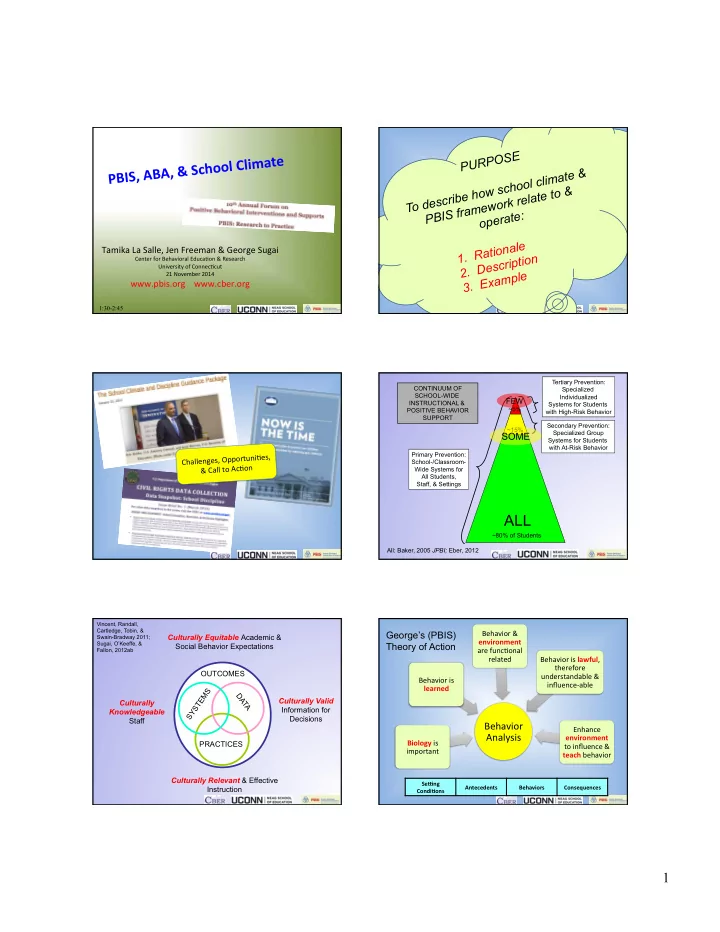
PURPOSE To describe how school climate & PBIS framework relate to &

  • perate:
  • 1. Rationale
  • 2. Description
  • 3. Example

Challenges, ¡Opportuni>es, ¡ & ¡Call ¡to ¡Ac>on ¡

Primary Prevention: School-/Classroom- Wide Systems for All Students, Staff, & Settings Secondary Prevention: Specialized Group Systems for Students with At-Risk Behavior Tertiary Prevention: Specialized Individualized Systems for Students with High-Risk Behavior ~80% of Students ~15% ~5% CONTINUUM OF SCHOOL-WIDE INSTRUCTIONAL & POSITIVE BEHAVIOR SUPPORT

ALL

SOME

FEW

All: Baker, 2005 JPBI; Eber, 2012

SYSTEMS PRACTICES DATA OUTCOMES

Vincent, Randall, Cartledge, Tobin, & Swain-Bradway 2011; Sugai, O’Keeffe, & Fallon, 2012ab

Culturally Equitable Academic & Social Behavior Expectations Culturally Relevant & Effective Instruction Culturally Knowledgeable Staff Culturally Valid Information for Decisions

Behavior ¡ Analysis ¡

Biology ¡is ¡ important ¡ Behavior ¡is ¡ learned ¡ Behavior ¡& ¡ environment ¡ are ¡func>onal ¡ related ¡ Behavior ¡is ¡lawful, ¡ therefore ¡ understandable ¡& ¡ ¡ influence-­‑able ¡ Enhance ¡ environment ¡ to ¡influence ¡& ¡ teach ¡behavior ¡

Se<ng ¡ Condi=ons ¡ Antecedents ¡ Behaviors ¡ Consequences ¡

George’s (PBIS) Theory of Action

slide-2
SLIDE 2

2

School ¡Reform ¡ Problem ¡Context ¡

School ¡ violence ¡ Under-­‑ achievement ¡ Suspension ¡& ¡ expulsions ¡ Disability ¡ Dispropor>onality ¡ & ¡Equity ¡ Restraint ¡& ¡ seclusion ¡ Bullying ¡ School ¡ comple>on ¡& ¡ dropping ¡out ¡ Delinquency ¡ Substance ¡ use ¡ School ¡ Climate ¡ . ¡. ¡. ¡. ¡. ¡. ¡. ¡

NOT Equal

School ¡ Climate ¡

STUDENT ¡ BEHAVIOR ¡ ADULT ¡BEHAVIOR ¡ OUTCOMES ¡

  • Aggression ¡
  • Bullying ¡behavior ¡
  • Non-­‑compliance ¡
  • Insubordina>on ¡
  • Social ¡w/drawal ¡
  • Truancy ¡
  • Law/norm ¡viola>ons ¡
  • Substance ¡use ¡
  • Weapon ¡possession ¡
  • Harassment ¡
  • Self-­‑injury ¡
  • ¡ ¡
  • Office ¡referral ¡
  • In ¡school ¡deten>on ¡
  • Out ¡of ¡school ¡

suspension ¡

  • Proba>on ¡& ¡parole ¡
  • Arrests ¡& ¡

incarcera>on ¡

  • Restraint ¡& ¡

seclusion ¡

  • Mental ¡health ¡

referral ¡

  • ¡ ¡
  • Dispropor=onality ¡
  • Dropping ¡out ¡
  • School ¡failure ¡
  • Mental ¡illness ¡
  • School-­‑to-­‑prison ¡

pipeline ¡

  • Achievement ¡gap ¡
  • Unemployment ¡
  • Delinquency ¡
  • ¡ ¡ ¡

Logic Model

edents ¡ Behaviors ¡ Consequences ¡

!

CONTEXT CONDITIONS STUDENT BEHAVIOR ADULT BEHAVIOR STUDENT OUTCOME RISK

  • Hunger
  • Chronic illness
  • Disability
  • Race
  • Gender
  • Violence & trauma

exposure

  • Unemployment
  • Gangs
  • Substance use
  • Mental illness
  • Aggression
  • Bullying behavior
  • Non-compliance
  • Insubordination
  • Social w/drawal
  • Truancy
  • Law/norm

violations

  • Substance use
  • Weapon

possession

  • Harassment
  • Self-injury
  • Office referral
  • In school detention
  • Out of school

suspension

  • Probation & parole
  • Arrests &

incarceration

  • Restraint &

seclusion

  • Mental health

referral

  • Disproportionality
  • Dropping out
  • School failure
  • Mental illness
  • School-to-prison

pipeline

  • Achievement gap
  • Unemployment
  • Delinquency
  • PREVENTIVE-PROTECTIVES
  • Employment
  • Physical health
  • Recreation
  • Healthy diet
  • Preschool
  • Literacy exposure
  • Safe

neighborhoods

  • Positive role

models

  • Problem solving
  • Conflict & anger

management

  • Asking for

assistance

  • Communicating

feelings

  • Literacy
  • Self-management

skills

  • Managing bullying

behavior

  • Teach, supervise,

reinforce

  • Active supervision
  • Check in check out
  • Function-based

support

  • Positive

reinforcement

  • Precorrection
  • Opportunity to

respond

  • Generalization

training

  • Data-based

decision making

  • Postsecondary

education

  • Employment
  • Family
  • Recreation &

leisure activities

  • Physical & mental

health

  • Positive peer group
  • Safe neighborhood
  • !

VIOLENCE ¡ (Bullying ¡ Behavior) ¡ PREVENTION ¡ Posi>ve ¡ predictable ¡ school-­‑wide ¡ climate ¡ High ¡rates ¡ academic ¡& ¡ social ¡success ¡ Formal ¡social ¡ skills ¡instruc>on ¡ Posi>ve ¡ac>ve ¡ supervision ¡& ¡ reinforcement ¡ Posi>ve ¡adult ¡ role ¡models ¡ Mul>-­‑component, ¡ mul>-­‑year ¡school-­‑ family-­‑community ¡ effort ¡

  • Surgeon General’s Report on Youth Violence (2001)
  • Coordinated Social Emotional & Learning

(Greenberg et al., 2003)

  • Center for Study & Prevention of Violence (2006)
  • White House Conference on School Violence (2006)

B I G ¡ I D E A ! ! ! ¡ Negative School Climates are Coercive Cycles (“Collections of Bad Habits”)

KID ¡ (-­‑) ¡School ¡Climate ¡

  • Non-­‑compliance ¡& ¡non-­‑

coopera>on ¡

  • Disrespect ¡
  • Low ¡academic ¡achievement ¡
  • Teasing, ¡harassment, ¡& ¡

in>mida>on ¡

  • Disengagement ¡& ¡withdrawal ¡
  • Nona`endance, ¡tardy, ¡& ¡

truancy ¡

  • Violent/aggressive ¡behavior ¡
  • Li`ering, ¡graffi>, ¡& ¡vandalism ¡
  • Substance ¡use ¡

SCHOOL ¡ (-­‑) ¡School ¡climate ¡

  • Reac>ve ¡management ¡
  • Exclusionary ¡disciplinary ¡prac>ces ¡
  • Informal ¡social ¡skills ¡instruc>on ¡
  • Poor ¡implementa>on ¡fidelity ¡of ¡

effec>ve ¡prac>ces ¡

  • Inefficient ¡organiza>on ¡support ¡
  • Poor ¡leadership ¡prepara>on ¡
  • Non-­‑data-­‑based ¡decision ¡making ¡
  • Inefficient, ¡ineffec>ve ¡instruc>on ¡
  • Nega>ve ¡adult ¡role ¡models ¡

Coercive ¡Cycle ¡

slide-3
SLIDE 3

3

Why ¡is ¡ nega>ve ¡ school ¡climate ¡ undesirable? ¡ Environments ¡of ¡ control ¡ Triggers ¡an>social ¡ behavior ¡ ¡ Shids ¡responsibility ¡for ¡ change ¡ Damages ¡rela>onship ¡ Weakens ¡academic ¡ & ¡social ¡ development ¡

SCHOOL ¡ (+) ¡School ¡Climate ¡

  • Posi>ve ¡> ¡nega>ve ¡contacts ¡
  • Predictable, ¡consistent, ¡& ¡

equitable ¡treatment ¡

  • Challenging ¡academic ¡

success ¡

  • Adults ¡modeling ¡expected ¡

behavior ¡

  • Recogni>on ¡& ¡

acknowledgement ¡

  • Opportunity ¡to ¡learn ¡
  • Safe ¡learning ¡environment ¡
  • Academic ¡& ¡social ¡

engagement ¡

KID ¡ (+) ¡School ¡Climate ¡ ¡

  • Compliance ¡& ¡coopera>on ¡
  • Respect ¡& ¡responsibility ¡
  • Posi>ve ¡peer ¡& ¡adult ¡

interac>ons ¡

  • Enhanced ¡academic ¡

achievement ¡

  • Engagement ¡& ¡par>cipa>on ¡
  • A`endance ¡& ¡punctuality ¡
  • Anger ¡& ¡conflict ¡management ¡
  • Safe ¡& ¡clean ¡environment ¡
  • Healthy ¡food ¡& ¡substance ¡use ¡
  • Self-­‑management ¡behavior ¡

Posi>ve ¡Reinforcement ¡Cycle ¡

Nega>ve ¡School ¡ Behavior ¡ Nega>ve ¡Student ¡ Behavior ¡ What’s ¡It ¡Take ¡to ¡Shid ¡from ¡Nega>ve ¡to ¡Posi>ve ¡ School ¡Climate??? ¡ Posi>ve ¡Student ¡ Behavior ¡ Posi>ve ¡School ¡ Behavior ¡ Coercive Cycle Positive Reinforcement Cycle

HOW? ¡

Establish ¡ posi>ve ¡school ¡ climate ¡ Maximizing ¡ academic ¡ success ¡ Teaching ¡ important ¡social ¡ skills ¡ Recognizing ¡ good ¡behavior ¡ Modeling ¡good ¡ behavior ¡ Supervising ¡ ac>vely ¡

Communica>ng ¡ posi>vely ¡

Biglan, Colvin, Mayer, Patterson, Reid, Walker

Common Vision/Values Common Language & Behaviors Common Experience Quality Leadership

Effective Organizational Systems

“Organizations are groups of individuals whose collective behaviors are directed toward a common goal & maintained by a common outcome”

Skinner, 1953, Science of Human Behavior

POSITIVE ¡SCHOOL-­‑WIDE ¡CLIMATE ¡FOR ¡ALL ¡

Students, ¡Family, ¡School, ¡Community ¡

School Climate Indicators

Subjective (Perceptions) Objective (Outcome data) Integrated Approach Strengths

  • Perceptions are based on
  • bjectively examined variables (so it

should be perceived in relatively similar ways across schools)

  • Generally accepted as a direct

indicator of normative climate

  • “the actual behavior is less important

than perceived behavior because it is what controls one’s responses (Halpin & Croft, 1963)

  • Objective measures

(e.g., school size, discipline referrals, suspension/expulsion, achievement) is data- based

  • The data is not based on

subjective interpretation

  • Represents the

dynamics of the school

  • Together subjective

(perception) data and

  • bjective data can

integrated to provide a more comprehensive perspective about the climate

  • Ability to understand the

relationships between perceptions and

  • utcome data
  • Important for

understanding group experienced

Limitations

  • Largely dependent on previous

experiences, needs, values (resulting in differences based on SES, ability, grade, sex)

  • Reliance on perceptual data

includes variance from individuals and groups

  • Evidence on the accuracy of

perceptual data is inconclusive

  • Truly “objective”

measures (social composition, ability composition, size) are considered inadequate proxies

  • Even the observer’s

perception or thinking is biased in some ways

  • Validating perceptual

data with observations is complicated because:

  • Behaviors leading to

perceptions may be infrequent but intense

  • The behavior leading to

the perception may take place regularly but is not
  • bservable
slide-4
SLIDE 4

4

School Climate Teaching & Learning Institutional Environment/Structure Safety ŸSupport for Learning

“Teachers at my school have high standards for achievement “I Have worried about

  • ther students

hurting me”

ŸOrder and Discipline Peer Victimization

“I feel safe in my school” “I have been bullied or threatened by

  • ther students”

ŸPhysical Environment

“Instructional materials are up to date and in good condition” “Students in my school take pride in keeping the school building clean”

ŸPeer/adult relations ŸConnectedness (professional relationships) ŸParent Involvement

Relationships

“I feel successful at school” “I know an adult I can talk to if I need help”

ž Our purpose is to integrate both subjective data

(school climate perceptions) and objective data (PBIS outcome indicators) to support data-based decision making to improve student outcomes.

Our Purpose…

Data Objective Subjective Perceptions School Climate within the Context of PBIS

Prosocial behaviors support a positive school climate A positive school climate supports prosocial behaviors

Creating a Positive School Climate

ž From a PBIS perspective, a positive school

climate results from school environments that are:

— Predictable

○ Common language ○ Common vision (understanding expectations) ○ common experience

— Positive

○ Regular recognition for positive behavior

— Safe

○ Violence and disruptive behavior is not tolerated

— Consistent

○ Adults use similar expectations

Building a Framework…

PBIS

Consistent Safe Positive Predictable

Building a Framework…

PBIS School Climate

C

  • n

s i s t e n t S a f e P

  • s

i t i v e P r e d i c t a b l e F a i r n e s s / E q u i t y

Building a Framework…

PBIS School Climate

C

  • n

s i s t e n t S a f e P

  • s

i t i v e P r e d i c t a b l e F a i r n e s s / E q u i t y S a f e t y

slide-5
SLIDE 5

5

Building a Framework…

PBIS School Climate

Fairness/Equity Safety Order & Discipline Order & Discipline Consistent Safe Positive Predictable

Building a Framework…

PBIS School Climate Perceptions

Fairness/Equity Safety Order & Discipline Order & Discipline Consistent Safe Positive Predictable

Discipline Referrals Disproportionality Data Suspensions/ Referrals Attendance School Climate Data Student Outcomes

Data-Based Decision Making: Where Do You Begin?

School Climate Data

Behavioral Data Achievement Data PBIS Fidelity Data PBIS Implementation Strategies Outcome/ Achievement data School climate

PBIS Outcome Indicators

Student Outcomes

Data-Based Decision Making: Where Do You Begin?

School Climate Data

Behavioral Data Achievement Data PBIS Fidelity Data

Student Outcomes

PBIS Implementation Strategies Outcome/ Achievement data School climate

PBIS Outcome Indicators

PBIS Decision Making: Integrating Data

ž

PBIS decision making can be enhanced by:

— Integrating multiple sources of data ○ School climate perceptions ○ School outcome data — Discipline referrals — Suspension/expulsion data ○ PBIS fidelity data — School-wide Evaluation Tool — Benchmarks of Quality — Tiered Fidelity Inventory

School Climate Data: Overall Data

Average overall perceptions by group Data collected in Fall and Spring

QUESTIONS TO CONSIDER

  • How do different groups (e.g.,

students, teachers, parents) view the school climate?

  • How do perceptions of school

climate change over time (as result of PBIS)?

slide-6
SLIDE 6

6 School Climate Data: Subscales

0" 0.5" 1" 1.5" 2" 2.5" 3" 3.5" 4" O v e r a l l " S C " P S " A S " C A " S / C L " P E " S S " P V " O D " Middle"Subscale"Time"1" Middle"Subscale"Time"2" Middle"Subscale"Time"3"

Results by subscale

School Connectedness (SC) Peer Support (PS) Adult Support (AS) Cultural Acceptance (CA) Social/Civic Learning (S/CL) Physical Environment (PE) Safety (SS) Peer Victimization (PV) Order & Discipline (OD) QUESTIONS TO CONSIDER

ŸWhat aspects of school climate do students (parents/teachers) feel positive about? ŸWhat areas do students view negatively about? ŸHow does this data pair with outcome data (e.g., referrals, suspensions) ŸAre there differences among students across groups (e.g., disability, gender, achievement, race/ethnicity)? Does

  • ther data support that?

Tamika.la_salle ¡ Jennifer.freeman ¡ George.sugai ¡ @uconn.edu ¡ www.cber.org ¡ www.pbis.org ¡ ¡