
515000 Bibliotheca Alexandrina Compiled by Marwa Anani
Alfred Farag
(9191 -9002)
Biography:
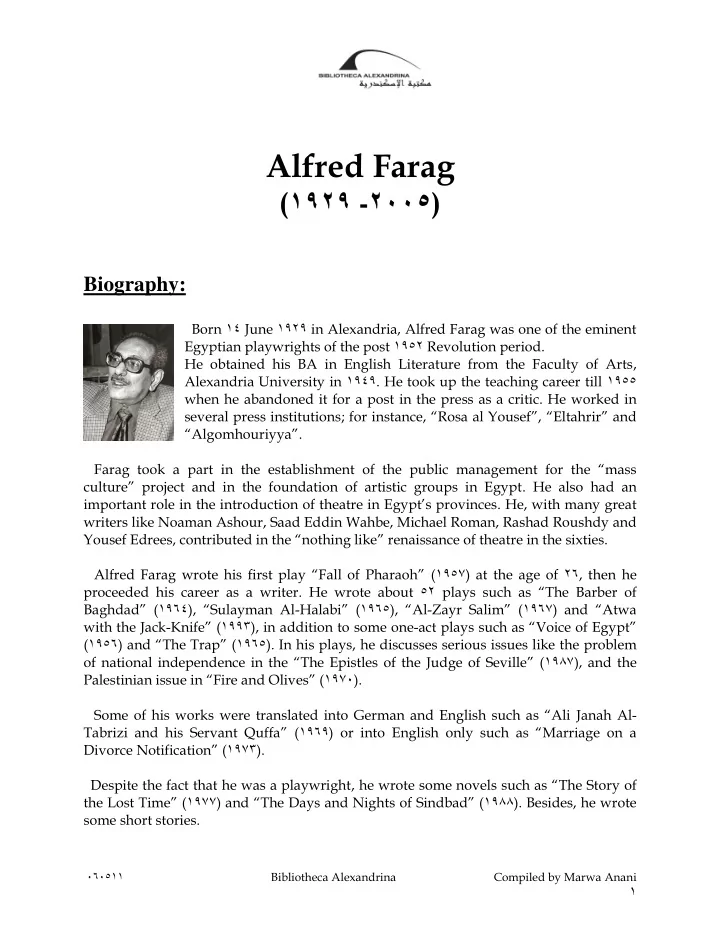
Born 01 June 0191 in Alexandria, Alfred Farag was one of the eminent Egyptian playwrights of the post 0109 Revolution period. He obtained his BA in English Literature from the Faculty of Arts, Alexandria University in 0111. He took up the teaching career till 0100 when he abandoned it for a post in the press as a critic. He worked in several press institutions; for instance, “Rosa al Yousef”, “Eltahrir” and “Algomhouriyya”. Farag took a part in the establishment of the public management for the “mass culture” project and in the foundation of artistic groups in Egypt. He also had an important role in the introduction of theatre in Egypt’s provinces. He, with many great writers like Noaman Ashour, Saad Eddin Wahbe, Michael Roman, Rashad Roushdy and Yousef Edrees, contributed in the “nothing like” renaissance of theatre in the sixties. Alfred Farag wrote his first play “Fall of Pharaoh” (0101) at the age of 91, then he proceeded his career as a writer. He wrote about 09 plays such as “The Barber of Baghdad” (0111), “Sulayman Al-Halabi” (0110), “Al-Zayr Salim” (0111) and “Atwa with the Jack-Knife” (0111), in addition to some one-act plays such as “Voice of Egypt” (0101) and “The Trap” (0110). In his plays, he discusses serious issues like the problem
- f national independence in the “The Epistles of the Judge of Seville” (0191), and the
Palestinian issue in “Fire and Olives” (0115). Some of his works were translated into German and English such as “Ali Janah Al- Tabrizi and his Servant Quffa” (0111) or into English only such as “Marriage on a Divorce Notification” (0111). Despite the fact that he was a playwright, he wrote some novels such as “The Story of the Lost Time” (0111) and “The Days and Nights of Sindbad” (0199). Besides, he wrote some short stories.