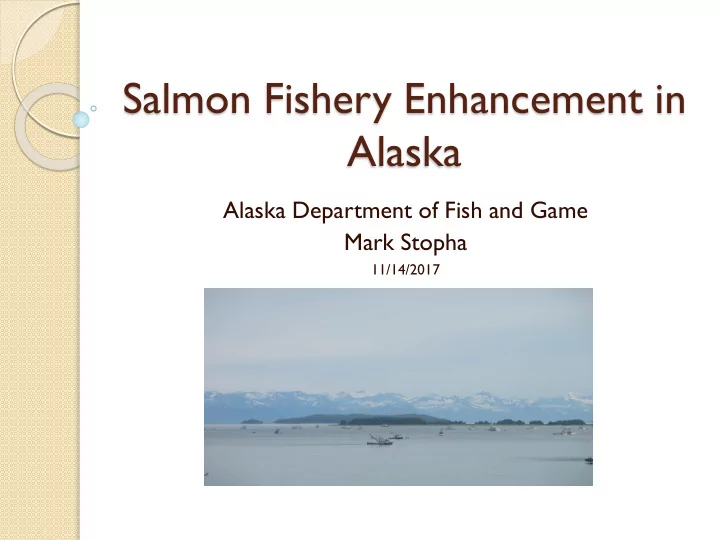
SLIDE 1 Salmon Fishery Enhancement in Alaska
Alaska Department of Fish and Game Mark Stopha
11/14/2017
SLIDE 2
Today’s Presentation
1.
The state’s role at Klawock River Hatchery
2.
State hatchery permitting process
3.
Options for sockeye fishery enhancement
SLIDE 3 Why did Alaska start it’s modern hatchery program?
20 40 60 80 100 120 140 1900 1905 1910 1915 1920 1925 1930 1935 1940 1945 1950 1955 1960 1965 1970 Statewide Salmon Harvest
Commercial Harvest in millions of fish
Statehood 1959
SLIDE 4 Salmon Production since 1975
50 100 150 200 250 300 1900 1905 1910 1915 1920 1925 1930 1935 1940 1945 1950 1955 1960 1965 1970 1975 1980 1985 1990 1995 2000 2005 2010 2015 Millions
Hatchery return Natural return
Commercial Harvest in number of fish
Statehood 1959 FRED 1971 Limited Entry and Hatcheries 1973 PNP Hatchery Program 1974
SLIDE 5
Why Alaska’s Hatchery Program Works
Fisheries managed for wild stock escapement Most salmon habitat intact Local stocks for hatchery broodstock Selective breeding not used Large number of broodstock used Hatchery Siting
SLIDE 6 Wild Stock Protection Mechanisms
Permit hatcheries at lower capacity Wild stocks priority in management Tagging/marking and sampling program Study wild/hatchery interactions
6
SLIDE 7 Alaska’s salmon fishery enhancement program is stakeholder driven
Stakeholders determine fishery enhancement in each
region.
The ADF&G determines what is appropriate within
their mandate to protect natural production.
Regional Planning Team (RPT) produce a
Comprehensive Salmon Plan for their region.
7
SLIDE 8
State Role in Hatchery Production
Oversight of salmon hatchery production Planning- Regional Planning T
eam
Manage fisheries to protect wild stocks
SLIDE 9
- I. State Role at Klawock Hatchery
State retains ownership of hatchery Regulates hatchery production through
the permitting process
Manage wild stocks to meet escapement
SLIDE 10
Klawock Hatchery Site
Klawock Hatchery was built in 1977 as
state hatchery.
The site was selected because of the large
volume of water available, public road access to reduce operating costs, local labor source, potentially high biological productivity, and historic salmon decline to this system and others in the vicinity.
SLIDE 11 Klawock River Hatchery Permitting
Built and operated by the state in 1978-
1992
City of Klawock 1993-1995 POWHA 1995-2016 Currently operated by SSRAA
- Currently permitted for 5 million coho
salmon and 1 million sockeye eggs.
SLIDE 12
- II. Hatchery Permitting Process
12
SLIDE 13 Only 2 types of permits that authorize salmon propagation in Alaska
Private Nonprofit
(PNP) Salmon Hatchery Permit
Fish Resource
Permit (FRP)
13
SLIDE 14
Fish Resource Permits (FRP’s)
Permit Classifications: Collection Holding Propagation
SLIDE 15
Propagative Research Permit
No more than 500,000 eggs from non- smolt species or 100,000 eggs from smolt species. Eggs are intended to produce fewer than 5,000 returning adults. All adult returns are considered common property and are not the exclusive property of the project.
SLIDE 16 PNP Hatchery Permit
Non-profit entity submits application to PNP
coordinator
ADFG staff review app and submit comments to
ADFG PNP coordinator
Management Feasibility Plan developed by ADFG RPT reviews application for compatibility with
regional comprehensive plan and sends recommendation to ADFG Commissioner
Hatchery operation plan (called Basic Management
Plan) drafted by applicant and ADFG Staff
Public Hearing held for comment on hatchery Hatchery App, BMP and Public Comment submitted
to Commissioner for decision
SLIDE 17 Ongoing Hatchery Permitting
FTP- Fish Transport Permit
- Egg takes, transports, releases.
AMP- Annual Management Plan
- Plan for the year’s egg takes, releases,
harvest management
SLIDE 18
- III. Sockeye Salmon Enhancement
Current permitting status:
- 1 million eggs are on SSRAAs Klawock River
PNP hatchery permit
SLIDE 19
Sockeye Production Requirements
IHN virus-free water Isolation in hatchery from other fish being
reared
SLIDE 20
Types of Sockeye Programs
Enhancement: Adding to natural
production.
Rehabilitation: Renewing natural
production.
SLIDE 21
Sockeye Fishery Enhancement
Adds to current natural production Returns are solely for harvest and
broodstock
SLIDE 22 Sockeye Rehabilitation
Must know what is limiting production
before adding fish to a system
- Limited Spawning Area?
- Limited Escapement?
- Limited Nutrients in the Lake?
- Poor habitat?
- Predators?
- Competitors?
SLIDE 23 Sockeye Production in Alaska
Prince William Sound
- Main Bay Hatchery
- Gulkana River
Southeast
Kodiak
Cook Inlet