Akihiko KUZE Akihiko KUZE CIMSS SSEC CIMSS SSEC University of - - PowerPoint PPT Presentation

akihiko kuze akihiko kuze
SMART_READER_LITE
LIVE PREVIEW

Akihiko KUZE Akihiko KUZE CIMSS SSEC CIMSS SSEC University of - - PowerPoint PPT Presentation

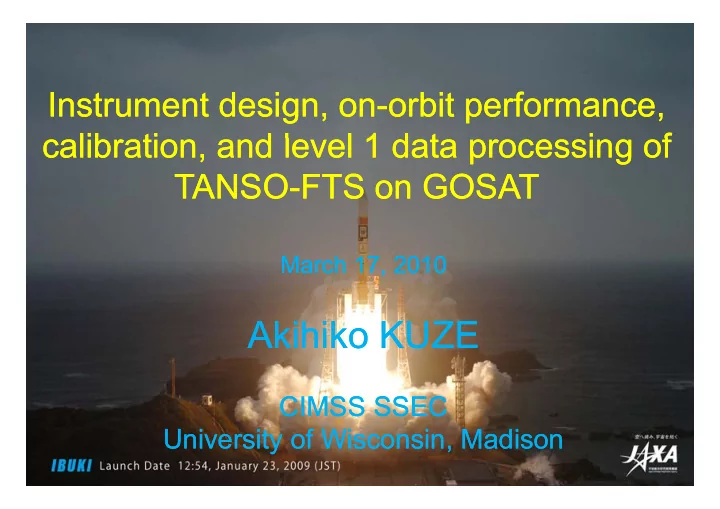
Instrument design, on Instrument design, on- -orbit performance, orbit performance, calibration, and level 1 data processing of calibration, and level 1 data processing of lib lib ti ti d l d l l 1 d t l 1 d t i i f f TANSO TANSO


slide-1
SLIDE 1

Instrument design, on Instrument design, on-

  • orbit performance,
  • rbit performance,

lib ti d l l 1 d t i f lib ti d l l 1 d t i f calibration, and level 1 data processing of calibration, and level 1 data processing of TANSO TANSO-FTS on GOSAT FTS on GOSAT TANSO TANSO FTS on GOSAT FTS on GOSAT

March 17, 2010 March 17, 2010

Akihiko KUZE Akihiko KUZE

CIMSS SSEC CIMSS SSEC University of Wisconsin, University of Wisconsin, Madison Madison

slide-2
SLIDE 2

Contents Contents (1) GOSAT (1) GOSAT-

  • project overview

project overview (2) TANSO instrumentation (2) TANSO instrumentation (3) On (3) On-

  • orbit Performance
  • rbit Performance

(4) Data (4) Data Processing Processing and instrument model and instrument model ( ) ( ) g (5) (5) TIR data TIR data (5) (5) TIR data TIR data

slide-3
SLIDE 3

TANSO status

The Greenhouse gases Observing SATellite (GOSAT) observes carbon dioxide (CO2) and methane (CH4) globally from space. It was launched on January 23, 2009 from Tanegashima Space Center. Since February 7, 2009, the Thermal And Near infrared Sensor for carbon Observation Fourier Transform Spectrometer (TANSO FTS) and Cloud Sensor for carbon Observation Fourier-Transform Spectrometer (TANSO-FTS) and Cloud and Aerosol Imager (TANSO-CAI) have been continuously operated. They acquire global data every three days. The brief summary of instrument design, pre-launch test results,

  • bservation plan (grid and sun glint observation and special target mode), onboard

calibrations, and the initial on-orbit results of radiometric, geometric and spectroscopic performances are presented TANSO FTS Level 1A and 1B data processing algorithm and performances are presented. TANSO-FTS Level 1A and 1B data processing algorithm and its updates on the ground are also presented. In addition we will show recent on-orbit instrument status such as pointing accuracy, interferogram quality, and radiometric accuracy and vicarious calibration results. Especially TANSO-FTS band 4 (thermal infrared band) performance and calibration will be discussed in detail.

March, 2010, Madison, Wisconsin

3

slide-4
SLIDE 4

GOSAT GOSAT GOSAT GOSAT P j t O i P j t O i Project Overview Project Overview j j

slide-5
SLIDE 5

Mission Targets Mission Targets

Greenhouse gases reenhouse gases O Observing bserving SAT SATellite. ellite. Nickname = “ Nickname = “IBUKI” (Breath in Japanese) ” (Breath in Japanese) Nickname Nickname IBUKI (Breath in Japanese) (Breath in Japanese)

(1) To observe CO2 and CH4 column density ( )

2 4

y

  • at -1000km spatial scale (with scanning mechanical)
  • with relative accuracy of 1% for CO2(4ppmv, 3 months average)

(t t 1 V) d 2% f CH (target 1ppmV) and 2% for CH4.

  • during the Kyoto Protocol's first commitment period (2008 to 2012).

(2) To reduce sub-continental scale CO2 annual flux estimation errors by half

  • 0.54GtC/yr→0.27GtC/yr

March, 2010, Madison, Wisconsin

5

slide-6
SLIDE 6

GHG Observing Points

Ground Stations From Space (Now)

g

Ground Stations From Space (Now)

(By WMO WDCGG)

  • 337 ground stations in the world.
  • The number of stations is limited

・Over 56,000 points per 3days

(L1 data, L2 before screening) The number of stations is limited, and they exists unevenly in the world. ・Global and frequent observation with an single instrument

March, 2010, Madison, Wisconsin

6

slide-7
SLIDE 7

Organization g

ORGANIZATION

GOSAT is the joint project of JAXA, MOE (Ministry of the Environment) and NIES (National Institute for Environmental Studies) NIES (National Institute for Environmental Studies).

JAXA MOE

  • Sensor development
  • Satellite development
  • H-IIA launch

H IIA launch

  • Satellite operation
  • Data acquisition
  • Calibration
  • Algorithms development
  • Algorithms development
  • Data use for science
  • Validation

NIES

March, 2010, Madison, Wisconsin

7

slide-8
SLIDE 8

Launch Vehicle

Size Main body 3 7m(H) x1 8m(W) x 2 0m(D) Size Main body 3.7m(H) x1.8m(W) x 2.0m(D) (Except attachment) Wing Span 13.7 m Mass Total 1,750 kg Power Total 3.8KW(EOL) Life Span 5 years Life Span 5 years Orbit Sun Synchronous Orbit Local time 13:00+/-0:15 (12:47 March 2009) Local time 13:00 / 0:15 (12:47 March 2009) Altitude 666 km Inclination 98 deg Re-visit 3 days Launch Vehicle H-IIA

March, 2010, Madison, Wisconsin

8

Date

  • Jan. 23, 2009
slide-9
SLIDE 9

Satellite Configuration g

Thermal And Near infrared Sensor for carbon Observation

TANSO FTS TANSO-CAI TANSO-FTS

SWIR/TIR FTS

March, 2010, Madison, Wisconsin

9

UV, Visible, SWIR Imager SWIR/TIR FTS

slide-10
SLIDE 10

TANSO-FTS Spectral Coverage p g

GOSAT Spectral Coverage 250

3 narrow bands

200 nce

  • n)

Band 2 10 20 1 57 1 62 1 67 Band 1 50 100 0 758 0 763 0 768 0 773

CO2 O2 CH4

3 narrow bands

0.76 μm 1.6 μm 2.0 μm

A id b d

100 150 ctral Radian tr/m2/micro

1.57 1.62 1.67 0.758 0.763 0.768 0.773 Band 3 10

CO2

A wide band

5.5 – 14.3 μm

With 0.2cm-1 spectral l ti (i t l)

50 100 Spec (W/s

5 1.98 2.03 2.08

O3 CH4 CO2

resolution (interval)

3 6 9 12 15 Wavelength (micron) Band 4

CH4

Wavelength (micron)

Column averaged density of CO2 is mainly retrieved by using the absorption lines between 1.6 μm region.

The intensities of these lines are less temperature dependent and not interfered by other molecules.

O A band absorption at 0 76 μm estimate the effective optical path length March, 2010, Madison, Wisconsin

10

O2 A band absorption at 0.76 μm estimate the effective optical path length.

slide-11
SLIDE 11

Radiative Transfer and Parameters to be observed Parameters to be observed

FTS covers wide spectral range

Cloud Stratospheric aerosol Tropospheric aerosol

GHG

Earth’s surface

High spectral resolution data of (1) Solar lines (2) Earth albedo (reflectance and scattering) (3) Thermal radiation

March, 2010, Madison, Wisconsin

11

(3) Thermal radiation (4) Two linear polarizations

slide-12
SLIDE 12

TANSO TANSO TANSO TANSO Instrument Instrument Instrument Instrument

slide-13
SLIDE 13

TANSO-FTS ifi ti d f specification and performance

FOV IFOV 10 5 k C 790 k FOV IFOV 10.5 km Coverage 790 km Speed 1.1, 2, 4 sec/interferogram band 1P, 1S 2P, 2S 3P, 3S 4 band 1P, 1S 2P, 2S 3P, 3S 4 Coverage (cm-1) 12900- 13200 5800- 6400 4800- 5200 700

  • 1800

Resolution (cm-1) 0.5 0.2 0.2 0.2 Detector Si InGaAs InGaAs PC-MCT SNR(prelaunch) >340 >320 >410 >280 SNR(prelaunch) (Measured) >340 >320 >410 >280 Onboard C lib ti Solar irradiance, D S Black body, d Calibration Deep Space, Lunar(radiance) Diode laser(ILS) deep space (Radiance)

March, 2010, Madison, Wisconsin

13

slide-14
SLIDE 14

FTS Optics Layout p y

Black body view Deep space view Scene flux from Diffused solar fl view view Pointing and image motion compensation from nadir flux CMOS Camera 1296 by 1040 Redundant pixels Aperture stop (Cube system DF3 DF2 Field stop (Cube Corner) Collecting mirror DF3 DF2 DF1 MCT(B4) on Dewar and Pulse Tube Cooler BPF2 BPF1 BPF3 Collimating mirror

March, 2010, Madison, Wisconsin

14

InGaAs with TE cooler (B2) P,S Si (B1)P,S InGaAs with TE cooler (B3) P,S

slide-15
SLIDE 15

Pointing and footprints g p

Mie Scattering Scattering P>>S

North

Camera FOV > 30 km TANSO FTS IFOV 10 5 k

TANSO-FTS

TANSO FTS IFOV=10.5 km TANSO CAI IFOV=0.5, 1.5 km SWATH 900km

TANSO-CAI

IMC ID=5

Camera

East West Equator

Sun glint

S P

TANSO-FTS

March, 2010, Madison, Wisconsin

Dayside:afternoon East West

S

Polarization

South

slide-16
SLIDE 16

Observation Patterns

Nominal Observation (Grid Observation) By adjusting turn-around-time onboard, TANSO-FTS revisit the same observation Special Target

March, 2010, Madison, Wisconsin

TANSO FTS revisit the same observation points every 3 days. Special Target Validation point , Mega City, Pipeline, Sun glint

slide-17
SLIDE 17

Polarization Measurements

Input: I, Q, U, V of Stokes Vector Input: I, Q, U, V of Stokes Vector Output: Two Linear Polarizations

S P

( ) ( ) ( ) ( )

input CT r AT m AT p CT r

  • pt

pp Poutput

S M M M M M M S θ θ θ θ 2 2 − =

( ) ( ) ( ) ( )

input CT r AT m AT p CT r

  • pt

pp Poutput

( ) ( ) ( ) ( )

input CT r AT m AT p CT r

  • pt

ps Soutput

S M M M M M M S θ θ θ θ 2 2 − =

March, 2010, Madison, Wisconsin 17

slide-18
SLIDE 18

TANSO-CAI Specification and Performance Specification and Performance

Center SNR band Center wavelength (μm) Bandwidth (nm) Resolution (IFOV) (km) pixel Detector SNR (Prelaunch) (measured) 1 0.380 20 0.5 2000 Si >200 2 0.674 20 0.5 2000 Si >200 3 0.870 20 0.5 2000 Si >200 4 1.60 90 1.5 500 InGaAs >200

0.8 1.0 d

TANSO-CAI Band 1 Spectral Response (Optics(with new filter) + Si CCD response)

0.8 1.0

TANSO-CAI Band 4 Spectral Response (Optics + InGaAs CMOS response)

0.0 0.2 0.4 0.6 Normalized 0.0 0.2 0.4 0.6 Normalized

March, 2010, Madison, Wisconsin

18

350 360 370 380 390 400 410 Wave length (nm) 1500 1550 1600 1650 1700 Wave length (nm)
slide-19
SLIDE 19

Radiometric Calibration X calibration with OCO X calibration with OCO

AIST/NMIJ St d d NIST Lamp Standard Standard

Portable standard radiometers 3 spectral bands (GOSAT)

GOSAT Inner- Illuminated Integrating Sphere OCO Inner

Fixed-point Blackbody

0.76 micron Inner- Illuminated Integrating Sphere ABO2

y (GOSAT)

1.6 micron Field spec p WCO2 Double Grating Monochromator 2.0 micron

3 Detectors (OCO)

SCO2

Dec 2008@TKSC

March, 2010, Madison, Wisconsin

19

April 2008@JPL Difference 1.5%±0.6%, 2.7%±1.1%, 0.2%±4.1% Dec, 2008@TKSC Difference 1.59%,1.1%, 1.4%

slide-20
SLIDE 20

On On-orbit

  • rbit

On On orbit

  • rbit

performance performance performance performance

slide-21
SLIDE 21

First Spectra (Feb. 7, 2009) p ( , )

0.0016 0.0012 /cm-1] B3P 0.0008 0.0004 0.0000 Intensity [V/ 5500 5400 5300 5200 5100 5000 4900 4800 4700 B3P B3S 0.0016 0.0012 0.0008 0.0004 ensity [V/cm-1] B2P B2S 0.0030 0 0020 V/cm-1] 0.0000 Inte 6700 6600 6500 6400 6300 6200 6100 6000 5900 5800 5700 5600 5500 B1P 0.0020 0.0010 0.0000 Intensity [V 13500 13400 13300 13200 13100 13000 12900 12800 12700 [ ] B1P B1S

Successful FTS application in space at Vis(760 nm) and SWIR (1 6 2 0um)

Wavenumber [cm-1]

March, 2010, Madison, Wisconsin

Successful FTS application in space at Vis(760 nm) and SWIR (1.6, 2.0um). 0.2 cm-1 high spectral resolution data with two linear polarizations.

slide-22
SLIDE 22

First CAI data

March, 2010, Madison, Wisconsin

slide-23
SLIDE 23

First TIR data

Radiometric calibration will be updated in a few months.

March, 2010, Madison, Wisconsin

slide-24
SLIDE 24

CAI data (UV and V images)

April 8, 2009 over Japan, band 1 (380nm) and band 3 (870nm) Very low surface albedo at band 1 and suitable for aerosol detection.

March, 2010, Madison, Wisconsin 24

y

slide-25
SLIDE 25

Lunar Calibration Spectra p

March 11, 2009, Lunar Calibration (Radiance Check) 6.0E-07 7.0E-07 str) 4.0E-07 5.0E-07 e (W/cm2/cm-1/s 2.0E-07 3.0E-07 ectral Radiance MODTRAN data base(albedo around 0.28) March 11 Lunar Radiance (size 0.0E+00 1.0E-07 5700 5800 5900 6000 6100 6200 6300 6400 6500 Spe corrected)

Band 2P and Monitor Camera (moon rise and tracking)

wavenumber (cm-1)

March, 2010, Madison, Wisconsin

No significant degradation of the optical and modulation efficiency

25

slide-26
SLIDE 26

Onboard Solar Irradiance Calibration

8.0E-06 6 0E-06 7.0E-06 4 0E 06 5.0E-06 6.0E 06 m2/cm-1) 3.0E-06 4.0E-06 ance (W/cm

Modtran Solar Irradiance (March 4)(front) 2P

Solar Fraunhofer lines ll b d

1.0E-06 2.0E-06 Irradia

Solar Irradiance (March 4)(front) 2P Smithsonian Kurucz (2009)

are well observed. N t t C ti f th S t l Diff BRDF

0.0E+00 6170 6175 6180 6185 6190 6195 6200 Wavenumber (cm-1)

March, 2010, Madison, Wisconsin

26

Not yet: Correction of the Spectralon Diffuser BRDF Not yet: Doppler Correction

slide-27
SLIDE 27

Onboard Instrument Line Shape Function (S t l l ti ) d W l th St bilit (Spectral resolution) and Wavelength Stability

March 12 2009 ILS Calibration with the onboard Diode Laser

0.8 1.0

March 12, 2009 ILS Calibration with the onboard Diode Laser

0.6

ized

Inflight March 12, 2009 Model

Optical alignment

0.2 0.4

Normal

has not changed since the launch.

0.0

L di d t t 2 K ( b d) W l th t bilit i b tt th 10 7

  • 0.2

6457 6458 6459 6460 6461 6462 6463

Wavenumber (cm-1)

March, 2010, Madison, Wisconsin

27

Laser diode temperature: 2mK p-p (onboard) > Wavelength stability is better than 10-7

slide-28
SLIDE 28

On-orbit performance and Operation remarks remarks

  • Possibility small radiometric response degradation has been

SO S C

  • bserved at shorter wavelength in both TANSO-FTS and CAI.
  • A few km pointing offset of TANSO FTS were detected from
  • A few km pointing offset of TANSO-FTS were detected from
  • nboard camera data.
  • 10-20 % of acquired interferograms has fluctuation.

They can be distinguished by checking level 1 data quality flag.

  • Sampling laser signal level decreases very slowly due to mis-

alignment but no impact on performance (small wavelength shift) alignment but no impact on performance (small wavelength shift).

  • Periodical FTS operation reset for ZPD shift correction and

March, 2010, Madison, Wisconsin

p

  • peration for pointing mechanism operation: regularly

28

slide-29
SLIDE 29

Vicarious Calibration with ACOS

TANSO-FTS on-orbit measured radiance and simulated TOA data with ground measured surface albedo and sonde profile (humidity and temperature) agrees within ±10% profile (humidity and temperature) agrees within ±10%. Major error sources are Major error sources are (1) Solar irradiance data (2) Possibilit of TANSO instr ment response degradation (2) Possibility of TANSO instrument response degradation (3) IFOV averaged albedo extrapolation ( ) (4) BRDF correction

March, 2010, Madison, Wisconsin 29

slide-30
SLIDE 30

FTS on orbit FTS on orbit FTS on orbit FTS on orbit

slide-31
SLIDE 31

Micro Vibration (Theory) (Theory)

Source Effect solution Amplitude Modulation Shear between two beams Side lobe (Sample Ar line) Minimize Vibration beams Frequency Modulation Sampling jitter Delay matching j (delay mis- match) g Intensity Modulation IFOV jitter Ghost at Low frequency + side lobe Minimize Scene O ill ti Oscillation or vibration of pointing

March, 2010, Madison, Wisconsin

mechanism etc.

31

slide-32
SLIDE 32

Micro Vibration Effect On Orbit

O b d Onboard laser input Side lobe is detected but much lower than noise level. Side lobe location indicated that the earth sensor for the satellite

March, 2010, Madison, Wisconsin

Side lobe location indicated that the earth sensor for the satellite attitude control may be the vibration source.

32

slide-33
SLIDE 33

Stray Light (Prelaunch) y g ( )

CO2 Gas Cell Light Source ( Halogen Lamp with CO2 Gas Cell large Spectralon diffuser plate) Black Body Light Scene Light Path

Stray Light Path

Stray light source: Brighter light source to simulate the cloud etc. from

  • tside the scene light path

Black Body Light Scene Light Path

Stray Light Path

March, 2010, Madison, Wisconsin

  • utside the scene light path.

Scene Light path: Fully absorbed line

33

slide-34
SLIDE 34

In-flight stray light estimation

  • r

alibration

estimation

From Dayside path,

TANSO

  • FTS

Diffuse fo (solar ca

y p deep space viewing data; M i b t 1% DC

  • FTS

Deep space view (solar paddle)

Maximum about 1% DC level stray light was

  • bserved

TANSO

  • CAI

(solar paddle) Strong by clou

  • bserved.

AC (signal) is much lower. (smaller than noise level)

reflection ud

Black is not black in SWIR. Earth View Side

March, 2010, Madison, Wisconsin

Earth View Side

34

slide-35
SLIDE 35

DATA DATA DATA DATA Processing Processing Processing Processing

slide-36
SLIDE 36

GOSAT Data Products

JAXA

0.020

Measurement

JAXA

0.005 0.010 0.015 Relative value H2O CH4 CO2

H2O CO2 CH4

Receive and Record

Interferogram

0.000 5200 5400 5600 5800 6000 6200 6400 Wavenumber (cm-1)

Level 1 processing

  • processing to spectra
  • calibration

NIES

L1 Data

calibration Level 4 Processing

  • estimate the net flux

Data distribution

Level 2 and 3Processing

  • to produce the global distribution map for CO2

and CH4

  • validation

validation

March, 2010, Madison, Wisconsin

Carbon Tracker

slide-37
SLIDE 37

TANSO-FTS Level 1 Processing (JAXA)

SWIR

DS b

S S − ) (

TIR

Interferogram (IGM) (Digital Number) Interferogram (IGM) (Digital Number)

SWIR

e BBeffectiv DS BB DS

  • bs
  • bs

B S S S S B − = ) (ν

IGM (V) (Spike Correction) Interferogram (IGM) (Digital Number) (SWIR 76,336 points TIR 38,168 points) (Level-1A)

TIR (Blackbody (BB)

IGM (V) (Spike Correction) Interferogram (IGM) (Digital Number) (SWIR 76,336 points TIR 38,168 points) (Level-1A)

TIR (Blackbody (BB)

( ) ( p ) TIR AC (Non-Linear Correction) IGM Zero-Filling

SWIR

TIR DS ZPD Application

TIR (Blackbody (BB), Scene Flux)

( ) ( p ) TIR AC (Non-Linear Correction) IGM Zero-Filling

SWIR

TIR DS ZPD Application

TIR (Blackbody (BB), Scene Flux)

Zero Path Difference (ZPD) Detection I-FFT Spectra (SPC) Truncation I-FFT g TIR DS ZPD Application I-FFT SPC(Complex) Zero Path Difference (ZPD) Detection I-FFT Spectra (SPC) Truncation I-FFT g TIR DS ZPD Application I-FFT SPC(Complex) p ( ) I-FFT and Phase ZPD Fine Position Check (Fringe Count Error) Fine Step Phase Data

TIR

Spectra (Level-1B) BB, DS Calibration p ( ) I-FFT and Phase ZPD Fine Position Check (Fringe Count Error) Fine Step Phase Data

TIR

Spectra (Level-1B) BB, DS Calibration Correction Wavelength Correction Low Frequency Correction (IFOV Instability, Jitter)

TIR (Deep Space (DS))

I FFT SPC(C l ) Correction Wavelength Correction Low Frequency Correction (IFOV Instability, Jitter)

TIR (Deep Space (DS))

I FFT SPC(C l )

March, 2010, Madison, Wisconsin 37

I-FFT SPC(Complex) Spectra (Level-1B) I-FFT SPC(Complex) Spectra (Level-1B)
slide-38
SLIDE 38

GOSAT operation and Data Distribution

12 1 2 3 4 5 6 7 8 9 10 11 12 1 2

2009 2010

1 2 3 ~

2014 Launch

  • Jan. 23

Initial Checkout

Mission life I iti l Extra O ti ~ Initial Cal. and Val. Initial function check Nominal operation Operatio n

Critical phase

Column density global distribution to public

Spectral data to public

March, 2010, Madison, Wisconsin

38

slide-39
SLIDE 39

Level 1 Major Updates

<L+6M updates>

  • Phase correction
  • ZPD shift correction

<L+9M ver. 050 updates>

  • Low frequency correction

Low frequency correction

  • Quality flag

<L+14M (L+12M) level 1 updates>

  • TIR radiometric calibration correction considering polarization model.
  • Saturation quality flag
  • Interferogram quality flag

March, 2010, Madison, Wisconsin 39

slide-40
SLIDE 40

Models for users

Radiometric FTS SWIR Radiance excel Prelaunch, Cross-Calibrated (Update March 2010 ) Channeling correction (included but updated if necessary) Channeling correction (included but updated if necessary) FTS TIR radiance ATBD Use onboard deep space and BB (blackbody) (Processed in L1 , non-linearity, effective BB emissivity) CAI Radiance Excel Prelaunch (Update March 2010 ) CAI Radiance Excel Prelaunch (Update March 2010 ) FTS, CAI RCF Excel Radiance Correction factor (in preparation) (function of the day from the launch) S t l FTS ILSF E l C bi ti f P l h d d l l l ti Spectral FTS ILSF Excel Combination of Pre launch and model calculation Analyzing prelaunch, solar irradiance data (if necessary, updated) FTS Wavelength Excel Sampling laser change correction Wavelength Correction Factor (in preparation) g ( p p ) CAI Instrument Response Excel Prelaunch Geometric FTS ATBD Design base (pointing mechanism offset on orbit will be prepared) CAI ATBD 1st version (prelaunch) 2nd (GCP on-orbit calibration) Polarization FTS Mueller Matrix Excel Appendix (Power point file)

March, 2010, Madison, Wisconsin 40

slide-41
SLIDE 41

Radiometric Model (SWIR FTS) ( )

Level1B output V/cm-1 p Multiply output + calibration factor: output W/cm2/str/cm-1 For both Gain H and M Ab ti d B d 2S h li t d

Band 1(W/str/cm2/V) gain H 4.0E-04 Band 2(W/str/cm2/V) gain H Band 3(W/str/cm2/V) gain H 2.0E-04

Absorption and Band 2S channeling are corrected.

5 0E-05 1.0E-04 1.5E-04 2.0E-04 2.5E-04 3.0E-04 3.5E-04 4.0E 04 Response P (raw) S (raw) P (corrected) S (corrected) 5.0E-05 1.0E-04 1.5E-04 2.0E-04 2.5E-04 3.0E-04 Response P (raw) S (raw) P (corrected) S (corrected) 2 0E 05 4.0E-05 6.0E-05 8.0E-05 1.0E-04 1.2E-04 1.4E-04 1.6E-04 1.8E-04 Response P (raw) S (raw) P (corrected) S (corrected) 0.0E+00 5.0E 05 12700 12900 13100 13300 Wavenumber(cm‐1) Band 1(W/str/cm2/V) gain M 0.0E+00 5600 6100 6600 Wavenumber(cm‐1) Band 2(W/str/cm2/V) gain M 1.0E-03 0.0E+00 2.0E-05 4700 4900 5100 5300 5500 Wavenumber(cm‐1) Band 3(W/str/cm2/V) gain M 2.0E-04 4.0E-04 6.0E-04 8.0E-04 1.0E-03 Response P (raw) S (raw) P (corrected) S (corrected) 2.0E-04 4.0E-04 6.0E-04 8.0E-04 Response P (raw) S (raw) P (corrected) S (corrected) 5 0E-05 1.0E-04 1.5E-04 2.0E-04 2.5E-04 3.0E-04 3.5E-04 4.0E-04 4.5E-04 5.0E-04 Response P (raw) S (raw) P (corrected) S (corrected)

March, 2010, Madison, Wisconsin 41

0.0E+00 12700 12900 13100 13300 Wavenumber(cm‐1) 0.0E+00 5600 6100 6600 Wavenumber(cm‐1) 0.0E+00 5.0E 05 4700 4900 5100 5300 5500 Wavenumber(cm‐1)
slide-42
SLIDE 42

Radiometric Model (TIR FTS) ( )

TIR Level1B output W/cm2/str/cm-1 Using onboard blackbody and deep space calibration

No calibration model C l C lib ti (t th ith h ti )

DS

  • bs

B S S B − ) (ν

Complex Calibration (together with phase correction)

e BBeffectiv DS BB

  • bs

B S S B − = ) (ν

) ( ) 1 ( ) (

background blackbody e BBeffectiv

T B T B B ε ε − + =

March, 2010, Madison, Wisconsin 42

slide-43
SLIDE 43

Radiometric Model (CAI) ( )

Level1A output: raw digital number (4 odd, 4 even pre-scan +2048 pixels)

5.0 CAI band 1 Response W msec/m2/str/micron 4 5 5.0 CAI band 2 Response W msec/m2/str/micron

Multiply calibration factor by (raw signal – pre-scan data) Divided by integration time

1 5 2.0 2.5 3.0 3.5 4.0 4.5 Response W msec/m2/str/micron 1.5 2.0 2.5 3.0 3.5 4.0 4.5 Response W msec/m2/str/micron 0.0 0.5 1.0 1.5 500 1000 1500 2000 0.0 0.5 1.0 1.5 500 1000 1500 2000 3.5 4.0 4.5 5.0 CAI band 3 Response W msec/m2/str/micron Response W msec/m2/str/micron 2.0 2.5 3.0 CAI band 4 Response W msec/m2/str/micron Response W msec/m2/str/micron 0.5 1.0 1.5 2.0 2.5 3.0 0.0 0.5 1.0 1.5

March, 2010, Madison, Wisconsin 43

0.0 500 1000 1500 2000 100 200 300 400 500
slide-44
SLIDE 44

FTS and CAI RCF (Example) (Radiance Correction Factor) (Radiance Correction Factor)

Best estimated from solar irradiance diffuser plate data(both front and back sides) ( ) Vicarious calibration data (RRV, Sahara), Lunar Calibration, X-Cal with MODIS

March, 2010, Madison, Wisconsin 44

slide-45
SLIDE 45

FTS ILSF (Instrument Line Shape Function) (Instrument Line Shape Function)

± 50cm-1, 0.01 cm-1 step data 50cm , 0.01 cm step data Band 1P and 1S models are different. Band 2, 3; P and S are same. a d , 3; a d S a e sa e

March, 2010, Madison, Wisconsin 45

slide-46
SLIDE 46

CAI Spectral Response

0.6 0.8 1.0 ized TANSO-CAI Band 1 Spectral Response (Optics(with new filter) + Si CCD response) 0.8 1.0 d

TANSO-CAI Band 2 Spectral Response (Optics + Si CCD response)

0.0 0.2 0.4 350 360 370 380 390 400 410 Normali 0.0 0.2 0.4 0.6 Normalized Wave length (nm) 650 660 670 680 690 700 710 Wave length (nm)

TANSO-CAI Band 3 Spectral Response TANSO-CAI Band 4 Spectral Response (O ti + I G A CMOS )

0.6 0.8 1.0 alized

p p (Optics + Si CCD response)

0.6 0.8 1.0 alized

(Optics + InGaAs CMOS response)

0.0 0.2 0.4 850 860 870 880 890 900 910 Norm 0.0 0.2 0.4 1500 1550 1600 1650 1700 Norm

March, 2010, Madison, Wisconsin 46

Wave length (nm) Wave length (nm)
slide-47
SLIDE 47

FTS Wavelength Change

FTS reference laser path has been mis-aligned gradually but will converge soon converge soon. In consequence, the laser output level and wavelength shifted slightly. Wavelength Correction Factor (WCF) Wavelength Correction Factor (WCF) will be provided soon.

March, 2010, Madison, Wisconsin 47

slide-48
SLIDE 48

FTS Geometric Model

Input: pointing mechanism resolver telemetry data (2θAT) Input: pointing mechanism resolver telemetry data (2θAT) (coordination: GSAOT and TANSO) Output: Line Of Sight (LOS) vector

( )

⎟ ⎟ ⎞ ⎜ ⎜ ⎛ − = ⎟ ⎟ ⎞ ⎜ ⎜ ⎛ + + + − = ) 2 cos( ) sin( ) 2 sin( 4 / cos ) sin( ) 4 / sin( 2 ) 4 / ( sin 2 1

2 AT AT

b θ θ θ θ π θ θ π θ π

( )

⎟ ⎟ ⎠ ⎜ ⎜ ⎝ − = ⎟ ⎟ ⎠ ⎜ ⎜ ⎝ + + + + − = ) 2 cos( ) cos( ) 2 cos( ) sin( ) 4 / cos( ) cos( ) 4 / sin( 2 4 / cos ) sin( ) 4 / sin( 2

AT CT AT CT AT CT AT AT CT AT LOS

b θ θ θ θ θ π θ θ π θ π θ θ π

Offset information will be provided soon

March, 2010, Madison, Wisconsin 48

Offset information will be provided soon.

slide-49
SLIDE 49

CAI Geometric Model

Input: band, pixel number, center pixel p , p , p Output: Line Of Sight (LOS) vector

⎟ ⎟ ⎞ ⎜ ⎜ ⎛

atc

b θ θ θ i sin ) ( ⎟ ⎟ ⎠ ⎜ ⎜ ⎝ =

ctc atc ctc atc LOSC m

b θ θ θ θ cos cos sin cos ) ( ⎠ ⎝

ctc atc

3 3 2 2 1

) ( ) ( ) (

m c m x m c m x cm m x m x atc

n n p n n p n n p p − + − + − + = θ

3 3 2 2 1

) ( ) ( ) (

cm m y cm m y cm m y m y ctc

n n p n n p n n p p − + − + − + = θ

March, 2010, Madison, Wisconsin 49

Coefficients were updated after launch

slide-50
SLIDE 50

FTS Two Linear Polarization

GOSAT definition : P Primary S Secondary (S can be used as redundancy Optical Definition: German words Senkrecht (perpendicular) Wave, Parallelität (parallel) Wave

S P

Instrument (mirror) Optical P=GOSAT P

S P S

Optical P GOSAT P GOSAT P has much higher efficiency than GOSAT S Observation (surface) Optical P = GOSAT S

March, 2010, Madison, Wisconsin 50

efficiency than GOSAT S (ZnSe BS efficiency)

slide-51
SLIDE 51

FTS Polarization Model (SWIR Muller Matrix) (SWIR Muller Matrix)

( ) ( ) ( ) ( )S

M M M M M M S θ θ θ θ 2 2 − =

( ) ( ) ( ) ( )

input CT r AT m AT p CT r

  • pt

pp Poutput

S M M M M M M S θ θ θ θ 2 2 − =

( ) ( ) ( ) ( )S

M M M M M M S θ θ θ θ 2 2

( ) ( ) ( ) ( )

input CT r AT m AT p CT r

  • pt

ps Soutput

S M M M M M M S θ θ θ θ 2 2 − =

( ) ( ) ( ) ( )

CT AT AT CT

M M M M θ θ θ θ 2 2 −

( ) ( ) ( ) ( )

CT r AT m AT p CT r

M M M M θ θ θ θ 2 2

is function of

CT AT θ

θ ,

TANSO-FTS PFM PM-Mirror witness with polarimeter (Aug 6, 2009 TKSC) 160 170 180 rence (deg) 30 deg 35 deg

Mueller matrix together with pointing mirror

120 130 140 150 1500 1700 1900 2100 Phase Differ 35 deg 40 deg 45 deg 50 deg 55 deg 60 deg

reflectance and mirror surface phase model are provided.

March, 2010, Madison, Wisconsin 51

1500 1700 1900 2100 Wavenumber (nm)
slide-52
SLIDE 52

FTS Polarization Model (TIR Muller Matrix) (TIR Muller Matrix)

Large Polarization Sensitivity g y Pointing mirror (8-15 μm) FTS ZnSe Beam splitter Aft ti (b d ti ti ) Aft optics (band separation optics) And different geometry between calibration and observation Need correction

( ) ( ) ( ) ( )

Tinput CT r AT m AT p CT r

  • pt

Toutput

S M M M M M S − = θ θ θ θ 2 2

Need correction

( )

BG Tmirror CT r

  • pt

S S M M + − + θ 2

/ )) )( ( ) )( /(( ) 2 / ) )( )( ( ) (( 4 ) (

2 2 2 2 2 2 2 2 2 2 2 2

R T RB I I T B ) ( ) )( ( 2 ) ( )) )( ( ) )( (( ) ( ) /( ) 2 / ) )( )( ( ) )(( ( / )) )( ( ) )( /(( ) 2 / ) )( )( ( ) (( 4 ) (

2 1 2 1 2 2 2 2 2 1 2 1 2 2 2 2 2 1 2 1 2 2 2 2 2 1 2 1 2 2 2 2 2 1 2 1 2 2 2 2 2 1 2 1 2 2 2 2 2 1 2 1 2 2 2 2 DS Toutput DS BB mirror DS Toutput BB mirror DS Toutput scene

T B q p q p T B q p q p q p q p I I I I q p q p T RB I I T B R q p q p q p q p q p q p T RB I I T B − − + − − − + + − = − − − + − = − − + + + − − + − =

March, 2010, Madison, Wisconsin 52

) ( )) )( ( ) )( (( ) ( )) )( ( ) )( (( ) (

2 1 2 1 2 2 2 2 2 1 2 1 2 2 2 2 2 1 2 1 2 2 2 2 2 1 2 1 2 2 2 2 mirror BB DS BB

T B q p q p q p q p T B q p q p q p q p I I − − + + + + − − + + + − =

slide-53
SLIDE 53

TIR Data TIR Data TIR Data TIR Data

slide-54
SLIDE 54

L+14M data release major updates j p

  • Non linearity correction 3rd order polynomial (DC+ AC)

Coefficients are tuned to minimize the negative peak at ZPD of the interferogram created by low frequency portion.

  • Polarization model (mirror coating etc) has been considered.
  • Calibration data selection schemes has been updated. Removal bad quality

interferogram (blackbody and deep space)

March, 2010, Madison, Wisconsin 54

slide-55
SLIDE 55

Data Quality Check points y p

  • Comparison with AIRS and IASI data.
  • Low brightness temperature data
  • Level 2 data stripe check (both CT and AT direction)

March, 2010, Madison, Wisconsin 55

slide-56
SLIDE 56

TANSO status (ILSF) ( )

Effect Effect IFOV Size Resolution, Asymmetry (consider collection optics aberration) Optical axis offset Resolution, Asymmetry Vignetting Resolution S lf A di ti R l ti Self Apodization Resolution Aberration Resolution

(1) D t il d iti it i b i t di d ith th d l (1) Detailed sensitivity is being studied with the model. (2) Most probable ILSF will be updated using the following data Prelaunch CO2 gas cell Prelaunch diffused Tunable Diode Laser Prelaunch integrating sphere with Ar lamps Prelaunch blackbody

March, 2010, Madison, Wisconsin

56

y On-orbit solar lines (diffuser plate, lunar calibration)

slide-57
SLIDE 57

Conclusion Conclusion Conclusion Conclusion

slide-58
SLIDE 58

Conclusion and Future Plan

  • GOSAT was successfully launched on Jan. 23, 2009.
  • TANSO-FTS and CAI data acquisition started from Feb. 7.

Now TANSO is operating regularly (almost 100%) Now TANSO is operating regularly (almost 100%).

  • Initial function checkout and calibration were completed on Apr. 10 and Jul. 30,
  • respectively. No significant degradation of radiometric and spectroscopic

performance was observed.

  • Most probable Instrument line shape function and radiometric calibration table

will be updated in a timely manner.

  • Annual Lunar calibration on March 1 and 30 and RRV vicarious campaign,

June 2010 are planned.

March, 2010, Madison, Wisconsin

p

58

slide-59
SLIDE 59

Publications

(1) TANSO instrumentation Kuze et al " Thermal and near infrared sensor for carbon observation Fourier transform Kuze et. al. " Thermal and near infrared sensor for carbon observation Fourier-transform spectrometer on the Greenhouse Gases Observing Satellite for greenhouse gases monitoring,"

  • Appl. Opt., vol. 48, pp. 6716-6733, Dec. 2009.

(2) Level 1 processing Kuze et .al. ,“On-orbit performance and level 1 data processing of TANSO-FTS and CAI on GOSAT,

  • Proc. SPIE, vol. 7474, 74740I, 2009.

(3) Cross Calibration (Pre-launch) ( ) ( )

  • F. Sakuma et. al., “OCO-GOSAT preflight cross calibration experiment,” IEEE
  • Trans. Geosci. Remote Sens., vol. 48, pp. 585–599, 2010.

(4) Vicarious Calibration Kuze et .al. ,“Vicarious calibration of the GOSAT sensors using the Railroad Valley desert playa” March, 2010, Madison, Wisconsin 59