AJ DREXEL AUTISM INSTITUTE http://drexel.edu/autisminstitute/ EARLY - - PDF document

aj drexel autism institute
SMART_READER_LITE
LIVE PREVIEW

AJ DREXEL AUTISM INSTITUTE http://drexel.edu/autisminstitute/ EARLY - - PDF document

7/30/17 AJ DREXEL AUTISM INSTITUTE http://drexel.edu/autisminstitute/ EARLY START DENVER MODEL A NATURALISTIC DEVELOPMENTAL BEHAVIORAL INTERVENTION DESIGNED FOR PRESCHOOLERS WITH AUTISM SPECTRUM DISORDER Prof. Craig Newschaffer, Autism


slide-1
SLIDE 1

7/30/17 1

EARLY START DENVER MODEL

A NATURALISTIC DEVELOPMENTAL BEHAVIORAL INTERVENTION DESIGNED FOR PRESCHOOLERS WITH AUTISM SPECTRUM DISORDER

Giacomo Vivanti PhD Assistant Professor,

AJ Drexel Autism Institute, Drexel University, Philadelphia

Associate Editor,

Journal of Autism and Developmental Disorders

AJ DREXEL AUTISM INSTITUTE

http://drexel.edu/autisminstitute/

  • Prof. Craig Newschaffer,

Autism Institute Director Associate Prof. Diana Robins Early Detection and Intervention Program Leader Associate Prof. Paul Shattuck Life Course Outcomes Program Leader

EARLY DETECTION AND INTERVENTION PROGRAM

Goal: understanding how early detection and early intervention practices improve outcomes in ASD Focus on characteristics of the: Child Program Context THE EVOLVING LANDSCAPE OF ASD EARLY INTERVENTION RESEARCH – CHANGES IN QUANTITY

slide-2
SLIDE 2

7/30/17 2

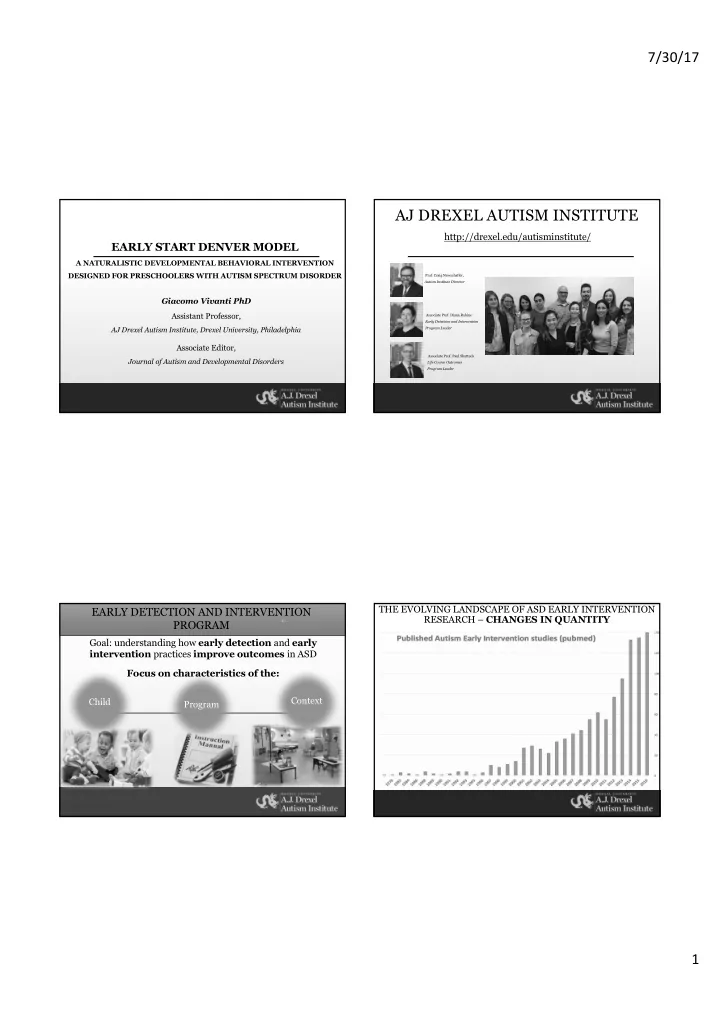
THE EVOLVING LANDSCAPE OF ASD EARLY INTERVENTION RESEARCH – CHANGES IN QUANTITY

More studies published between 2013 and 2017 than in the previous 3 decades combined

ABA/DTT (Smith et al., 2000)

THE EVOLVING LANDSCAPE OF ASD EARLY INTERVENTION RESEARCH – CHANGES IN QUALITY

MODELS SUPPORTED BY AT LEAST ONE RANDOMIZED CONTROLLED TRIAL
ABA/DTT (Smith et al., 2000) LEAP (Strain & Bovery, 2011) ESI/SCERTS (Wetherby et al., 2014) JASPER (Kasari et al., 2010, 2014) PLAY (Solomon et al., 2014) PACT (Pickles et al., 2016) ESDM (Dawson et al., 2010) TEACCH (Turner-Brown et al., 2016) PRT (Hardan et al., 2015) IMPACT (Ingersoll et al., 2016) Adapted Responsive Teaching (Baranek et al., 2016) Joint Attention Mediated Learning (Schertz et al., 2013)

THE EVOLVING LANDSCAPE OF ASD EARLY INTERVENTION RESEARCH – CHANGES IN QUALITY

MODELS SUPPORTED BY AT LEAST ONE RANDOMIZED CONTROLLED TRIAL

ABA/DTT (Smith et al., 2000) LEAP (Strain & Bovery, 2011) ESI/SCERTS (Wetherby et al., 2014) JASPER (Kasari et al., 2010, 2014) PLAY (Solomon et al., 2014) PACT (Pickles et al., 2016) ESDM (Dawson et al., 2010) TEACCH (Turner-Brown et al., 2016) PRT (Hardan et al., 2015) IMPACT (Ingersoll et al., 2016) Adapted Responsive Teaching (Baranek et al., 2016) Joint Attention Mediated Learning (Schertz et al., 2013)

THE EVOLVING LANDSCAPE OF ASD EARLY INTERVENTION RESEARCH – CHANGES IN QUALITY

MODELS SUPPORTED BY AT LEAST ONE RANDOMIZED CONTROLLED TRIAL

slide-3
SLIDE 3

7/30/17 3

EARLY START DENVER MODEL (ROGERS AND COLLEAGUES)

Those who fall in love with practice without science are like a sailor who enters a ship without a helm or a compass, and who never can be certain whither he is going (Leonardo Da Vinci, circa 1490)

  • RESEARCH ¡INFORMING ¡ESDM
  • ESDM ¡PRACTICES ¡
  • ESDM OUTCOME ¡RESEARCH
  • RESEARCH ¡INFORMING ¡ESDM
  • ESDM ¡PRACTICES ¡
  • ESDM OUTCOME ¡RESEARCH
slide-4
SLIDE 4

7/30/17 4

vEarly intervention focuses on facilitating the acquisition (learning) of novel skills in children with ASD vTherefore, interventions should evolve when our knowledge

  • n how children with ASD learn changes

vLack of cross-fertilization between research and practice – 80% of applied research in ASD fails to cite basic science research, and viceversa

NEED TO EXPAND RESEARCH KNOWLEDGE TO INFORM EFFECTIVE INTERVENTIONS

(Kazdin, 1999; Vivanti, 2017, Curr Dir Psychol Sci; Vivanti & Nuske, 2016, Behav Brain Res; Critchfield et al., 2015)

  • Early learning driven by selective responsivity to:
  • 1. Ostensive pedagogical cues, including:
  • Verbal Labels (Baldwin & Markman, 1989; Bloom, 2002)
  • Eye-Contact and gaze cues (Csibra & Gergely, 2011; Wang et al., 2010 )
  • Affect (Nielsen et al, 2008; Brand & Shallcross, 2008)
  • Goals (Over & Carpenter, 2012)

2. Novelty versus repetition (Stahl & Feigenson, 2015; Mather, 2013)

RESEARCH ON THE SELECTIVE NATURE OF EARLY LEARNING

(Vivanti & Rogers, 2014, Phil Trans R Soc B; Vivanti et al., 2017, Cognition)

Children with ASD can and do learn – not a learning disability

  • Intact ability to learn from own actions via trial & error (Vivanti et al 2016, Mol Aut)
  • Intact implicit learning (Foti, Vivanti et al 2015, Psych Med)

EARLY ¡LEARNING ¡IN ¡AUTISM ¡SPECTRUM ¡DISORDER

However difficulties in social learning – learning from (and about) actions and communication of other people

(Vivanti & Rogers, 2014; Vivanti, Dawson & Rogers, 2017) Children with ASD can and do learn – not a learning disability

  • Intact ability to learn from own actions via trial & error (Vivanti et al 2016, Mol Aut)
  • Intact implicit learning (Foti, Vivanti et al 2015, Psych Med)

EARLY ¡LEARNING ¡IN ¡AUTISM ¡SPECTRUM ¡DISORDER

However difficulties in social learning – learning from (and about) actions and communication of other people Early differences in early emerging preferences and responses that support social learning ‘System preferences’ facilitating learning in typical development are reversed More independent as children, but in most cases more dependent as adults

(Vivanti & Rogers, 2014; Vivanti, Dawson & Rogers, 2017)

slide-5
SLIDE 5

7/30/17 5

Ability ¡for ¡Social ¡Learning Motivation ¡for ¡Social ¡Learning Social ¡Modulation ¡of ¡Learning

Attention to the demonstration

10 20 30 40 50 60 70 80 90 Action Face ASD ID TD

F ¡(2, ¡54)=4.55;Ϳ ¡p=0.01, ¡η2= 0.15

F (2,60)=12.89; p <0.001, η2=0.30 F (2 (2,58)= )=10.68, p p <0. <0.001, 001, η2=0. 2=0.49 49 Fre Frequency St Style

slide-6
SLIDE 6

7/30/17 6

Fixation Duration Number of Trials Fixation Duration Fixation Duration Number of Trials

ASD WS TD

Group X Condition interaction F (2, 74) = 4.61, p =.01. η2p = .11 Number of Trials

P = ¡.001, ¡η2 ¡= ¡.20 P < ¡.05, ¡η2 ¡= ¡.09 Visual ¡Attention Performance

DD ASD

slide-7
SLIDE 7

7/30/17 7

Group X Condition interaction (F(1,38) = 9.42, p = .004, η 2 = .20)

Playful vs Neutral Model - WS

Social vs Instrumental Imitation

Group X Condition Interaction – F (2, 52)=5.5; p<0.05, η2= .09

(Vivanti et al., 2016, Mol Aut)

slide-8
SLIDE 8

7/30/17 8

Learning by watching vs learning by doing

  • No group differences between ASD and WS
  • TD at ceiling

Playful vs Non-Playful Imitation

Non-playful model Playful model

Gr Group F F (2, , 52 52)= )=12 12.61 61; ; p<0. 0.001 01, , η2= 2= .2 Gr Group X X Co Condition Interaction – F F (2, , 52 52)= )=5.5; ; p=0. 0.02, , η2= .1

slide-9
SLIDE 9

7/30/17 9

Group X Condition Interaction - F (2, 60)=4.23; p=0.01, η2

p = 0.13

Visual attention

(Vivanti et al., 2016b, JNDD)

Goal understanding

P = .001, η2 = .29

Importance of individual differences

(Vivanti et al., 2014, Exp Brain Research)

Same response to goal-directed and non goal-directed actions (in TD p <.001)

(Pokorny et al., 2015, Autism Research)

Implications for teaching practices

v Visual attention and learning less modulated by pedagogical cues and novelty v Relevance of goals v Individual differences v Implication for teaching

slide-10
SLIDE 10

7/30/17 10

  • RESEARCH ¡INFORMING ¡ESDM
  • ESDM ¡PRACTICES ¡
  • ESDM OUTCOME ¡RESEARCH

“Denver Model” Sally Rogers and colleagues, 1984 “Early Start Denver Model” Rogers & Dawson, 2010

Early ¡Start ¡Denver ¡Model

Comprehensive comprehensive early intervention for toddlers with autism ages 12–48 months.

Imitation Social Orientation Joint Attention Emotion Sharing Communication Social ¡Learning ¡ Infrastructure CRITICAL TREATMENT TARGETS Behaviors that enable social learning and engagement in naturalistic social interaction and cooperative activities

Curriculum follows Developmental Sequences Scaffolding, shared control, use of child-preferred activities for meaning, motivation and reward

ESDM - DEVELOPMENTAL APPROACH

slide-11
SLIDE 11

7/30/17 11

v Teaching episodes are embedded in daily routines and playful social interaction (Joint Activity Routines) v Active experiential learning promoted by following children’s preferences and motivation v Social-pragmatic view of language development v ABA strategies (ABC, fading, prompting etc..) v Data-driven (including, individualized goals, fidelity, decision tree)

ESDM PRINCIPLES

ESDM ¡– TREATMENT ¡PRACTICES

Table ¡1 ¡– Commonalities ¡and ¡differences ¡between ¡ABA/DTT ¡and ¡ESDM ¡instructional ¡approaches

Shared ¡Principles ¡and ¡Strategies Differences ¡in ¡Teaching ¡Procedures Individualization of treatment goals Comprehensive Intensity Manualized teaching practices and fidelity systems Data-based monitoring of progress Three-part contingency structure (Antecedent, Behavior, Consequence) Use of behavioral techniques (e.g. prompting, fading, shaping)

DTT ESDM Adult-directed

adult selects teaching materials, settings, activity and reinforcers

Shared control

adult builds learning

  • pportunities on child’s

spontaneous interest

Extrinsic Reinforcers

consequence of the desired behavior is an external reward, (e.g. token, edible)

Intrinsic Reinforcers

desired behavior occurs in the context of inherently rewarding social interactions

Discrete Trial format

adult delivers stripped- down, concise, and unambiguous instructional cues

Joint Activity Routine format

adult displays animated/playful facial emotions and body language when delivering instructional cues

THE STARTING POINT – EVALUATION: ESDM CURRICULUM CHECKLIST

  • ESDM Curriculum Checklist:

Criterion-referenced tool which provides developmental sequences of skills in 8 domains

  • 480 items organized in 4 levels:
  • 9-12 up to 48 month period
  • Placement of items across levels

reflects typical child development research and clinical experience FRAMEWORK FOR TEACHING: JOINT ACTIVITY ROUTINES

  • Follows child choice or interest
  • Both partners engage in activity
  • Targets multiple objectives from different domains
  • Brief, 2-4 minutes in length

qStep 1:Set Up (Develop a theme) qStep 2: Theme (Take turns, collaborate) qStep 3: Add variations (increase play complexity, expand child repertoire, target multiple objectives, build up flexibility) qStep 4: Close the activity and transition to new one

slide-12
SLIDE 12

7/30/17 12

EARLY START DENVER MODEL (ROGERS AND COLLEAGUES) GROUP-BASED EARLY START DENVER MODEL

Focused on facilitating learning within small groups through guided peer interaction (1:3/1:4) Target: community childcare/preschool programs Rationale vSmall group environments more consistent with common cultural practices vPeers and childcare teachers - untapped resources vConcerns with sustainability of 1:1 vConcerns with parent-implemented programs vMore opportunities to target goals needed in the next learning environment, including:

vFollowing shared daily routines vParticipating in group activities vSocial engagement and play with peers vDaily living and safety skills (e.g., hat!)

(Rogers & Lewis 1989; Rogers, 1998; Rogers & Dawson, 2010)

Fostering peer interactions

Set Up: § Physical positioning § Parallel play with double toy sets § Materials as magnets § Adults as “invisible supports” Circle games Goals: § Giving materials to peers § Taking materials from peers § Showing objects § Asking for a turn § Asking for an object § Saying “no”, “mine”, “not yet” or “in a minute” § Responding to peer greetings

FROM ESDM TO G-ESDM - KEY ADAPTATIONS

vLow staff-to-child ratios (1:3 – 1:4) vIndividual goals are targeted within small group activities vActivity centers vDifferent levels of training in the team

slide-13
SLIDE 13

7/30/17 13

  • RESEARCH ¡INFORMING ¡ESDM
  • ESDM ¡PRACTICES ¡
  • ESDM OUTCOME ¡RESEARCH

48 Children < 2.5 years of age ESDM vs. Community, 2 year intervention – 25 hr/week

Effects of Intervention on Expressive Language

Dawson, et al., Pediatrics 2010

NS p < .05

Severity of ASD moderates outcomes, but those with more severe ASD improve in ESDM

Changes in IQ with intervention Dawson, ¡et ¡al., ¡Pediatrics, ¡2010

slide-14
SLIDE 14

7/30/17 14

  • Follow-­‑up ¡of ¡the ¡same ¡children, ¡two ¡years ¡after

During treatment, costs for children in the ESDM group was higher by about $14,000 than those of children who received community-based treatment. In the post-intervention period, compared with children who had earlier received treatment as usual in community settings, children in the ESDM group needed less services, resulting in cost savings of about $19,000 per year per child. Costs associated with ESDM treatment were fully offset within a few years after the intervention due to reductions in other service use and associated costs. Outcome study TD=17 ESDM=24 Comm=24

12 wks, 1 hr clinic sessions involving collaborative parent coaching

slide-15
SLIDE 15

7/30/17 15

7 infants (7-15 month olds) symptomatic of ASD: sibs, clinical referrals Consistently elevated scores and parent and expert clinician concerns Parent coaching model 12 weeks, 1 session per week Post-treatment fewer ASD symptoms compared to controls, But more than typical children All children except for 1 in the typical cognitive range

*p <.05

20# 30# 40# 50# 60# 70# 80# Baseline# #12#months#

MSEL Developmental Quotient

ESDM# Control# 0" 2" 4" 6" 8" 10" Baseline" "12"months"

ADOS CSS

ESDM" Control"

p<.05

20# 30# 40# 50# 60# 70# 80# Baseline# #12#Months#

MSEL Receptive Language DQ

ESDM# Control#

Developmental Rate: Individual Gains in Mullen Overall AE (n=96) Developmental Rate: Individual Gains in Mullen Overall AE (n=96)

10 % Limited gains

slide-16
SLIDE 16

7/30/17 16

Developmental Rate: Individual Gains in Mullen Overall AE (n=96)

10% ¡Limited ¡gains 38 ¡% ¡Significant ¡progress ¡but ¡developmental ¡rate ¡not ¡in ¡keeping ¡with ¡typical ¡dev. ¡norms

Developmental Rate: Individual Gains in Mullen Overall AE (n=96)

10% ¡Limited ¡gains 38 ¡% ¡Significant ¡progress ¡but ¡developmental ¡rate ¡not ¡in ¡keeping ¡with ¡typical ¡dev. ¡norms 31 ¡% ¡‘Normal’ ¡developmental ¡rate ¡

Developmental Rate: Individual Gains in Mullen Overall AE (n=96)

10% Limited gains 38 % Significant progress but developmental rate not in keeping with typical dev. Norms 31 % Normal’ developmental rate 21 % Acceleration of developmental rate

Which Factors drive outcomes?

slide-17
SLIDE 17

7/30/17 17

ARISTOTLE (340 BC) “IT IS EASY TO KNOW THE EFFECTS OF HONEY, WINE AND OTHER REMEDIES. BUT TO KNOW HOW, FOR WHOM, AND WHEN WE SHOULD APPLY THESE AS REMEDIES IS NO LESS AN UNDERTAKING THAN BEING A PHYSICIAN”

r ¡=.02, ¡ ¡p = ¡.45 r ¡= ¡-­‑.56, ¡ ¡p = ¡.001

Language gains predicted by the combined effect of age and initial language level (R square increase due to interaction F=4.52, p<.05)

Impact of setting – inclusive vs segregated

Inclusive ASD ¡only

  • Pilot RCT - 16 children receiving Group-ESDM in a mainstream (inclusive)

setting and 16 in an ASD-only (segregated) setting

  • Sustained Shared Thinking and Emotional Well-Being scale (Siraj et al., 2015)
slide-18
SLIDE 18

7/30/17 18

The ¡Victorian ¡ASELCC ¡team, ¡OTARC ¡team ¡and ¡Drexel ¡EDI ¡team Sally ¡J ¡Rogers Cheryl ¡Dissanayake Tristram Smith Lynn ¡Koegel David ¡Mandell Connie ¡Kasari Heather ¡Nuske Darren ¡Hocking Peter ¡Fanning All ¡the ¡children ¡who ¡took ¡part ¡in ¡their ¡research ¡and ¡their ¡families ¡!

Thank you for your attention!

giacomo.vivanti@drexel.edu