AIRS Outreach Jet Propulsion Laboratory California Institute of - - PowerPoint PPT Presentation

airs outreach
SMART_READER_LITE
LIVE PREVIEW

AIRS Outreach Jet Propulsion Laboratory California Institute of - - PowerPoint PPT Presentation

AIRS Outreach Jet Propulsion Laboratory California Institute of Technology Science Team Meeting Oct 2008 - Sharon Ray 1 The New AIRS Web Site Jet Propulsion Laboratory California Institute of Technology Launched 9/29/08 Check out the new AIRS


slide-1
SLIDE 1

Jet Propulsion Laboratory California Institute of Technology
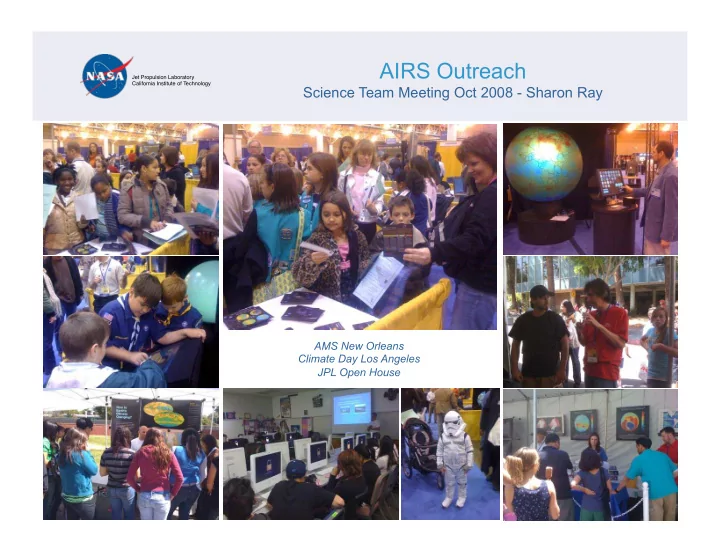
1

AIRS Outreach

Science Team Meeting Oct 2008 - Sharon Ray

slide-2
SLIDE 2

Jet Propulsion Laboratory California Institute of Technology

2

The New AIRS Web Site

Launched 9/29/08

Check out the new AIRS web site at airs.jpl.nasa.gov

slide-3
SLIDE 3

Jet Propulsion Laboratory California Institute of Technology

3

The New AIRS Web Site

slide-4
SLIDE 4

Jet Propulsion Laboratory California Institute of Technology

4

The New AIRS Web Site

  • Serving the Public & the Science Communities
  • Overviews, Stories, Maps, Rapid Reponse, Multimedia
  • Major Findings, Papers, Extensive Data Information, AskAIRS, FAQ
  • New Organization
  • Easy access
  • Get imagery the way you want it. Organized by:

geophysical data product, natural hazard, visualizations, animations, video

  • New Look
  • Lots of visuals with links to NASA databases
  • New Features
  • Maps In Motion: archive of the “pretty version” of 10 data products from the

beginning of the mission

  • Maps from Satellite Feed coming soon: daily images of 6 data products.

Image is zeroed out at night, builds up during the day as granules come in

  • Science News
  • FAQ
  • Publications Database
  • Efficient Image Archive Strategy
  • Fast updates
  • iWeb development environment
slide-5
SLIDE 5

Jet Propulsion Laboratory California Institute of Technology

5

The New AIRS Web Site

More content please

  • Papers
  • Publications Database
  • possible web feature (home page headline)
  • Feature stories
  • Home page headline
  • Could feed to the Global Climate Change web site
  • Science News
  • informal, to highlight an image, field campaign, anything
  • latest papers
  • Video
  • build up our scientist interviews gallery
  • Multimedia Gallery
  • add your image/movie/plot

Cyril Corvouisier Andrew Dessler Larrabee Strow Mitch Goldberg Walter Wolff David Neilan Chris Barnet Mous Chahine Andrew Gettleman Laura Pan

slide-6
SLIDE 6

Jet Propulsion Laboratory California Institute of Technology

6

  • 1.2 million hits/99,000 page views in

first two weeks

  • Already a top 10 Google search result

for ‘Global Climate Change’

  • Earth Vital Signs Widget: Number 9
  • ut of over 3,700 widgets
  • n Apple.com
  • Solid following on Twitter

http://climate.jpl.nasa.gov

Global Climate Change Web Site

Launched June 15, 2008

slide-7
SLIDE 7

Jet Propulsion Laboratory California Institute of Technology

7

News…key climate change indicators…interactives… videos…NASA’s role in climate science research

http://climate.jpl.nasa.gov

A Focus on Visual Elements

slide-8
SLIDE 8

Jet Propulsion Laboratory California Institute of Technology

8

Strong Reviews from Media, Web Pundits, and Users

Earth Vital Signs Widget: Number 9

  • ut of over 3,700 widgets
  • n Apple.com

Dozens of articles; 300+ blog postings

A solid following on Twitter

Reaching into the Web 2.0 World

I plan to have it a classroom staple.

–J.R.Waring, Earth science teacher

The “Climate Time Machine”…. will knock your socks off.

–Greg Laden, Science and Engineers for America

slide-9
SLIDE 9

Jet Propulsion Laboratory California Institute of Technology

9

Target Outlets

  • The Web
  • AIRS, Global Climate Change, JPL Home, Earth Observatory,

NASA Home, NASA Earth

  • Discovery EarthLive, Google Earth
  • Wikipedia
  • Print
  • Weatherwise
  • Radio
  • Broadcast
  • Event-driven visualizations for News outlets
  • CO visualization on KNBC
  • AIRS hurricane image on Fox News
slide-10
SLIDE 10

Jet Propulsion Laboratory California Institute of Technology

10

News Release:

NASA Maps Shed Insights Into Its Global Nature

  • Issued October 9

October 09, 2008PASADENA, Calif.

  • A NASA/university team has published the first

global satellite maps of the key greenhouse gas carbon dioxide in Earth's mid-troposphere, an area about 8 kilometers, or 5 miles, above

  • Earth. The team's study reveals new information
  • n how carbon dioxide, which directly

contributes to climate change, is distributed in Earth's atmosphere and moves around our world.

Chahine, M. T., L. Chen, P. Dimotakis, X. Jiang, Q. Li, E. T. Olsen, T. Pagano, J. Randerson, and Y. L. Yung (2008), Satellite remote sounding of mid-tropospheric CO2, Geophys. Res. Lett., 35, L17807, http://dx.doi.org/10.1029/2008GL035022 9 September 2008

slide-11
SLIDE 11

Jet Propulsion Laboratory California Institute of Technology

11

Web Stats

September 2008 October 1-12, 2008

  • News Release Issued October 9
slide-12
SLIDE 12

Jet Propulsion Laboratory California Institute of Technology

12

Web Stats

As of October 12

  • Google Search Terms
  • carbon dioxide: 19th
  • carbon dioxide map: 4th; 3 of the first 10
  • carbon dioxide map - images: 7th, 9th of 449k results
  • Yahoo Search Terms
  • carbon dioxide: -
  • carbon dioxide map: 3rd, 4th of 16.5 million results
  • carbon dioxide map - images: 24th of 504 results
  • Cited on 184 blogs
slide-13
SLIDE 13

Jet Propulsion Laboratory California Institute of Technology

13

Hurricane Rapid Response

  • AIRS supplied 41 of the 60 images used by the NASA Hurricane portal so far

during the 2008 Hurricane Season

  • NASA Hurricane Page - almost half a million visitors in September
  • The NASA Hurricane page pulled in 495,979 hits in the month of September (per Rob

Garner, NASA Goddard web master)

slide-14
SLIDE 14

Jet Propulsion Laboratory California Institute of Technology

14

New Visualization

Carbon Monoxide from California’s Wildfires

Visualization of the rapid increases in carbon monoxide (CO) emitted by fires burning in California in June and July 2008. Only the largest values of CO detected by AIRS are shown to highlight the impact of the fires. AIRS primarily observes CO in a layer from 2 to 7 kilometers above Earth's

  • surface. Thus, it tends to see where the wind blows the carbon monoxide and not just the smoke

directly above the fires. However, many of these intense fires lofted a significant amount of carbon monoxide directly above the fires, making the hotspots also visible to AIRS.

slide-15
SLIDE 15

Jet Propulsion Laboratory California Institute of Technology

15

New Visualization

CO2 with Mauna Loa Data Overlaid AIRS Sees Belt of CO2 in Southern Hemisphere, July 2003

  • Created by Lori Perkins, GSFC SVS
slide-16
SLIDE 16

Jet Propulsion Laboratory California Institute of Technology

16

New Visualization

Three-Dimensional View Of Water Vapor Transport Along A Pacific Basin Atmospheric River, January 4, 2005

slide-17
SLIDE 17

Jet Propulsion Laboratory California Institute of Technology

17

New Visualization

Three-Dimensional View Of Water Vapor Transport Along A Pacific Basin Atmospheric River, January 4, 2005

The development of a plug-in prototype GIS tool had, as a science driver, a case study examining the role of water vapor transport along an atmospheric river across the Pacific Basin in January

  • 2005. During this time period an extreme precipitation event was produced. This event caused

significant amounts of rain to fall over much of California, triggering mudslides that resulted in millions of dollars of damage and a dozen deaths. The study characterized the three-dimensional distribution of water vapor during the event and related surface winds and height-resolved water vapor to coastal rainfall. Measurements were supplied by a host of spaceborne instruments and one ground-based instruments. These measurements consisted of: water vapor from the AIRS instrument, surface winds from QuikSCAT, precipitation from TRMM, sea surface temperature from GHRSST, and integrated water vapor from SCIGN ground-based GPS. Back-in-time trajectories were provided by HYSPLIT. In this figure, a granule of AIRS water vapor data was subsetted to show the points with highest values of water vapor in the northeastern Pacific. These measurements are shown as a point cloud superimposed on a background of GHRSST sea surface temperatures, TRMM precipitation, and QuikSCAT wind vectors. To the right of the image, water vapor amounts from the SCIGN GPS network are shown color- coded by absolute magnitude for various stations. Back trajectories from the NOAA HYSPLIT model are shown as dotted lines, indicating the relationship between the atmospheric water vapor

  • ver the Pacific and water vapor over land. A histogram of the AIRS data values is also shown in

the top center of the image.

slide-18
SLIDE 18

Jet Propulsion Laboratory California Institute of Technology

18

Carbon Markets Insights Conference

“Point Carbon is a world-leading provider of independent news, analysis and consulting services for European and global power, gas and carbon markets.” “...the number one supplier of unrivaled market intelligence of these markets.” “Our staff includes experts in international and regional climate policy, mathematical and economic modeling, forecasting methodologies, risk management and market reporting.”

  • New Audience
  • Congressional staffers, venture capitalists, policy makers
  • Objective
  • Convey that JPL is a leader in the remote sensing of CO2
  • unbiased, global data that is free
  • introduce existing data (AIRS) and new missions (OCO & Ascends)
  • AIRS & OCO presence, booth
  • Staffed by Tom Pagano & Sharon Ray (AIRS), Stacey Boland OCO
slide-19
SLIDE 19

Jet Propulsion Laboratory California Institute of Technology

19

Book:

Atmospheric Science at NASA - A History

  • Chronicles the history of atmospheric science at NASA
  • traces the story from its beginnings in 1958, the International Geophysical Year, through to the

present, focusing on NASA's programs and research in meteorology, stratospheric ozone depletion, and planetary climates and global warming. But the story is not only a scientific one.

  • NASA's researchers operated within an often politically contentious environment. Although

environmental issues garnered strong public and political support in the 1970s, the following decades saw increased opposition to environmentalism as a threat to free market capitalism.

  • Critically examines this politically controversial science
  • Dissects the often convoluted roles, motives, and relationships of the various institutional

actors involved -- among them NASA, congressional appropriation committees, government weather and climate bureaus, and the military. "The author does an excellent job of telling this story -- translating the science into prose, characterizing the various personalities and institutions, organizing the convoluted tale into a narrative, and assessing interactions of multifarious factors. The work... will stand as a significant contribution to the literature. Much of the story has not yet been told, or if it has, certainly not in this detail or scope. It is likely to rank high in the top score or so of books devoted to the history of space science."

  • - Joseph N. Tatarewicz, University of Maryland, Baltimore County

Johns Hopkins University Press http://www.press.jhu.edu/books/title_pages/9567.html