
SLIDE 1
Air Monitoring, Advisories, and Public Health Information on Vog
John Peard, HDOH, HEER Office
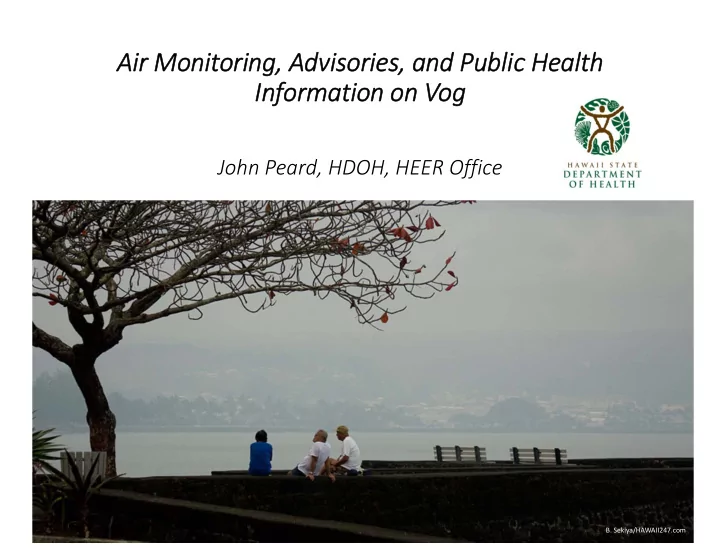
- B. Sekiya/HAWAII247.com
Air Monitoring, Advisories, and Public Health Information on Vog - - PowerPoint PPT Presentation
Air Monitoring, Advisories, and Public Health Information on Vog John Peard, HDOH, HEER Office B. Sekiya/HAWAII247.com HDOH Air Monitoring Station on Konawaena School Road, Upper Campus of the High School
HDOH Air Monitoring Station on Konawaena School Road, Upper Campus of the High School
http://www.hiso2index.info/assets/FinalSO2Exposurelevels.pdf
SULFUR DIOXIDE ACTION PLAN
CONDITION SCHOOL ACTION
Green Good 0.0 – 0.2 ppm
1) Maintain normal school operations 2) Monitor air quality 3) Notify health room if staff/students are in need of medical attention 4) Affected staff/students will be evaluated by school health aide with reference to Respiratory Action Plan (RAP)
Yellow Moderate 0.2 – 0.4 ppm
1) Maintain normal school operations 2) Monitor air quality 3) Notify health room if staff/students are in need of medical attention 4) Affected staff/students will be evaluated by school health aide with reference to Respiratory Action Plan (RAP) 5) Updates will be made every hour or as needed
Orange Unhealthy for Sensitive Groups 0.4 – 1.0 ppm
1) Limit outdoor exposures by conducting indoor activities (Recess, PE) 2) Conduct Shelter in Place Procedures 3) Monitor air quality 4) Notify health room if staff/students are in need of medical attention 5) Affected staff/students will be evaluated by school health aide with reference to Respiratory Action Plan (RAP) 6) Updates will be made every hour or as needed
Red Unhealthy 1.0 – 3.0 ppm
1) Limit outdoor exposures by conducting indoor activities (Recess, PE) 2) Monitor air quality 3) Notify health room if staff/students are in need of medical attention 4) Affected staff/students will be evaluated by school health aide with reference to Respiratory Action Plan (RAP) 5) Updates will be made every hour or as needed
Purple Very Unhealthy 3.0 – 5.0 ppm
1) Conduct Shelter in Place (School‐Wide Safer Room Procedure) 2) Monitor air quality 3) Notify health room if staff/students are in need of medical attention 4) Affected staff/students will be evaluated by school health aide with reference to Respiratory Action Plan (RAP) 5) Updates will be made every hour or as needed 6) Communicate with district office on current conditions and next steps
Maroon Hazardous 5.0+ ppm
1) Conduct Shelter in Place (School‐Wide Safer Room Procedure) 2) Monitor air quality 3) Notify health room if staff/students are in need of medical attention 4) Affects staff/students will be evaluated by school health aide with reference to Respiratory Action Plan (RAP) 5) Updates will be made every hour or as needed 6) Communicate with district office on current conditions and next steps
Claire Horwell
Sulfur Dioxide Gas
Breath
Ailments
dizziness Fine Particle Pollution
Breath
vog conditions, keep medications at hand if you have asthma or other respiratory conditions
pollutants and heat
advice