AI showcase: Summerization Examples of if-statements in Python - - PDF document

ai showcase summerization examples of if statements in
SMART_READER_LITE
LIVE PREVIEW

AI showcase: Summerization Examples of if-statements in Python - - PDF document

AI showcase: Summerization Examples of if-statements in Python simple: multi-way: Task: Check the online versions of various newspapers to identify if x==bye : current topics. Write one summary article per topic. if x > y : print


slide-1
SLIDE 1

1

AI showcase: Summerization

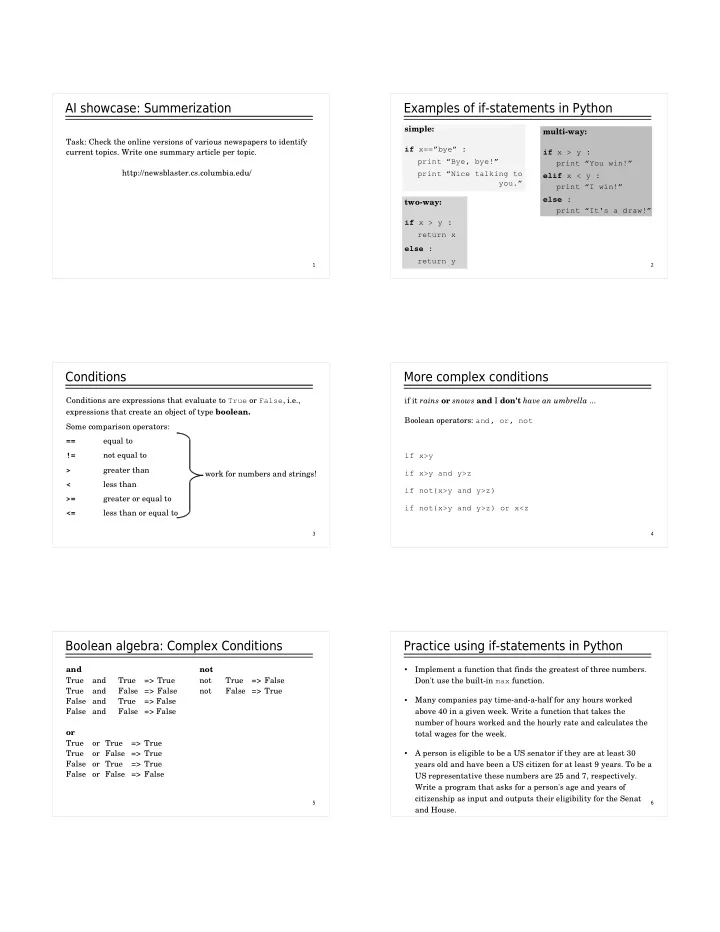
Task: Check the online versions of various newspapers to identify current topics. Write one summary article per topic. http://newsblaster.cs.columbia.edu/

2

Examples of if-statements in Python

simple: if x==”bye” : print “Bye, bye!” print “Nice talking to you.” two-way: if x > y : return x else : return y multi-way: if x > y : print “You win!” elif x < y : print “I win!” else : print “It's a draw!”

3

Conditions

Conditions are expressions that evaluate to True or False, i.e., expressions that create an object of type boolean. Some comparison operators: == equal to != not equal to > greater than < less than >= greater or equal to <= less than or equal to work for numbers and strings!

4

More complex conditions

if it rains or snows and I don't have an umbrella ... Boolean operators: and, or, not if x>y if x>y and y>z if not(x>y and y>z) if not(x>y and y>z) or x<z

5

Boolean algebra: Complex Conditions

and True and True => True True and False => False False and True => False False and False => False

  • r

True or True => True True or False => True False or True => True False or False => False not not True => False not False => True

6

Practice using if-statements in Python

  • Implement a function that finds the greatest of three numbers.

Don't use the built-in max function.

  • Many companies pay time-and-a-half for any hours worked

above 40 in a given week. Write a function that takes the number of hours worked and the hourly rate and calculates the total wages for the week.

  • A person is eligible to be a US senator if they are at least 30

years old and have been a US citizen for at least 9 years. To be a US representative these numbers are 25 and 7, respectively. Write a program that asks for a person's age and years of citizenship as input and outputs their eligibility for the Senat and House.

slide-2
SLIDE 2

7

loops

... carry out some instructions repeatedly go 10 steps north go north until you see the wall go north as long as you don't see the wall

9

Practice using while-loops

  • Write an algorithm that sums up all numbers from 0 to 100
  • Write an algorithm that reads in numbers from the user and

calculates the average of those numbers. The algorithm should keep reading in numbers until the user says that he has no more numbers.

  • Write an algorithm that reads in numbers from the user and

sums them up until the sum is greater than 1000.

10

while-loops in Python

while <condition>: <statements> x = 0 while x != 10: print x x = x + 1 x = raw_input(“Type sth: “) while x != “quit”: print x x = raw_input(“Type more: “)

11

Practice using while-loops in Python

  • Write a program that reads in numbers from the user and sums

them up until the sum is greater than 1000. It then prints out the sum and the average of those numbers.

  • Another number guessing game: The computer randomly

generates a number. Then it asks the user to input a number and tells the user whether this number is smaller or greater than the randomly generated number. The user gets to guess again and gets feedback again, and this is repeated until the user guesses the right number.

  • The Fibonacci sequence starts 1, 1, 2, 3, 5, 8, ... . Each number

in the sequence (after the first two) is the sum of the previous

  • two. Write a program that computes and outputs the nth

Fibonacci number, where n is a number entered by the user.

Essential computer architecture schema

slide-3
SLIDE 3

13

Practice Working with Strings

  • Write a function that takes a string as parameter and replaces all
  • ccurrences of a by o.
  • Write a function that takes a string and replaces all vowels by o.
  • Make up five keywords. Write a function that takes a string and

checks whether one of these five keywords appears in the string. Have the function print out the first keyword that it finds in the string.

  • Do the same as before but have the function print out all of the

keywords that occur in the string.

  • Write a function that takes a string and encodes it into ASCII. I.e., for

every letter in the string it prints out its ASCII number. (Hint: You have to use a loop to go through the string letter by letter.)

14

Practice Pattern Matching

Test your patterns by trying to match it on various strings (re.search(<pattern>, <string>)).

  • Write a pattern finds all variants of the verb like in a string,

i.e., liked, likes, liking.

  • Write a pattern that matches any of the following sequences:

Paul likes ... . Paul hates ... . Mary likes ... . Mary likes ... . Mary doesn't like ... . Mary doesn't like ... . Paul doesn't like ... . Paul doesn't like ... .

15

More Pattern Matching Exercises

  • Write a function that takes a string and then checks whether it

matches the paul-mary-like-hate pattern that you defined

  • previously. If it does print a response in the following style:

paul likes pizza => mary hates pizza mary hates pizza => paul likes pizza mary does not like pizza => paul likes pizza

  • Think of an inputer-response-patterns that you remember from
  • Eliza. Write a function that takes a string as parameter, checks

whether this pattern matches, and if so, outputs the appropriate response.