Agents that Plan Reflex Agents Reflex agents: Choose - - PowerPoint PPT Presentation

agents that plan reflex agents
SMART_READER_LITE
LIVE PREVIEW

Agents that Plan Reflex Agents Reflex agents: Choose - - PowerPoint PPT Presentation

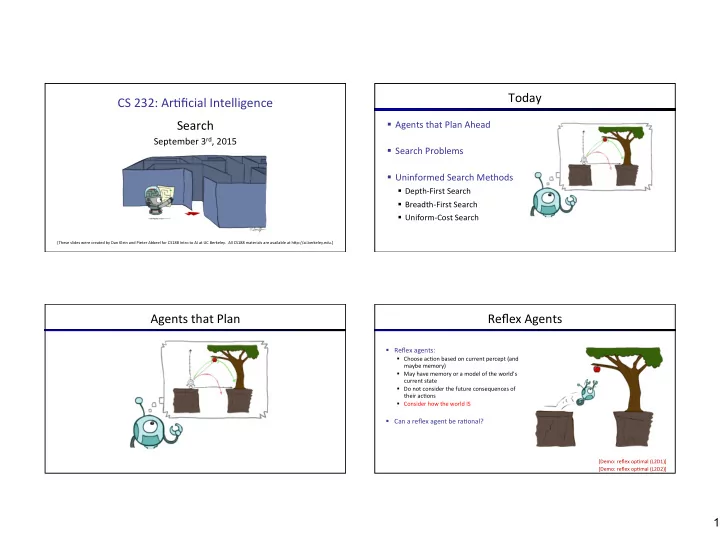
Today CS 232: Ar)ficial Intelligence Search Agents that Plan Ahead September 3 rd , 2015 Search Problems Uninformed Search Methods


slide-1
SLIDE 1

1

CS ¡232: ¡Ar)ficial ¡Intelligence ¡

¡

Search ¡

September ¡3rd, ¡2015 ¡

[These ¡slides ¡were ¡created ¡by ¡Dan ¡Klein ¡and ¡Pieter ¡Abbeel ¡for ¡CS188 ¡Intro ¡to ¡AI ¡at ¡UC ¡Berkeley. ¡ ¡All ¡CS188 ¡materials ¡are ¡available ¡at ¡hMp://ai.berkeley.edu.] ¡

Today ¡

§ Agents ¡that ¡Plan ¡Ahead ¡ § Search ¡Problems ¡ § Uninformed ¡Search ¡Methods ¡

§ Depth-­‑First ¡Search ¡ § Breadth-­‑First ¡Search ¡ § Uniform-­‑Cost ¡Search ¡

Agents ¡that ¡Plan ¡ Reflex ¡Agents ¡

§ Reflex ¡agents: ¡

§ Choose ¡ac)on ¡based ¡on ¡current ¡percept ¡(and ¡ maybe ¡memory) ¡ § May ¡have ¡memory ¡or ¡a ¡model ¡of ¡the ¡world’s ¡ current ¡state ¡ § Do ¡not ¡consider ¡the ¡future ¡consequences ¡of ¡ their ¡ac)ons ¡ § Consider ¡how ¡the ¡world ¡IS ¡

§ Can ¡a ¡reflex ¡agent ¡be ¡ra)onal? ¡

[Demo: ¡reflex ¡op)mal ¡(L2D1)] ¡ [Demo: ¡reflex ¡op)mal ¡(L2D2)] ¡

slide-2
SLIDE 2

2

Video ¡of ¡Demo ¡Reflex ¡Op)mal ¡ Video ¡of ¡Demo ¡Reflex ¡Odd ¡ ¡ Planning ¡Agents ¡

§ Planning ¡agents: ¡

§ Ask ¡“what ¡if” ¡ § Decisions ¡based ¡on ¡(hypothesized) ¡ consequences ¡of ¡ac)ons ¡ § Must ¡have ¡a ¡model ¡of ¡how ¡the ¡world ¡evolves ¡in ¡ response ¡to ¡ac)ons ¡ § Must ¡formulate ¡a ¡goal ¡(test) ¡ § Consider ¡how ¡the ¡world ¡WOULD ¡BE ¡if ¡a ¡certain ¡ ac)on ¡is ¡performed ¡

§ Op)mal ¡vs. ¡complete ¡planning ¡ ¡

§ Op)mal: ¡find ¡the ¡best ¡solu)on ¡ § Complete ¡planning: ¡finds ¡a ¡solu)on ¡

§ Planning ¡vs. ¡replanning ¡

[Demo: ¡replanning ¡(L2D3)] ¡ [Demo: ¡mastermind ¡(L2D4)] ¡ Generates one single plan vs. replans at every step of the way

Search ¡Problems ¡

slide-3
SLIDE 3

3

Search ¡Problems ¡

§ A ¡search ¡problem ¡consists ¡of: ¡

§ A ¡state ¡space ¡ § A ¡successor ¡func)on ¡ ¡(with ¡ac)ons, ¡costs) ¡ § A ¡start ¡state ¡and ¡a ¡goal ¡test ¡

§ A ¡solu)on ¡is ¡a ¡sequence ¡of ¡ac)ons ¡(a ¡plan) ¡which ¡ transforms ¡the ¡start ¡state ¡to ¡a ¡goal ¡state ¡

“N”, ¡1.0 ¡ “E”, ¡1.0 ¡ How the world evolves in response to agent’s actions. A model of the world at a given point in time.

Search ¡Problems ¡Are ¡Models ¡

Important: Find the right level of abstraction, so that your model is a good model of the world.

Example: ¡Traveling ¡in ¡Romania ¡

§ State ¡space: ¡

§ Ci)es ¡

§ Successor ¡func)on: ¡

§ Roads: ¡Go ¡to ¡adjacent ¡city ¡with ¡ cost ¡= ¡distance ¡

§ Start ¡state: ¡

§ Arad ¡

§ Goal ¡test: ¡

§ Is ¡state ¡== ¡Bucharest? ¡

§ Solu)on? ¡

What’s ¡in ¡a ¡State ¡Space? ¡

§ Problem: ¡Pathing ¡

§ States: ¡(x,y) ¡loca)on ¡ § Ac)ons: ¡NSEW ¡ § Successor: ¡update ¡loca)on ¡

  • nly ¡

§ Goal ¡test: ¡is ¡(x,y)=END ¡

§ Problem: ¡Eat-­‑All-­‑Dots ¡

§ States: ¡{(x,y), ¡dot ¡booleans} ¡ § Ac)ons: ¡NSEW ¡ § Successor: ¡update ¡loca)on ¡ and ¡possibly ¡a ¡dot ¡boolean ¡ § Goal ¡test: ¡dots ¡all ¡false ¡ The ¡world ¡state ¡includes ¡every ¡last ¡detail ¡of ¡the ¡environment ¡ A ¡search ¡state ¡keeps ¡only ¡the ¡details ¡needed ¡for ¡planning ¡(abstrac)on) ¡

slide-4
SLIDE 4

4

State ¡Space ¡Sizes? ¡

§ World ¡state: ¡

§ Agent ¡posi)ons: ¡120 ¡ § Food ¡count: ¡30 ¡ § Ghost ¡posi)ons: ¡12 ¡ § Agent ¡facing: ¡NSEW ¡ ¡

§ How ¡many ¡

§ World ¡states? ¡ ¡120x(230)x(122)x4 ¡ § States ¡for ¡pathing? ¡ ¡120 ¡ § States ¡for ¡eat-­‑all-­‑dots? ¡ ¡120x(230) ¡ ¡

Quiz: ¡Safe ¡Passage ¡

§ Problem: ¡eat ¡all ¡dots ¡while ¡keeping ¡the ¡ghosts ¡perma-­‑scared ¡ § What ¡does ¡the ¡state ¡space ¡have ¡to ¡specify? ¡ ¡ ¡ ¡ ¡Solu)on: ¡ ¡

State ¡Space ¡Graphs ¡and ¡Search ¡Trees ¡ State ¡Space ¡Graphs ¡

§ State ¡space ¡graph: ¡A ¡mathema)cal ¡ representa)on ¡of ¡a ¡search ¡problem ¡

§ Nodes ¡are ¡(abstracted) ¡world ¡configura)ons ¡ § Arcs ¡represent ¡successors ¡(ac)on ¡results) ¡ § The ¡goal ¡test ¡is ¡a ¡set ¡of ¡goal ¡nodes ¡(maybe ¡only ¡one) ¡

§ In ¡a ¡state ¡space ¡graph, ¡each ¡state ¡occurs ¡only ¡

  • nce! ¡

§ We ¡can ¡rarely ¡build ¡this ¡full ¡graph ¡in ¡memory ¡ (it’s ¡too ¡big), ¡but ¡it’s ¡a ¡useful ¡idea ¡ ¡

slide-5
SLIDE 5

5

State ¡Space ¡Graphs ¡

§ State ¡space ¡graph: ¡A ¡mathema)cal ¡ representa)on ¡of ¡a ¡search ¡problem ¡

§ Nodes ¡are ¡(abstracted) ¡world ¡configura)ons ¡ § Arcs ¡represent ¡successors ¡(ac)on ¡results) ¡ § The ¡goal ¡test ¡is ¡a ¡set ¡of ¡goal ¡nodes ¡(maybe ¡only ¡one) ¡

§ In ¡a ¡search ¡graph, ¡each ¡state ¡occurs ¡only ¡once! ¡ § We ¡can ¡rarely ¡build ¡this ¡full ¡graph ¡in ¡memory ¡ (it’s ¡too ¡big), ¡but ¡it’s ¡a ¡useful ¡idea ¡ ¡

S

G d b p q c e h a f r Tiny ¡search ¡graph ¡for ¡a ¡0ny ¡ search ¡problem ¡

Search ¡Trees ¡

§ A ¡search ¡tree: ¡

§ A ¡“what ¡if” ¡tree ¡of ¡plans ¡and ¡their ¡outcomes ¡ § The ¡start ¡state ¡is ¡the ¡root ¡node ¡ § Children ¡correspond ¡to ¡successors ¡ § Nodes ¡show ¡states, ¡but ¡correspond ¡to ¡PLANS ¡that ¡achieve ¡those ¡states ¡ § For ¡most ¡problems, ¡we ¡can ¡never ¡actually ¡build ¡the ¡whole ¡tree ¡

“E”, ¡1.0 ¡ “N”, ¡1.0 ¡

This ¡is ¡now ¡/ ¡start ¡ Possible ¡futures ¡

State ¡Space ¡Graphs ¡vs. ¡Search ¡Trees ¡

S a b d p a c e p h f r q q c G a q e p h f r q q c G a

S G

d b p q c e h a f r

We ¡construct ¡both ¡

  • n ¡demand ¡– ¡and ¡

we ¡construct ¡as ¡ li:le ¡as ¡possible. ¡ Each ¡NODE ¡in ¡in ¡ the ¡search ¡tree ¡is ¡ an ¡en0re ¡PATH ¡in ¡ the ¡state ¡space ¡

  • graph. ¡

Search ¡Tree ¡ State ¡Space ¡Graph ¡

Quiz: ¡State ¡Space ¡Graphs ¡vs. ¡Search ¡Trees ¡

S

G b a

Consider ¡this ¡4-­‑state ¡graph: ¡ ¡

Important: ¡Lots ¡of ¡repeated ¡structure ¡in ¡the ¡search ¡tree! ¡

How ¡big ¡is ¡its ¡search ¡tree ¡(from ¡S)? ¡

slide-6
SLIDE 6

6

Tree ¡Search ¡ Search ¡Example: ¡Romania ¡ Searching ¡with ¡a ¡Search ¡Tree ¡

§ Search: ¡

§ Expand ¡out ¡poten)al ¡plans ¡(tree ¡nodes) ¡ § Maintain ¡a ¡fringe ¡of ¡par)al ¡plans ¡under ¡considera)on ¡ § Try ¡to ¡expand ¡as ¡few ¡tree ¡nodes ¡as ¡possible ¡

General ¡Tree ¡Search ¡

§ Important ¡ideas: ¡

§ Fringe ¡ § Expansion ¡ § Explora)on ¡strategy ¡

§ Main ¡ques)on: ¡which ¡fringe ¡nodes ¡to ¡explore? ¡

slide-7
SLIDE 7

7

Depth-­‑First ¡Search ¡ Depth-­‑First ¡Search ¡

S

a b d p a c e p h f r q q c

G

a q e p h f r q q c

G

a S G

d b p q c e h a f r q p h f d b a c e r

Strategy: ¡expand ¡a ¡ deepest ¡node ¡first ¡ Implementa0on: ¡ Fringe ¡is ¡a ¡LIFO ¡stack ¡

Search ¡Algorithm ¡Proper)es ¡

§ Complete: ¡Guaranteed ¡to ¡find ¡a ¡solu)on ¡if ¡one ¡exists? ¡ § Op)mal: ¡Guaranteed ¡to ¡find ¡the ¡least ¡cost ¡path? ¡ § Time ¡complexity? ¡ § Space ¡complexity? ¡ § Cartoon ¡of ¡search ¡tree: ¡

§ b ¡is ¡the ¡branching ¡factor ¡ § m ¡is ¡the ¡maximum ¡depth ¡ § solu)ons ¡at ¡various ¡depths ¡

§ Number ¡of ¡nodes ¡in ¡en)re ¡tree? ¡

§ 1 ¡+ ¡b ¡+ ¡b2 ¡+ ¡…. ¡bm ¡= ¡O(bm) ¡

… b 1 node b nodes b2 nodes bm nodes m tiers

Depth-­‑First ¡Search ¡(DFS) ¡Proper)es ¡

… b 1 node b nodes b2 nodes bm nodes m tiers

§ What ¡nodes ¡DFS ¡expand? ¡

§ Some ¡lep ¡prefix ¡of ¡the ¡tree. ¡ § Could ¡process ¡the ¡whole ¡tree! ¡ § If ¡m ¡is ¡finite, ¡takes ¡)me ¡O(bm) ¡

§ How ¡much ¡space ¡does ¡the ¡fringe ¡take? ¡

§ Only ¡has ¡siblings ¡on ¡path ¡to ¡root, ¡so ¡O(bm) ¡

§ Is ¡it ¡complete? ¡

§ m ¡could ¡be ¡infinite, ¡so ¡only ¡if ¡we ¡prevent ¡ cycles ¡(more ¡later) ¡

§ Is ¡it ¡op)mal? ¡

§ No, ¡it ¡finds ¡the ¡“lepmost” ¡solu)on, ¡ regardless ¡of ¡depth ¡or ¡cost ¡

slide-8
SLIDE 8

8

Breadth-­‑First ¡Search ¡ Breadth-­‑First ¡Search ¡

S

a b d p a c e p h f r q q c

G

a q e p h f r q q c

G

a

S

G d b p q c e h a f r Search Tiers Strategy: ¡expand ¡a ¡ shallowest ¡node ¡first ¡ Implementa0on: ¡Fringe ¡ is ¡a ¡FIFO ¡queue ¡

Breadth-­‑First ¡Search ¡(BFS) ¡Proper)es ¡

§ What ¡nodes ¡does ¡BFS ¡expand? ¡

§ Processes ¡all ¡nodes ¡above ¡shallowest ¡solu)on ¡ § Let ¡depth ¡of ¡shallowest ¡solu)on ¡be ¡s ¡ § Search ¡takes ¡)me ¡O(bs) ¡

§ How ¡much ¡space ¡does ¡the ¡fringe ¡take? ¡

§ Has ¡roughly ¡the ¡last ¡)er, ¡so ¡O(bs) ¡

§ Is ¡it ¡complete? ¡

§ s ¡must ¡be ¡finite ¡if ¡a ¡solu)on ¡exists, ¡so ¡yes! ¡

§ Is ¡it ¡op)mal? ¡

§ Only ¡if ¡costs ¡are ¡all ¡1 ¡(more ¡on ¡costs ¡later) ¡

… b 1 node b nodes b2 nodes bm nodes s tiers bs nodes

Quiz: ¡DFS ¡vs ¡BFS ¡

§ When ¡will ¡BFS ¡outperform ¡DFS? ¡ § When ¡will ¡DFS ¡outperform ¡BFS? ¡

[Demo: dfs/bfs maze water (L2D6)]

slide-9
SLIDE 9

9

Cost-­‑Sensi)ve ¡Search ¡

BFS ¡finds ¡the ¡shortest ¡path ¡in ¡terms ¡of ¡number ¡of ¡ac)ons. ¡ It ¡does ¡not ¡find ¡the ¡least-­‑cost ¡path. ¡ ¡We ¡will ¡now ¡cover ¡ a ¡similar ¡algorithm ¡which ¡does ¡find ¡the ¡least-­‑cost ¡path. ¡ ¡ ¡

START GOAL

d b p q c e h a f r 2 9 2 8 1 8 2 3 2 4 4 15 1 3 2 2

Uniform ¡Cost ¡Search ¡ Uniform ¡Cost ¡Search ¡

S

a b d p a c e p h f r q q c

G

a q e p h f r q q c

G

a Strategy: expand a cheapest node first: Fringe is a priority queue (priority: cumulative cost) S G

d b p q c e h a f r

3 9 1 16 4 11 5 7 13 8 10 11 17 11 6 3 9 1 1 2 8 8 2 15 1 2 Cost contours 2 …

Uniform ¡Cost ¡Search ¡(UCS) ¡Proper)es ¡

§ What ¡nodes ¡does ¡UCS ¡expand? ¡

§ Processes ¡all ¡nodes ¡with ¡cost ¡less ¡than ¡cheapest ¡solu)on! ¡ § If ¡that ¡solu)on ¡costs ¡C* and ¡arcs ¡cost ¡at ¡least ¡ε , then ¡the ¡ “effec)ve ¡depth” ¡is ¡roughly ¡C*/ε ¡ § Takes ¡)me ¡O(bC*/ε) ¡(exponen)al ¡in ¡effec)ve ¡depth) ¡

§ How ¡much ¡space ¡does ¡the ¡fringe ¡take? ¡

§ Has ¡roughly ¡the ¡last ¡)er, ¡so ¡O(bC*/ε) ¡

§ Is ¡it ¡complete? ¡

§ Assuming ¡best ¡solu)on ¡has ¡a ¡finite ¡cost ¡and ¡minimum ¡arc ¡cost ¡ is ¡posi)ve, ¡yes! ¡

§ Is ¡it ¡op)mal? ¡

§ Yes! ¡ ¡(Proof ¡next ¡lecture ¡via ¡A*) ¡

b C*/ε “tiers” c ≤ 3 c ≤ 2 c ≤ 1

slide-10
SLIDE 10

10

Uniform ¡Cost ¡Issues ¡

§ Remember: ¡UCS ¡explores ¡increasing ¡cost ¡ contours ¡ § The ¡good: ¡UCS ¡is ¡complete ¡and ¡op)mal! ¡ § The ¡bad: ¡

§ Explores ¡op)ons ¡in ¡every ¡“direc)on” ¡ § No ¡informa)on ¡about ¡goal ¡loca)on ¡

§ We’ll ¡fix ¡that ¡soon! ¡

Start Goal … c ≤ 3 c ≤ 2 c ≤ 1 [Demo: empty grid UCS (L2D5)] [Demo: maze with deep/shallow water DFS/BFS/UCS (L2D7)]

The ¡One ¡Queue ¡

§ All ¡these ¡search ¡algorithms ¡are ¡the ¡ same ¡except ¡for ¡fringe ¡strategies ¡

§ Conceptually, ¡all ¡fringes ¡are ¡priority ¡ queues ¡(i.e. ¡collec)ons ¡of ¡nodes ¡with ¡ aMached ¡priori)es) ¡ § Prac)cally, ¡for ¡DFS ¡and ¡BFS, ¡you ¡can ¡ avoid ¡the ¡log(n) ¡overhead ¡from ¡an ¡actual ¡ priority ¡queue, ¡by ¡using ¡stacks ¡and ¡ queues ¡ § Can ¡even ¡code ¡one ¡implementa)on ¡that ¡ takes ¡a ¡variable ¡queuing ¡object ¡

Search ¡and ¡Models ¡

§ Search ¡operates ¡over ¡ models ¡of ¡the ¡world ¡

§ The ¡agent ¡doesn’t ¡ actually ¡try ¡all ¡the ¡plans ¡

  • ut ¡in ¡the ¡real ¡world! ¡

§ Planning ¡is ¡all ¡“in ¡ simula)on” ¡ § Your ¡search ¡is ¡only ¡as ¡ good ¡as ¡your ¡models… ¡

Search ¡Gone ¡Wrong? ¡