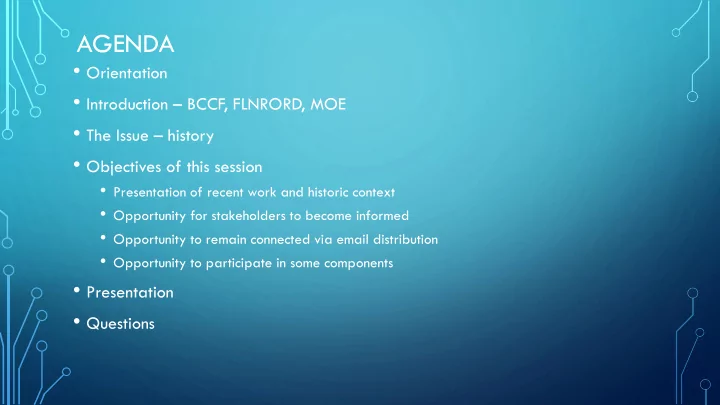
AGENDA Orientation Introduction BCCF, FLNRORD, MOE The Issue - - PowerPoint PPT Presentation

agenda
SMART_READER_LITE
LIVE PREVIEW

AGENDA Orientation Introduction BCCF, FLNRORD, MOE The Issue - - PowerPoint PPT Presentation

AGENDA Orientation Introduction BCCF, FLNRORD, MOE The Issue history Objectives of this session Presentation of recent work and historic context Opportunity for stakeholders to become informed Opportunity to


slide-1
SLIDE 1

AGENDA

  • Orientation
  • Introduction – BCCF, FLNRORD, MOE
  • The Issue – history
  • Objectives of this session
  • Presentation of recent work and historic context
  • Opportunity for stakeholders to become informed
  • Opportunity to remain connected via email distribution
  • Opportunity to participate in some components
  • Presentation
  • Questions
slide-2
SLIDE 2

GOLD RIVER STEELHEAD

INVESTIGATIONS INTO CURRENT STOCK STATUS AND POTENTIAL REASONS FOR DECLINE

PRESENTATION FOR PUBLIC AND INTERESTED STAKEHOLDERS, HOSTED BY CAMPBELL RIVER FISH AND WILDLIFE BY JERAMY DAMBORG (BCCF), MIKE MCCULLOCH AND BRENDAN ANDERSON (FLNRORD), PAID FOR IN PART BY HABITAT CONSERVATION TRUST FOUNDATION JAN 23RD, 2019

slide-3
SLIDE 3

PROBLEM THE BIG QUESTION

  • Winter run steelhead severe stock

decline over last decade (thousands to dozens)

  • Currently at near functional extinction

levels for winter runs

  • Heber and upper gold summer run in

Routine Management Zone (RMZ), and appear relatively stable

  • Why this significant differential

between SR and WR stocks?

slide-4
SLIDE 4

POSSIBLE REASONS FOR DECLINE

  • Habitat
  • Degraded rearing or spawning habitat
  • Water
  • Shifts in flow regime
  • Flooding/extreme low flows
  • Changes in temperatures due to climate

change or watershed impacts

  • Poor Ocean survival
  • Ocean conditions (warming)
  • Changes in prey abundance
  • Aquaculture, log booming or other near

shore influences

  • Predators, either nearshore, offshore or

in river

slide-5
SLIDE 5

Analysis of hydrologic record shows some recent very low flow years. 2015 is a stand out and represents the drought of record. Droughts serve to:

  • Reduce rearing area

and capacity to produce parr/smolts

  • Change distribution of

adult summer runs

  • Can be warmer years

that produce larger fry but limit parr habitats

slide-6
SLIDE 6
slide-7
SLIDE 7

HCTF PROJECT – SOME KEY FINDINGS TO DATE

  • Peak WR snorkel count over 3 swims

in 2 years is 3 adults over 8km

  • Heber SR in 2018 = 259 fish
  • Upper Gold SR = 66 fish (with

suspected poor migration into swim reach due to extreme low flows)

  • Electrofishing Summary (2017 and

2018)

  • Upper Gold and Heber 5-10x fry

densities vs Lower Gold

slide-8
SLIDE 8

Heber summer steelhead VS Gold summer steelhead High Heber count correlates to high Gold counts where they were completed coincidentally Upper gold has not been as intensively surveyed in the last decade because there is more uncertainty due to: Higher or lower water in some years that could shift adult distribution, Unable to survey portions of the anadromous section

slide-9
SLIDE 9
slide-10
SLIDE 10

2017 and 2018 Electrofishing surveys for steelhead fry

Predicted capacity based

  • n an alkalinity model which

estimates how productive a system is

slide-11
SLIDE 11
slide-12
SLIDE 12
slide-13
SLIDE 13

How fry and adult densities relate.

slide-14
SLIDE 14

PUBLIC INVOLVEMENT

Fishery Closure Monitoring

  • Weekend and weekday AM
  • RAPP line
  • Collect info to report (lic #, vehicle

and angler descriptions)

  • Posting closure notices

Seal monitoring in lower river

  • Time lapse or motion trigger

Camera monitoring

  • Active monitoring -Cover known fish

holding pools (i.e. ‘Lake Pool) and estuary by Nootka Sound Watershed Society

slide-15
SLIDE 15

HCTF – 2019/20

  • BCCF applied for Yr-2 - $41,030
  • Ramping up predator (pinniped)

monitoring at HCTF request

  • Continue Snorkel/EF stock

assessment

  • Limiting factors analysis, expand

hydrological analysis,

slide-16
SLIDE 16

SPORT FISHERY MANAGEMENT

  • Gold River mainstem was varied closed in winter 2019 with closure reflected

in the synopsis in 2019-2021

  • Spring / Summer closures are being considered but not currently

implemented based on monitored stock strength

  • Current press release is somewhat vague around tributaries which will remain closed

(normal closures) during the winter period

  • Duration is estimated at 5 years (one steelhead generation) BUT will be

varied open if positive abundance trends and minimum threshold are met

slide-17
SLIDE 17

HELPING IDENTIFY THE ISSUES…. CONTACT INFORMATION

  • Mike.McCulloch@gov.bc.ca
  • (250) 751-3156
  • Ministry of Forests , Lands and

Natural Resource Operations +RD

  • Jdamborg@BCCF.com
  • (250) 390-2525
  • BC Conservation Foundation
slide-18
SLIDE 18
slide-19
SLIDE 19
slide-20
SLIDE 20
slide-21
SLIDE 21
slide-22
SLIDE 22

Questions