Agenda: Person Centered Practices Questions Changes and Surveyor - - PowerPoint PPT Presentation

agenda
SMART_READER_LITE
LIVE PREVIEW

Agenda: Person Centered Practices Questions Changes and Surveyor - - PowerPoint PPT Presentation

Four-year Revisions Cycle Agenda: Person Centered Practices Questions Changes and Surveyor Training Updates Innovations in NCI and Remote Surveying Update the DD Field One States Experiences: HI Alternative Payment Topical Issues in


slide-1
SLIDE 1

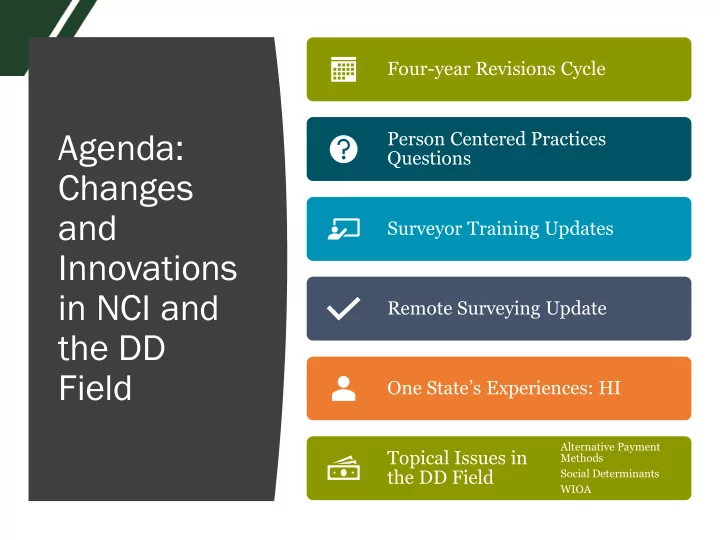
Agenda: Changes and Innovations in NCI and the DD Field

Four-year Revisions Cycle Person Centered Practices Questions Surveyor Training Updates Remote Surveying Update One State’s Experiences: HI Topical Issues in the DD Field

Alternative Payment Methods Social Determinants WIOA

slide-2
SLIDE 2

NCI I 4 YEAR AR REVISI VISIONS NS CYCLE CLE

This Photo by Unknown Author is licensed under CC BY-SA

slide-3
SLIDE 3

What does a “four-year revisions cycle for the NCI Surveys” mean for me and my state?

  • We will only make substantive changes every fourth year.
  • Next year of substantive changes will be the 2021-22 data cycle.
  • A substantive change is defined as:
  • The addition of questions in the main survey tool (states may still

add their state specific questions using NCI’s usual procedure);

  • The removal or restructuring of sections of the survey;
  • Wording changes that alter the meaning of the survey questions.
  • Small changes may be made in the interim.
  • Small changes are defined as: grammatical, punctuation, or slight

vocabulary changes; the correction of typos; the addition of instructions or clarifying guidance for surveyors within the survey tool.

slide-4
SLIDE 4

Why is NCI making ng this s change? ge?

States expressed a desire to have a stable tool. Creates time to gather meaningful feedback from states, surveyors and people taking the survey about the functionality of questions. Allows for testing of proposed new questions before they’re added to the survey. NCI Team is working to submit selected measures to the National Quality Forum as LTSS quality measures. This longer revisions cycle allows for robust psychometric testing and review of select measures for submission.

slide-5
SLIDE 5

4 Year Revisions Cycle

2018-2019 Data collection year

with new Person Centered questions added.

  • Review performance of BI elements

2019-2020

  • (Summer 2019) Issues/concepts and

data on performance of measures for review at NCI annual meeting (summer 2019) and in a communication with NCI states.

  • Analyze performance of Person

Centered questions and new questions.

  • Focus groups with stakeholders to

ensure that the survey meets needs

  • states, service recipients, families,

researchers, surveyors for data collection, implementation and reporting.

2020-2021

  • (Summer 2020) Draft survey

changes reviewed at NCI annual meeting and in a communication with NCI states.

  • If needed, cognitive testing (if new

questions – or major survey restructure)

  • Final tool

2021-2022

  • (Summer 2021) Roll out of new

survey to all states for survey administration.

  • Present draft report templates at

annual meeting and in a communication with states.
slide-6
SLIDE 6

ODESA changes

  • Along with survey tool

changes, we will be looking at updating ODESA to match states’ needs

  • We’ll be looking for your

feedback in various ways

slide-7
SLIDE 7

PERSO SON N CENTER ERED ED PRACT CTICES ICES

This Photo by Unknown Author is licensed under CC BY-SA

slide-8
SLIDE 8

Person-Centered Practices (PCP) Questions in IPS 2018-19

  • ACL grant to enhance the collection of data on PCP
  • NCI already collected process questions:
  • At your service planning meeting, did your service coordinator ask what you want?
  • Wanted to add questions to assess whether person was living person-centered

life

  • Think about the number of times you went out shopping in the past month. Would you like

to go….(more, less…)

  • Added questions to look at person’s goals and whether they’re in the service plan
  • ADLs
  • Community inclusion
  • Relationships
  • How can states use these data?
slide-9
SLIDE 9

NCI I IPS S TRAIN AINING ING UPDATES

This Photo by Unknown Author is licensed under CC BY-SA

slide-10
SLIDE 10

Training Expectations, Updates and Recommendations

slide-11
SLIDE 11

Notes from the Field

  • Work with people to understand how they

communicate

  • Find the right person to facilitate

communication if needed Communication!!!

  • Introduce the project and importance of

hearing from the person

  • Before meeting ask about some key

elements in the survey (service plan, person’s daily activities) When family or others are present

slide-12
SLIDE 12

Training Expectations and Recommendations

2019-20

slide-13
SLIDE 13

Training Expectations

Each state to have a lead trainer Surveyors will satisfactorily complete appropriate training Surveyors are in compliance with NCI protocol

slide-14
SLIDE 14

Lead Trainer Role

Crucial to maintaini ng fidelity

  • f data

Ensure surveyors complete appropria te training Ongoing monitorin g of surveyors

Be in regular conduct with the NCI team

slide-15
SLIDE 15

Types of Training

  • Refresher training
  • Only for returning surveyors
  • NCI National team provides training via

vide

  • Full training
  • Intended for:
  • New surveyors
  • Returning surveyors every four

years after

slide-16
SLIDE 16

Training Materials

Lead Trainer Orientation

  • Video

based Refresher training

  • Refresher

training video Full training

  • Suggested

agenda

  • Full training

PowerPoint

  • Lead

trainer guide For all surveyors

  • Pre- and

Post- training assessment s

  • Surveyor

Handbook

slide-17
SLIDE 17

Full Training PowerPoint

  • Updated to include:
  • Detailed information in notes for lead trainer

to use as guide/script

  • Questions to engage surveyors
  • Section on communication strategy
  • Slides for state-specific information
  • Surveyors should receive a copy of slides without

training notes

slide-18
SLIDE 18

Pre-Training Assessment

Assessments are anonymous Surveyors should complete two- three weeks before training Lead trainer will request results from HSRI Results can be used by lead trainers to gauge: Familiarity with surveying and population Areas that need particular focus/attention during training

slide-19
SLIDE 19

Post-Training Assessment

Assessments are not anonymous Surveyors should complete within five days of training

Lead trainer will request results from HSRI Results can be used by lead trainers to determine:

Whether surveyors understand important aspects of NCI process Identify areas

slide-20
SLIDE 20

Ongoing Monitoring

  • Lead trainers are responsible for ensuring
  • ngoing quality of data collection
  • Shadow surveys (or inter-rater reliability) are

an important tool for assurance

  • Shadows should consist of:
  • The lead trainer scoring along with the

surveyor and noting instances when the surveyor does or does not follow NCI protocol

  • The lead trainer should provide a debrief

including a review of how questions were scored and the surveyor’s compliance with NCI protocol

  • Number of shadows completed each year

will vary state to state

slide-21
SLIDE 21

Ongoing Monitoring– New Surveyors

  • Before surveying in the field
  • Lead trainers should observe and/or take part in practice surveys with

new surveyor

  • New surveyors should observe a veteran surveyor in the field
  • Within the first 10 surveys, new surveyors should be shadowed to ensure

compliance with NCI protocol

slide-22
SLIDE 22

Ongoing Monitoring– Returning Surveyors

  • For surveyors who have been in the field for several years:
  • Sometimes become too familiar/comfortable with the survey (may miss

changes to the survey)

  • Can fall into bad habits
  • May have developed useful skills that can be shared with team
  • Lead trainers should shadow at least a select number of returners each year
slide-23
SLIDE 23

Process for Trainings

  • Pre-assessments
  • Primarily for full trainings
  • Send 2-3 weeks before training
  • Review results and note parts of training that may need

more emphasis

  • Training
  • Should take place 2-3 weeks before surveying begins so

additional training can be completed as needed

  • Post-training assessment
  • Surveyors should complete within 5 days after training
  • Follow-up with surveyors who score under 85%
  • Follow-up with team if there are areas that were

consistently answered incorrectly

  • Prior to surveying in field
  • Conduct practice surveys
  • Should happened 1-2 weeks before surveying to allow time

for additional training as needed

  • Shadow surveys
  • Conduct with new surveyors within first 10 surveys in the

field

  • Conduct with selected or all returning surveyors
  • Provide feedback to individual surveyors or team as

needed

slide-24
SLIDE 24

QUESTIONS?

slide-25
SLIDE 25

REMOTE SURVE RVEYING ING

This Photo by Unknown Author is licensed under CC BY-SA

slide-26
SLIDE 26

Remote Surveying

  • Remote surveying
  • Conducting “face-to-face”

surveys using Zoom

  • Piloting in AK in 2019-20
  • Reduce weather and distance

related travel barriers

  • Specific protocols developed by

NCI will be used

  • Hoping to roll out to NCI states

in 2020-21

  • There will be requirements

re: situations in which remote surveying can be used

slide-27
SLIDE 27

Hawaii

Increasing participation in the IPS when you’re hearing a lot of “NO, thank you”!

This Photo by Unknown Author is licensed under CC BY

slide-28
SLIDE 28

NCI AND TOPICAL ICAL ISS SSUES ES IN THE HE DD FIELD LD

This Photo by Unknown Author is licensed under CC BY-SA

slide-29
SLIDE 29

Alternative Payment Models

  • Value Based Payment

– Payment models that range from rewarding for performance in fee-for-service (FFS) to capitation, including alternative payment models and comprehensive population-based payments. – Broad set of performance-based payment strategies that link financial incentives to providers’ performance on a set of defined measures of quality and/or cost or resource use.*

– APM encompasses a range of approaches intended to better align incentives for providers to deliver high quality care and reward value in the health care system

National Core Indicators (NCI)

slide-30
SLIDE 30

IAP webinar: 10/2017 accessed from CMS.gov on 10/29/2018

NASDDDS National Association of State Directors of Developmental Disabilities Services

30

slide-31
SLIDE 31

IAP webinar: 10/2017 accessed from CMS.gov on 10/29/2018

NASDDDS National Association of State Directors of Developmental Disabilities Services

slide-32
SLIDE 32

Considering VBP in I/DD Systems: Key Steps

Goal and Issue Identification What problem(s) or desired outcome(s) have you identified?

  • Effective models for individuals with significant challenging

behaviors/histories and/or individuals with co-occurring psychiatric support needs

  • Improved/ more efficient administration of functions such as:

resource management, gaps analysis/service development, and quality management; risk/crisis management

  • Improved or enhanced integration of acute, behavioral and

LTSS

  • Infusion of LifeCourse throughout service delivery
  • Reducing cross system (Medicaid and non-Medicaid)

misalignment

slide-33
SLIDE 33

Considering VBP in I/DD Systems: Key Steps

Data Analysis What does your data tell you about the “as is” state? What gaps in data do you need to obtain for further program analysis and improvement? What data do you hope to impact? Program Design (including approach to Quality) Without thinking about Medicaid specifically, what program features would you want to include? Payment methodologies, providers/partners, eligibility criteria (functional and clinical), etc. What quality metrics do you hope to impact? ▪ Partner/contractor performance metrics ▪ Individual outcome objectives ▪ NCI Opportunities for Integration (internal and external to Medicaid)

slide-34
SLIDE 34

Emerging Interest Areas

Employment – Pay for Performance Workforce Issues – Career Ladder Individual Quality Outcomes – Accountable Provider Models Strategies to Weave VBP in HCBS Regulatory Transformation Efforts

slide-35
SLIDE 35

Social Determinants

  • What are social determinants?
  • What can NCI tell us about social

determinants?

  • Erickson, S., Houseworth, J., Esler,
  • A. (draft) Social determinants

associated with use of psychotropic medication in adults who have Intellectual and Developmental Disability and challenging behaviors

slide-36
SLIDE 36

NCI Employment Data

  • The Workforce Innovation and Opportunity Act (WIOA)
  • In 17-18 data, the Paid Community Job variable included
  • Individual
  • Group
  • Business that primarily hires people with disabilities
  • New definition created in consultation with team of State DD

directors and other experts

  • May not perfectly crosswalk with the WIOA definition (as of right now)
slide-37
SLIDE 37

Paid community job (17-18)

NE 43% 404 CT 43% 343 MN 39% 379 OK 37% 400 VT 36% 331 ME 33% 362 RI 33% 304 WY 32% 325 MA 27% 395 UT 25% 384 OH 24% 694 CO 24% 339 SC 23% 392 KS 20% 370 PA 19% 587 IN 19% 735 DE 18% 390 NC 18% 615 TN 18% 427 NCI Average 18% 23,232 MI 16% 594 AZ 16% 476 KY 15% 394 LA 15% 401 CA 15% 8,228 NV 14% 384 NY 13% 490 IL 12% 357 VA 12% 771 AR 11% 387 FL 10% 941 DC 9% 398 MO 9% 396 GA 6% 465 AL 6% 374

slide-38
SLIDE 38

IPS Indicators Background Information Self-Direction Module Using technology

Discussion of Possible Revisions

National Core Indicators (NCI)

slide-39
SLIDE 39

In Person Survey

National Core Indicators (NCI)

slide-40
SLIDE 40

Background Indicators

National Core Indicators (NCI)

slide-41
SLIDE 41

NCI IPS Background Information

  • Where does the data live? (electronic

records, electronic health record, paper file)

  • How do you pull data? (from database, by

hand from record review, during the interview, etc…)

  • Reason for IDKs and missing data

National Core Indicators (NCI)

slide-42
SLIDE 42

How States Use Background Information

Context, Analysis and Program Specific Information

  • Compare people who work with people who

don’t work

  • Compare outcomes for people based on their

living situation

  • Compare outcomes for people based on

guardianship status

National Core Indicators (NCI)

slide-43
SLIDE 43

Background Information

  • Which data from the IPS Background

Information section is most useful to your state?

National Core Indicators (NCI)

slide-44
SLIDE 44

Self-Direction Module

  • State Work Plan Discussions reveal some

confusion regarding self-direction

  • NCI is looking for data for formal self-

direction programs

  • How should we define/make more clear?

National Core Indicators (NCI)

slide-45
SLIDE 45

State Work-Plan

National Core Indicators (NCI)

Does your state offer the opportunity to self- direct DD supports? __ Yes __ No Describe self-direction option(s). mark all authorities that exist in your state. _________Budget Authority: In this model, the consumer or their representatives are responsible for managing expenditures within the limits of a specified budget allocation. This may mean choosing how to allocate funds for hiring support workers and/or purchasing other goods and services. ______Employer Authority: In this model, participants or their representatives have the responsibility of hiring, firing and supervising their support workers.

slide-46
SLIDE 46

NCI Handbook Guidance

  • BI-58: Is this person currently using a self-directed

supports option?

  • Is this person currently using a self-

directed/participant-directed supports option? Does he/she have a financial management service (also called a fiscal agent, fiscal intermediary, intermediary service organization, etc.)? These

  • ptions offer individuals (and their representatives)

the opportunity to manage some or all of their

  • services. For example, they may hire and fire their
  • wn support workers and/or have control over their

budget or services.”

National Core Indicators (NCI)

slide-47
SLIDE 47

MODEL FOR IMPROVEMENT

This Photo by Unknown Author is licensed under CC BY-SA

slide-48
SLIDE 48

2

Quality Improvement:

Brief overview of Model for Improvement including PDSA cycle: Context for quality improvement discussions Fun and games Lunch

slide-49
SLIDE 49

Key Elements of Improvement

Will to do what it takes to change to a new system Ideas on which to base the design of the new system Execution of the ideas

slide-50
SLIDE 50
slide-51
SLIDE 51

Many ways to execute improvement work…

❑ Six Sigma (DMAIC) ❑ Lean ❑ TJC- 10 Step ❑ TJC - PDMAI ❑ Turning Point ❑ PDSA ❑ FOCUS PDCA ❑ Model For Improvement (MFI)

slide-52
SLIDE 52

Langley, et al, The Improvement Guide, 2009

A multi-purpose tool to Think About, Execute, and Accelerate Improvement

slide-53
SLIDE 53

Time for the pegboards!

slide-54
SLIDE 54

Improvement happens through more than one PDSA cycle

slide-55
SLIDE 55

A Way to Execute and Accelerate Improvement

Langley, et al, The Improvement Guide, 2009 12

slide-56
SLIDE 56

Repeated Use of the Cycle

Hunches Theories Ideas

A P S D

Changes That Result in Improvement

A P S D

slide-57
SLIDE 57

This Photo by Unknown Author is licensed under CC BY-SA

HOW ARE STATES USING NCI FOR QUALITY?

slide-58
SLIDE 58

National Core Indicators (NCI)

Living Well-Model Approaches for Enhancing the Quality, Effectiveness and Monitoring of Home and Community Based Services for Individuals with Developmental Disabilities

slide-59
SLIDE 59

This Photo by Unknown Author is licensed under CC BY-SA

NCI AND CULTURAL AND LINGUISTIC COMPETENCY

slide-60
SLIDE 60

This Photo by Unknown Author is licensed under CC BY-SA

STAFF STABILITY

slide-61
SLIDE 61

NCI Staff Stability

  • What’s new?
  • How is it being used?

▪ Ohio

  • Initiatives at federal and state levels

National Core Indicators (NCI)

slide-62
SLIDE 62

See you at Dinner

  • Dinner in this room at 7:00 pm

National Core Indicators (NCI)