Agenda 08:00 PST 1 hr 50 mins Part I - Review of CSKGs 15 min - - PowerPoint PPT Presentation

agenda
SMART_READER_LITE
LIVE PREVIEW

Agenda 08:00 PST 1 hr 50 mins Part I - Review of CSKGs 15 min - - PowerPoint PPT Presentation

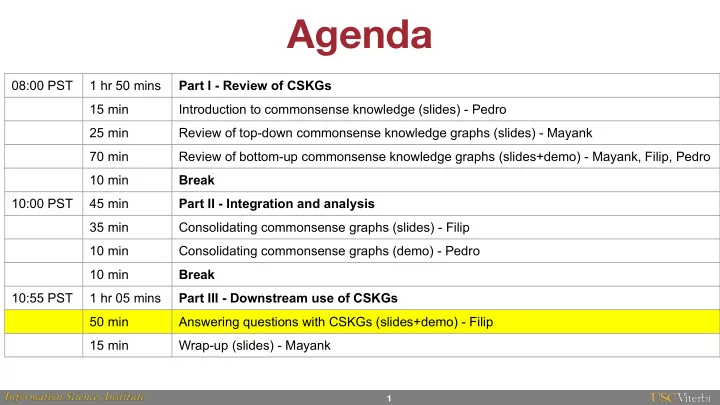
Agenda 08:00 PST 1 hr 50 mins Part I - Review of CSKGs 15 min Introduction to commonsense knowledge (slides) - Pedro 25 min Review of top-down commonsense knowledge graphs (slides) - Mayank 70 min Review of bottom-up commonsense knowledge


slide-1
SLIDE 1

Agenda

1

08:00 PST 1 hr 50 mins Part I - Review of CSKGs 15 min Introduction to commonsense knowledge (slides) - Pedro 25 min Review of top-down commonsense knowledge graphs (slides) - Mayank 70 min Review of bottom-up commonsense knowledge graphs (slides+demo) - Mayank, Filip, Pedro 10 min Break 10:00 PST 45 min Part II - Integration and analysis 35 min Consolidating commonsense graphs (slides) - Filip 10 min Consolidating commonsense graphs (demo) - Pedro 10 min Break 10:55 PST 1 hr 05 mins Part III - Downstream use of CSKGs 50 min Answering questions with CSKGs (slides+demo) - Filip 15 min Wrap-up (slides) - Mayank

slide-2
SLIDE 2

Answering Questions with CSKGs

Filip Ilievski

slide-3
SLIDE 3

Commonsense Knowledge Graphs

slide-4
SLIDE 4

The Commonsense Knowledge Graph (CSKG)

Roget

7 sources 2.3M nodes 6M edges

Preprint: Consolidating Commonsense Knowledge. Filip Ilievski, Pedro Szekely, Jingwei Cheng, Fu Zhang, Ehsan Qasemi.

slide-5
SLIDE 5

Semantic Parsing

Construct semantic representations of question and answers

slide-6
SLIDE 6

Grounding Questions

Link semantic parses to KG

slide-7
SLIDE 7

Grounding Answers

Link semantic parses to KG

slide-8
SLIDE 8

Reasoning

Find and rank connections for question/answer pairs Connection subgraph is an explanation

slide-9
SLIDE 9

Grounding

Slides adapted from: Anthony Chen, Robert Logan, Sameer Singh UC Irvine

slide-10
SLIDE 10

Motivating Example

When boiling butter, when it’s ready, you can... pour it on a plate pour it into a jar

Source: Physical IQA

slide-11
SLIDE 11

Motivating Example

When boiling butter, when it’s ready, you can...

Source: Physical IQA

Required Common Sense:

  • Things that boil are liquid (when they’re ready)
  • Liquids can be poured
  • Butter can be a liquid
  • Jars hold liquids
  • Plates (typically) do not contain liquids

Required Linguistic Understanding:

  • The antecedent of ‘it’ is ‘butter’

Captured in CSKG! pour it on a plate pour it into a jar

slide-12
SLIDE 12

Semantic Parsing: Text to Meaning Representation

When boiling butter, when it’s ready, you can... ..pour it on a plate ...pour it into a jar When boiling butter, when it’s ready, you can...

slide-13
SLIDE 13

Three steps:

1.

Semantic Role Labeling

Graphical encoding of dependencies between subjects/verbs in a sentence.

2.

Coreference Resolution

Link mentions of entity within and across sentences.

3.

Named Entity Recognition

Map fine-grained entities (e.g., “John”) to common entities (e.g., “Person”).

Better generalization

Semantic Parsing: Text to Meaning Representation

slide-14
SLIDE 14

Semantic Role Labeling

John is waiting for his car to be finished. John

subject

for his car to be finished waiting

  • bject

his car finished

sub sub

  • bject

Labels predicates (verbs) and their associated arguments.

slide-15
SLIDE 15

Coreference Resolution

Links mentions of a single entity in a sentence or across sentences.

John is waiting for his car to be finished. John

subject

for his car to be finished waiting

  • bject

his car finished

sub sub

  • bject

same

slide-16
SLIDE 16

Named Entity Recognition

Marks each node if it is a named entity along with the entity type.

John is waiting for his car to be finished. John

subject

for his car to be finished waiting

  • bject

his car finished

sub sub

  • bject

same PERSON

slide-17
SLIDE 17

Semantic Parse: Question/Context

  • Q. When boiling butter, when it is ready, you can…

Ans 1 pour it on a plate. Ans 2 pour it into a jar

Which answer choice is better?

slide-18
SLIDE 18

Semantic Parse: Answer 1

When boiling butter, when it is ready, you can pour it on a plate. boiling butter

  • bject

when

time

when it is ready you can

  • n a plate

pour

time

it

location

  • bject

subject mod same same same

slide-19
SLIDE 19

Semantic Parse: Answer 2

When boiling butter, when it is ready, you can pour it into a jar. boiling butter

  • bject

when

time

when it is ready you can into a jar pour

time

it

location

  • bject

subject mod same same same

slide-20
SLIDE 20

Many different ways to parse a sentence/sentences

  • Semantic role labeling focuses on predicates, but ignores things like prepositional

phrases.

  • Can incorporate dependency parsing, abstract meaning representations (AMR), etc.

Future Work: Explore other meaning representations, including logic

Shortcomings and Future Directions

slide-21
SLIDE 21

Linking to Commonsense KG

Score possible reasoning in CSKG score(q, a1) When boiling butter, when it’s ready, you can... ..pour it on a plate

slide-22
SLIDE 22

Linking to Commonsense KG

Score possible reasoning in CSKG score(q, a2) When boiling butter, when it’s ready, you can... ...pour it into a jar

slide-23
SLIDE 23

Linking to Commonsense KG

Which reasoning is better? score(q, a1) score(q, a2)

>

...pour it into a jar When boiling butter, when it’s ready, you can...

slide-24
SLIDE 24

Linking to CSKG

So that reasoning can take place!

slide-25
SLIDE 25

Linking to CSKG: Question/Context

The boy loved telling scary stories. The boy scary stories loved telling

/c/en/loved /c/en/boy /c/en/horror_stories /c/en/telling

Generalizes to concepts (not just lexical)

slide-26
SLIDE 26

Approach

  • Embed words and phrases
  • Tokenization/concept matching
  • “Natural language processing” or “Natural”, “language”, “processing”?
  • Use embeddings
  • ConceptNet Numberbatch [Speer et al., AAAI 2017]
  • BERT [Devlin et al., 2018]
  • Node representation = function of word embeddings
  • Compute alignment between text and KG

embeddings

  • Cosine/L2 distance
slide-27
SLIDE 27

Examples

“amused” -> amused (0.0), amusedness (0.04), amusedly (0.12), ... “Tina, a teenager” -> teenager (0.0), tina (0.0), subteen (0.01), … “With how popular her mother is” -> mother (0.0), with (0.0), is (0.0), … “Scary stories” -> stories (0.0), scary (0.0), scarisome (0.02), …

slide-28
SLIDE 28

Examples

“amused” -> amused (0.0), amusedness (0.04), amusedly (0.12), ... “Tina, a teenager” -> teenager (0.0), tina (0.0), subteen (0.01), … “With how popular her mother is” -> mother (0.0), with (0.0), is (0.0), … “Scary stories” -> stories (0.0), scary (0.0), scarisome (0.02), …

  • Potentially better links: scary_story, horror_story
  • horror_story appears in the top-5 using original averaging method
slide-29
SLIDE 29

Challenges

Multi-word phrases: His car -> /c/en/his? /c/en/car?

  • Average embedding is closer to his. Car is not linked.
  • Alternatives:
  • Link each word. Simple, but not compositional.
  • Link root of dependency parse. Discards even more information.

Polysemous words: “Doggo is good boy” vs. “Toilet paper is a scarce good”

  • Only one entry in ConceptNet: /c/en/good.
  • Can perform word sense disambiguation/link to WordNet nodes instead.
  • Better to handle at linking or graph reasoning step?

Evaluation

slide-30
SLIDE 30
  • Exact matches may exist, but are not always useful
  • Incorporate node degree?

Fidelity vs. Utility Trade-off

slide-31
SLIDE 31

Neuro-symbolic Reasoning Approaches

slide-32
SLIDE 32

Neuro-Symbolic Reasoning Approaches

Knowledge enhances language models Language models fill in knowledge gaps

slide-33
SLIDE 33

Neuro-Symbolic Reasoning Approaches

Knowledge enhances language models Language models fill in knowledge gaps

Kaixin Ma, Filip Ilievski, Jon Francis, Yonatan Bisk, Eric Nyberg, Alessandro Oltramari. In prep.

slide-34
SLIDE 34

Structured evidence in CSKGs

slide-35
SLIDE 35

Structured evidence in CSKGs

AtLocation (ConceptNet)

slide-36
SLIDE 36

Structured evidence in CSKGs

AtLocation (ConceptNet) HasInstance (FrameNet-ConceptNet)

slide-37
SLIDE 37

Structured evidence in CSKGs

AtLocation (ConceptNet) HasInstance (FrameNet-ConceptNet) MayHaveProperty (Visual Genome)

slide-38
SLIDE 38

HyKAS (based on Ma et al. 2019)

Grounding Lexicalization Path extraction

Q: Bob the lizard lives in a warm place with lots of water. Where does he probably live? A: Tropical rainforest

Q: /c/en/lizard, vg:water, … A:/c/en/tropical, ... (lizard, AtLocation, tropical rainforest) (place, HasInstance, tropical) (water, MayHaveProperty, tropical) Lizards can be located in tropical rainforests. Tropical is a kind of a place. Water can be tropical. Attention Layer

slide-39
SLIDE 39

HyKAS (based on Ma et al. 2019)

[CLS] Bob the lizard lives in a warm place with lots

  • f water. Where does he probably live?

[SEP] tropical rainforest [SEP]

Grounding Lexicalization Path extraction

Q: Bob the lizard lives in a warm place with lots of water. Where does he probably live? A: Tropical rainforest

Q: /c/en/lizard, vg:water, … A:/c/en/tropical, ... (lizard, AtLocation, tropical rainforest) (place, HasInstance, tropical) (water, MayHaveProperty, tropical) Lizards can be located in tropical rainforests. Tropical is a kind of a place. Water can be tropical. Attention Layer

slide-40
SLIDE 40

Lexicalized evidence

Lexicalized evidence

HyKAS (based on Ma et al. 2019)

[CLS] Bob the lizard lives in a warm place with lots

  • f water. Where does he probably live?

[SEP] tropical rainforest [SEP] [CLS] Bob the lizard lives in a warm place with lots

  • f water. Where does he probably live?

[SEP] mountain [SEP] [CLS] Bob the lizard lives in a warm place with lots

  • f water. Where does he probably live?

[SEP] desert [SEP]

OCN cell OCN cell OCN cell Grounding Lexicalization Path extraction

Q: Bob the lizard lives in a warm place with lots of water. Where does he probably live? A: Tropical rainforest

Q: /c/en/lizard, vg:water, … A:/c/en/tropical, ... (lizard, AtLocation, tropical rainforest) (place, HasInstance, tropical) (water, MayHaveProperty, tropical) Lizards can be located in tropical rainforests. Tropical is a kind of a place. Water can be tropical. Attention Layer Attention Layer Attention Layer

slide-41
SLIDE 41

‘No-knowledge’ baseline is strong

Train+inference Knowledge Dev acc

  • 76.7

ATOMIC 77.1 ConceptNet 80.1 CSKG 79.5 CSKG -symmetric -overlapping 79.7 CSKG in a separate OCN 80.1 ConceptNet (2-hop) 80.5 Train knowledge Inference Knowledge Dev acc

  • 78.7

ATOMIC ATOMIC 79.04 CSKG CSKG 78.56 CSKG

  • 77.22

CSKG

  • Visual Genome

78.4 CSKG ConceptNet 78.61 CSKG Visual Genome 78.04 CSKG ConceptNet+Visual Genome 78.81 CSKG

  • RelatedTo

78.4 CSKG

  • Synonym-Antonym

78.66

slide-42
SLIDE 42

Adding knowledge helps

Train+inference Knowledge Dev acc

  • 76.7

ATOMIC 77.1 ConceptNet 80.1 CSKG 79.5 CSKG -symmetric -overlapping 79.7 CSKG in a separate OCN 80.1 ConceptNet (2-hop) 80.5 Train knowledge Inference Knowledge Dev acc

  • 78.7

ATOMIC ATOMIC 79.04 CSKG CSKG 78.56 CSKG

  • 77.22

CSKG

  • Visual Genome

78.4 CSKG ConceptNet 78.61 CSKG Visual Genome 78.04 CSKG ConceptNet+Visual Genome 78.81 CSKG

  • RelatedTo

78.4 CSKG

  • Synonym-Antonym

78.66

slide-43
SLIDE 43

Different knowledge helps different problems

Train+inference Knowledge Dev acc

  • 76.7

ATOMIC 77.1 ConceptNet 80.1 CSKG 79.5 CSKG -symmetric -overlapping 79.7 CSKG in a separate OCN 80.1 ConceptNet (2-hop) 80.5 Train knowledge Inference Knowledge Dev acc

  • 78.7

ATOMIC ATOMIC 79.04 CSKG CSKG 78.56 CSKG

  • 77.22

CSKG

  • Visual Genome

78.4 CSKG ConceptNet 78.61 CSKG Visual Genome 78.04 CSKG ConceptNet+Visual Genome 78.81 CSKG

  • RelatedTo

78.4 CSKG

  • Synonym-Antonym

78.66

slide-44
SLIDE 44

More knowledge is not always better

Train+inference Knowledge Dev acc

  • 76.7

ATOMIC 77.1 ConceptNet 80.1 CSKG 79.5 CSKG -symmetric -overlapping 79.7 CSKG in a separate OCN 80.1 ConceptNet (2-hop) 80.5 Train knowledge Inference Knowledge Dev acc

  • 78.7

ATOMIC ATOMIC 79.04 CSKG CSKG 78.56 CSKG

  • 77.22

CSKG

  • Visual Genome

78.4 CSKG ConceptNet 78.61 CSKG Visual Genome 78.04 CSKG ConceptNet+Visual Genome 78.81 CSKG

  • RelatedTo

78.4 CSKG

  • Synonym-Antonym

78.66

slide-45
SLIDE 45

Enhancing CSKGs with Language Models

Wang et al. (2020). Connecting the Dots: A Knowledgeable Path Generator for Commonsense Question Answering. EMNLP Findings 2020

slide-46
SLIDE 46

Neuro-Symbolic Reasoning Approaches

Knowledge enhances language models Language models fill in knowledge gaps

slide-47
SLIDE 47

Retrieving KG facts does not suffice

Challenges

  • KG incompleteness
  • Introducing irrelevant facts
slide-48
SLIDE 48

Retrieving KG facts does not suffice

Challenges

  • KG incompleteness
  • Introducing irrelevant facts

Solution

  • Learn a path generator to connect

entities mentioned in context with novel multi-hop knowledge paths

slide-49
SLIDE 49

A KG-augmented QA Framework

  • Context Module
  • Encode question and answer

choices as unstructured evidence

  • Knowledge Module
  • Encode knowledge facts (paths)

as structured evidence

  • Reasoning Module
  • Score a question-choice pair

based on un/structured evidence

slide-50
SLIDE 50

Path Generator for Connecting Dots

Goal: generate a multi-hop path between two entities 1. Path Sampling with KG random walk 2. Training by fine-tuning GPT-2 3. Inference by using greedy decoding

slide-51
SLIDE 51

Generating knowledge paths is better than merely retrieving them

Test Accuracy on OpenBookQA

slide-52
SLIDE 52

Consistent improvements with less training data

Test Accuracy on CommonsenseQA and OpenBookQA with different amount of training data.

slide-53
SLIDE 53

Interpretability with “real” structured paths

53

slide-54
SLIDE 54

Existing benchmarks

Role of knowledge

knowledge language models

New benchmarks? Few shot, zero shot

slide-55
SLIDE 55

Agenda

55

08:00 PST 1 hr 50 mins Part I - Review of CSKGs 15 min Introduction to commonsense knowledge (slides) - Pedro 25 min Review of top-down commonsense knowledge graphs (slides) - Mayank 70 min Review of bottom-up commonsense knowledge graphs (slides+demo) - Mayank, Filip, Pedro 10 min Break 10:00 PST 45 min Part II - Integration and analysis 35 min Consolidating commonsense graphs (slides) - Filip 10 min Consolidating commonsense graphs (demo) - Pedro 10 min Break 10:55 PST 1 hr 05 mins Part III - Downstream use of CSKGs 50 min Answering questions with CSKGs (slides+demo) - Filip 15 min Wrap-up (slides) - Mayank

slide-56
SLIDE 56

Wrap-up

slide-57
SLIDE 57

What Is Common Sense?

57

Common sense is sound practical judgement concerning everyday matters,

  • r a basic ability to perceive, understand, and judge that

is shared by ("common to") nearly all people. Wikipedia

slide-58
SLIDE 58

58

Slide by Yejin Choi

slide-59
SLIDE 59

A Common Sense Task

59

Input: a set of common concepts Output: a sentence using these concepts dog | frisbee | catch | throw

https://inklab.usc.edu/CommonGen/

slide-60
SLIDE 60

Role Of Knowledge

60

dog play game catch throw flying disk frisbee play game play frisbee disc park wants to capable of related to type of antonym used for synonym used for located at located at PersonX throws a frisbee catch frisbee fun for dog created by has property is a

  • thers then

subclass

  • f
slide-61
SLIDE 61

Common Sense Knowledge Graphs

61

Cyc

[Lenat et al., 1984]

OpenCyc 4.0

[Lenat 2012]

Open Mind Common Sense

[Minski, Singh, Havasi,1999]

ConceptNet

[Liu, Singh, 2004]

ConceptNet 5.5

[Speer et al., 2017]

NELL

[Carlson et al., 2010]

NELL

[Mitchell et al., 2015]

WebChild

[Tandon et al., 2014]

WebChild 2.0

[Tandon et al., 2017]

Atomic

[Sap et al., 2019]

Wikidata

[Vrandečić, 2012]

COMET

[Bosselut et al., 2019]

slide-62
SLIDE 62

Dimensions Of Common Sense Knowledge

62

Representation

○ symbolic ○ natural language ○ neural

Creation method

○ expert input ○ crowdsourcing ○ information extraction, machine learning

Knowledge type

○ entities and actions ○ inferential/rules

Topic

○ general ○ social OpenCyc ConceptNet NELL WebChild Atomic Wikidata COMET

slide-63
SLIDE 63

Why is top-down knowledge necessary?

63

“In Artificial intelligence, commonsense knowledge is the set of background information that an individual is intended to know or assume and the ability to use it when appropriate.” Argument: This knowledge cannot be acquired simply through text (or in an otherwise ‘inductive’ fashion)

slide-64
SLIDE 64

64

Taxonomy of 30 representational areas

slide-65
SLIDE 65

Example of a ‘top-down’ CSKG: Cyc

65

slide-66
SLIDE 66

Evolution of Cyc

66

slide-67
SLIDE 67

Limitations of top-down CSKGs

67

Many of the same issues that other top-down systems (including, famously, expert systems) have, such as brittleness, expense of acquisition... Even if it were possible, we can never get away from language models completely

slide-68
SLIDE 68

The many faces of ConceptNet

68

slide-69
SLIDE 69

X repels Y’s attack

slide-70
SLIDE 70

Commonsense Knowledge in Wikidata

slide-71
SLIDE 71

Wikidata-CS Is Small But Novel

ConceptNet 3.4M edges

Wikidata-CS 102K edges 2.4K edges

slide-72
SLIDE 72

Commonsense Knowledge Sources

– 72

slide-73
SLIDE 73

Consolidation Hypothesis

73

Integrating multiple knowledge sources in CSKG is beneficial for downstream reasoning tasks.

slide-74
SLIDE 74

Principles for a modular and useful CSKG

74

  • P1. Embrace heterogeneity of nodes
  • bjects, classes, words, actions, frames, states
  • P2. Reuse edge types across resources

/r/HasProperty from ConceptNet applicable for attributes in Visual Genome

  • P3. Leverage external links

many sources map to WordNet

  • P4. Generate high-quality probabilistic links

many facts not explicitly stated

  • P5. Enable access to labels

text labels and aliases are the key, in particular for NLP use cases

slide-75
SLIDE 75

The Commonsense Knowledge Graph (CSKG)

Roget

7 sources 2.3M nodes 6M edges

Preprint: Consolidating Commonsense Knowledge. Filip Ilievski, Pedro Szekely, Jingwei Cheng, Fu Zhang, Ehsan Qasemi.

slide-76
SLIDE 76

Neuro-Symbolic Reasoning Approaches

Knowledge enhances language models Language models fill in knowledge gaps

slide-77
SLIDE 77

A KG-augmented QA Framework

  • Context Module
  • Encode question and answer

choices as unstructured evidence

  • Knowledge Module
  • Encode knowledge facts (paths)

as structured evidence

  • Reasoning Module
  • Score a question-choice pair

based on un/structured evidence

slide-78
SLIDE 78

Our final takeaways

78

  • Commonsense (CS) reasoning is a difficult general AI problem

that has come of age

Ironically, exposed both the strengths and limitations of neural networks, including language representation learning

We hypothesize that a neuro-symbolic approach is necessary for CS reasoning

  • CS knowledge, appropriately contextualized, is critical for

robust CS reasoning and QA

  • Much progress has been achieved in integrating multiple

sources into a single CSKG, but many open challenges remain

slide-79
SLIDE 79

Bibliography

79

Baker, C. F., Fillmore, C. J., & Lowe, J. B. (1998, August). The berkeley framenet project. In 36th Annual Meeting of the Association for Computational Linguistics and 17th International Conference on Computational Linguistics, Volume 1 (pp. 86-90). Bosselut, A., Rashkin, H., Sap, M., Malaviya, C., Celikyilmaz, A., & Choi, Y. (2019). COMET: Commonsense transformers for automatic knowledge graph construction. arXiv preprint arXiv:1906.05317. Devlin, J., Chang, M. W., Lee, K., & Toutanova, K. (2018). Bert: Pre-training of deep bidirectional transformers for language

  • understanding. arXiv preprint arXiv:1810.04805.

Fellbaum, C. (2012). WordNet. The encyclopedia of applied linguistics. Gordon, A. S., & Hobbs, J. R. (2004). Formalizations of commonsense psychology. AI Magazine, 25(4), 49-49. Hobbs, J., Croft, W., Davies, T., Edwards, D., & Laws, K. (1987). Commonsense metaphysics and lexical semantics. Computational linguistics, 13(3-4), 241-250.

slide-80
SLIDE 80

Bibliography

80

Hobbs, J. R., & Gordon, A. S. (2010, July). Goals in a Formal Theory of Commonsense Psychology. In FOIS (pp. 59-72). Ilievski, F., Szekely, P., Cheng, J., Zhang, F., & Qasemi, E. (2020). Consolidating Commonsense Knowledge. arXiv preprint arXiv:2006.06114. Ilievski, F., Szekely, P., & Schwabe, D. (2020). Commonsense Knowledge in Wikidata. Wikidata Workshop at ISWC 2020. Lenat, D. B., Guha, R. V., Pittman, K., Pratt, D., & Shepherd, M. (1990). Cyc: toward programs with common sense. Communications of the ACM, 33(8), 30-49. Krishna, R., Zhu, Y., Groth, O., Johnson, J., Hata, K., Kravitz, J., ... & Bernstein, M. S. (2017). Visual genome: Connecting language and vision using crowdsourced dense image annotations. International journal of computer vision, 123(1), 32-73. Mitchell, T., Cohen, W., Hruschka, E., Talukdar, P., Yang, B., Betteridge, J., ... & Krishnamurthy, J. (2018). Never-ending learning. Communications of the ACM, 61(5), 103-115.

slide-81
SLIDE 81

Bibliography

81

Matuszek, C., Witbrock, M., Kahlert, R. C., Cabral, J., Schneider, D., Shah, P., & Lenat, D. (2005). Searching for common sense: Populating cyc from the web. UMBC Computer Science and Electrical Engineering Department Collection. Roget, P. M. (2008). Roget'S International Thesaurus, 3/E. Oxford and IBH Publishing. Sap, M., Le Bras, R., Allaway, E., Bhagavatula, C., Lourie, N., Rashkin, H., ... & Choi, Y. (2019, July). Atomic: An atlas of machine commonsense for if-then reasoning. In Proceedings of the AAAI Conference on Artificial Intelligence (Vol. 33, pp. 3027-3035). Speer, R., Chin, J., & Havasi, C. (2016). Conceptnet 5.5: An open multilingual graph of general knowledge. AAAI 2017. Storks, S., Gao, Q., & Chai, J. Y. (2019). Commonsense reasoning for natural language understanding: A survey of benchmarks, resources, and approaches. arXiv preprint arXiv:1904.01172, 1-60. Von Ahn, L., & Dabbish, L. (2008). Designing games with a purpose. Communications of the ACM, 51(8), 58-67.

slide-82
SLIDE 82

Bibliography

82

Wang, P., Peng, N., Ilievski, F., Szekely, P., & Ren, X. (2020). Connecting the Dots: A Knowledgeable Path Generator for Commonsense Question Answering. EMNLP Findings 2020.