AGENDA PLEASE BE ADVISED THAT THE KALAMAZOO COMMUNITY MENTAL HEALTH - - PDF document

agenda
SMART_READER_LITE
LIVE PREVIEW

AGENDA PLEASE BE ADVISED THAT THE KALAMAZOO COMMUNITY MENTAL HEALTH - - PDF document

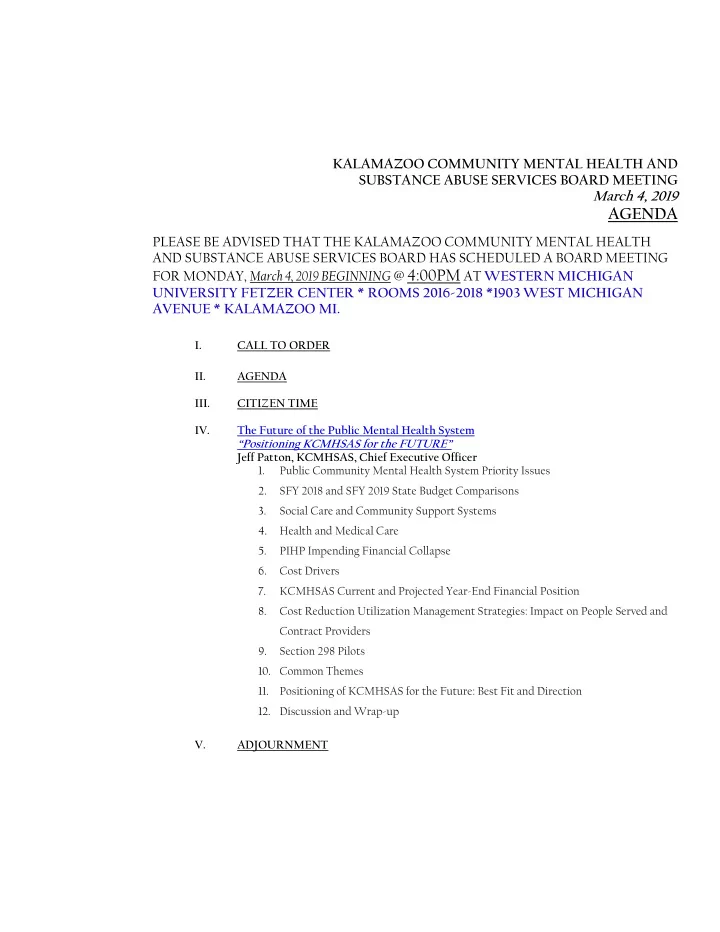
KALAMAZOO COMMUNITY MENTAL HEALTH AND SUBSTANCE ABUSE SERVICES BOARD MEETING March 4, 2019 AGENDA PLEASE BE ADVISED THAT THE KALAMAZOO COMMUNITY MENTAL HEALTH AND SUBSTANCE ABUSE SERVICES BOARD HAS SCHEDULED A BOARD MEETING FOR MONDAY, March 4,


slide-1
SLIDE 1

KALAMAZOO COMMUNITY MENTAL HEALTH AND SUBSTANCE ABUSE SERVICES BOARD MEETING March 4, 2019

AGENDA

PLEASE BE ADVISED THAT THE KALAMAZOO COMMUNITY MENTAL HEALTH AND SUBSTANCE ABUSE SERVICES BOARD HAS SCHEDULED A BOARD MEETING FOR MONDAY, March 4, 2019 BEGINNING @ 4:00PM AT WESTERN MICHIGAN UNIVERSITY FETZER CENTER * ROOMS 2016-2018 *1903 WEST MICHIGAN AVENUE * KALAMAZOO MI.

I. CALL TO ORDER II. AGENDA III. CITIZEN TIME IV. The Future of the Public Mental Health System “Positioning KCMHSAS for the FUTURE” Jeff Patton, KCMHSAS, Chief Executive Officer 1. Public Community Mental Health System Priority Issues 2. SFY 2018 and SFY 2019 State Budget Comparisons 3. Social Care and Community Support Systems

  • 4. Health and Medical Care

5. PIHP Impending Financial Collapse 6. Cost Drivers 7. KCMHSAS Current and Projected Year-End Financial Position 8. Cost Reduction Utilization Management Strategies: Impact on People Served and Contract Providers 9. Section 298 Pilots

  • 10. Common Themes
  • 11. Positioning of KCMHSAS for the Future: Best Fit and Direction
  • 12. Discussion and Wrap-up

V. ADJOURNMENT

slide-2
SLIDE 2

Kalamazoo Community Mental Health and Substance Abuse Services Board Retreat

March 4, 2019 4:00 p.m.

slide-3
SLIDE 3

The Future of the Public Mental Health System Positioning KCMHSAS for the Future

slide-4
SLIDE 4

AGENDA

1.

Call to Order and Introductions

2.

Public Community Mental Health System Priority Issues

3.

SFY 2018 and SFY 2019 State Budget Comparisons

4.

Social Care and Community Support Systems

5.

Health and Medical Care

6.

PIHP Impending Financial Collapse

7.

Cost Drivers

8.

KCMHSAS Current and Projected Year-End Financial Position

9.

Cost Reduction Utilization Management Strategies: Impact on People Served and Contract Providers

  • 10. Section 298 Pilots
  • 11. Common Themes
  • 12. Positioning of KCMHSAS for the Future: Best Fit and Direction
  • 13. Discussion and Wrap-up

3

slide-5
SLIDE 5

Public Community Mental Health System Priority Issues

  • Statutory Obligations for Preserving the Public

Community Mental Health System

  • Impending Financial Collapse of PIHPs
  • Section 298 Pilots and Demonstration Initiatives

4

slide-6
SLIDE 6

Section 3330.1116 of the Michigan Mental Health Code

Consistent with section 51 of article IV of the state constitution of 1963, which declares that the health of the people of the state is a matter of primary concern, and as required by section 8 of article VIII of the state constitution of 1963, which declares that services for the care, treatment, education, or rehabilitation of those who are seriously mentally disabled shall always be fostered and supported, the department shall continually and diligently endeavor to ensure that adequate and appropriate mental health services are available to all citizens throughout the state…To this end, the department shall have the general powers and duties to do all

  • f the following:

…(b) Administer the provisions of chapter 2 so as to promote and maintain an adequate system of community mental health services programs throughout the state. In the administration of chapter 2, it shall be the objective of the department to shift primary responsibility for the direct delivery of public mental health services from the state to a community mental health services program whenever the community mental health services program has demonstrated a willingness and capacity to provide an adequate and appropriate system of mental health services for the citizens of that service area.

5

slide-7
SLIDE 7

Michigan’s Public Community Mental Health System

Michigan’s public community mental health system is nationally recognized as

  • ne of the most comprehensive, innovative, person-centered and community-

driven systems in the country. Michigan citizens deserve and expect a world class public community mental health system building on the nationally- recognized public system that Michigan has built over the past fifty years. Such a world class system is accessible and fosters whole person and whole population health, addresses the social determinants of health, is a vital member of the community, and remains fiscally and clinically sound.

6

slide-8
SLIDE 8

Michigan’s Public Community Mental Health System

However, then and now, very few of the services and supports provided through the public community mental health system for persons with serious mental illnesses, substance use disorders and/or intellectual-developmental disabilities, could properly be termed “medical care.” The overwhelming volume of mental health encounters involve case management, supports coordination, community living supports, skills training, attendant services, supervised monitoring, supportive employment, habilitation and rehabilitation services, caregiver respite, psychosocial rehabilitation, crisis stabilization, residential (in-home) assistance, peer support specialist services, and other non-medical forms of care.

7

slide-9
SLIDE 9

Michigan’s Public Community Mental Health System

The public mental health system was established as a priority population, severity-based, resource-constrained, queuing (wait list), and rationed care system for the “least well off” seriously mentally ill or intellectual- developmentally disabled individuals. Over time, funding arrangements became more diversified and community support options expanded.

8

slide-10
SLIDE 10

9

slide-11
SLIDE 11

10

slide-12
SLIDE 12

SFY 2018 and SFY 2019 Final State Budget Comparisons

SFY 2018 SFY 2019 Difference Percent Change CMH Non-Medicaid Services $ 120,050,400 $ 125,578,200 $ 5,527,800 5% Medicaid Mental Health Services $2,315,608,800 $2,319,029,300 $ 3,420,500 0.1% Medicaid Substance Abuse Services $ 52,408,500 $ 67,640,500 $ 15,232,000 29% State Disability Assistance Program $ 2,018,800 $ 2,018,800 $ 00 0% Community Substance Abuse Prevention $ 76,530,000 $ 76,530,000 $ 426,200 0.6% Children’s Waiver Home Care Program $ 20,241,100 $ 20,241,100 $ 00 Autism Services $ 105,097,300 $ 192,890,700 $ 87,793,400 84% Healthy Michigan Plan $ 288,655,200 $ 299,439,000 $ 10,783,800 4% Total $2,980,610,100 $3,103,793,800 $ 123,183,700 4%

11

slide-13
SLIDE 13

Social Care and Community Support Systems

Social care and community support systems for the mentally or intellectually- developmentally disabled (and for the physically disabled, the traumatic brain injury patients, and for seniors) are under funded, frequently means-tested, rationed and generally locally organized – with significant user/family participation in care system governance (CMHSP Boards, Self-Determination arrangements), policies and service practitioners.

12

slide-14
SLIDE 14

Social Care and Community Support Systems

Most social care and community support systems are also inextricably linked to other local agencies, non-profits and charitable organizations that offer complimentary components necessary for community living (e.g., housing, vocational rehabilitation, income supports, etc.). Social/community care provision arrangements are actually comprised of many

  • verlapping social care systems, each with slightly different target populations, distinct

missions and legislative mandates, multiple funding sources, and gradually assembled core provider networks.

13

slide-15
SLIDE 15

Social Care and Community Support Systems

This patchwork configuration of overlapping systems reflect historical developments, hard-won delineation of population and service priorities, piecemeal accretion of necessary resources, and use of means-tested or ability- to-pay criteria to manage overwhelming demand (frequently accompanied by waiting lists). Social care and community support systems have slowly and incrementally devised a hodgepodge of resource streams to underwrite the cost of social/community care for designated populations and recipients.

14

slide-16
SLIDE 16

Social Care and Community Support Systems

In the mental health arena, creative design of optional benefits and Medicaid waiver programs – targeted for beneficiaries with serious mental illness and/or developmental disorders – along with redeployment of existing state and local mental health resources (to provide the non-federal match share required to draw down Federal Medical Assistance Percentage (FMAP), expanded the resource pool underwriting social care/community supports for mentally, intellectually/developmentally disabled individuals. Note here that the FMAP for the Medicaid Specialty Services Program is 64.9% (federal share) and 35.1% (state share). For the Healthy Michigan Program (ACA Medicaid Expansion), the FMAP is 90% (federal share) and 10% (state share).

15

slide-17
SLIDE 17

Social Care and Community Support Systems

The creative benefit design and funding strategies played a key role in facilitating the state closure of 33 psychiatric hospitals, developmental disability centers and other specialized facilities over the past thirty years (savings the state billions of dollars). However, devising and co-funding these targeted and tailored Medicaid

  • ptional benefits (commonly referred to now as Medicaid (b)(3) services) and

waiver programs (without new state general funds to match federal contributions) did not mysteriously convert these social care and community support benefits into “medical care” services.

16

slide-18
SLIDE 18

Social Care and Community Support Systems

These expanded community support services were and remain variants of social care arrangements and should remain under public governance and management structures. The success of the Michigan Department of Health and Human Services (and its predecessors, the Michigan Department of Mental Health and Michigan Department of Community Health) in executing a Medicaid maximization strategy within the public mental health system should not imply that such hard-won benefits and resources are suddenly transferrable and fungible “commodities.”

17

slide-19
SLIDE 19

Health and Medical Care

Health care is a well-financed enterprise dominated by insurers, hospitals and physicians – providing insured individuals with a universal claim to policy/plan covered benefits, consistent with medical need, as determined by physicians and practitioners, and subject to payer authorization and utilization management.

18

slide-20
SLIDE 20

Health and Medical Care

  • Health and medical care systems are not disability competent systems.
  • Medical insurers, health systems and managed care organizations have, until recently,

vigilantly guarded the border between medical care and social care/community supports.

  • These medically oriented systems have only a rudimentary understanding of the

underfunded, resource constrained and rationed social/community care systems that lie beyond the border of medical care. They do not have the requisite tactical knowledge of the linkages between social care systems and other local agencies/assistance networks.

19

slide-21
SLIDE 21

Medicaid

Medicaid is the largest – but not the only – funding source underwriting community support and social care arrangements for persons with serious mental illnesses, co-occurring substance use disorders, children and youth with serious emotional disturbance and persons with intellectual-developmental disabilities. Regardless of funding source, the public community mental health system retains its primary identity and character as a social/community care – not medical care – system.

20

slide-22
SLIDE 22

Medicaid

The Medical Services Administration (state Medicaid agency) within the Michigan Department of Health and Human Services (MDHHS) plan for Section 298 pilots seems to be a repetition of past efforts to “build out” its existing managed care strategy and extend the reach of its long-time partners, the Medicaid Health Plans (MHPs). In the 1990s, MSA attempted to impose its preferred management/delivery system arrangements on mentally ill and intellectual-developmental disabled beneficiaries, stubbornly insisting that both health care benefits and home/community support services be packaged together and managed by Medicaid Health Plans.

21

slide-23
SLIDE 23

Medicaid

The Michigan Department of Health and Human Services and members of the Michigan Legislature’s attempt (if successful) to assert hegemony over resources and delivery system arrangements for mentally/intellectually-developmentally disabled specialty populations – under the banner of “integrated health care” – will seriously undermine the viability and sustainability of the local social care and support system specifically established to meet the needs of people with serious mental/intellectual-developmental disabilities living in community settings.

22

slide-24
SLIDE 24

Medicaid

The current Section 298 Full Financial Integration pilot is more objectionable, since it includes both redistribution of social care/community support resources, and promotes the use of Medicaid Health Plans that propose to serve as integrated delivery system structures as the managing entities, compounding the risk of serious malfunctions and service disasters.

23

slide-25
SLIDE 25

Medicaid

There have been small-scale efforts, in various locations, to integrate health care and social care/community supports (i.e. PACE programs, Social Health Maintenance Organizations (SMHO), Medicare-Medicaid Integration Program (MMIP) demonstrations) but these endeavors have been limited in scope, or required private resources as well as payer capitation payments to remain viable,

  • r have experienced provider defections or withdrawals that threatened

program sustainability. In short, such arrangements have proven hard to sustain, difficult to bring to scale and/or are tough to successfully replicate.

24

slide-26
SLIDE 26

Medicaid

Clearly, the Section 298 Full Financial Integration pilots are precursors to an eventual wholesale “carve-in” of the Medicaid Managed Specialty Supports and Services program from the current public community mental health system, to the management of the Medicaid Health Plan.

25

slide-27
SLIDE 27

Medicaid

An enduring (unproven) belief of the proponents of Section 298 Full Financial Integration pilots and carve-in of the Medicaid Managed Specialty Services benefit under the management of Medicaid Health Plans is that consolidating various service systems, benefits and funds under a single managed care entity will save money by reducing administrative costs and improving “care coordination.”

26

slide-28
SLIDE 28

Medicaid

The limited evidence that exists suggests that this type of full “all or nothing” financial integration or wholesale carve-in approach to integrating various health benefits, payer sources, and social care/community supports, may inadvertently increase administrative “costs” long before yielding any savings in service expenditures. A carve-in arrangement will require Medicaid Health Plans to enhance its operational, technological, care and utilization management systems as it attempts to effectively manage a more diverse set of beneficiaries, authorize and coordinate unfamiliar benefits (social/community care) and assemble a network of providers whose structure and modes of operation are much different than medical care providers.

27

slide-29
SLIDE 29

Medicaid

A “carve-in” of the Medicaid Managed Specialty Services program under the management of Medicaid Health Plans, will certainly results in unanticipated difficulties with care coordination, particularly in making effective linkages and appropriate arrangements for social care/community supports. Care coordination methods (whether teams or a designated care manager) in health care are much different than approaches employed in social/community care systems. Coordination issues in social care extend far beyond medical linkages and encompass multiple assistance networks and community institutions (e.g., housing, law enforcement, public welfare, public health, schools, etc.).

28

slide-30
SLIDE 30

Prepaid Inpatient Health Plans Impending Financial Collapse

29

slide-31
SLIDE 31

CMHSP/PIHP Behavioral Health Fee Screen Development Workgroup

Project Motivation

MDHHS collects detailed financial reports on an annual basis from PIHPs, including utilization, cost per service, and expenditure information for each of the services provided under the managed care contract. These reports provide a source for understanding how both utilization and cost change over time. The PIHPs reported material unit cost increases for services provided during state fiscal year (SFY) 2017 in comparison to amounts from the prior

  • year. As a result, the PIHPs reported losses of approximately $130 million on a statewide

basis in SFY 2017. The CMHSP and PIHP reporting provided to MDHHS did not include sufficient information to discern the drivers of the unit cost increases from SFY 2016 to SFY

  • 2017. Additionally, there was inconsistency in reporting of both benefit and administrative

costs incurred across the CMHSPs and PIHPs for the behavioral health program. Therefore, MDHHS is creating this workgroup to help identify those drivers and provide more transparency in how unit costs are calculated across the behavioral health program.

30

slide-32
SLIDE 32

CMHSP/PIHP Behavioral Health Fee Screen Development Workgroup

Statement of Problem

The Michigan budget appropriation for the Managed Medicaid Behavioral Health and Substance Abuse Specialty Supports and Services Program for the public community mental health system is approximately $2.4 billion. However, the actual amount paid to Prepaid Inpatient Health Plans (PIHPs) falls short of this amount. The Milliman community rating methodology does not consider actual cost of services (experience rating), as the essential component for capitation rate setting for PIHPs. By the end of Fiscal Year 2019, it is expected that all but three PIHPs in the state will totally deplete their Internal Service Funds (ISFs), and the resulting deficits that emerge will require them to enter the shared financial risk corridor with the state. Without an infusion of substantial additional revenues to PIHPs, structural deficits will continue and threaten the financial stability and long-term survival of Michigan’s public community mental health system.

31

slide-33
SLIDE 33

Crain’s Detroit Business

December 17, 2018

Managed Care Companies Push for Privatization Amid Losses for Public Mental Health Authorities Michigan’s managed-care companies are pushing to speed up the privatization

  • f the state’s $2.4 billion Medicaid behavioral managed care system, pointing to

structural losses the state’s public mental health authorities reported in November financial filings…Nine of Michigan’s 10 regional mental health authorities, also called prepaid inpatient health plans, are running deficits this year totaling $132.8 million based on Medicaid revenue of $2.8 billion, according to an analysis of annual financial filings by the Michigan Association

  • f Health Plans, the trade organization for the state’s managed-care companies.

32

slide-34
SLIDE 34

Medicaid Managed Specialty Supports and Services Concurrent 1915(b)(c) Waiver Program SFY 2019 Contract Between MDHHS and PIHPs

Section 8.6.1 Risk Corridor

The shared risk arrangement shall cover all Medicaid 1915, 1915(b)(3), 1115 Healthy Michigan Plan capitation and 1915(c) Habilitation Supports Waiver

  • payments. The risk corridor is administered across all services, with no

separation for mental health and substance abuse funding.

33

slide-35
SLIDE 35

Medicaid Managed Specialty Supports and Services Concurrent 1915(b)(c) Waiver Program SFY 2019 Contract Between MDHHS and PIHPs

Section 8.6.1 Risk Corridor

8.6.1 Risk Corridor

A. The PIHP shall retain unexpended risk-corridor-related funds between 95% and 100% of said funds. The PIHP shall retain 50% of unexpended risk-corridor related funds between 90% and 95% of said funds. The PIHP shall return unexpended risk-corridor-related funds to the MDHHS between 0% and 90% of said funds and 50% of the amount between 90% and 95%. B. The PIHP may retain funds noted in 8.6.1.A, except as specified in Part 1, section 16.0 “Closeout”. C. The PIHP shall be financially responsible for liabilities incurred above risk-corridor-related operating budget between 100% and 105% of said funds contracted. D. The PIHP shall be responsible for 50% of the financial liabilities above the risk corridor-related operating budget between 105% and 110% of said funds contracted. E. The PIHP shall not be financially responsible for liabilities incurred above the risk corridor-related operating budget

  • ver 110% of said funds contracted.

34

slide-36
SLIDE 36

Medicaid Managed Specialty Supports and Services Concurrent 1915(b)(c) Waiver Program SFY 2019 Contract Between MDHHS and PIHPs

Section 8.6.1 Risk Corridor

8.6.1 Risk Corridor The assumption of a shared-risk arrangement between the PIHP and MDHHS shall not permit the PIHP to

  • verspend its total operating budget for any fiscal year.

The PIHP shall not pass on, charge, or in any manner shift financial liabilities to Medicaid beneficiaries resulting

from PIHP financial debt, loss and/or insolvency.

The PIHP financial responsibility for liabilities for costs between 100% and 110% must first be paid from the

PIHP’s ISF for risk funding or insurance for cost over-runs. The ISF balance shall be tracked by Medicaid and Healthy Michigan funds contributed . Each portion of the ISF shall retain its character as Medicaid and Healthy Michigan Funds but may be used for risk financing across the Medicaid and Healthy Michigan programs. Medicaid ISF amounts may be used for Medicaid or Healthy Michigan cost over runs into the risk corridor and Healthy Michigan ISF amounts may be used for Medicaid or Healthy Michigan cost over runs into the risk corridor.

If the PIHP’s liability exceeds the amount available from ISF and insurance, other funding available to the PIHP

may be utilized in accordance with the terms of the PIHP’s Risk Management Strategy.

35

slide-37
SLIDE 37

Estimated PIHP Capitated Revenues and Deficits For State Fiscal Years Ending 2019 and 2020

PIHP Capitated Funding Based on Milliman Report, which does not include Autism Services Estimated Deficits SFY Ending 2019 Lakeshore $228,800,000 ($23,600,000) Southeast $135,500,000 ($13,100,000) Detroit-Wayne $586,900,000 ($37,500,000) Oakland $246,700,000 ($13,400,000) Macomb $157,800,000 ($17,800,000) Southwest $210,300,000 ($9,900,000) Midstate $444,900,000 ($13,900,000) Total $2,010,900,000 ($129,200,000)

36

slide-38
SLIDE 38

Estimated PIHP and MDHHS Risk-Corridor Liabilities For State Fiscal Years Ending 2019 and 2020

PIHP Total PIHP Risk-Corridor Liability Total MDHHS Risk-Corridor Liability Lakeshore $17,160,000 $6,440,000 Southeast $9,937,500 $3,162,500 Detroit-Wayne $33,422,500 $4,077,500 Oakland $12,867,500 $532,500 Macomb $11,835,000 $5,965,000 Southwest $9,900,000 $0 Midstate $13,900,000 $0 Total $109,022,500 $20,177,500

37

slide-39
SLIDE 39

Maximum MDHHS Risk-Corridor Liabilities For State Fiscal Year Ending 2019 Should PIHPs Default on their Risk-Corridor Liability Obligations

PIHP Total PIHP Risk-Corridor Liability Total MDHHS Risk-Corridor Liability Lakeshore $0 $23,600,000 Southeast $0 $13,100,000 Detroit-Wayne $0 $17,222,500 Oakland $0 $12,667,500 Macomb $0 $17,800,000 Southwest $0 $0 Midstate $0 $0 Total $0 $84,390,000

38

slide-40
SLIDE 40

Maximum MDHHS Risk-Corridor Liabilities For State Fiscal Year Ending 2020 Should PIHPs Default on their Risk-Corridor Liability Obligations

PIHP Total PIHP Risk-Corridor Liability Total MDHHS Risk-Corridor Liability Lakeshore $0 $23,600,000 Southeast $0 $13,100,000 Detroit-Wayne $0 $37,500,000 Oakland $0 $13,400,000 Macomb $0 $17,800,000 Southwest $0 $3,700,000 Midstate $0 $12,500,000 Total $0 $121,600,000

39

slide-41
SLIDE 41

Cost Drivers

  • Growing demand for mental health services not reflected in funding to the public system.
  • Insufficient Medicaid funding to meet community demand and real costs of care. The

factors behind this underfunding include: the funding approach being based on two year old data, thus not reflecting current and emerging needs and costs.

  • The state public Medicaid mental health system was underfunded by $133 million in SFY
  • 2017. During that period, the public system spent over 99% of the funds that it received on

mental health services with 6.1% spent on administration. During that same year, the private Medicaid managed care plans took in profits of over $136 million, while spending

  • nly 89.8% on medical services with administrative costs 40% higher than the public system.
  • Failure of the state to fund federally required contributions to public mental health system’s

risk reserves.

40

slide-42
SLIDE 42

Cost Drivers (cont’d)

  • Inability of public system to retain savings of sufficient size to ensure fiscal stability. The

PIHPs are prohibited from holding sufficient risk reserves. Similarly, CMHSPs are prohibited from retaining any Medicaid savings that they generate through efficiencies and effective clinical practices.

  • Inappropriate state demand that county match funds be used to draw-down federal

Medicaid matching funds.

  • General Fund shortfall. While long insufficient, the State General Fund (non-Medicaid)

support for the public mental health system and its ability to meet increasing community demand has fallen off dramatically. The 60% cut to general fund revenues of the state’s CMHSPs, in 2014 and 2015 to support Medicaid expansion (Healthy Michigan Plan), led to 10,000 fewer persons receiving services. As a result of this cut, $7.50 per person per year is available, to the public mental health system, to provide mental health care to the 8 million Michiganders without Medicaid.

41

slide-43
SLIDE 43

Current and Year-End Financial Projections for KCMHSAS

  • Discussion of Most Current Financial Position and Year-End Projections

42

slide-44
SLIDE 44

KCMHSAS Fiscal Year ‘19 Budget Major Funding Sources As % of Budget

Medicaid, 71% Healthy MI 7% Autism 6% State GF 4% Other Sources 12%

Medicaid Healthy MI Autism State GF Other Sources

KCMHSAS RISK (Reds) SWMBH RISK (Blues) Other Sources: County of Financial Responsibility, Grants, Children’s Waiver, Youth Serious Emotional Disturbance, County Allocation

43

slide-45
SLIDE 45

KCMHSAS Fiscal Year ‘19 Budget Various Revenues As % of Budget

Medicaid 71% Autism 6% Healthy MI 7% State GF 4% Grants 5%

Medicaid Autism Healthy MI State GF Veterns Office Grants Earned Revs & Fees County Allocation SED Waiver Children's Waiver Other Non-Match Rev

44

slide-46
SLIDE 46

KCMHSAS Fiscal Year ‘19 Budget Various Expenditures As % of Budget

Youth 15% Adult 31%

  • Dev. Disabled

34% Integrated Clinic 4% Administration 7% Federal and State Grants 6%

45

slide-47
SLIDE 47

KCMHSAS Fiscal Year ‘19 Budget

Provider & Direct Operated As % of Budget

Provider, 73% Direct Operated, 27%

Provider Direct Operated

46

slide-48
SLIDE 48

Cost Reduction Utilization Management Strategies and Impact on People Served and Contract Providers

Level of Care Utilization System Level 1 – Recovery Maintenance and Health management Level 2 – Low Intensity Community Based Services Level 3 – High Intensity Community Based Services Level 4 – Medically Monitored Non-Residential Services Level 5 – Medically Monitored Residential Services Level 6 – Medically Managed Residential Services

47

slide-49
SLIDE 49

Discussion and Recommendations

  • To better capture the real costs of Behavioral and Intellectual-Developmental Disability

Specialty Supports and Services, eliminate the eligibility capitation rate model and replace it with an enrollment model.

  • Because the diagnosis of mental disorders is often believed more difficult than diagnosis of

somatic or general medical disorders since there is no definitive lesion, laboratory test, or abnormality of the brain tissue that can identify illness, eliminate diagnosis of behavioral health from the capitation rate setting methodology.

  • The CMHSP and PIHP reporting provided to MDHHS does not include sufficient

information to discern the drivers of the unit cost increases from SFY 2016 to SFY 2017. Maintain the MDHHS Behavioral Health Fee Screen Development Workgroup to help identify cost drivers and provide more transparency in how unit costs are calculated across the behavioral health program.

  • Eliminate Regional PIHP structure and replace it with a Statewide Administrative Service

Organization (ASO). Administrative cost savings realized could be as high as $40 million.

48

slide-50
SLIDE 50

Comparison of Actuarial Projected Funding Versus Actual Funding Advances Fiscal Year 2018

Funding Per Date Comparison Projected by Milliman to be Advanced YTD Actual Advanced on A YTD Basis Number of Months of Advances Year-to-Date Over+ & Under- Percentage Advanced Total $2,869,500,000 $2,822,674,015 12 ($52,611,278) 98.4%

49

slide-51
SLIDE 51

Comparison of Actuarial Projected Funding Versus Actual Funding Advances Fiscal Year 2019 as of February 7, 2019

Funding Per Date Comparison Projected by Milliman to be Advanced YTD Actual Advanced on A YTD Basis Number of Months of Advances Year-to-Date Over+ & Under- Percentage Advanced Total $959,116,667 $921,383,152 3.85 ($37,733,514) 96.1%

50

slide-52
SLIDE 52

Comparison of Actuarial Projected Funding Versus Actual Funding Advances Fiscal Year 2019 Full Year Projections Based on of February 7, 2019 Actuals

Funding Per Date Comparison Projected by Milliman to be Advanced YTD Actual Advanced on A YTD Basis Number of Months of Advances Year-to-Date Over+ & Under- Percentage Advanced Total $2,990,300,001 $2,874,064,663 12 ($116,235,336) 96%

51

slide-53
SLIDE 53

Section 298 Service vs. Financial Behavioral and Physical Health Integration Pilots

52

slide-54
SLIDE 54

Section 298 of Governor Rick Snyder’s Fiscal Year 2017 Executive Budget Recommendations

…transfer the service funds appropriated in part 1 currently provided to PIHPs through the Medicaid mental health services, Medicaid substance use disorder services, Healthy Michigan – behavioral health and Autism services lines to the Health plan services line by September 30, 2017. To implement this change the department shall:

a)

Amend the contracts for the Medicaid health plans to include responsibility for covering the full array of specialty services and supports for eligible Medicaid beneficiaries with a serious mental illness, developmental disability, serious emotional disturbance, or substance use disorder upon completion of a plan to integrate these specialty services and supports into the comprehensive health plan

53

slide-55
SLIDE 55

Section 298 of Public Act 107 of 2017

The Section 298 initiative is a statewide effort to improve the coordination of physical and behavioral health services in Michigan. This initiative is based upon Section 298 in the Public Act 268 of 2016. Under Section 298, the Michigan Legislature directed the Michigan Department of Health and Human Services (MDHHS) to develop a set of recommendations “regarding the most effective financing model and policies for behavioral health services in order to improve the coordination of behavioral and physical health services for individuals with mental illnesses, intellectual and developmental disabilities, and substance use disorders.” Subsequently, the Legislature approved a revised version of Section 298 as part of Public Act 107 of 2017, and directed the MDHHS to develop and implement up to three pilots and one demonstration model in Kent County to test the integration of physical health and behavioral health services.

54

slide-56
SLIDE 56

Section 298 Wrong Paradigm Social Care is Different from Medical Care

Medical care systems and managed care organizations (MCOs) initially pursued integrated or managed health delivery arrangements to treat, administer and coordinate acute illnesses for patients/plan members across multiple settings and practitioners. More recently, with demographic changes, an aging patient/member base, and increased awareness of chronic illness and morbidities, these systems and

  • rganizations have incorporated chronic care protocols and enhanced geriatric

services into their care management repertoire.

55

slide-57
SLIDE 57

Section 298 Wrong Paradigm Social Care is Different from Medical Care

It is important to recognize that authorization, provision and payment for health/medical services revolve around insurance concepts of “covered benefits,” with all policy-holders or plan members having a right or claim to plan or policy benefits based on “medical necessity” (as determined by physician or other health practitioner). Medicare, and now most managed care Medicaid benefits and coverage policies (although somewhat antiquated), are organized along the same basic lines and principles as commercial plans.

56

slide-58
SLIDE 58

Section 298 Wrong Paradigm Social Care is Different from Medical Care

Insurance plans and health care systems have assiduously guarded the border that separates medical care from “non-medical” social care and services (e.g., homemaker, chore services, personal care, caregiver respite, habilitation, attendant care, environmental modifications, etc.). Such social and community care services have historically been considered “long-term”, non-medical support issues, a nebulous and boundless no-man’s- land dealing with care components the medical system does not typically cover

  • r address.

57

slide-59
SLIDE 59

Section 298 Wrong Paradigm Social Care is Different from Medical Care

Most people with moderate means must pay out-of-pocket for any ongoing, support-oriented, non-medical, social and community care, or rely on family caregivers to provide such services.

58

slide-60
SLIDE 60

Discussion and Recommendations

  • Support the 70 recommendations of the 298 Facilitation Workgroup, which includes the

preservation of the public community mental health system and opposes the Original Section 298 Executive Budget recommendation to “carve-in” the Managed Medicaid Behavioral and Intellectual-Developmental Disability Supports and Services Program under the management of private Medicaid Health Plans.

  • Support the direction the state is taking to achieve greater coordination, integration, and

alignment of behavioral health and intellectual-developmental disability specialty supports and services with physical health care.

  • To achieve this goal, the MDHHS should pursue alternative and more viable ways for not
  • nly reshaping the public community mental health system, but restructuring the Managed

Medicaid Specialty Supports and Services Program.

59

slide-61
SLIDE 61

Recommended Plan to Reshape and Restructure the Public Community Mental Health System and the Managed Medicaid Specialty Supports and Services Program

Eliminate and replace the existing PIHPs with one Statewide Administrative Service Organization (ASO), which will serve as a Statewide Integrator. This plan would be designed and implemented in accordance with the following subsection of Section 298: (1) The department shall… (c) Contract with an administrative service organization to provide oversight of the Medicaid health plans and the CMHSPs and ensure continuity

  • f care for the served populations. This organization would be responsible for, at

minimum, conducting analytics on claims from Medicaid health plans and CMHSPs, reducing duplicative administrative functions at the CMHSP and the service delivery level, and advising the state on performance outliers and population health status. The department may issue a request for information to identify potential administrative service organization. The department is authorized to conduct a competitive direct solicitation to procure services in accordance with state procurement policy.

60

slide-62
SLIDE 62

Michigan Department of Health and Human Services Public Prepaid Inpatient Health Plans Community Mental Health Services Programs Current PIHP/CMHSP Structure Managed Medicaid Carve-out Structure

Capitation Payments Sub-Capitation Payments

61

slide-63
SLIDE 63

Managed Medicaid Carve-in Structure

Michigan Department of Health and Human Services Medicaid Health Plans Community Mental Health Service Programs Capitation Payments

Sub-Capitation Payments or Fee-for-Service Payments based on New State Fee Schedule Other Provider Contingent on Amended Budget Bill ?

62

slide-64
SLIDE 64

Section 298 Full Financial Integration Pilots Managed Medicaid Carve-in Structure

Michigan Department of Health and Human Services Medicaid Health Plans

Pilot #1 Muskegon & West Michigan CMHSPs Pilot #2 Saginaw CMHSP Pilot #3 Genesee CMHSP

Capitation Payments

Sub-Capitation Payments and Shared Savings Payments based

  • n New State Fee Schedule

Other Provider Contingent on Amended Budget Bill

63

slide-65
SLIDE 65

Statewide Integrator

A statewide “Integrator” should be selected through an open and competitive procurement process and placed directly under contract with the MDHHS. This statewide “Integrator” would be considered the “right arm” of the Behavioral Health and Developmental Disability Administration and Medical Services Administration (Medicaid Agency) within the MDHHS, whose primary responsibility would be to enter into relational contracts with each of the existing CMHSPs in the state. Each of the 46 CMHSPs would be designated as “special needs” plans. Approximately $40 million in administrative savings may be realized with this structural change. Refer to the following chart for an illustration of the structural component of the Statewide Integrator.

64

slide-66
SLIDE 66

Statewide Integrator Alternative Managed Medicaid Re-Structure of the Public Community Mental Health System

Michigan Department of Health and Human Services Capitation Payments Medicaid Health Plans Community Mental Health Services Programs (Special Needs Plans)

Integrative Health Coordination Statewide Integrator Administrative Service Organization Capitation Payments

65

slide-67
SLIDE 67

66

slide-68
SLIDE 68

The Future of the Public Mental Health System Positioning KCMHSAS for the Future

slide-69
SLIDE 69

Common Themes

  • Increased demand for specialty mental health services will continue
  • Uncertain fiscal climate for the public community mental health system
  • Uncertain survival of the Regional Prepaid Inpatient Health Plans
  • Possibility for a wholesale “carve-in” of the Medicaid specialty services

benefit under the management of private Medicaid Health Plans

  • Need for Restructuring the Public Community Mental Health System to

accommodate future change and increase administrative efficiencies

68

slide-70
SLIDE 70

Positioning KCMHSAS for the Future Best Fit and Direction

Maintain direction and focus on current strategic plan to be a premier provider and comprehensive specialty services network system in Kalamazoo County

69

slide-71
SLIDE 71

Kalamazoo Community Mental Health Service Authority Comprehensive Specialty Services Network

Kalamazoo Community Mental Health Services Authority Comprehensive Specialty Services Network (includes direct service provision and targeted contract provider network) Regional Prepaid Inpatient Health Plan (Current Arrangement)

Michigan Department of Health and Human Services

70

slide-72
SLIDE 72

Kalamazoo Community Mental Health Service Authority Comprehensive Specialty Services Network

Michigan Department of Health and Human Services Medicaid Health Plans

Kalamazoo Community Mental Health Services Authority Comprehensive Specialty Services Network (includes direct service provision and targeted contract provider network)

71

slide-73
SLIDE 73

Kalamazoo Community Mental Health Service Authority Comprehensive Specialty Services Network

Michigan Department of Health and Human Services

Medicaid Health Plans Kalamazoo Community Mental Health Services Authority Comprehensive Specialty Services Network and Special Needs Plan (includes direct service provision and targeted contract provider network)

Integrative Health Coordination Statewide Integrator Administrative Service Organization Capitation Payments

72

slide-74
SLIDE 74

Discussion and Wrap-up

73