Agenda 1. Project Overview/Timeline 2. Existing Conditions Update - - PDF document

agenda
SMART_READER_LITE
LIVE PREVIEW

Agenda 1. Project Overview/Timeline 2. Existing Conditions Update - - PDF document

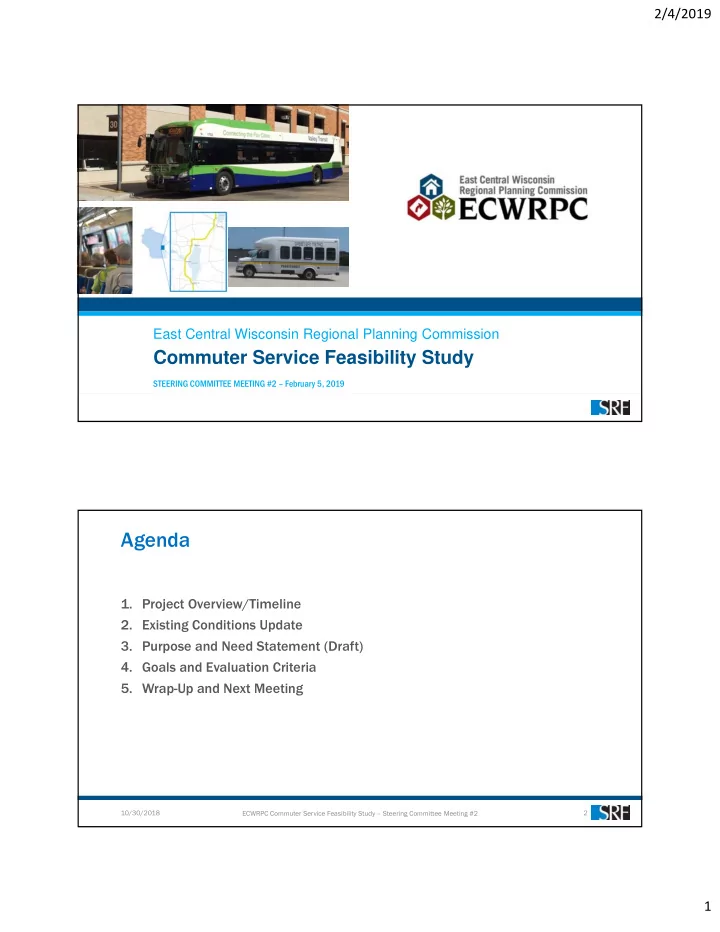
2/4/2019 East Central Wisconsin Regional Planning Commission Commuter Service Feasibility Study STEERING COMMITTEE MEETING #2 February 5, 2019 Agenda 1. Project Overview/Timeline 2. Existing Conditions Update 3. Purpose and Need Statement


slide-1
SLIDE 1

2/4/2019 1

East Central Wisconsin Regional Planning Commission

Commuter Service Feasibility Study

STEERING COMMITTEE MEETING #2 – February 5, 2019

ECWRPC Commuter Service Feasibility Study – Steering Committee Meeting #2

Agenda

  • 1. Project Overview/Timeline
  • 2. Existing Conditions Update
  • 3. Purpose and Need Statement (Draft)
  • 4. Goals and Evaluation Criteria
  • 5. Wrap-Up and Next Meeting

10/30/2018 2

slide-2
SLIDE 2

2/4/2019 2

ECWRPC Commuter Service Feasibility Study – Steering Committee Meeting #2

Project Overview

  • SRF has been hired to assist ECWRPC

in assessing the feasibility of commuter service in the I-41 corridor.

  • Major communities in the study area include

the cities of Green Bay, Appleton, Oshkosh, and Fond du Lac.

  • Public transit is available in each of these

cities, but intercity travel options are limited.

  • The study will include analysis of existing

conditions, as well as development of service concepts, financial strategies, and an action plan for implementation.

10/30/2018 3 ECWRPC Commuter Service Feasibility Study – Steering Committee Meeting #2

Project Timeline

10/30/2018 4

slide-3
SLIDE 3

2/4/2019 3

ECWRPC Commuter Service Feasibility Study – Steering Committee Meeting #2

Existing Conditions

10/30/2018 5 ECWRPC Commuter Service Feasibility Study – Steering Committee Meeting #2

Demographics

Population Density

Population density is highest in core urban neighborhoods of Green Bay, Appleton, Oshkosh, and Fond du Lac.

10/30/2018 6

slide-4
SLIDE 4

2/4/2019 4

ECWRPC Commuter Service Feasibility Study – Steering Committee Meeting #2

Demographics

Employment Density

Employment density varies more widely, with extremely dense concentrations in core downtowns (Green Bay, Appleton, Oshkosh), as well as development along I-41 and other major highways

10/30/2018 7 ECWRPC Commuter Service Feasibility Study – Steering Committee Meeting #2

Demographics

Non-Auto Households

Households without cars form a significant percentage of the population in many core urban areas, in some cases exceeding 50 percent.

10/30/2018 8

slide-5
SLIDE 5

2/4/2019 5

ECWRPC Commuter Service Feasibility Study – Steering Committee Meeting #2

Employment

Brown County Outagamie County Winnebago County Fond du Lac County Manufacturing 19.1% 23.1% 24.6% 23.5% Retail trade 11.8% 11.1% 11.8% 9.9% Professional, scientific, and management 7.8% 8.8% 8.3% 5.1% Educational services, health care and social assistance 20.6% 19.3% 20.6% 20.9% Arts, entertainment, and recreation 9.2% 8.5% 8.8% 7.4%

10/30/2018 9

Employment in Top 5 Industries by County (Study Area)

Source: 2012-2016 American Community Survey 5-Year Estimates

ECWRPC Commuter Service Feasibility Study – Steering Committee Meeting #2

Regional Travel Patterns

10/30/2018 10

Source: 2009-2013 American Community Survey 5-Year Estimates via the Census Transportation Planning Package (CTPP)

Cross-County Commute Flows

Origin (Residence) Destination (Workplace) Brown County Outagamie County Winnebago County Fond du Lac County Brown County

112,914 4,334 1,205 65

Outagamie County

8,050 61,106 17,245 432

Winnebago County

1,320 15,226 59,250 2,839

Fond du Lac County

81 577 3,599 36,365

slide-6
SLIDE 6

2/4/2019 6

ECWRPC Commuter Service Feasibility Study – Steering Committee Meeting #2

Common Themes

10/30/2018 11

Regional Economic Development Regional Transit Connectivity Local Land Use & TOD

ECWRPC Commuter Service Feasibility Study – Steering Committee Meeting #2

Purpose and Need

10/30/2018 12

slide-7
SLIDE 7

2/4/2019 7

ECWRPC Commuter Service Feasibility Study – Steering Committee Meeting #2

Purpose and Need

PURPOSE: Clear and succinct statement of the fundamental reasons for new commuter

service in the I-41 Corridor.

NEEDS: Existing transportation needs in the corridor that the new commuter service is

intended to address.

GOALS: Desired outcomes for I-41 Corridor communities.

Goals should be measurable: they will inform the criteria used to evaluate alternatives.

10/30/2018 13 ECWRPC Commuter Service Feasibility Study – Steering Committee Meeting #2

Purpose and Need

EXAMPLE PURPOSE STATEMENT: Commuter Service in the I-41 Corridor will strengthen connections between communities, enhance access to jobs, and create

  • pportunities for regional economic development.

10/30/2018 14

slide-8
SLIDE 8

2/4/2019 8

ECWRPC Commuter Service Feasibility Study – Steering Committee Meeting #2

Purpose and Need

EXAMPLE NEEDS: Limited options for non-auto travel between I-41 communities Limited fixed-route transit service to some employment centers Lack of a current funding structure to support transit service between urban areas What other Needs exist? .......................................................................................... ..........................................................................................

10/30/2018 15 ECWRPC Commuter Service Feasibility Study – Steering Committee Meeting #2

Goals and Evaluation Measures

GOAL 1: Enhance regional access to jobs via transit EVALUATION MEASURES: Percentage of regional jobs within ¼ mile of fixed-route transit Percentage of regional jobs served by demand-response or shuttle services

10/30/2018 16

slide-9
SLIDE 9

2/4/2019 9

ECWRPC Commuter Service Feasibility Study – Steering Committee Meeting #2

Goals and Evaluation Measures

GOAL 2: Improve transit travel times between study area communities EVALUATION MEASURES: Scheduled/estimated travel time (actual and percent change)

10/30/2018 17 ECWRPC Commuter Service Feasibility Study – Steering Committee Meeting #2

Goals and Evaluation Measures

GOAL 3: Identify and establish sustainable funding sources for new commuter services EVALUATION MEASURES: Intergovernmental agreements (yes/no) Public-private partnerships (yes/no)

10/30/2018 18

slide-10
SLIDE 10

2/4/2019 10

ECWRPC Commuter Service Feasibility Study – Steering Committee Meeting #2

Goals and Evaluation Measures

GOAL 4: .......................................................................................... EVALUATION MEASURES: .......................................................................................... ..........................................................................................

10/30/2018 19 ECWRPC Commuter Service Feasibility Study – Steering Committee Meeting #2

Goals and Evaluation Measures

GOAL 5: .......................................................................................... EVALUATION MEASURES: .......................................................................................... ..........................................................................................

10/30/2018 20

slide-11
SLIDE 11

2/4/2019 11

ECWRPC Commuter Service Feasibility Study – Steering Committee Meeting #2

Transit Needs

  • Who are the target customers?
  • Commuters?
  • Shift workers?
  • General-purpose travelers?
  • Where are the primary destinations?
  • Job centers near freeways?
  • Downtown areas?
  • Airports?
  • Higher education?
  • What type of transit suits each market?
  • Express routes (freeway-only)?
  • Limited-stop local segments?
  • What connections to other modes are

available?

  • Local transit centers or

high-frequency fixed routes?

  • Amtrak/Greyhound intercity buses?
  • First- and last-mile services (Valley

Transit Connector, Call-a-Ride, etc.)

  • Taxis/Rideshare/TNCs

10/30/2018 21 ECWRPC Commuter Service Feasibility Study – Steering Committee Meeting #2

Goals for New Service

Provide mobility benefits to travel markets identified by technical analysis and community input. Support local planning efforts and capitalize on the potential for new development. Provide affordable and effective transportation improvements. Seamlessly integrate with existing systems and provide valuable regional connections.

10/30/2018 22

slide-12
SLIDE 12

2/4/2019 12

ECWRPC Commuter Service Feasibility Study – Steering Committee Meeting #2

Discussion

10/30/2018 23 ECWRPC Commuter Service Feasibility Study – Steering Committee Meeting #2

Thanks!

Joseph Kapper SRF Consulting Group jkapper@srfconsulting.com Matthew Stegeman SRF Consulting Group mstegeman@srfconsulting.com

10/30/2018 24