Agenda Agenda 8:30 am Introduction - Kate Smiley - AGC-CA Why We - - PowerPoint PPT Presentation

agenda agenda
SMART_READER_LITE
LIVE PREVIEW

Agenda Agenda 8:30 am Introduction - Kate Smiley - AGC-CA Why We - - PowerPoint PPT Presentation

Agenda Agenda 8:30 am Introduction - Kate Smiley - AGC-CA Why We Care About Job Site Dust Control: 8:35 am The Science Behind It Joel Cohen, MPH,CIH - The COHEN Group 9:30 am Cal/OSHA and the Regulatory Perspective Date Bob Barish


slide-1
SLIDE 1

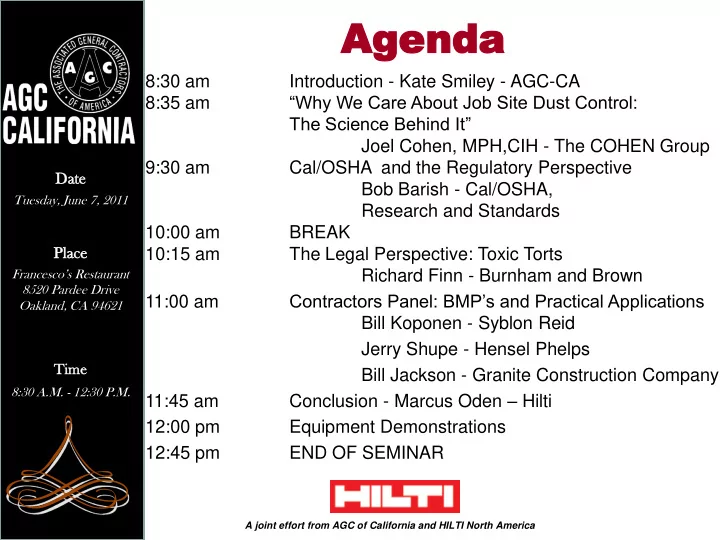
8:30 am Introduction - Kate Smiley - AGC-CA 8:35 am “Why We Care About Job Site Dust Control: The Science Behind It” Joel Cohen, MPH,CIH - The COHEN Group 9:30 am Cal/OSHA and the Regulatory Perspective Bob Barish - Cal/OSHA, Research and Standards 10:00 am BREAK 10:15 am The Legal Perspective: Toxic Torts Richard Finn - Burnham and Brown 11:00 am Contractors Panel: BMP’s and Practical Applications Bill Koponen - Syblon Reid Jerry Shupe - Hensel Phelps Bill Jackson - Granite Construction Company 11:45 am Conclusion - Marcus Oden – Hilti 12:00 pm Equipment Demonstrations 12:45 pm END OF SEMINAR

Agenda Agenda

A joint effort from AGC of California and HILTI North America

Date

8:30 A.M. - 12:30 P.M.

Time

Place

Francesco’s Restaurant 8520 Pardee Drive Oakland, CA 94621 Tuesday, June 7, 2011

slide-2
SLIDE 2

The Cohen Group San Mateo, CA

Jobsite Dust Control: Why We Care

Joel Cohen, MPH, CIH The Cohen Group San Mateo, CA www.thecohengroup.com

slide-3
SLIDE 3

The Cohen Group San Mateo, CA

Agenda

 What is Silica & Where is it found?  What are the Health hazards

associated with Silica?

 What levels of Silica are commonly

found in Construction?

 How do you sample for airborne Silica?  Q & A

slide-4
SLIDE 4

The Cohen Group San Mateo, CA

What is Silica?

slide-5
SLIDE 5

The Cohen Group San Mateo, CA

What is Silica?

 Chemically, it is SiO2  Silica can be crystalline or non-crystalline

– Non-crystalline forms

 Referred to as „amorphous‟  Some common forms include:

– Diatomaceous Earth – Silica Gel (paint fillers) – Fused Silica (found in glass, plastics, camera lenses)

slide-6
SLIDE 6

The Cohen Group San Mateo, CA

Where is Crystalline Silica Found?

 Crystalline Silica, Free Silica and Quartz are terms

used interchangeably.

 Quartz is the second most common mineral found

in the earth‟s crust

 Quartz is a common component of sand, stone,

rock, concrete, clay, brick, block, and mortar

– Granite

25-40% quartz

– Shale

20-25% quartz

– Sandstone

60-70% quartz

– Concrete

>5% quartz

slide-7
SLIDE 7

The Cohen Group San Mateo, CA

What are the Health Effects?

slide-8
SLIDE 8

The Cohen Group San Mateo, CA

slide-9
SLIDE 9

The Cohen Group San Mateo, CA

Health Hazards Associated with Quartz

 Silicosis

– Pulmonary fibrosis from inhalation of respirable

crystalline silica particles < 10µm

– Particle Size and Dose are most important factors – Latency of fibrosis may be 30-40 years

 3 types of Silicosis

– Chronic (>10yrs of relatively low dose) – Accelerated (develops in 5-10 years after first dose) – Acute (develops within weeks to years after high dose)

[CDC/NIOSH, Health Effects of Occupational Exposure to Respirable Crystalline Silica, 2002-129]

slide-10
SLIDE 10

The Cohen Group San Mateo, CA

Health Hazards Associated with Quartz

 Most epidemiologic data and dose/response models

developed from study of miners, granite workers, & foundry workers

Not construction workers

 Other Health Hazards Associated with Quartz

Chronic Obstructive Pulmonary Disease (COPD)

Tuberculosis

 As silicosis progress, bacterial or fungal infections are possible  Tuberculin test now recommended for >25yrs of silica work (ATS

1997)

Other effects (Rheumatoid arthritis, scleroderma, lupus)

[CDC/NIOSH, 2002-129]

slide-11
SLIDE 11

The Cohen Group San Mateo, CA

Cancer Association with Quartz

 1980s – Debate started  International Agency for Research on Cancer

(IARC)

– 1996 deemed “sufficient evidence in humans” (Group 1) – 1997 acknowledged epi studies were not uniform and

work groups are not comparable

 Carcinogenicity “may be dependent on characteristics of

silica or external factors”  National Toxicology Program (NTP)

– 1998 re-evaluated studies due to IARC – 2000 designated crystalline silica a human carcinogen

[see IARC Volume 68, 5/20/97; NTP Report on Carcinogens, 11th Ed.]

slide-12
SLIDE 12

Cancer Association with Quartz

 NIOSH

– Recommended respirable crystalline silica to be

considered a potential occupational carcinogen

 ACGIH

– 2006 adds A2 Notation “Suspected Human Carcinogen”

 California Prop 65

– 1988 Silica added to list as cancer causing agent

[Ca Hlth and Safety Code, §25249]

The Cohen Group San Mateo, CA

slide-13
SLIDE 13

The Cohen Group San Mateo, CA

Occupational Exposure Limits for Quartz

Source Type Limit (mg/m3)*

Cal/OSHA §5155 Total Respirable 0.3 0.1 Fed/OSHA 1910.1000 Z-3 table Total Respirable 30/(%quartz + 2) 10/(%quartz + 2) MSHA 30CFR56,57,70,71 Respirable Respirable (>5%) 10/(%quartz +2) 10/%quartz ACGIH Respirable 0.025 (adopted 2006) NIOSH Respirable 0.05, 10-hr TWA

* Note: 8-hr TWA, unless otherwise noted

slide-14
SLIDE 14

The Cohen Group San Mateo, CA

Quartz Exposures in Construction

Task Samples Collected Quartz Concentration

(GM - mg/m3)

Tuckpoint grinding 101 0.60 Drill concrete 97 0.20 Surface grinding 122 0.29 Road demo 51 0.09 Cut concrete/brick 164 0.08 Cleanup 61 0.05

J Occ Env Hyg 3:144-152, 2006

slide-15
SLIDE 15

The Cohen Group San Mateo, CA U of Wash, Sept 2006

slide-16
SLIDE 16

Quartz Exposure From Hand-Held Grinders

 4.5 inch angle grinder used on concrete walls in

a parking garage

 Effect of Wind (upwind/downwind measurement)

> 2 mph 0.02 – 1.80 mg/m3 Quartz 0.34 – 40.0 mg/m3 Respirable Dust < 2 mph 0.17 – 7.10 mg/m3 Quartz 3.80 – 81.0 mg/m3 Respirable Dust

 Approx. 69% of subjects overexposed

[Akbar-Khanzadeh, F, Ann Occ Hyg 46:341-346, 2002] The Cohen Group San Mateo, CA

slide-17
SLIDE 17

Other Source of Silica Exposure

 Wall Caulk Removal

– PCBs and Silica exposure

 Dry Removal (reciprocating saw, utility

knife)

– ND to 0.054 mg/m3 quartz

 Wet Removal (same tools)

– ND to 0.016 mg/m3

quartz

[AIHCE Conference May 2011 Poster 109] The Cohen Group San Mateo, CA

slide-18
SLIDE 18

The Cohen Group San Mateo, CA

How Do You Sample for Silica?

slide-19
SLIDE 19

The Cohen Group San Mateo, CA

How IH‟s Collect Silica Samples in Air

Pre-weighed 37mm, 5µ PVC Filter Cyclones

IHs collect air samples for short term or up to 8 hours called an 8 hr TWA (time weighted average) IHs collect Personal

  • r Area Samples or

Both

slide-20
SLIDE 20

The Cohen Group San Mateo, CA

Conclusions

 Silica is ubiquitous in our environment  Silica (quartz) is associated with

respiratory disease and may be associated with lung cancer

 Not all dusts on construction sites

contain silica. The only way one can confirm exposure is by industrial hygiene sampling

slide-21
SLIDE 21

The Cohen Group San Mateo, CA

Conclusions

 Identify silica dust producing tasks and

use controls

 There is overwhelming evidence

demonstrating many construction tasks are associated with elevated quartz levels

 When controlling silica dust, you are

controlling all dust!!

slide-22
SLIDE 22

The Cohen Group San Mateo, CA

Information Sources

 Federal OSHA [www.osha.gov]  Cal/OSHA [www.dir.ca.gov]

– See Cal/OSHA’s eTool on Silica

 NIOSH [www.cdc.gov/niosh/topics/silica]  The Cohen Group/On-Site Health and Safety

[thecohengroup.com/Silica%20Memo.pdf]

slide-23
SLIDE 23

The Cohen Group San Mateo, CA

Questions??

Joel Cohen, MPH, CIH The Cohen Group San Mateo, CA www.thecohengroup.com

slide-24
SLIDE 24

What is Title 8 Section 1530.1? How did it come about and what does it require.

AGC Jobsite Dust Control Seminar June 7, 2011 Oakland, California Bob Barish, Cal/OSHA Research & Standards Unit

slide-25
SLIDE 25

Process started with silica PEL

  • May 2005 Cal/OSHA public advisory meeting on silica PEL
  • Much employer comment on possible revision to PEL for silica

with so many different businesses affected

  • Federal OSHA working on silica PEL >15 years – also looking at

work based approach for construction

  • Also, growing concern with dust exposure of the public from

construction worksites (San Francisco ordinance)

  • Alarcon bill – SB 46 June 2, 2006 This bill would prohibit the

dry cutting and dry grinding of masonry materials, except where it is determined that the use of water in cutting or grinding masonry materials is not feasible

slide-26
SLIDE 26

What‟s the concern?

  • Operations with high exposure potential, even with relatively short

exposures can be >>>PEL, especially when conducted indoors or in partially completed structures

  • Serious, debilitating, sometimes fatal lung diseases:

silicosis lung cancer TB susceptibility

Recognized more recently: Chronic bronchitis, airflow obstruction,

possibly COPD, even in the absence of radiologic signs of silicosis:

American Thoracic Society statement on adverse effects of crystalline silica (1997) http://www.thoracic.org/sections/publications/statements/pages/eoh/506.html Chronic obstructive pulmonary disease due to occupational exposure to silica dust: a review of epidemiological and pathological evidence. Hnizdo E. and Vallyathan V Occup. Environ. Med. 2003;60;237-243

http://www.pubmedcentral.nih.gov/picrender.fcgi?artid=1740506&blobtype=pdf

  • Can also have acute or accelerated silicosis with very high

exposures

slide-27
SLIDE 27

Informal public advisory process to develop regulatory alternative to proposed legislation

  • >60 attendees at each of 2 public meetings January 17

and March 26, 2007

– Contractor organizations (CAL-PASC, AGC, CEA, Roofers) – Labor unions (Bricklayers, Laborers, Roofers) – Equipment manufacturers – Individual workers and contractors – Equipment manufacturers

  • Major outcomes of the two advisory meetings:

– Water or Local exhaust ventilation (LEV) for dust control – Exceptions – Training details

Standards Board Public Hearing December 13, 2007

– Only minor changes from the original proposal – Regulation took effect October 22, 2008

slide-28
SLIDE 28

Title 8: §1530.1: Control of Employee Exposures from Dust-Generating Operations Conducted on Concrete or Masonry Materials (effective 10.22.08)

(Coverage by this regulation does not exclude coverage by other related standards) Concrete or Masonry Material (examples. brick, clay brick, concrete block, mortar, natural or manufactured stone, tile, terra cotta)

  • Includes any „stone-like‟ material

Unless indicated by evidence to not contain cement, sand, gravel, stone, clay,

  • r aggregate material containing silica

Certain materials and operations are not covered by this regulation, but are still covered by other relevant standards (see the Exceptions in 1530.1(a)) Cutting, Grinding, Coring, Drilling Using power tools } AND

  • 1. Required Dust Reduction System
  • - Water or Local Exhaust (vacuum)
  • 2. Ensure Safety and Effectiveness
  • f dust reduction system
  • - as per manufacturer’s specifications
  • 3. Employee Training
  • - health hazards, dust reduction

systems, proper use and maintenance, good site hygiene

  • 4. Supervisor Training
  • - everything above, task identification,

how to implement dust reduction system Exceptions:

  • If shown to be < PEL
  • If rooftop operation
  • Emergency (24 hrs.)

(1530.1 (e) Training still required)

  • Maintain effectiveness
  • Electrical safety with

water

  • Waste disposal
  • Manufacturer

instructions

  • At least annually.
  • At least annually.

http://www.dir.ca.gov/Title8/1530_1.html

  • P. Scholz , 2.13.09
slide-29
SLIDE 29

Key elements of 1530.1

SUPPLEMENTAL to existing PELs and other applicable regs

  • A. Covers (with some exceptions – see next slide)
  • Powered tools or equipment
  • Cutting, grinding, coring, or drilling
  • On concrete or masonry material (as specifically defined in the regulation)
  • B. Requires 3 MAIN ELEMENTS:
  • 1. Use of water or local exhaust ventilation (LEV) (see exceptions next slide) Note:

LEV can include, per definition, vacuum systems, dust collection systems, and dust exhaust systems (“fan” is not included in the definition of LEV) Detail Item 1: Per language of 1530.1(c) Exception No. 1, must be below all applicable PELs for exception to dust controls apply, not just respirable silica. So 1530.1 is intended to control all dusts from covered operations, not just respirable silica. Detail Item 2: When water or LEV dust control system does not control below PEL, as studies indicate can happen, then need to also use other feasible controls, including potentially water with ventilation if can, to control below PEL per Title 8 section 5141

  • 2. Safe and effective use of dust reduction systems (maintenance, electrical safety,

waste)

  • 3. Employee and supervisor training to be conducted annually
slide-30
SLIDE 30

Two kinds of exceptions in 1530.1

1. Specific operation exceptions for coverage by 1530.1 (but still covered by PELs 8 CCR 5155 and control of over-exposures, IIP Training, and Hazard Communication Training) – Stucco, plaster, and similar products – Wall cladding, siding, or similar products – Downward drilling – Jack-hammering or chipping incidental to plumbing or landscaping activity – Work with powder-actuated tools – Work incidental to installation of concrete and masonry materials – Tile backer board 2. Exceptions to dust control systems for covered operations, but specified 1530.1 training is still required:

  • 1. Where reliably show by air sampling data that applicable PELs not exceeded (not just

respirable silica) (NOTE: This means sampling of the employer’s own operations. Generalized data for similar

  • perations from, for example, tool manufacturers or employer or trade associations will

generally not be specific enough to get exception)

  • 2. Rooftop operations (1530.1 covered operations should be conducted on ground or scaffold if

possible so that dust controls can be used safely)

  • 3. Emergency operations as defined (1st 24 hours)

NOTE: Title 8 section 5145 Media for Allaying Dusts, Fumes, Mists, Vapors, and Gases includes requirement for use of water or other liquid for dust control beyond operations specifically covered by 1530.1

slide-31
SLIDE 31

1530.1 Training Elements

For affected workers and their supervisors

  • Silica-related diseases
  • Methods employer uses to control dust exposures
  • Proper use of dust controls including waste handling
  • Good hygiene and housekeeping

Additonal information for supervisors

  • Work tasks which may result in exposures to silica dust
  • The employer‟s procedures for implementing the required dust

control measures

Periodic training

  • Conducted at least annually
slide-32
SLIDE 32

Information Resources

  • DOSH Policy & Procedure C-51

Crystalline Silica Inspection Guidelines with emphasis on exposure to concrete and masonry dust in construction per 8 CCR section 1530.1 (4/23/09) https://www.dir.ca.gov/DOSHPol/P&PC-51.HTM

  • Cal/OSHA E-tool: Hazards of Silica in Construction Consultation Silica “e-tool” (The E-tool can be printed

with “Print this e-tool” at the top of its page) https://www.dir.ca.gov/dosh/etools/08-019/index.htm

  • Cal/OSHA Standards Board website for 8 CCR 1530.1 with rulemaking documentation

https://www.dir.ca.gov/oshsb/concreteandmasonry0.html

  • OSHA (Federal). Controlling Silica Exposures in Construction 2009 OSHA Publication 3362-04 72 pgs

http://www.osha.gov/Publications/3362silica-exposures.pdf (Very detailed on dust controls for different tools)

  • NIOSH Pub. 2008-126:Control of Hazardous Dust During Tuckpointing

http://www.cdc.gov/niosh/docs/wp-solutions/2008-126/

  • What Physicians Need to Know About Silicosis in Construction, Demolition, and Renovation Workers

http://www.elcosh.org/record/document/617/d000599.pdf (New Jersey Dept. of Health & Senior Svcs)

slide-33
SLIDE 33

BREAK

slide-34
SLIDE 34
slide-35
SLIDE 35

 Action Level of 0.05mg/M3  Personal Monitoring 24-month

intervals

 Engineering/Administrative Controls  Respiratory Protection Program  Medical Surveillance  Risk Communication/Training  Recordkeeping

slide-36
SLIDE 36

 Utilize all Dust Controls Available; Do Not

Operate Without Them

 Assure that Controls are Working Properly;

Inform Your Supervisor if They are Not

 Avoid Dry Sweeping; Keep Work Areas Free

  • f Excess Accumulations of Dust

 Avoid Areas of Visible Dust  Where Necessary Utilize Respirators

slide-37
SLIDE 37

 During Clean-up in High Dust Areas  Maintenance/Repair in High Dust Areas  In Designated or Posted Respirator Required

Areas

 When You Believe Dust Concentrations are

too High

 When the Action Level is Exceeded and

Prior to Controls being Installed

slide-38
SLIDE 38

 A comprehensive work and medical history to evaluate

exposure and the signs and symptoms of respiratory disease before exposure to RCS.

 A thorough medical examination emphasizing the

respiratory system.

 A 14 X 17 inch posterior/anterior chest roentgenogram (x-

ray), interpreted, using the ILO classifications, by a Board- certified or Board-eligible radiologist or a certified “B'' reader.

 A pulmonary function test (PFT) that includes forced

expiratory volume in 1 second (FEV1), forced vital capacity (FVC) and diffusion lung capacity (DLCO).

slide-39
SLIDE 39
slide-40
SLIDE 40
slide-41
SLIDE 41
slide-42
SLIDE 42
slide-43
SLIDE 43

 If we know and don’t tell (customers,

employees, etc.), we increase the risk of punitive damages above and beyond injury claims.

 If we know and don’t act, we increase the

risk of punitive damages above and beyond injury claims.

 NOT KNOWING IS NO DEFENSE!

slide-44
SLIDE 44
slide-45
SLIDE 45

Silica in Construction

slide-46
SLIDE 46

Applicable Regulations

 Injury and Illness Prevention Program

(1509)

 General Requirements of Mechanical

Ventilation Systems (1530)

 Control of Concrete and Masonry Dust

(1530.1)

 Respiratory Protection (5144)  Hazard Communication (5194)

slide-47
SLIDE 47

Resources

 Cal/OSHA Consultation

  • www.dir.ca.gov

 Federal OSHA

  • www.osha.gov

 NIOSH

  • www.cdc.gov/niosh
slide-48
SLIDE 48

Video 1

slide-49
SLIDE 49

Protecting your People

Identify Possible Sources Determine the Hazard Develop Controls Train Reassess

slide-50
SLIDE 50

Identify Possible Sources

 Product labels  Material Safety Data Sheets (MSDS)  Sampling

slide-51
SLIDE 51

MSDS Review

slide-52
SLIDE 52

Developing Controls

Eliminate or Reduce Exposure Engineering Controls Administrative or Work Practices Personal Protective Equipment

slide-53
SLIDE 53
slide-54
SLIDE 54
slide-55
SLIDE 55

Sample Controls

slide-56
SLIDE 56

Sample Controls

slide-57
SLIDE 57

Sample Controls

slide-58
SLIDE 58

Sample Controls

slide-59
SLIDE 59

Video 2

slide-60
SLIDE 60

Lessons Learned on Implementation: Change Management Subs PEL’s are Fascinating Things (Do the IH Studies) Training on equipment Productivity Myths (Water is Faster and you get what you pay for) Silica Dust and Stormwater = Dual Compliance Return on Investment = What is it worth to do what it takes to be in compliance? (We know CAL OSHA has been told to write more serious violations and the EPA can fine contractors up to $37,500 per drainage point per day, State Water Boards can fine up to $10K per drainage point per day, and $10 to $20 per gallon of bad discharge for ph

  • contaminants. Just another relationship between safety & environmental compliance. Done

right, employee engagement will increase and they view the safety program in a positive light)

slide-61
SLIDE 61
slide-62
SLIDE 62
slide-63
SLIDE 63
slide-64
SLIDE 64
slide-65
SLIDE 65
slide-66
SLIDE 66

ww www. w.us.hilti.com us.hilti.com l w l www ww.hilt .hilti.ca i.ca June Dust Control Conferencesl June 2011

Jobsite Dust Removal Systems for 2011

Work safe. Improve productivity.

slide-67
SLIDE 67

ww www. w.us.hilti.com us.hilti.com l w l www ww.hilt .hilti.ca i.ca June Dust Control Conferencesl June 2011

Pr Prod

  • duc

ucti tive? e?

Concrete cutting application performed by two operators – May 2009

slide-68
SLIDE 68

ww www. w.us.hilti.com us.hilti.com l w l www ww.hilt .hilti.ca i.ca June Dust Control Conferencesl June 2011

Our harmonized systems outperform the competition

Harmonized system Continuous suction power

Consumables Tool design Accessories Vacuums

We are a system solution provider – not selling single product features

Dust Amount (kg) Suction Power (l/s)

slide-69
SLIDE 69

ww www. w.us.hilti.com us.hilti.com l w l www ww.hilt .hilti.ca i.ca June Dust Control Conferencesl June 2011

Unique TE DRS-B

Two chamber air flushing system

TE DRS-B not only removes dust from the working surface, but also from the front end of the chuck, hence reducing dust exposure by up to 95% of total dust, and 99% of respirable dust.

Inner ring (2nd ring) at working end

The purpose of this ring is to restrict intake

  • f large pieces of concrete / surface

material which could block the system and cause working interruptions.

1 2

slide-70
SLIDE 70

ww www. w.us.hilti.com us.hilti.com l w l www ww.hilt .hilti.ca i.ca June Dust Control Conferencesl June 2011

Have you ever considered….

  • How does this impact the life of the tool

and consumables?

  • The drilling/cutting speed of the tools?
  • Jobsite preparation and cleaning –

productivity?

  • The comfort and protection of the
  • perator?
  • The environment?

Up to 2.20 lbs dust are produced with five minutes sawing / cutting. Now imagine working like this for one hour. Or a full day.

slide-71
SLIDE 71

ww www. w.us.hilti.com us.hilti.com l w l www ww.hilt .hilti.ca i.ca June Dust Control Conferencesl June 2011

Hilti DRS helps with regulatory compliance, helps to save costs and improve productivity.

no DRS

Respirable dust

no DRS

Tool lifetime

no DRS

Consumable lifetime

no DRS

Application speed

no DRS

Cleaning effort Jobsite compliance Longer lifetime Labor time savings

no DRS

Inhalable dust

slide-72
SLIDE 72

ww www. w.us.hilti.com us.hilti.com l w l www ww.hilt .hilti.ca i.ca June Dust Control Conferencesl June 2011

Consumables Power Tools Accessories Vacuum Cleaners

Effective dust control begins with the design of the tools used. Thanks to innovative design, Hilti systems remove dust right at its source Stop kicking up dust! There‟s even a dust removal system for Hilti breakers. Hilti AirBoost technology – for maximum performance and efficiency.

Hilti Dust Removal Systems

Four components – one winner

All system components, including consumables, drill bits, discs, blades or other accessories as well as fully integrated systems, are perfectly matched to maximize the amount of dust removed at its source and collected efficiently by the vacuum removal system.

slide-73
SLIDE 73

ww www. w.us.hilti.com us.hilti.com l w l www ww.hilt .hilti.ca i.ca June Dust Control Conferencesl June 2011

Summary: Our recommendation for superior performance - use our harmonized system

Factors increasing productivity and worker protection:

  • Harmonized system which is designed and developed together
  • A high continuous suction power - more important than only a high filter class
  • Easy to transport, mobile on site, robustly designed and easy to use
slide-74
SLIDE 74

ww www. w.us.hilti.com us.hilti.com l w l www ww.hilt .hilti.ca i.ca June Dust Control Conferencesl June 2011