SPARC 12 Speed Presentation Abstracts Group 1: Arts and Health - - PDF document

sparc 12 speed presentation abstracts
SMART_READER_LITE
LIVE PREVIEW

SPARC 12 Speed Presentation Abstracts Group 1: Arts and Health - - PDF document

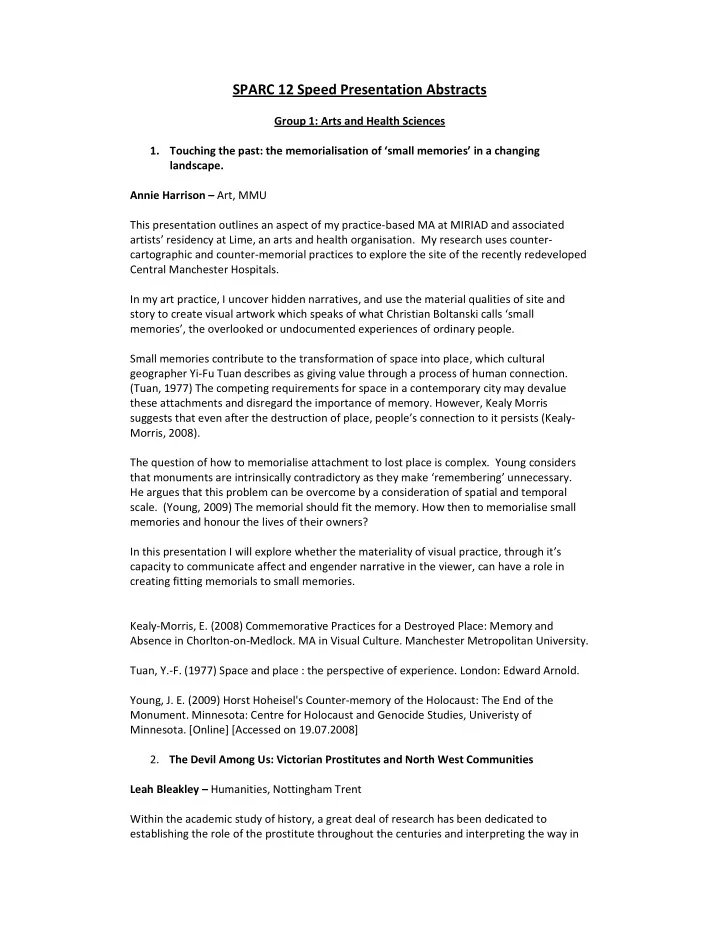
SPARC 12 Speed Presentation Abstracts Group 1: Arts and Health Sciences 1. Touching the past: the memorialisation of small memories in a changing landscape. Annie Harrison Art, MMU This presentation outlines an aspect of my


slide-1
SLIDE 1

SPARC 12 Speed Presentation Abstracts

Group 1: Arts and Health Sciences

  • 1. Touching the past: the memorialisation of ‘small memories’ in a changing

landscape. Annie Harrison – Art, MMU This presentation outlines an aspect of my practice-based MA at MIRIAD and associated artists’ residency at Lime, an arts and health organisation. My research uses counter- cartographic and counter-memorial practices to explore the site of the recently redeveloped Central Manchester Hospitals. In my art practice, I uncover hidden narratives, and use the material qualities of site and story to create visual artwork which speaks of what Christian Boltanski calls ‘small memories’, the overlooked or undocumented experiences of ordinary people. Small memories contribute to the transformation of space into place, which cultural geographer Yi-Fu Tuan describes as giving value through a process of human connection. (Tuan, 1977) The competing requirements for space in a contemporary city may devalue these attachments and disregard the importance of memory. However, Kealy Morris suggests that even after the destruction of place, people’s connection to it persists (Kealy- Morris, 2008). The question of how to memorialise attachment to lost place is complex. Young considers that monuments are intrinsically contradictory as they make ‘remembering’ unnecessary. He argues that this problem can be overcome by a consideration of spatial and temporal

  • scale. (Young, 2009) The memorial should fit the memory. How then to memorialise small

memories and honour the lives of their owners? In this presentation I will explore whether the materiality of visual practice, through it’s capacity to communicate affect and engender narrative in the viewer, can have a role in creating fitting memorials to small memories. Kealy-Morris, E. (2008) Commemorative Practices for a Destroyed Place: Memory and Absence in Chorlton-on-Medlock. MA in Visual Culture. Manchester Metropolitan University. Tuan, Y.-F. (1977) Space and place : the perspective of experience. London: Edward Arnold. Young, J. E. (2009) Horst Hoheisel's Counter-memory of the Holocaust: The End of the

  • Monument. Minnesota: Centre for Holocaust and Genocide Studies, Univeristy of
  • Minnesota. [Online] [Accessed on 19.07.2008]
  • 2. The Devil Among Us: Victorian Prostitutes and North West Communities

Leah Bleakley – Humanities, Nottingham Trent Within the academic study of history, a great deal of research has been dedicated to establishing the role of the prostitute throughout the centuries and interpreting the way in

slide-2
SLIDE 2

which societies reacted to these deviant women. However, despite the extensive enquiries that have been previously undertaken on the topic, there is still a need for substantive work that goes beyond the common academic focus on extraordinary events or particular locations. By shifting the focus away from unusual events and individuals, as well as away from attitudes found in large conurbations such as London, a better comprehension can be gained

  • f the ‘ordinariness’ of prostitution and the role it played in the daily life of provincial
  • communities. Critical reflection on historical studies such as those by Judith Walkowitz

underlines the need for local or micro-studies, as general comments on locations such as Portsmouth and Aldershot are derived from research focusing on London, York, Manchester

  • r Liverpool. This research project will address this by providing case studies on the

Northern towns of Chester, Birkenhead, Crewe and Nantwich. By studying these summary courts, a greater comprehension of the extent to which prostitution was tolerated or persecuted can be achieved. Therefore, this thesis will promote a more profound understanding of the historical geography of deviance; in turn allowing for the evolution of a more inflected comprehension of Victorian prostitution nationally.

  • 3. The role of the interpreter in Videoconference Interpreting

Jerome Devaux – Languages, Salford Her Majesty’s Courts Service has been subject to various changes within the past decade. Owing to budgetary constraints new working methods have been adopted, while the introduction of new technologies has revolutionised the legal sphere. Since 2002, courts in England and Wales have increasingly been using videoconference (VC) technologies to speed up the legal process and reduce costs. Within this context, an important social actor is the legal interpreter, whose role, according to the Interpreter’s Oath, is “to well and faithfully interpret and make true explanation of all such matters and things as shall be required of [him/her] according to the best of [his/her] skill and understanding” between English and a foreign language. It is currently unclear whether this role is being affected by the increasing use of VC

  • technologies. While some studies have been carried out on their use in monolingual settings,

where results suggest that there is only a minimal impact on the proceedings and their

  • utcomes (Fullwood et al.; 2008, Hodges; 2008), certain findings raise issues that could

impact on the role of the interpreter. This presentation therefore aims to contextualise the role of the interpreter within the UK and to compare face-to-face interpreting (i.e. when all the parties are present in court) with VC interpreting. To do so, the approach will be based on work carried out by prominent scholars in Interpreting Studies such as Gentile et al. (1996), Wadensjö (1998) and Braun & Taylor (2011).

  • 4. The Translation of Idioms between English and Arabic

Khalid Al-Saleem – Languages, Salford This paper explores obstacles to the translation of idioms from English into Arabic. It explores the differences between ‘idiom’, ‘term’ and ‘terminology’ – an idiom being prototypically a word or phrase which has a figurative meaning and cannot be translated literally, while a term is a ‘word or expression with a special meaning or used in a particular activity, job, profession’, and ‘terminology’ is a ‘system of specialised words and expressions

slide-3
SLIDE 3

used in a particular science, profession, activity’ (Collins English Dictionary). Non-technical terms are found in areas which are specialized but do not require deep knowledge or training such as the terminology of gardening, while technical terms are found in areas which are specialized and require training. The paper also presents the results of a practical study conducted in Saudi Arabia to assess whether idioms dictionaries help Arab students in translating idioms. The specific aims of this study are: 1. To investigate the translation techniques used by Saudi student learners of English to translate English idioms; 2. To assess how useful idioms dictionaries are in helping Saudi student learners translate Arabic idioms into English. The study shows that idioms dictionaries make a significant contribution to improving Saudi learners translations of idioms.

  • 5. Flirting with the audience and other functions of musical quotation.

Andra Ivanescu Abstract: Musicians, specifically composers, have always borrowed material from other

  • musicians. From orally transmitted song traditions that involved the same songs being retold

in almost infinite varieties over decades and maybe even hundreds of years to 20th century jazz standards that have similarly endless variations and modern-day sampling, appropriation and borrowing have always been a part of musical composition. Quotation, however, is a special type of musical appropriation. My research focuses on musical quotation and its functions within a large variety of musical genres, from classical music of the Renaissance to cartoon music and sample-based electronica. By using a wide range of examples and using a strong theoretical framework, largely based on linguistics, I identify three main types of quotation: quotation that refers to the original piece from which it is extracted, quotation that is used in order to refer to something else and quotation that does both.I therefore aim to create a broad taxonomy of musical quotation and its functions that applies to virtually every musical quote in practically every musical genre.

  • 6. Experiences of healthcare services for Multiple Sclerosis: A qualitative study of

service users and healthcare professionals Abigail Methley – Health Sciences, Manchester Multiple Sclerosis (MS) is a chronic and degenerative condition. The complex nature and poor outcomes of MS may result in it being a difficult condition to manage, both physically and psychologically. Research suggests high rates of psychological and emotional issues are identified in people with MS, yet these additional psychological issues are not always identified or treated in healthcare services. There is little qualitative research available on the experiences of people with MS of healthcare services generally, or the experience and treatment of psychological and emotional issues specifically. In addition there is little research available on the experiences of healthcare professionals who care for people with MS. This study proposes to investigate the experience of psychological issues in MS and perceptions of healthcare services, from the point of view of both people with MS and healthcare professionals. Semi-structured interviews will be conducted, investigating topics such as diagnosis, psychological issues in MS, factors that improve or restrict access to services, satisfaction with services and areas to prioritise for change. Longitudinal follow-ups will measure use of services and individual’s reactions to services over one year.

slide-4
SLIDE 4

This research will be able to provide useful feedback to healthcare services by outlining areas for change highlighted by both service users and service providers. In particular information providing an insight into how psychological issues are perceived and treated will fill a gap in our current research and policy knowledge. A qualitative systematic review on people with MS’ experiences of healthcare services will also be conducted.

  • 7. Effect of Media Multitasking on Children's Exogenous Attention

Christopher Lowe – Health Sciences, Salford Media multitasking is a new phenomenon involving simultaneous engagement in media activities within one media platform and/or multiple media (e.g. watching television whilst using a laptop; Vega, 2009). Initial studies have identified that adults who engage in heavy media multitasking have a tendency to processing more visual information when completing a task, subsequently being distracted by irrelevant information in their environment (Ophir et al. 2009; Cain & Mitroff, 2011). This research suggests a possible negative impact of heavy media multitasking on attentional control. Recent reports from the USA indicate that some children multitask with media 29% of the time spent using media (Rideout, Foehr & Roberts, 2010). Similarly, UK based research has also identified that children do engage in regular media multitasking (Jago, et al., 2011). To date no research has examined the possible attentional impacts of media multitasking in relation to children. Therefore, questions relating to whether we should encourage or discourage children to engage in media multitasking still need to be addressed. The current study will measure media multitasking engagement in children using a structured interview

  • approach. Children’s attentional control will be measured using a computer based

exogenous orienting task, the task measures reaction time to attend an on-screen peripheral

  • target. The extent of the relationship between amount of media multitasking in children and

their performance on the orienting task is to be examined. The study aims to explore how children’s media multitasking behaviour relates to a tendency towards exogenous attentional control.

  • 8. The progression of profiles of children with Development Coordination Disorder
  • ver time

Vicky McQuillan – Health Sciences, Leeds Developmental coordination disorder (DCD) can be a hidden childhood handicap, yet the motor impairment experienced can significantly interfere with daily life. DCD affects 5% of schoolchildren of both sexes, can disrupt their academic progress, participation in leisure and physical activities and wellbeing and causes severe impairment in nearly 2%. Longitudinal studies suggest DCD extends into adulthood with very poor outcomes, yet the course and prognosis are difficult to predict and poorly understood. Furthermore, children with DCD more often than not have associated difficulties in attention, language, social interaction and specific learning difficulties. Yet few studies have examined the nature of their interaction and effect on outcomes. Even the motor characteristics experienced by children with DCD can vary and large within group differences have been found. However, DCD is still often treated as a homogeneous group which is not helpful for intervention. This study aims to profile children with DCD for motor and associated characteristics over a two year period to examine for stability and change. It will use a mixed methodology to compare typically developing children with children with DCD using standardised motor

slide-5
SLIDE 5

assessments, child self report and parent questionnaires. A case study design will also be employed to explore the children’s context using Bronfenbrenner’s model. This presentation will outline some of the major issues in the field of DCD research, my research question and the proposed research design.

  • 9. How should we measure the effectiveness of cognitive rehabilitation post-stroke?

Patient involvement is the key. Emma Patchick – Health Sciences, Manchester Stroke is the leading cause of disability in the UK. The James Lind Alliance bring patients, carers and clinicians together and takes a comprehensive and rigorous approach to identify treatment uncertainties. Their number one identified research priority for stroke is finding the best interventions to improve cognition. Appropriate outcome measures are fundamental for evaluation of the effectiveness of interventions. The body of work to be presented has included a review of current outcome measures used in trials of cognitive rehabilitation that has identified the requirement to develop a patient-centred outcome measure suitable for use in this field. This body of work will make significant use of patient and public involvement (PPI) to guide the direction of the measure development: what

  • utcomes are most important to patients with stroke and cognitive problems? What should

we be measuring to determine the effectiveness of a rehabilitation intervention for these individuals? What level of the World Health Organisation’s international classification of functioning, disability and health (ICF) should outcomes measure: at the level of impairment, activity or participation? What are the best ways to engage users to comment on these topics? By 30th May (SPARC conference) some of these questions will have started to be answered; the future direction and next stages of the research will be set out. I hope to engage other SPARC attendees and discuss interesting ways of including PPI in postgraduate research.

  • 10. Do nursing students in their final year of BSc General/Adult nursing programme

feel empowered? an exploratory study. Sara Kennedy – Nursing, Salford Introduction This is the first study that proposes to explore the process of empowerment in nursing students during the final year of a BSc (Hons) nursing degree programme in General/Adult nursing in Ireland. Nursing empowerment is viewed as a positive concept, desirable and beneficial for patients and personal growth and development of the nurse (Kuokkanen and Leino-Kilpi 2000, Laschinger 2008). Aim The aim of this study is to explore what are the factors that promote or hinder empowerment during the socialisation processes of nursing education. Method A mixed methods study will comprise of three phases that will be conducted during the final year of a four year nursing degree. The final year comprises of a 36 week placement to consolidate practice and a pre-post test survey design will be undertaken. It is proposed that Phase 1 will measure levels of empowerment, using a validated questionnaire (Laschinger et al 2001). Phase 2 will utilise the survey measurements to inform nursing student focus groups to further illuminate the concept of empowerment. Phase 3 will gather data, using focus groups to ascertain the perceptions of empowerment from preceptors’ perspectives.

slide-6
SLIDE 6

Sample A total sample (n= 50) of all year 4 final year students at one nursing college. Ethical approval from Salford University and the Local Ethical Research Committee from the nursing college will be sought. Discussion It is unclear as to how or if the empowerment of nursing students is enabled or inhibited by clinical placements in nurse student education. It is anticipated that the outcomes will contribute to international perspectives on empowerment. Group 2: Computing and Business

  • 1. What does philosophy have to do with energy research?

Tara Hughes – Computing, Salford In the UK we have a really big problem with the amount of energy being used in our homes. Today more energy is used in homes than by either road transport or industry, accounting for nearly a third of total energy use. Between 1970 and 2009 energy use in housing rose by 17%. Over the same time the number of homes increased by a fifth, and crucially the number of energy consuming appliances we would feel lost without has exploded. Unless domestic energy demand is cut dramatically and rapidly the UK will neither achieve the 2020 carbon emissions targets nor meet the fuel poverty reductions required by legislation. There has been considerable research into improving energy consumption of buildings and

  • appliances. Yet, despite the importance of home energy consumption there has been very

little research into the behaviour patterns of people when they are using energy in the

  • home. The most common approach to dealing with the unknowns of human behaviour is to

make opaque and inadequate assumptions. In this presentation I will outline how I intend to use quotidian philosophical theories to justify my approach to my SUMMER (Salford University Monitoring & Management Energy Research) project. French intellectual activist Henri Lefebvre argued that the familiar is not necessarily known and his peer Michel De Certeau called for the inherent yet unseen ‘inventiveness’ of everyday life to be uncovered.

  • 2. Servant Leadership : Management Mastery. An exploration of the paradoxes

through the cultural lenses of chartered accountants in two Southern African countries Tapiwa Gande – Business, Derby Leadership and management have been compared and contrasted in theory, practice and

  • research. While there are different and divergent views of exactly what each entails

including reasonable agreement that they are complementary, at the subsidiary theoretical level there seems to be an imbalance between the extensive research and theory on servant-leadership with an equal treatment of the principles, implications and possible application of ‘management-mastery’ as a comparable concept and possible theoretical framework. The speed presentation will argue for a concept of ‘mastery’ of management as a worthwhile area of research to be regarded as of similar importance to servant-leadership.

slide-7
SLIDE 7

The main cultural aspects of servant-leadership and ‘management-mastery’ that have to be accounted for in comparable research on ‘mastery’ in management are national culture,

  • rganisational culture and the professional culture of the respondents chosen as the

medium of any research into such mastery. This ensures that generalizations that arise from the research can be transferable into the different cultural settings in which servant- leadership and ‘management-mastery’ could be taught, practiced and researched. The argument principally employs the Hegel dialectic system of thinking. This commences by presenting a thesis, countered by an opposing antithesis and finally argues for a probable synthesis emanating from research and practice. The methodology to be employed is an

  • nline survey employing expert-validated and pre-piloted questionnaires of British-qualified

accountants in three countries. The United Kingdom, assumed to have more cultural diversity of practicing accountants, will be included in the research as a check and counterpoint research site.

  • 3. Evaluating how police and partners identify and manage the risk of domestic

abuse. Linda Reid – Business, Manchester Overview: The prevention of homicide through early identification of risk is a challenge to police forces, and the DASH (Domestic Abuse, Stalking and Harassment, and Honour-Based Violence Risk Model) (Richards, 2008) has been developed and introduced. There is little evaluation of the effectiveness of this risk model, or the extent to which it has been successfully implemented in police forces. This doctoral research is evaluating the implementation in Greater Manchester Police (GMP). Research Approach: The methodological approach will be a realistic evaluation (Pawson and Tilley, 1997) which emphasises the interaction between context, mechanisms and outcomes. A case study strategy (Yin, 1994) will be utilised. It will be mainly qualitative, multi-method data collection and analysis. Methodology: A pilot study is evaluating the implementation of DASH in GMP. The dataset consists of

  • rganisational policies and documents; 800 police domestic abuse incidents; 12 interviews

with managers; 3 focus groups with public protection specialists and an online questionnaire to 546 frontline police officers. Data analysis will be qualitative and using NVivo8 and SPSS software. Contribution: Although there is a substantial body of literature about domestic abuse, there is an absence

  • f research from a business and management perspective. This study will contribute to

evaluative studies of police policy, and add to the limited knowledge about the effectiveness

  • f the DASH risk management model in managing the risk of domestic abuse.
  • 4. An Investigation into the Effects of Using Different types of Oil and Gas

Agreements on the Economic Rent arising for the Libyan Government of its Petroleum Resources

slide-8
SLIDE 8

Tarek Gamudie – Business, Nottingham Trent Abstract The concept of the economic rent is very complicated and one of most arguable issues in

  • economics. In this study, we aims to clarify the concept of economic rents by carful historical

reviewing of hypothesis and studies related to economic rent. Then investigating and analysing the effects of using different types of oil and gas agreements on the economic rent arising for the Libyan government of its petroleum resources. The current literature does not offer much information about the international oil and gas investment in Libya, particularly in terms of economic rent. Most of the previous studies have focused on the history of the oil and gas investment in Libya - especially the changes in the terms and conditions of oil and gas agreements over time (Bakar, 1997, Zubi, 1978). Few studies explored the accountability of the oil and gas agreements used in Libya, for example Bakar (1997). It seems that no studies have been conducted around the economic rent of Libyan international oil and gas agreements. The Libyan economy depends largely on the oil and gas sector; therefore it is important for the Libyan government to consider the best possible method to increase their economic rent from their international oil and gas agreements. The Libyan government uses different types

  • f oil and gas agreements to achieve the best economic rent.

We hope this study covers a part of literature review regarding Libyan economy and oil industry, which is currently very poor and may reveal important facts that could be beneficial for Libyan economy.

  • 5. The Individualism Cultural Orientation in Emerging Chinese Adults: A Comparative

Study of Implication Lei Zhu – Business, Salford The purpose of this paper is to reconsider some assumptions within the field of Chinese culture about how individualism is experienced by the emerging Chinese adults. Due to increasing globalisation between China and other countries and due to the fast development

  • f Chinese economy and politics, such a reconsideration has become paramount important.

The article’s major point is that Chinese new generation is believed to be the generation of

  • individualism. Mainland Chinese who were born in 1980s were focused. Further attempts

were also made to explain the formation of individualism and its influence on the shape of contemporary Chinese culture. In this study, some postulated influences of Western culture

  • n contemporary Chinese culture were drawn from the literature that identified cognitive

and motivational mechanisms through which the individualism cultural orientation manifests its influences. It has been found that the new generation’s individualism cultural value is positively influenced by western exposure and family wealth. Therefore, this study enriches existing Chinese cultural value studies and serves as a starting point for future research concerning that influence of contemporary Chinese cultural trend on the new generation of Chinese.

  • 6. How to manage customer knowledge and achieve 360-degree-view of customers

in organisations while encompassing the fundamental organisational elements? Pavan Vasireddy – Business, Bolton

slide-9
SLIDE 9

Literature review has revealed that current concepts and theories to adopt and improve CKM in organisations are inadequate to address the research problem. The following research questions were derived from the research problem.

  • What are the factors that affect CKM in organisations?
  • How do various organisational elements influence CKM in achieving the 360-degree-view
  • f customers?
  • What are the strategies, initiatives and measures to be adopted by organisations for each
  • f the identified factors to manage the customer knowledge effectively and achieve 360-

degree-view of customers? Addressing the above three research questions in an integrated manner provides necessary elements to develop a framework for practicing CKM and thereby achieving a 360-degree- view of customers in organisations. Six case-organisations from varied industry sectors are being investigated for this research study. Group 3: Science and Technology

  • 1. Using the urban landscape mosaic to develop and validate methods for assessing

the spatial distribution of urban ecosystem services Oliver Gunawan - ELS Increasing urbanisation is altering the ecology of modern cities as demand for accommodation, energy, and amenities rise. However, there is also a wealth of literature highlighting the crucial position that urban green spaces hold in contributing towards the physical, social and mental well-being of the resident human population. Management of the supply and demand for these limited resources is a constant challenge for urban

  • planners. Without a deeper understanding of ecosystem services in the urban landscape, ill-

advised environmental management decisions could reduce urban ecosystem sustainability, leading to degradation of services for future use. An initial step towards this understanding is development of ecosystem service mapping

  • methods. Current literature uses proxy measures such as land cover to estimate ecosystem

service provision. However, this is done on a relatively basic level, employing simplistic analytical operations to produce crude models and unsuitable maps. More accurate physical landscape characterisation will better model the heterogeneous, 3Dimensional landscape and is likely to produce better ecosystem service distribution predictions. This research aims to develop and validate methods for assessing the spatial distribution in potential urban ecosystem services based on the physical and heterogeneous urban landscape mosaic. This includes integrating the third dimension into the methodologies, which can potentially be used to produce a more realistic measure of service provision and accessibility as well as better facilitating measurements of highly valued, but less tangible cultural ecosystem services.

slide-10
SLIDE 10
  • 2. Towards a framework for social housing sustainable management practice in

Nigeria. Paulinus Ihauh - Salford, Built Environment Housing is a centre for many socio-economic activities and often provides a mark of prosperity, social acceptance, and an element of urban development and growth in a

  • country. However, it is suspected that the significance of housing to people in the Niger

Delta region of Nigeria is lacking because of poor post-construction management practice that is resulting in subsequent abandonment of its social housing stock. This has been a continuing challenge in the region as reported in previous research. Therefore, the overall aim of the research study is to develop a framework for social housing sustainable management practice in the Niger Delta region of Nigeria. This paper aims is to set out the context for the research, identify its overall aim and objectives and thereafter considers issues related to the determination of an appropriate research approach for the study. This paper argues that the management of social housing stock needs to adopt the principles

  • f sustainability in combination with effective people centred estate management and

building maintenance management practices. It is asserted that the development of such a framework would alleviate the continuous shortage of social housing in the Niger Delta of Nigeria.

  • 3. Incorporating gender mainstreaming perspective into sustainable

post disaster reconstruction Tri Yumarni –Built Environment, Salford Mainstreaming gender is a strategy for making women's as well as men's concerns and experiences an integral dimension in decision making so that women and men benefit equally and inequality is not perpetuated. Mainstreaming gender in post disaster reconstruction is often seen as a way to ensure sustainable post disaster reconstruction and

  • development. However, experiences in many post disaster reconstruction illustrate that

gender mainstreaming perspectives often missing. This paper aims to review current gender and post disaster reconstruction literature to incorporate gender mainstreaming perspective into sustainable post disaster reconstruction. The preliminary findings show that planning for post natural disaster reconstruction predominantly focuses on the physical management

  • f disasters and also largely tends to be ‘gender blind’. These situations result in women’s

needs and capacities overlooked by men’s needs and capacities. The implementation of gender mainstreaming in post disaster reconstruction enables the mapping of not only the ways in which women and men are negatively impacted but also the ways in which they can contribute to post disaster reconstruction. By integrating gender mainstreaming strategy in all efforts of reconstruction, policy makers and development practitioners will have valuable information to understand the possible effects of policies and measures developed for reconstruction on gender roles which are needed for better and more sustainable reconstruction.

  • 4. Improve performance in construction by improving lean maturity

Claus Nesensohn - Built Environment, LJMU The latest developments and trends in the construction industry are to seek integrated solutions to increase profit, quality and value in their projects. Lean Construction provides

slide-11
SLIDE 11

the construction industry a way to achieve this aim. But the current approaches for the effective transformation to Lean Construction in the project organisations are not always

  • successful. Hence approaches which measure and interpret where a construction project
  • rganisation is on their Lean journey and where they want to be in the future are required.

The development and application of organisational maturity model concepts, contextualised to Lean Construction can support such an approach. Such models assess the maturity in a project organisation (in this case in Lean Construction) and show how the organisation’s processes and behaviours are effectively conditioned to achieve its objectives. This paper provides an overview of the proposed doctoral research project, which aims to develop a maturity framework model for Lean Construction. A “Lean Maturity Model” will enable construction project organisations to measure the gap between where they currently are and where they want to be, in terms of Lean Construction; and hence facilitate the improvement of their processes and their performance.

  • 5. Extending the Flight Endurance and Mission Capabilities of Mini Unmanned Aerial

Vehicles (UAVs) Using Advanced Thin-Film Solar Cells Onur Deveci - TOBB University of Economics and Technology (Ankara, Turkey) Flight endurance is a very critical design parameter for the tactical operation of UAVs. Currently, majority of the mini-UAVs powered by electric batteries (such as lithium-ion or lithium polymer batteries) have a flight endurance limited nearly between 60 to 90 minutes without any other source of power. This research aims to find a physical solution for extending the mission capabilities and develop an approach to achieve longer flight endurance for a mini-UAV. Benchmarking techniques will be adopted as research methodology in which the options of currently available copper indium gallium di-selenide (CIGS) and copper indium sulphide (CuInS2) thin-film solar cells will be adapted separately to the wings of an already operational military mini-UAV and the system operation during flight will be compared with the system operation before modification with thin-film solar cells. Data (test results) will be gathered during the flight and simulation studies will be conducted with MATLAB/Simulink respectively. Comparing the simulation and real life data will assist the researchers identifying the better option for thin-film solar cell technology providing improved performance in terms of longer flight endurance and extended mission capabilities for the specific UAV. This research is expected to contribute to the enhancement of already

  • perational military mini-UAVs by extending the aforementioned performance issues via a

small solar system modification. Without the need of any conventional power source, solar modified mini-UAVs will be able to self-charge on ground when exposed to sunlight.

  • 6. Structural behaviour of new developed lightweight concrete masonry walls

Adnan Al-Sibahy –Engineering, Manchester Masonry walls normally act as structural members to resist the massive floor and (in some cases) beams loads. Axial compression forces form a significant part of the total live and dead loads applied upon the masonry walls. In order to improve the bearing capacity, a new type of masonry wall was formulated using by-product materials. An appropriate experimental programme was designed to investigate the structural behaviour of two different small scale walls (wallettes) produced with developed lightweight concrete blocks. Both vertical and lateral deformations were measured at different positions. The results

  • btained were analytically simulated using the Abaqus/Standard finite element package.
slide-12
SLIDE 12

The result showed that the maximum axial loads at failure were 474 KN and 558 KN for the reference and optimum modified wallettes respectively, which imply corresponding bearing capacity of 7.1 MPa and 8.3 MPa. The critical path of the failure mode was approximately similar for all tested wallettes and normally starts from underneath the load point and passing through the concrete blocks and head joint to reach the wallette toe. The most influential factors on the analytical model are the value of penalty stiffness, imperfect wallette construction and mesh size. Close agreement between the measured and simulated results has been observed. These findings have important implications for enhancing the strength of masonry walls and mitigating the effect of waste materials.

  • 7. An Intelligent Transportation Disaster Management System

Zubaida Al-Azawi - Engineering, Salford Information and Communication Technologies (ICT) are continuing to make profound impacts on the way we live and work, enabling our move towards a Digital Economy (DE). A DE aims to enable sustainable replacements and organisations of the various socio-economic interactions and activities that we undertake, using technologies such as internet, mobile phones, sensor and social networks. Digital technologies offer huge potential for providing efficient and easy access to public services. They can connect people in rural areas, enable remote access to healthcare, build social inclusion, and help solve our energy crisis. Transportation is an important dimension of this move towards a DE. Next generation economies will rely on intelligent transportation systems (ITS), enabled through increased ICT penetration, aiming to increase safety and system efficiency, reduce accidents, congestion and journey times, and improve its carbon footprint. ITS are also set to play critical role in responding to emergencies and large-scale disasters. This presentation will focus on a disaster management system based on state-of-the-art technologies including Vehicular Networks (VANETs) and Cloud Computing. The system is intelligently able to gather information from multiple sources and make effective strategies and decisions, and propagate the information to vehicles and nodes in real-time. The effectiveness of our system is demonstrated through modelling the impact of a disaster on a real city transport environment and comparing it with the case where our system was in

  • place. We report great benefits in terms of improved and balanced traffic flow and smooth

evacuation.

  • 8. Solution based deposition of smooth ZnO thin films for device application

Dheeraj Singh - Engineering, Bolton, The limited sensitivity of thin film based sensors has motivated the search for sensing structures and materials with greater sensing performance. Because of its excellent chemical and thermal stability, Zinc Oxide (ZnO) thin films can serve as a solution for fabricating such thin film based sensing devices. A novel aqueous solution method has been developed for synthesizing ZnO thin films embedded by highly crystalline ZnO nanorods (NRs) on variety of substrates including Si wafers, glass and even flexible polymers. In this paper, we will present the morphological transformation of ZnO from one dimensional nanorods array to dense thin films. Implementation of these NRs embedded thin films as sensing elements would have great advantages over others as ZnO NRs not only enhances the sensing power

  • f the device due to large surface to volume ratio but also has high piezoelectric constant

and quantum confinement which makes it suitable for much easy and inexpensive planar device fabrication. Structure and morphologies of the synthesized ZnO thinfilms were

slide-13
SLIDE 13

investigated by using scanning electron microscope, atomic force microscope and the film properties have been characterized by X-ray diffraction, photoluminescence.

  • 9. Exploring anti aggregation properties of Phyllantus niruri L. extracts

Nanda Puspita - Life Sciences, Salford, Phyllanthus niruri L. is one of tropical plants that have been widely used in Indonesia as a traditional medicine for treating dengue haemorrhagic fever, particularly in the case of low platelet count and disturbance of platelet functions. However, literature discussing its pharmacological effects toward platelet is very limited. The aim of this study is to explore the effect of crude Phyllantus niruri L. extracts towards inhibition of platelet aggregation. The plant is extracted with maceration method using various solvents; hexane, chloroform, ethanol, methanol, and water. The aggregation assay uses adenosine diphosphate (ADP) as aggregation agent and is performed in 96-wells microplate reader. The result demonstrated that chloroform, ethanol, methanol and water extracts inhibited platelet aggregation. Compared with other extracts, water extract showed the strongest inhibition as well as with adenosine as a positive control. Chloroform, ethanol and methanol extracts showed relatively similar inhibition pattern with adenosine. In contrast, hexane extract has not showed significant anti aggregation effect.