Afternoon structure 1.00am to 2.30 Listening and facilitation - - PowerPoint PPT Presentation

afternoon structure
SMART_READER_LITE
LIVE PREVIEW

Afternoon structure 1.00am to 2.30 Listening and facilitation - - PowerPoint PPT Presentation

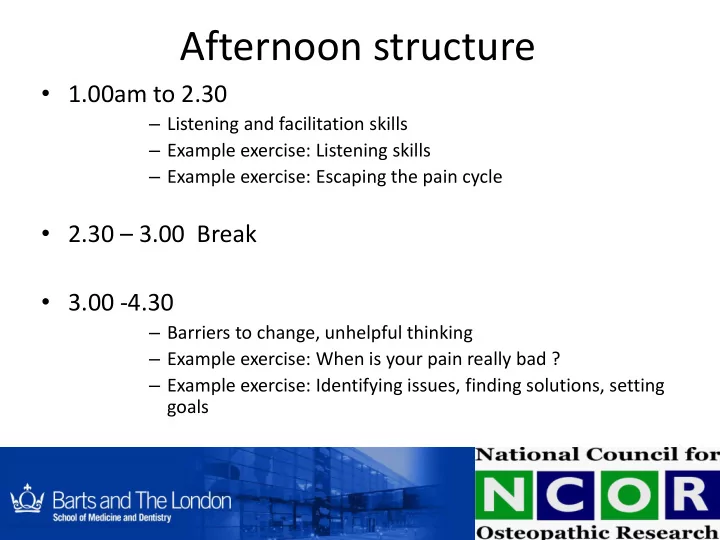
Afternoon structure 1.00am to 2.30 Listening and facilitation skills Example exercise: Listening skills Example exercise: Escaping the pain cycle 2.30 3.00 Break 3.00 -4.30 Barriers to change, unhelpful thinking


slide-1
SLIDE 1

Afternoon structure

  • 1.00am to 2.30

– Listening and facilitation skills – Example exercise: Listening skills – Example exercise: Escaping the pain cycle

  • 2.30 – 3.00 Break
  • 3.00 -4.30

– Barriers to change, unhelpful thinking – Example exercise: When is your pain really bad ? – Example exercise: Identifying issues, finding solutions, setting goals

slide-2
SLIDE 2

Aim

To introduce you to concepts of cognitive behavioural approaches for chronic pain that you can use with your patients Letting patients realise and solve their own problems

slide-3
SLIDE 3

Psychological approaches

  • Self management and
  • Cognitive behavioural techniques
slide-4
SLIDE 4

Essential Skills for Clinicians

  • Identify issues and self-management targets

– Identify patients’ agenda

  • Listening
  • Open questions
  • Non-judgemental
slide-5
SLIDE 5

Communication Skills

  • Gaining Information

– eliciting participants’ perspective

  • Individuals hold mental picture of illness and

treatment in head, called illness and treatment beliefs

  • Illness and treatment beliefs strong predictor of

physical outcomes, emotional outcomes, coping

slide-6
SLIDE 6

Patients Beliefs

  • Beliefs are influenced by:
  • Personal experience
  • Experience of friends or family
  • Media/ Television
  • Internet
  • Advice from Medical Professionals
slide-7
SLIDE 7

What does this mean

  • Need to remember uniqueness of each

individual

  • Can be helpful to understand an individual’s
  • wn experiences
  • Never make assumptions
slide-8
SLIDE 8

Active Listening

  • Open/ Closed/Leading Questions

– How, what rather than why

  • Encouragers

– Nod, hmm, I see, (beware using OK , great etc) – Pauses, silence

  • Reflection
  • Summarise/ Paraphrase
slide-9
SLIDE 9

Active Listening - Cont.

  • Checking (to avoid making assumptions)

– It sounds like…

  • Non-Verbal Behaviour

– Position (the set up of the room) – Posture (open / friendly) – Eye contact (lots of it) – Facial expression (relax, smile, attentive) – Tone of voice (gentle, encouraging)

slide-10
SLIDE 10

Establishing Rapport

  • Empathy not Sympathy
  • Non-Judgemental - accept patients’ views
  • Building a trusting relationship - honesty
  • Provide support
slide-11
SLIDE 11

Giving feedback

  • Ask:

– How did you feel about that? – How did you think that went?

  • Say something positive
  • Mention something that could be improved

and formulate ideas for improvement together

slide-12
SLIDE 12

Listening skills

  • Person A has 2 minutes to describe how they would feel

about informing a patient their pain might never go away.

  • Person B listens with no interruptions
  • Person B relays back what they have heard and interpreted to

person A (Person A has to listen with no interruption)

  • Person A to comment on accuracy and interpretation of

information

21 Session 18

slide-13
SLIDE 13

Listening skills

  • Person B has 2 minutes to describe how they might manage a

patient who is unlikely to get better.

  • Person A listens with no interruptions
  • Person A relays back what they have heard and interpreted to

person B (Person B has to listen with no interruption)

  • Person B to comment on accuracy and interpretation of

information

21 Session 18

slide-14
SLIDE 14

Listening to Facilitation

  • You have listened to your patient
  • You have identified some of their pain beliefs / issues
  • Facilitate next steps:
  • Guiding and supporting your patients to understand

their own behaviour, thoughts and feelings

  • Helping patients find their own solutions
slide-15
SLIDE 15

Facilitation – Golden guidelines

  • 80/20 guide for talking time
  • Don’t offer solutions
  • Ask an open question, keep it simple and clear
  • Don’t be afraid of silences
  • Active listening
slide-16
SLIDE 16

Facilitation – Key skills

Challenging unhelpful beliefs / behaviours How do you challenge beliefs sensitively?

slide-17
SLIDE 17

Facilitation – Key skills

Challenging beliefs sensitively:

  • Clarify the belief: Summarise / repeat the belief to the patient.
  • What advice would you give some one who said that to you?
  • Interesting point, can you explain it further?
  • Ask if the patient thinks the belief is helpful or unhelpful to them.
  • Ask how the patient can change their behaviour or belief.
slide-18
SLIDE 18

The Pain cycle

slide-19
SLIDE 19

Pain

Fear, anxiety

Inactivity

Physical deterioration and weak muscles Low mood, Loss of confidence, stress, work, money worries

slide-20
SLIDE 20

The pain cycle

(Unhelpful/Negative emotions and behaviours)

– The persistent pain cycle (show your patient the diagram)

  • Describe the pain cycle
  • Ask the patient to generate list of reasons why people

don’t and can’t get out of the cycle

slide-21
SLIDE 21

Pain

Fear, anxiety

Inactivity

Physical deterioration and weak muscles Low mood, Loss of confidence, stress, work, money worries

slide-22
SLIDE 22

Pain

Fear, anxiety, anger, frustration, stress Inactivity Physical deterioration and weak muscles Low mood, Loss of confidence , stress, work and money worries Goals and action planning Activities, hobbies, exercise Pain medication, Breathing, relaxation Understanding and recognising unhelpful behaviour

slide-23
SLIDE 23

10

Examples of behaviours:

  • Doing something vs Doing nothing
  • Setting realistic goals vs over/under doing it
  • Managing emotions vs Anger / frustration
  • Healthy eating vs Over eating, using alcohol
  • Good sleep hygiene vs Over/under sleeping
slide-24
SLIDE 24

10

Role play exercise (30 minutes): Groups of 6-8 people:

  • 1 patient
  • 1 clinician
  • 4 – 6 observers

Observers make notes about question techniques Facilitators and observers can use a pause Please pause whenever advice is given and discuss how best to move forward without giving advice Feedback: How was that for you? Things done well, Things to do different next time.

slide-25
SLIDE 25

Role play

  • Your patient (male, 45 years old) has chronic low back

pain and is very sedentary, his mood is low, he does not know what to do: he is stuck in his own version of the chronic pain cycle.

  • Your job is to help your patient manage his pain better

and devise a way out of the pain cycle WITHOUT GIVING ANY ADVICE

slide-26
SLIDE 26

Session 2

Barriers and unhelpful thinking

slide-27
SLIDE 27

What to do, when a patient is ‘stuck’ ?

  • Over-whelmed by pain
  • Resistent or reluctant to help themselves
  • Resistent or reluctant to change
  • Feels useless, lacks confidence (self-efficacy)

Recognising and challenging negative beliefs and attitudes sensitively

slide-28
SLIDE 28

Examples of patient quotes: “My pain is unbearable all the time!” “I get no relief: my pain is terrible” “Nothing helps my pain”

slide-29
SLIDE 29

Helping your patients understand the link between pain and mood Pain perception fluctuates

slide-30
SLIDE 30

Pain, bearable or not?

  • Mind and mood and pain perception (role play)
  • When was the last time your pain was really bad?
  • Reflection and Discussion
  • When was the last time your pain wasn’t so bad?
  • Reflection and discussion

Helping patients recognise there are differences in their pain perception that are dependent on mood, situation and circumstance.

slide-31
SLIDE 31

Barriers to change; unhelpful thinking

– Introduce ideas about unhelpful thoughts and automatic thoughts – Recognising unhelpful thoughts and automatic thoughts

slide-32
SLIDE 32

Unhelpful thinking

1. Mental filter 2. Mind reading 3. Prediction 4. Critical self 5. Compare and despair 6. Shoulds and musts 7. Catatrophising 8. Emotional reasoning 9. Mountains and molehills

  • 10. Evaluations/judgements
  • 11. Black and white thinking
  • 12. Memories
  • 13. Rumination
  • 14. Procrastination

15 Session 10 Mental Filter - When we notice

  • nly what the filter allows or wants

us to notice, and we dismiss anything that doesn’t ‘fit’. Like looking through dark blinkers or ‘gloomy specs’, or

  • nly catching the negative stuff in our

‘kitchen strainers’ whilst anything more positive or realistic is dismissed. Are you only noticing the bad stuff? Are you filtering out the positives? What would be more realistic?

slide-33
SLIDE 33

Unhelpful thinking

1. Mental filter 2. Mind reading 3. Prediction 4. Critical self 5. Compare and despair 6. Shoulds and musts 7. Catatrophising 8. Emotional reasoning 9. Mountains and molehills

  • 10. Evaluations/judgements
  • 11. Black and white thinking
  • 12. Memories
  • 13. Rumination
  • 14. Procrastination

15 Session 10 Mind-Reading - Assuming we know what others are thinking (usually about us). Are you assuming you know what

  • thers are thinking?

What’s the evidence? Is there another, more balanced way

  • f looking at it?
slide-34
SLIDE 34

Unhelpful thinking

1. Mental filter 2. Mind reading 3. Prediction 4. Critical self 5. Compare and despair 6. Shoulds and musts 7. Catatrophising 8. Emotional reasoning 9. Mountains and molehills

  • 10. Evaluations/judgements
  • 11. Black and white thinking
  • 12. Memories
  • 13. Rumination
  • 14. Procrastination

15 Session 10 Prediction - Believing we know what’s going to happen in the future. Are you thinking that you can predict the future? How likely is it that that might really happen?

slide-35
SLIDE 35

Unhelpful thinking

1. Mental filter 2. Mind reading 3. Prediction 4. Critical self 5. Compare and despair 6. Shoulds and musts 7. Catatrophising 8. Emotional reasoning 9. Mountains and molehills

  • 10. Evaluations/judgements
  • 11. Black and white thinking
  • 12. Memories
  • 13. Rumination
  • 14. Procrastination

15 Session 10

Critical self - Putting ourselves down, self-criticism, blaming

  • urselves for events or situations

that are not (totally) our responsibility

Would most people who really know you say that about you? Is this something that you are totally responsible for?

slide-36
SLIDE 36

Unhelpful thinking

1. Mental filter 2. Mind reading 3. Prediction 4. Critical self 5. Compare and despair 6. Shoulds and musts 7. Catatrophising 8. Emotional reasoning 9. Mountains and molehills

  • 10. Evaluations/judgements
  • 11. Black and white thinking
  • 12. Memories
  • 13. Rumination
  • 14. Procrastination

15 Session 10 Compare and despair - Seeing only the good and positive aspects in

  • thers, and getting upset when

comparing ourselves negatively against them.

What would be a more balanced and helpful way of looking at it? Illustrate using ‘the facebook’ filter, where people only show the best bits.

slide-37
SLIDE 37

Unhelpful thinking

1. Mental filter 2. Mind reading 3. Prediction 4. Critical self 5. Compare and despair 6. Shoulds and musts 7. Catatrophising 8. Emotional reasoning 9. Mountains and molehills

  • 10. Evaluations/judgements
  • 11. Black and white thinking
  • 12. Memories
  • 13. Rumination
  • 14. Procrastination

15 Session 10 Shoulds and musts - Thinking or saying ‘I should’ (or shouldn’t) and ‘I must’ puts pressure on ourselves, and sets up unrealistic expectations. Are you putting more pressure on yourself than you need to? Are you setting up expectations that are almost impossible? What would be more realistic?

slide-38
SLIDE 38

Unhelpful thinking

1. Mental filter 2. Mind reading 3. Prediction 4. Critical self 5. Compare and despair 6. Shoulds and musts 7. Catatrophising 8. Emotional reasoning 9. Mountains and molehills

  • 10. Evaluations/judgements
  • 11. Black and white thinking
  • 12. Memories
  • 13. Rumination
  • 14. Procrastination

15 Session 10 Catastrophising - Imagining and believing that the worst possible thing will happen. Will the worst possible thing definitely happen? What’s most likely to happen?

slide-39
SLIDE 39

Unhelpful thinking

1. Mental filter 2. Mind reading 3. Prediction 4. Critical self 5. Compare and despair 6. Shoulds and musts 7. Catatrophising 8. Emotional reasoning 9. Mountains and molehills

  • 10. Evaluations/judgements
  • 11. Black and white thinking
  • 12. Memories
  • 13. Rumination
  • 14. Procrastination

15 Session 10 Emotional Reasoning - I feel bad so it must be bad! I feel anxious, so I must be in danger. Just because it feels bad, doesn’t necessary mean it is bad. Are your feelings reactions to your thoughts –are the thoughts are just automatic brain reflexes?

slide-40
SLIDE 40

Unhelpful thinking

1. Mental filter 2. Mind reading 3. Prediction 4. Critical self 5. Compare and despair 6. Shoulds and musts 7. Catatrophising 8. Emotional reasoning 9. Mountains and molehills

  • 10. Evaluations/judgements
  • 11. Black and white thinking
  • 12. Memories
  • 13. Rumination
  • 14. Procrastination

15 Session 10

Mountains and Molehills -

Exaggerating the risk of danger, or the negatives. Minimising the odds of how things are most likely to turn

  • ut, or minimising positives

Are you exaggerating the bad stuff? How would someone else see it? What’s the bigger picture?

slide-41
SLIDE 41

Unhelpful thinking

1. Mental filter 2. Mind reading 3. Prediction 4. Critical self 5. Compare and despair 6. Shoulds and musts 7. Catatrophising 8. Emotional reasoning 9. Mountains and molehills

  • 10. Evaluations/judgements
  • 11. Black and white thinking
  • 12. Memories
  • 13. Rumination
  • 14. Procrastination

15 Session 10 Judgements - Making evaluations or judgements about events, ourselves,

  • thers, or the world, rather than

describing what we actually see and have evidence for. Are you making an evaluation about the situation or person? Is your judgement accurate or helpful? Is there another perspective?

slide-42
SLIDE 42

Unhelpful thinking

1. Mental filter 2. Mind reading 3. Prediction 4. Critical self 5. Compare and despair 6. Shoulds and musts 7. Catatrophising 8. Emotional reasoning 9. Mountains and molehills

  • 10. Evaluations/judgements
  • 11. Black and white thinking
  • 12. Memories
  • 13. Rumination
  • 14. Procrastination

15 Session 10 Black and white thinking - Believing that something or someone can be only good or bad, right or wrong, rather than anything in- between or ‘shades of grey’. Things are rarely either totally white

  • r totally black – there are shades of
  • grey. Where is this on the

spectrum?

slide-43
SLIDE 43

Unhelpful thinking

1. Mental filter 2. Mind reading 3. Prediction 4. Critical self 5. Compare and despair 6. Shoulds and musts 7. Catatrophising 8. Emotional reasoning 9. Mountains and molehills

  • 10. Evaluations/judgements
  • 11. Black and white thinking
  • 12. Memories
  • 13. Rumination
  • 14. Procrastination

15 Session 10 Memories - Current situations and events can trigger upsetting memories, leading us to believe that the danger is here and now, rather than in the past, causing us distress right now. Are your thoughts just a reminder of the past? That was then, and this is now. Even though this memory makes you feel upset, it’s not actually happening again right now.

slide-44
SLIDE 44

Unhelpful thinking

1. Mental filter 2. Mind reading 3. Prediction 4. Critical self 5. Compare and despair 6. Shoulds and musts 7. Catatrophising 8. Emotional reasoning 9. Mountains and molehills

  • 10. Evaluations/judgements
  • 11. Black and white thinking
  • 12. Memories
  • 13. Rumination
  • 14. Procrastination

15 Session 10 Rumination and procrastination – Going round in circular thoughts. Are these thoughts only? Can you do something about them?

slide-45
SLIDE 45

Barriers to change; making plans

  • FOCUS ON ONE THING THAT IS IMPORTANT TO YOUR

PATIENT

  • SMART Goals:
  • Simple
  • Measurable
  • Achievable
  • Relevant
  • Timed
slide-46
SLIDE 46

Barriers to change; making plans

EXAMPLE SMART GOAL: I need to lose weight OR I can limit myself to 1 biscuit per day for 2 weeks and see if I lose weight

slide-47
SLIDE 47

Example role play

Liz and Austin

slide-48
SLIDE 48
  • 1. Ask your patient about their pain:

When is your pain at its worst? When is it less than at its worst (other scenarios) (Highlight to your patient the pain does vary)

  • 2. Ask your patient how they could become more active

(Listen out for resistance and automatic unhelpful thoughts, can you challenge them?) OR

  • 3. Help your patient identify one thing they think they can do

and ask them: What they can do realistically Over what period of time What they would like to achieve SMART goal and action plan

slide-49
SLIDE 49

10

Role play exercise (30 minutes): Groups of 6-8 people:

  • 1 patient
  • 1 clinician
  • 4 – 6 observers

Observers make notes about question techniques Facilitators and observers can use a pause Please pause whenever advice is given and discuss how best to move forward without giving advice Feedback: How was that for you? Things done well, Things to do different next time.

slide-50
SLIDE 50

Role play

  • Your patient has chronic ‘unbearable’ knee pain,

he tells you he is unable to do anything.

  • Your job is to help your patient devise a way of

becoming more active WITHOUT GIVING ANY ADVICE

slide-51
SLIDE 51

FINAL TAKE HOME MESSAGES

  • TRY NOT TO GIVE ADVICE
  • HELP PATIENTS OWN SOLUTIONS TO THEIR PROBLEMS
  • HELP PATIENTS RECOGNISE THEIR UNHELPFUL THINKING

AND BEHAVIOURS

  • PAIN MANAGEMENT THROUGH IMPROVING MOOD AND

CONFIDENCE

  • WE CAN’T CHANGE THE PAST BUT WE CAN INFLUENCE

OUR FUTURE

slide-52
SLIDE 52

THANK YOU

  • Austin Plunkett for organising
  • Our presenters: Paul Vaucher, Liz

Steed, Steve Vogel

  • Our facilitators: Carol Fawkes,

Oliver Thomson, Hillary Abbey

  • Our sponsors: MINT, osteobiz.com,

IJOM