Advancing Localisation in Coordination Mechanisms Jakarta 27th - - PowerPoint PPT Presentation

advancing localisation in coordination mechanisms
SMART_READER_LITE
LIVE PREVIEW

Advancing Localisation in Coordination Mechanisms Jakarta 27th - - PowerPoint PPT Presentation

Breakout session: Coordination Advancing Localisation in Coordination Mechanisms Jakarta 27th August 2019 Regional Localisation Conference, GB Workstream 2 Jakarta August 2019 1 Aim of the session Share learning on advancing the


slide-1
SLIDE 1

Breakout session: Coordination

Jakarta August 2019 Regional Localisation Conference, GB Workstream 2 1
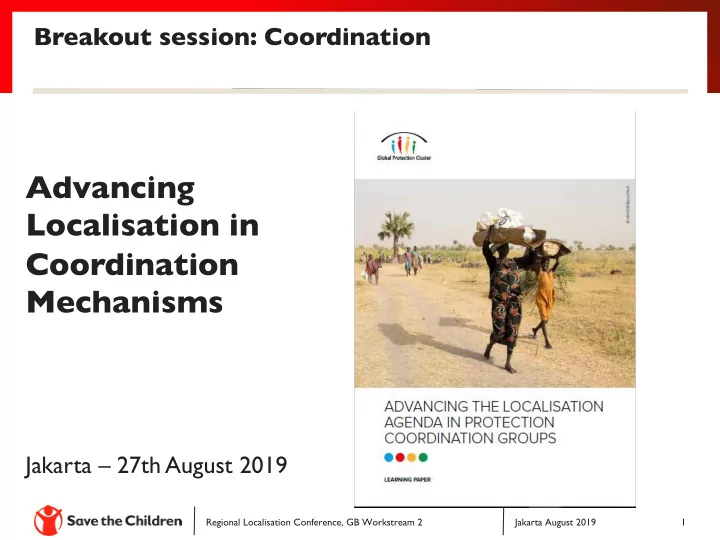
Advancing Localisation in Coordination Mechanisms

Jakarta – 27th August 2019

slide-2
SLIDE 2

Aim of the session

  • Share learning on advancing the localisation agenda

in coordination mechanisms,

  • Provide input to a Guidance paper on inclusion of

national and local actors in coordination mechanisms

Jakarta August 2019 Regional Localisation Conference, GB Workstream 2 2

slide-3
SLIDE 3

Agenda

  • 1. Presentation of main findings from reports on

coordination and inclusion

  • 2. Group work
  • 3. Feedback in plenary

Jakarta August 2019 Regional Localisation Conference, GB Workstream 2 3

slide-4
SLIDE 4

Grand Bargain Localisation Workstream

Jakarta August 2019 Regional Localisation Conference, GB Workstream 2 4

slide-5
SLIDE 5

Statistics on local responders in coordination mechanisms

  • 254 clusters surveyed in 23 operations, half have

national or local authorities in leadership roles at national or subnational levels,

  • 42% of cluster members globally are national NGOs

Jakarta August 2019 Regional Localisation Conference, GB Workstream 2 5

slide-6
SLIDE 6

ALNAP: Improving Humanitarian Coordination

Jakarta August 2019 Regional Localisation Conference, GB Workstream 2 6

July 2016

slide-7
SLIDE 7

State and national civil society in coordination

National state actors

  • State obligation
  • Statemechanisms can often

respond quickly to emergencies

  • Often conversant with long-term

development activities

  • Reduce risk of duplication
  • Reduce the risk of decreased state

legitimacy and accountability National Civil Society

  • More effective coordination, as

more initiatives are coordinated,

  • Reduce risk of undermining local
  • wnership of the response
  • Reduce risk of parallel systems -
  • ften national networks and pre-

existing coordination mechanisms already exists

Jakarta August 2019 Regional Localisation Conference, GB Workstream 2 7

Advantages

slide-8
SLIDE 8

ALNAP 2016 – Selected Recommendations

  • Adaptability: Develop context-relevant coordination

systems that build on existing government and civil society coordination mechanisms, one size does not fit all

  • Practicalities and culture: language, location, connectivity

(IT),

  • Awareness: Explain to civil society the potential of

coordination,

Jakarta August 2019 Regional Localisation Conference, GB Workstream 2 8

slide-9
SLIDE 9

Advancing the Localisation Agenda in Protection Coordination Groups

Jakarta August 2019 Regional Localisation Conference, GB Workstream 2 9

slide-10
SLIDE 10

Local actors in protection coordination groups

Jakarta August 2019 Regional Localisation Conference, GB Workstream 2 10

  • The membership of protection coordination groups is composed of a large

number of national actors (government counterparts, national and local NGOs) and they participate regularly in cluster meetings.

  • Local actors recognized the benefits that the cluster system can bring to their
  • rganizations:
  • Being informed about practices and standards (22%)
  • Enhancing partnerships between humanitarian actors (19%)
  • Joining a forum for joint-advocacy (17%)
  • Coordinating and planning a more effective humanitarian response (15%)
  • Networking and peer support (14%)
  • Sharing information and good practices (12%)
slide-11
SLIDE 11

Obstacles to participation in cluster coordination

Jakarta August 2019 Regional Localisation Conference, GB Workstream 2 11

slide-12
SLIDE 12

Recommendations from the Protection coordination report

Coordination groups:

ü Strengthen capacity of national actors towards meaningful engagement with coordination groups, fostering a better understanding of the benefits and the processes

  • f coordination.

ü Take practical steps to address the barriers to meaningful participation, making coordination meetings more accessible and more culturally inclusive. ü Support national actors to be more engaged in governance structures and decision- making processes (e.g. cluster co-lead, SAG, steering committees, HCT) by providing guidance, orientation, training, funding opportunities. ü Give space for local actors to be part of decision-making processes including them in planning of humanitarian strategies; ü Engage diaspora in the humanitarian system and build on their capacities in terms of project design, data analyses and institutional capacity strengthening.

Jakarta August 2019 Regional Localisation Conference, GB Workstream 2 12

slide-13
SLIDE 13

Recommendations from the Protection Coordination report

UN and INGOs:

ü Invest in sustained capacity and institutional strengthening for local and national organizations to strengthen their coordination capacities

ü Including a section in partnership agreements to identify priority recommendations that the national partner wants to work on over the course of the partnership.

ü Ensure evaluation of any localization approach or research conducted in the sector. Share and replicate best practices and methodologies on localization that have worked and ensure those practices are taken to scale through coordination groups and are anchored in the cluster system.

Jakarta August 2019 Regional Localisation Conference, GB Workstream 2 13

slide-14
SLIDE 14

Recommendations from the Protection Coordination report

National and local responders:

ü Complete stakeholder/actor mapping (the 5W) to increase visibility and strategic positioning and meaningful participation within the cluster, seek to become Humanitarian Response Plan partners and advocate for increased access to funding mechanisms.

Jakarta August 2019 Regional Localisation Conference, GB Workstream 2 14

slide-15
SLIDE 15

Recommendations from the Protection Report

Donors:

ü Prioritize funding for interventions that demonstrate effective support to local partners’ coordination capacities. ü Commit to multi-year flexible funding to support core organizational costs of local organizations, to strengthen their leadership in protection coordination mechanisms. ü Support the idea that country-based pooled funds should be used to channel funds directly to local and national NGOs.

Jakarta August 2019 Regional Localisation Conference, GB Workstream 2 15

slide-16
SLIDE 16

Group discussion (45 min)

Group work

a) What coordination mechanisms have you used/been exposed to in your context? b) In your experience what has enabled/driven inclusion of local actors in coordination mechanisms? c) In your experience what has hindered or challenged inclusion of local actors in coordination mechanisms? d) What advice would you give to a coordinator on localisation in coordination?

Jakarta August 2019 Regional Localisation Conference, GB Workstream 2 16

Discuss and list approximately 3 main points pr question (b,c,d)

slide-17
SLIDE 17

Plenary presentation (15 min)

Group 1: Presentation Group 2: Presentation Similarities and summary

Jakarta August 2019 Regional Localisation Conference, GB Workstream 2 17

slide-18
SLIDE 18

For more information

ü Read the GPC Learning Paper

http://www.globalprotectioncluster.org/wp-content/uploads/Learning_Paper-

  • n-localisatoin-screen.pdf

ü Visit the GPC Localisation webpage

http://www.globalprotectioncluster.org/themes/localisation/

ü Contact Alice Hawkes, IRC at alice.hawkes@rescue.org ü Titi Moektijasih, OCHA at moektijasih@un.org ü Katja Rosenstock, Save the Children, kr@redbarnet.dk

Jakarta August 2019 Regional Localisation Conference, GB Workstream 2 18