23 October 2019, Gisela Duetting Presentation Technical Guidance - - PowerPoint PPT Presentation

23 october 2019 gisela duetting
SMART_READER_LITE
LIVE PREVIEW

23 October 2019, Gisela Duetting Presentation Technical Guidance - - PowerPoint PPT Presentation

23 October 2019, Gisela Duetting Presentation Technical Guidance Note Gender and Localisation Brussels, GB Localisation Workstream, Global Meeting What we kn know: In humanitarian and crisis settings: situation for women and girls


slide-1
SLIDE 1

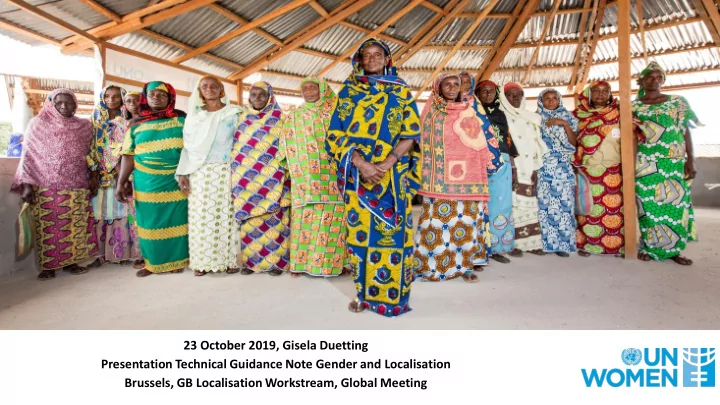
23 October 2019, Gisela Duetting Presentation Technical Guidance Note Gender and Localisation Brussels, GB Localisation Workstream, Global Meeting
slide-2
SLIDE 2

What we kn know:

  • In humanitarian and crisis settings:

situation for women and girls deteriorates, gender relations change

  • Women are first responders, agents of

change, women’s organisations are active, on the ground (social networks and broad agenda)

  • Limited funding for women’s
  • rganisations and gender often seen as

not ‘life saving’

  • Limited access to decision-making on

humanitarian and crisis response

  • Women leaders challenge gender norms

and WROs have wider/ transformative agendas

slide-3
SLIDE 3

UN Women and Friends of Gender

  • UN Women has LEAP humanitarian
  • program. Leadership and Accountability,

Livelihood, Protection (498 org/33 countries)

  • Aim GB: 2020: 25% of budget to local
  • actors. UN Women’s aim: substantial size

to WRO/WLOs (and track)

  • 2016: initiative to set up informal Grand

Bargain Friends of Gender group

  • 4 workstreams identified as key for

women: cash, humanitarian needs assessments, participation revolution, LOCALISATION

slide-4
SLIDE 4

What UN Women and FoG achieve:

  • Technical Guidance Notes (TGN)
  • Research on transformative gender responsive

localization and participation –community perceptions (Jordan, Bangladesh, Uganda and Colombia), with UNFPA

  • Global meetings/Global Dialogue
  • Ongoing engagement in operationalization of all

workstream workplans (enhance gender dimensions/across WSs)

  • Global advocacy (GB Annual Meeting

with Annual statement)

  • Accountability through gender

indicator integration in the GB Annual Reporting Format /reinforcing all Gender Commitments/ 2018 Self- reporting

slide-5
SLIDE 5

Technical Guidance Notes: process

  • Ongoing process: International, regional,

national/ local level

  • Also beyond GB (Feminist humanitarian policy,

Leadership in LEAP, IASC Gender Policy and Accountability Framework, SENDAI, BPfA, CEDAW 37)

  • For Workstream on Localisation: regional

conferences (Addis Abeba, Amman, Jakarta)

  • UN Women, FoG and co-hosts Oxfam, Care and

OCHA: pre-consultation with WOMEN’s GROUPS (July-August 2019)

  • Aim: bring women’s organisations together for

joint thinking and recommendations from their practices

  • Consultations have informed presence in

WS regional/global meetings and TGNs

slide-6
SLIDE 6
  • Primary audience are humanitarian actors: donors, member states, UN,

international organizations, national and local civil society organizations (FoG members add to TGN)

  • What: Practical guidance, advocacy tool, practitioner framework (language)/

with checklists, case studies

  • Outcome: gender equitable outcomes through promoting women and girls in

decision-making processes, stronger partnerships with local women’s rights and women led organizations and direct access to funding resources for the advancement of gender equality and empowerment of women and girls in humanitarian settings. Result: more effective and inclusive humanitarian action.

TGN Gender and Localisaton

slide-7
SLIDE 7

Key issues, globally shared:

  • Ensure dedicated, flexible and sustainable

funding for WLOs and WROs – including through a dedicated quota - and ensure internal tracking mechanisms

  • Focus on long-term, quality and equitable

partnerships to strengthen local WLO and WRO leadership through training, policy development, fair overheads, flexible funding and reporting requirements;

  • Ensure the meaningful participation and

leadership of local WLOs and WROs at the different stages of humanitarian planning processes and in humanitarian coordination mechanisms, including in decision-making and ensure the inclusion of their voices in HROs and HRPs;

slide-8
SLIDE 8

Key issues:

  • Make available sex and age disaggregated data and

gender specific at-risk profiles in HNOs, HRPs and cluster plans and document the voices and experiences

  • f affected women and girls;
  • Conduct gender analysis and needs assessments

consistently, with the meaningful engagement and leadership of women’s networks, WLOs and WROs;

  • Support the capacity, strengthen and establish local

women’s networks, WLOs and WROs to monitor, inform and influence humanitarian response prioritization and funding allocations and to promote social norms towards gender equality , inclusion and women’s empowerment;

slide-9
SLIDE 9

Key issues:

  • Promote organizational change in the culture,

structures and policies of humanitarian partners and in coordination structures to ensure greater leadership and effective influencing by local WLOs and WROs as well as a more inclusive leadership for all, taking into account intersectionality and inclusion;

  • Strengthen and establish meaningful partnerships

between humanitarian partners and local WLOs and WROs on issues related to accountability for affected populations through gender-responsive community feedback mechanisms

slide-10
SLIDE 10

Key issues:

  • Recognise the importance of investing in GEEWG as a

strategy to end women’s and women’s organisations’ marginalisation

  • Better map and scale up excellent country-based

initiatives, strategic partnerships and explore entry points, linkages and advocacy strategies with other coordination and advocacy mechanisms on gender and GBV issues in humanitarian settings (e.g. GBV Area of Responsibility; Call to Action on Protection from Gender-Based Violence in Emergencies; Women Deliver; key IASC mechanisms; and others) to broaden commitments to GEEWG beyond the Grand Bargain.

slide-11
SLIDE 11
  • Women leaders and women’s organisations challenge existing norms on

leadership and women’s roles

  • Women’s organisations face exclusion, discrimination, invisibility and backlash

(and share concerns of all smaller NGOs)

  • For Gender Equality and Women’s Empowerment: fund along the HDP NEXUS
  • Good example of funding modality is Women’s Peace and Humanitarian Fund:

30 million US$ directly to WROs/WLOs since 2016 ( https://wphfund.org/)

  • Make unpaid (care) work central in Humanitarian Needs Assessments and

HRPs/HNOs

  • Support the establishment of networks between women's organizations as

well as alliance-building

  • Further discuss feminist approaches to humanitarian action and crisis

response and advocate for transformative approaches drawing on the experiences and knowledge of local women’s organizations in country.

CRUCIAL for Women’s ORGANISATIONS

slide-12
SLIDE 12

TGN on Financing

  • Increased, specific, global and national allocations of funds (including CERF and

pooled funds)

  • Include specific tracking and accountability requirements
  • Keep women’s leadership on the international agenda and keep pressing for

accountability in very specific terms,(link advocacy and operational)

  • Establish long-term/standby/pre-existing agreements (with women’s orgs)
  • Increase access to humanitarian funding for local women’s organizations and

support capacity for self-sustaining fundraising, prioritising multi-year, flexible and sustainable funds;

  • Reduce bureaucratic requirements (fair overhead arrangements, harmonise and

simplify procedures,translation and other requirements)

  • Set a dedicated percentage for women’s organisations
  • Consider proven funding modalities reaching women’s organisations like the UN

Women’s Women’s Peace and Humanitarian Fund

slide-13
SLIDE 13

TGN on Partnerships

  • Prior to seeking partnerships, assess their own organisational capacity

strengths and weaknesses

  • Institutional strengthening and investment in local and national WROs and

WLOs; including both human and technical resources as well as financing;

  • Redesigning partnership processes and requirements to prioritise, value and

resource the establishment of relationships of trust, including by simplifying due diligence requirements and overcoming risk aversion by sharing risks more equally;

  • Establishing long-term partnerships, allowing for growth and transition in

capacity, accountability and transparency, and knowledge sharing and management; also in view of the necessary long-term engagement towards gender equality

slide-14
SLIDE 14

TGN on Coordination

  • Design, develop, and consistently implement gender responsive policies and

strategies;

  • Promote Women organisations’ consortia and networks and their involvement in

humanitarian needs assessments and planning processes;

  • Ensure monitoring and accountability;
  • Disseminate good examples, such as rotating chairing arrangements; ensure that

inter-cluster coordination and sub-groups are also co-led by UN Women to ensure a gender perspective

  • Enhance good examples of Coordination between UN, national governments and

INGOs, plus local (women’s) organisations

  • Create an enabling environment for women’s leadership and decision-making in

disaster management, including funding, by mandating a minimum of 30 per cent women’s representation in coordination structures as well as through training, mentorship, apprenticeship and mobilization into immediate response teams;

slide-15
SLIDE 15

Women’s leadership/Capacity Strengthening

  • Recognising, reducing and redistributing women’s unpaid (care) work; this includes the often unpaid

work of women’s organisations advising and advocating on gender equality

  • Invest in women’s organisations
  • Shift towards meaningful participation and decision-making by women/girls and women’s
  • rganisations and move towards enhancing inclusive leadership overall.
  • Comprehensive leadership program, building support for women’s leadership in communities and
  • rganisations, enhancing women’s self-organisation and links between women’s rights organisations

and humanitarian actors; invest in networks and alliance-building

  • Enhancing and expanding women’s leadership can build on cultural notions of women’s leadership

roles already existing, keeping in mind that each context is different;

  • Set quota for women and women’s organisations present in all decision-making mechanisms
  • Introduce specific provisions on institutional capacity strengthening for women’s organisations through

funding integrated in the partnership agreements

  • Expand women’s networks to include grassroots group and self-organising affected women
  • Humanitarian actors to invest in expanding the pool of local actors engaging in global spaces by

Involving local women leaders in systematic ways;