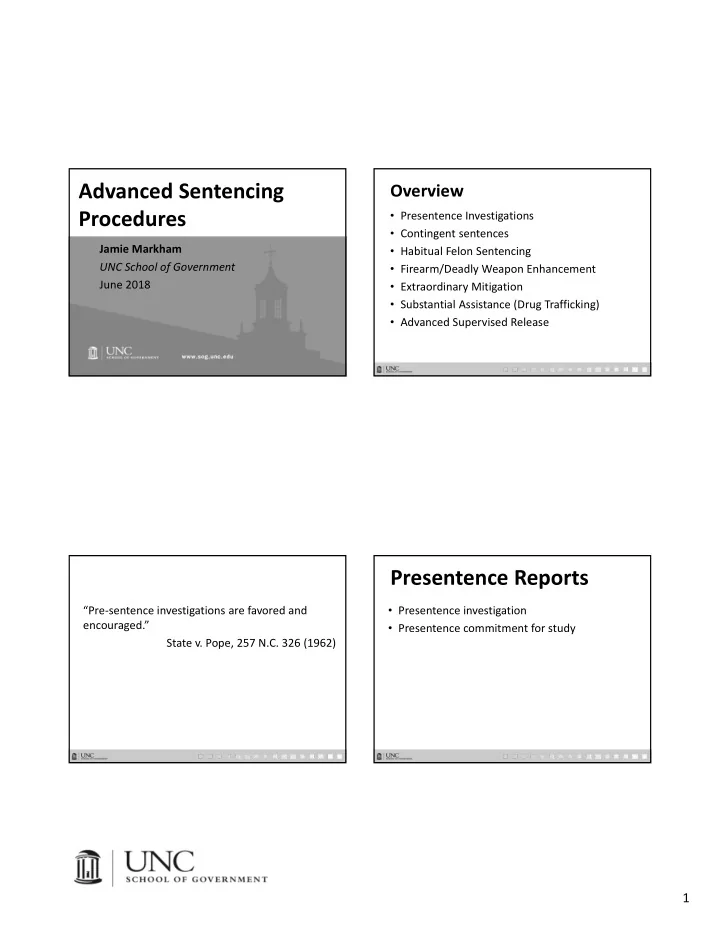
Advanced Sentencing Overview Procedures Presentence Investigations - - PDF document

advanced sentencing
SMART_READER_LITE
LIVE PREVIEW

Advanced Sentencing Overview Procedures Presentence Investigations - - PDF document

Advanced Sentencing Overview Procedures Presentence Investigations Contingent sentences Jamie Markham Habitual Felon Sentencing UNC School of Government Firearm/Deadly Weapon Enhancement June 2018 Extraordinary Mitigation


slide-1
SLIDE 1

1

Advanced Sentencing Procedures

Jamie Markham UNC School of Government June 2018

  • Presentence Investigations
  • Contingent sentences
  • Habitual Felon Sentencing
  • Firearm/Deadly Weapon Enhancement
  • Extraordinary Mitigation
  • Substantial Assistance (Drug Trafficking)
  • Advanced Supervised Release

Overview

“Pre‐sentence investigations are favored and encouraged.” State v. Pope, 257 N.C. 326 (1962)

  • Presentence investigation
  • Presentence commitment for study

Presentence Reports

slide-2
SLIDE 2

2

  • G.S. 15A‐1332

– Court may order PSI for any defendant

  • Pre‐conviction on defendant’s motion

– Completed by probation officer

Presentence Investigation

  • Prompt investigation into defendant’s:

– Health – Family and social history – Criminal history – History of substance abuse – Employment – Education

  • Tailored to your request

Presentence Investigation

  • Risk assessment:

– Offender Traits Inventory, Revised (OTI‐R)

  • Needs assessment

– Officer interview + Offender self‐report – Will flag substance abuse, family issues

Risk‐Needs Assessment

  • Any felony or Class A1 or 1 misdemeanor
  • Requires defendant’s consent (except for

sexually violent predator determination)

  • Commit for up to 90 days
  • Coordinated through DAC Diagnostic Services

Presentence Commitment

slide-3
SLIDE 3

3

  • Sentencing hearing may be held in different

district upon completion of report

  • Reports not a public record
  • Reports may be expunged upon request, in your

discretion

Presentence Reports

“Contingent” Sentences

  • Active sentence followed by probation
  • Permitted under G.S. 15A‐1346
  • Four‐class enhancement, capped at C
  • HF sentences must run consecutively to other sentences

“being served”

  • Prior convictions used to habitualize do not count

toward prior record level

– State may allege more than three – State may choose which convictions to allege – Consolidated/same week convictions: One for HF and one for prior record level – Masked conviction may still establish “bonus point”

Habitual Felon

slide-4
SLIDE 4

4

  • Minimum sentence enhancement if defendant

“actually possessed and used, displayed, or threatened the use or display of a firearm or deadly weapon in committing a felony.”

– Gun‐shaped cigaree lighter ≠ Actual possession

Firearm/Deadly Weapon

  • Offenses committed before 10/1/2013:

– Class B1‐E: 60‐month enhancement

  • Offenses committed on/after 10/1/2013:

– Class B1‐E: 72‐month enhancement – Class F‐G: 36‐month enhancement – Class H‐I: 12‐month enhancement

Firearm/Deadly Weapon

  • Facts must be charged in indictment/information

– One pleading sufficient for all felonies tried together

  • Proved to jury beyond a reasonable doubt,

unless defendant pleads guilty

  • Can’t be proved with evidence necessary to

prove an element of the underlying felony

  • Active sentences only

Firearm/Deadly Weapon

  • Second‐degree kidnapping

(Class E)

– Offense date: Jan. 4, 2016 – Prior record level II – Firearm enhancement properly alleged, proved

  • What is highest enhanced

MIN‐MAX from the presumptive range?

Firearm/Deadly Weapon

+72

slide-5
SLIDE 5

5

Extraordinary mitigation

  • Allows Intermediate probation in an

“A”‐only cell of the sentencing grid when court finds:

– Extraordinary mitigating factors of a kind significantly greater than in the normal case; – Those factors substantially outweigh any factors in aggravation; and – It would be a manifest injustice to impose an active punishment in the case

Extraordinary mitigation

  • Exclusions

–Cannot use with Class A or Class B1 felony –Cannot use for drug trafficking/conspiracy –Must have fewer than 5 prior record points

slide-6
SLIDE 6

6

Extraordinary mitigation

  • Court must find extraordinary mitigating

factors “significantly greater than in the normal case”

– Quality, not quantity, makes mitigation extraordinary – Cannot be an ordinary mitigating factor

Extraordinary mitigation

  • Improper extraordinary mitigating factors

– “The defendant’s level of mental functioning was

insufficient to constitute a defense but significantly reduced his culpability.” – The 14‐year‐old victim consented to the crime

Extraordinary mitigation

slide-7
SLIDE 7

7

Substantial Assistance

  • Drug trafficking only
  • “Substantial assistance in the

identification, arrest, or conviction of any accomplices, accessories, co‐conspirators,

  • r principals.”
  • Judge has discretion to give reduced

sentence, reduced fine, or probation

Attempted Trafficking

  • Reverts to regular sentencing grid for that

class of offense

– Class E drug trafficking: 90‐120 months – Attempted Class E trafficking: 20‐36 months

Advanced Supervised Release

  • Created by Justice Reinvestment Act
  • Allows early release from prison to PRS for

identified defendants who complete “risk reduction incentives” in prison

Eligibility

  • Only certain grid cells
  • Only Active sentences
  • Only if court‐ordered at

sentencing

  • Never over prosecutor
  • bjection
slide-8
SLIDE 8

8

ASR Date

  • Court imposes regular sentence

from the grid

  • ASR date, if ordered, flows from

regular sentence – If presumptive or aggravated, ASR date is the lowest mitigated minimum sentence in the defendant’s grid cell – If mitigated, ASR date is 80% of imposed minimum sentence

4‐14 month sentence ASR date: 3.2 months

8 19 10

Last 9 months Last 13 months ASR Date Regular sentence: 8‐19 months ASR date: 6 months

6

Questions?