NORTH CAROLINA SENTENCING AND POLICY ADVISORY COMMISSION DWI - - PDF document

north carolina
SMART_READER_LITE
LIVE PREVIEW

NORTH CAROLINA SENTENCING AND POLICY ADVISORY COMMISSION DWI - - PDF document

NORTH CAROLINA SENTENCING AND POLICY ADVISORY COMMISSION DWI Sentencing Impaired driving (DWI) offenses are not sentenced under Structured Sentencing. They are sentenced in one of six punishment levels based on the presence of grossly


slide-1
SLIDE 1

1

NORTH CAROLINA SENTENCING AND POLICY ADVISORY COMMISSION

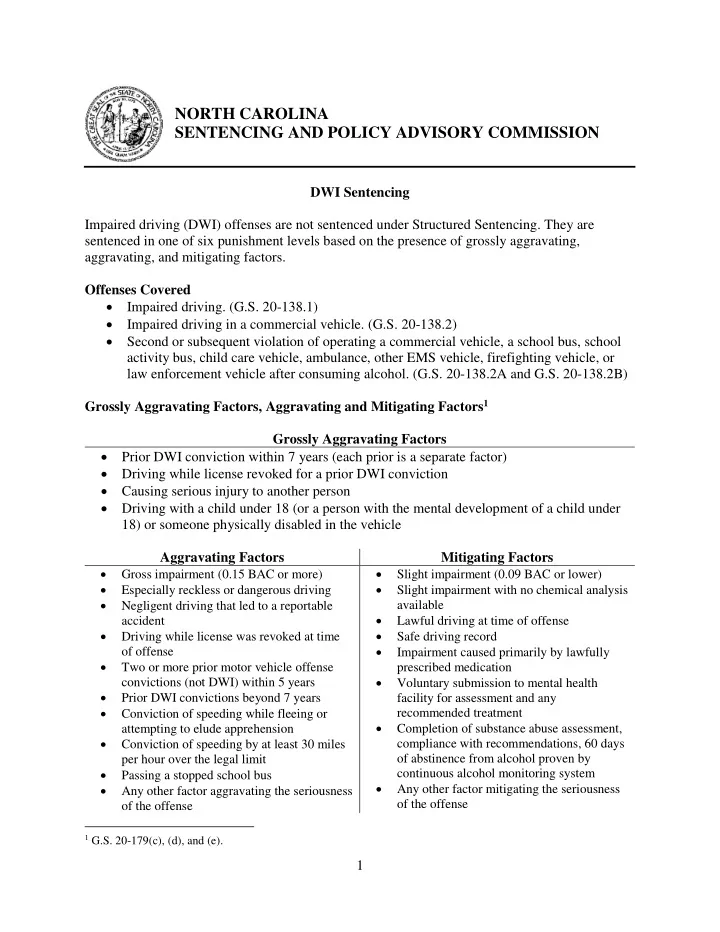
DWI Sentencing Impaired driving (DWI) offenses are not sentenced under Structured Sentencing. They are sentenced in one of six punishment levels based on the presence of grossly aggravating, aggravating, and mitigating factors. Offenses Covered  Impaired driving. (G.S. 20-138.1)  Impaired driving in a commercial vehicle. (G.S. 20-138.2)  Second or subsequent violation of operating a commercial vehicle, a school bus, school activity bus, child care vehicle, ambulance, other EMS vehicle, firefighting vehicle, or law enforcement vehicle after consuming alcohol. (G.S. 20-138.2A and G.S. 20-138.2B) Grossly Aggravating Factors, Aggravating and Mitigating Factors1 Grossly Aggravating Factors  Prior DWI conviction within 7 years (each prior is a separate factor)  Driving while license revoked for a prior DWI conviction  Causing serious injury to another person  Driving with a child under 18 (or a person with the mental development of a child under 18) or someone physically disabled in the vehicle Aggravating Factors Mitigating Factors

 Gross impairment (0.15 BAC or more)  Especially reckless or dangerous driving  Negligent driving that led to a reportable accident  Driving while license was revoked at time

  • f offense

 Two or more prior motor vehicle offense convictions (not DWI) within 5 years  Prior DWI convictions beyond 7 years  Conviction of speeding while fleeing or attempting to elude apprehension  Conviction of speeding by at least 30 miles per hour over the legal limit  Passing a stopped school bus  Any other factor aggravating the seriousness

  • f the offense

 Slight impairment (0.09 BAC or lower)  Slight impairment with no chemical analysis available  Lawful driving at time of offense  Safe driving record  Impairment caused primarily by lawfully prescribed medication  Voluntary submission to mental health facility for assessment and any recommended treatment  Completion of substance abuse assessment, compliance with recommendations, 60 days

  • f abstinence from alcohol proven by

continuous alcohol monitoring system  Any other factor mitigating the seriousness

  • f the offense

1 G.S. 20-179(c), (d), and (e).

slide-2
SLIDE 2

2 Punishment Levels2 Punishment for DWI offenses committed on or after October 1, 2013 Factors Level Minimum Sentence Maximum Sentence If Suspended, Special Probation Requiring: Maximum Fine 3+ Grossly Aggravating A1 12 months 36 months Active term of at least 120 days + 120 days continuous alcohol monitoring (CAM) $10,000 2 Grossly Aggravating or 1 Driving with Minor/Disabled Person in Vehicle 1 30 days 24 months Active term of at least 30 days or 10 days and 120 days CAM $4,000 1 Grossly Aggravating other than Driving with Minor/Disabled Person in Vehicle 2 7 days 12 months Active term of at least 7 days or 90 days CAM $2,000 Aggravating > Mitigating 3 72 hours 6 months Active term of 72 hours and/or 72 hours community service $1,000 Aggravating = Mitigating

  • r None

4 48 hours 120 days Active term of 48 hours and/or 48 hours community service $500 Mitigating > Aggravating 5 24 hours 60 days Active term of 24 hours and/or 24 hours community service $200

Note: In all punishment levels, the offender is required to obtain a substance abuse assessment and education or treatment required by G.S. 20-17.6. Source: UNC School of Government

Sentence3 A sentence to imprisonment must impose a maximum term and may impose a minimum

  • term. The impaired driving judgment may state the minimum term or may state that a term

constitutes both the minimum and maximum terms. A sentence to probation must include a suspended term of imprisonment and a period of probation of up to five years; probation may be supervised or unsupervised.

2 G.S. 20-179(f3) to (k). 3 G.S. 15A-1351(b), G.S. 15A-1341 to -1343.3.

slide-3
SLIDE 3

3 Place of Confinement4 All offenders sentenced for DWI are housed in local jails through the Statewide Misdemeanant Confinement Program. Sentence Credits5 Punishment Level Credit A1 None.* 1–5

Good Time - One day deducted for each day served in custody for good behavior and/or without an infraction of inmate conduct rules

Gain Time – Specified days deducted for participation in approved work and/or program activities

*Pursuant to Department of Public Safety, Division of Adult Correction and Juvenile Justice policies.

Method of Release6 Punishment Level Method Application A1 Post-Release Supervision Four months prior to the maximum imposed term 1–5 Parole*  At any time after the statutory minimum if there is no minimum sentence imposed

After serving the minimum sentence imposed or one-fifth of the maximum penalty allowed by law for the offense, whichever is less (less Good Time) Terminate sentence After serving the maximum sentence less sentence credits

*Parole-eligible offenders must serve the statutory minimum for their punishment level and obtain a substance abuse assessment and complete any recommended treatment or training program or be paroled into a residential treatment program.

Habitual Impaired Driving Offense7 A person who has been convicted of three or more DWI offenses within 10 years of the date

  • f the current offense. Habitual impaired driving is punished as a Class F felony under

Structured Sentencing.

4 G.S. 148-32.1(b2). 5 G.S. 148-13(b). 6 G.S. 15A-1370.1 to -1376, G.S. 20-179(f3). 7 G.S. 20-138.5.