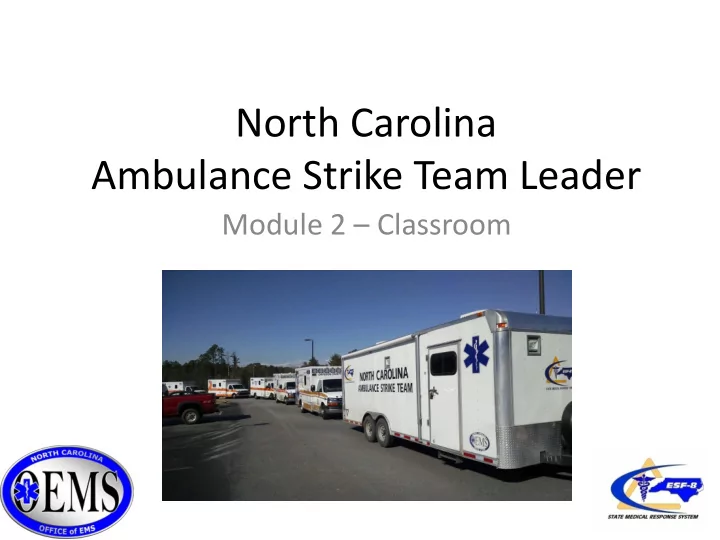
SLIDE 1
North Carolina Ambulance Strike Team Leader
Module 2 – Classroom
SLIDE 2
North Carolina Ambulance Strike Team Leader
Module 2 – Classroom Unit 1 – Course Introduction
SLIDE 3
Unit Terminal Objective
Identify the course objectives and resource materials for the position of Ambulance Strike Team / Task Force Leader
SLIDE 4 Unit Overview
- Introductions
- General Info
- Expectations
- Course Objectives
- Course Design
- Course Topics/Agenda
- Program Manual
SLIDE 5 Introductions
- Instructor and student introductions
- Incident response experiences
- Reasons for being an Ambulance Strike Team /
Task Force Leader
SLIDE 6 General Information
- Lodging
- Transportation
- Smoking Policy
- Message Location and Available Telephones
- Cell Phone Policy
- Restrooms and Drinking Fountains
- Other Local Information
- Facility Safety
- Lunches / Breaks
SLIDE 7 Expectations
- Student Expectations
- Instructor Expectations
SLIDE 8 Course Objective
- Upon completion of this course, students will
demonstrate, through exercises and a final exam, the capability to perform the duties and responsibilities of an effective Ambulance Strike Team / Task Force Leader.
SLIDE 9 Course Design
– Module 1 – Web Based Self Study 6-8 hours – Module 2 – Classroom 8 hours
- Course Methodology
- Course Materials
- Course Prerequisites
- Quizzes / Exams/ Practical Scenarios
SLIDE 10 Course Topics
- Module 1 – Web Based Self Study
– Unit 1-1 Course Introduction – Unit 1-2 Overview of the Incident Management Organization and the Operations Section – Unit 1-3 Roles and Responsibilities of the Strike Team / Task Force Leader – Unit 1-4 Information Flow and Dissemination
SLIDE 11 Course Topics
- Module 1 – Web Based Self Study
– Unit 1-5 Leadership, Management, and Supervision – Unit 1-6 Risk Management and Safety – Unit 1-7 Final Review
SLIDE 12 Course Topics
- Module 2 – Classroom Practical's and
Scenarios
– Unit 2-1 Course Introduction – Unit 2-2 Strike Team Assembly – Unit 2-3 Operational Briefing – Unit 2-4 Common Interactions – Unit 2-5 Demobilization
SLIDE 13
Course Agenda
8:00AM – Unit 1 9:30AM – Unit 2 10:30AM – Unit 3 12:00AM – Lunch 1:00PM – Unit 3 (cont) 2:00PM – Unit 4 3:00PM – Unit 5 4:00PM – Review and Exam
SLIDE 14
NC AST Mission Plan
SLIDE 15 Pre-Dispatch
- Assemble a Go-Kit
- Gather Required ICS Forms
- Gather Additional Forms
INSERT PIC
SLIDE 16 Hurricane Kim
On September 1st, Hurricane Kim made landfall
- n the North Carolina Coast.
SLIDE 17
Hurricane Kim
SLIDE 18 Dispatch Phase
- What kind of incident has occurred?
- Where is the incident located?
- Are resources ready to go?
- Are there any restrictions on travel routes?
- What is the team’s expected time of arrival?
SLIDE 19 Hurricane Kim
- On September 2nd, OEMS is asked to activate
and AST to respond to the NCEM RCC-East in Kinston.
- You have been asked to be the Strike Team
Leader for the Team.
- Rally point for the Strike Team is the CapRAC
Warehouse at 1700 Hours.
SLIDE 20 Dispatch Phase
- Order and request number
- Reporting times, locations, and date
- Radio frequencies and incident contact phone
number
SLIDE 21 Dispatch Phase
- Special travel routes and restrictions
- The type of incident you are responding to
- The location of the check-in point
SLIDE 22
EXERCISE 1
ICS Forms and Documentation
SLIDE 23 Visual 1-23
Handout 1-1
ICS Form 214: Activity Log ICS Form 211: Check-In List
SLIDE 24
North Carolina Ambulance Strike Team Leader
Module 2 – Classroom Unit 2 – Strike Team Assembly
SLIDE 25
Unit Terminal Objective
Describe the information needed and process for being deployed as an Ambulance Strike Team Leader.
SLIDE 26 Team Assembly Briefing
- Conduct an assembly briefing
– Ensure that personnel have proper Personal Protective Equipment (PPE) ready to go – Make sure everyone on the team knows what you are doing – Complete the Strike Team / Task Force Personnel Data Sheet – Designate re-assembly points – Agree upon travel routes, rate of travel, and travel radio frequencies – Agree upon how often communication checks will be done and what back up method of communications will be used.
SLIDE 27
EXERCISE 2
Strike Team Assembly Briefing
SLIDE 28 Team Travel
- Stay together as a team.
- Travel as fast as your slowest vehicle
- Ensure fuel and rest stops are coordinated
SLIDE 29
North Carolina Ambulance Strike Team Leader
Module 2 – Classroom Unit 3 – Operational Briefing
SLIDE 30 Hurricane Kim
- You and your team arrive at the RCC-East in
Kinston to check in.
- Due to weather conditions, traveled is delayed
until September 3 at 0800 Hours.
- You are provided sleeping quarters and
advised that you will be going to Columbus County to support local resources.
SLIDE 31 Hurricane Kim
- On September 3rd, your team leaves the RCC-
East enroute to the Whiteville FD to support Columbus County.
- You arrive in Columbus County, just prior to
their 3rd Operational Period that begins at 1700 Hours.
SLIDE 32 Hurricane Kim
– Check In
- May be a Check-In Recorder
- Operations Section Chief
- Staging Area Manager
- Incident Commander
– Who you check in with will be determined by the scope and scale of the incident and how long it has been going.
SLIDE 33 Hurricane Kim
– On a large incident it will likely be a Division/Group Supervisor – Sometimes you may report to the Operations Section Chief or even the Incident Commander
SLIDE 34 Assignment
– During the start of the Operational Period, this may be nothing more than the Incident Commander telling you, “This is what I want done, here are some resources, let me know how it works out.”
SLIDE 35 Hurricane Kim
- Obtain a copy of the IAP and review it for your
day’s assignment
– Where is your Team working? – Who is your Supervisor? – Are there any special considerations?
- Strike Team / Task Force Leader attends the
Operational Period Briefing
– Verify your assignment and identify your supervisor – Verify personnel on your team according to the IAP and identify any changes necessary
SLIDE 36 Hurricane Kim
- After the Operational Period Briefing, attend
the Division/Group Breakout Meeting
– This is where you will get specific information about your assignment – Determine reporting location – Establish 2-way communication with your supervisor – Determine Check-back or reporting-in requirements – Provide and get feedback
SLIDE 37 Hurricane Kim
- Take the information you received and brief
the members of your Team
– Review the IAP with them – If special equipment is needed, assign someone to
- btain it from the Supply Unit
– Assign specific units to tactical operations – Reaffirm communications procedures
SLIDE 38
EXERCISE 3
Operational Team Briefing “Resource Briefing”
SLIDE 39
North Carolina Ambulance Strike Team Leader
Module 2 – Classroom Unit 4 – Common Interactions
SLIDE 40 Hurricane Kim
- Travel to your Assignment
– Remain together as a Team enroute to your assignment – The Team travels only as fast as its slowest resource – If one person gets lost, everyone gets lost – Arrive at your reporting location, debrief any off-going resources for situation updates – Set expectations for your team before you head back to the incident base – Complete all necessary paperwork
SLIDE 41 Hurricane Kim
- The incoming Strike Team / Task Force Leader
should seek out the current Strike Team / Task Force Leader and conduct an information exchange, then adjust to the new information if necessary.
- This is an opportunity to obtain new
information from the off-going Division resources.
SLIDE 42 Monitor Team Activities
- If changes need to be made, the Strike Team /
Task Force Leader provides team with required information and instructions.
- The Strike Team / Task Force Leader then
informs the supervisor of changes made.
SLIDE 43 Monitor Team Activities
– Maintain contact with the members of your Team – Get regular feedback from them and provide the same to your supervisor – Your supervisor may establish regular check-back times
SLIDE 44 The Risk Management Process
- Situational Awareness
- Hazard Assessment
- Hazard Control
- Decision Point (“Go” vs. “No Go”)
- Evaluation
SLIDE 45
EXERCISE 4
Interaction with ICS Functional Areas
SLIDE 46
North Carolina Ambulance Strike Team Leader
Module 2 – Classroom Unit 5 – Demobilization
SLIDE 47 End of the Operational Period
- Determine with your Supervisor End of
Operational Period Expectations
– Account for the resources in your Team – Debrief with your supervisor – Debrief with in-coming resources
- What did you accomplish?
- What remains to be done?
- What worked?
- What didn’t work?
– Verify work times are documented for personnel on CTRs and ICS Form 214s are completed as necessary
SLIDE 48 End of the Operational Period
- Travel back to Incident Base as a Team
– Refuel vehicles immediately on return – Restock supplies as needed – Effect any necessary repairs to equipment – DO NOT LEAVE THIS UNTIL THE NEXT MORNING – YOU NEVER KNOW! – Get food, shower, sleep
SLIDE 49 Post-Operational Period
- The Strike Team / Task Force Leader must:
– Complete and turn in daily documentation – Debrief with their supervisor – Conduct a post-operational team debrief – Attend to the team’s outstanding logistical needs
- Resupply of equipment
- Feeding
- Sleeping
– Attend the next Operational Period Briefing
SLIDE 50
EXERCISE 5
Demobilization: End of Shift and Demobilization
SLIDE 51 Post-Operational Period (cont.)
- During the Post-Operational Period of an
incident, there are certain responsibilities that the Strike Team / Task Force Leader must complete, including:
– Conducting a Demobilization Briefing – Returning all Non-Consumable Items to the appropriate places – Completing ICS Form 221 (Demobilization Check- Out List)
SLIDE 52 Post-Incident Phase
- After an incident, there are certain
responsibilities that the Strike Team / Task Force Leader must complete. These include:
– Completing all final documentation – Conducting an After Action Review (AAR)
SLIDE 53 Review and Exam
- Review
- Exam (30 Questions/Multiple Choice and T/F)
- Course Evaluation