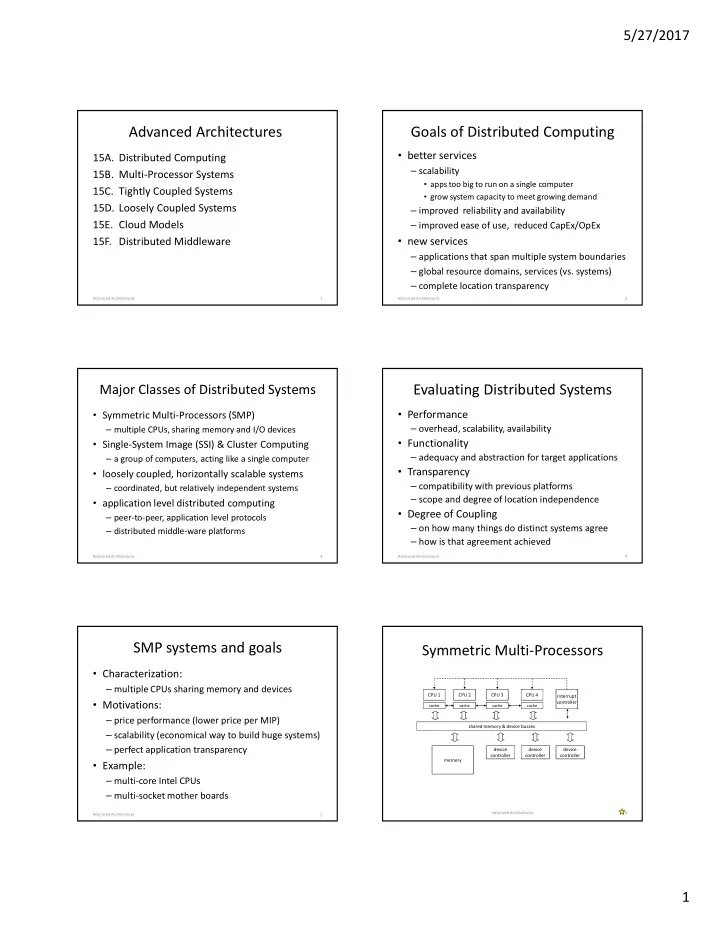
Advanced Architectures Goals of Distributed Computing better - - PDF document

advanced architectures goals of distributed computing
SMART_READER_LITE
LIVE PREVIEW

Advanced Architectures Goals of Distributed Computing better - - PDF document

5/27/2017 Advanced Architectures Goals of Distributed Computing better services 15A. Distributed Computing scalability 15B. Multi-Processor Systems apps too big to run on a single computer 15C. Tightly Coupled Systems grow


slide-1
SLIDE 1

5/27/2017 1

Advanced Architectures

  • 15A. Distributed Computing
  • 15B. Multi-Processor Systems
  • 15C. Tightly Coupled Systems
  • 15D. Loosely Coupled Systems
  • 15E. Cloud Models
  • 15F. Distributed Middleware

Advanced Architectures 1

Goals of Distributed Computing

  • better services

– scalability

  • apps too big to run on a single computer
  • grow system capacity to meet growing demand

– improved reliability and availability – improved ease of use, reduced CapEx/OpEx

  • new services

– applications that span multiple system boundaries – global resource domains, services (vs. systems) – complete location transparency

Advanced Architectures 2

Major Classes of Distributed Systems

  • Symmetric Multi-Processors (SMP)

– multiple CPUs, sharing memory and I/O devices

  • Single-System Image (SSI) & Cluster Computing

– a group of computers, acting like a single computer

  • loosely coupled, horizontally scalable systems

– coordinated, but relatively independent systems

  • application level distributed computing

– peer-to-peer, application level protocols – distributed middle-ware platforms

Advanced Architectures 3

Evaluating Distributed Systems

  • Performance

– overhead, scalability, availability

  • Functionality

– adequacy and abstraction for target applications

  • Transparency

– compatibility with previous platforms – scope and degree of location independence

  • Degree of Coupling

– on how many things do distinct systems agree – how is that agreement achieved

Advanced Architectures 4

SMP systems and goals

  • Characterization:

– multiple CPUs sharing memory and devices

  • Motivations:

– price performance (lower price per MIP) – scalability (economical way to build huge systems) – perfect application transparency

  • Example:

– multi-core Intel CPUs – multi-socket mother boards

Advanced Architectures 5

shared memory & device busses memory device controller device controller device controller CPU 1

cache

CPU 2

cache

CPU 3

cache

CPU 4

cache

interrupt controller

Symmetric Multi-Processors

Advanced Architectures 6

slide-2
SLIDE 2

5/27/2017 2

SMP Price/Performance

  • a computer is much more than a CPU

– mother-board, disks, controllers, power supplies, case – CPU might cost 10-15% of the cost of the computer

  • adding CPUs to a computer is very cost-effective

– a second CPU yields cost of 1.1x, performance 1.9x – a third CPU yields cost of 1.2x, performance 2.7x

  • same argument also applies at the chip level

– making a machine twice as fast is ever more difficult – adding more cores to the chip gets ever easier

  • massive multi-processors are obvious direction

Advanced Architectures 7

SMP Operating System Design

  • one processor boots with power on

– it controls the starting of all other processors

  • same OS code runs in all processors

– one physical copy in memory, shared by all CPUs

  • Each CPU has its own registers, cache, MMU

– they must cooperatively share memory and devices

  • ALL kernel operations must be Multi-Thread-Safe

– protected by appropriate locks/semaphores – very fine grained locking to avoid contention

Advanced Architectures 8

SMP Parallelism

  • scheduling and load sharing

– each CPU can be running a different process – just take the next ready process off the run-queue – processes run in parallel – most processes don't interact (other than in kernel)

  • serialization

– mutual exclusion achieved by locks in shared memory – locks can be maintained with atomic instructions – spin locks acceptable for VERY short critical sections – if a process blocks, that CPU finds next ready process

Advanced Architectures 9

The Challenge of SMP Performance

  • scalability depends on memory contention

– memory bandwidth is limited, can't handle all CPUs – most references satisfied from per-core cache – if too many requests go to memory, CPUs slow down

  • scalability depends on lock contention

– waiting for spin-locks wastes time – context switches waiting for kernel locks waste time

  • contention wastes cycles, reduces throughput

– 2 CPUs might deliver only 1.9x performance – 3 CPUs might deliver only 2.7x performance

Advanced Architectures 10

Managing Memory Contention

  • Fast n-way memory is very expensive

– without it, memory contention taxes performance – cost/complexity limits how many CPUs we can add

  • Non-Uniform Memory Architectures (NUMA)

– each CPU has its own memory

  • each CPU has fast path to its own memory

– connected by a Scalable Coherent Interconnect

  • a very fast, very local network between memories
  • accessing memory over the SCI may be 3-20x slower

– these interconnects can be highly scalable

Advanced Architectures 11

Non-Uniform Memory Architecture Symmetric Multi-Processors

PCI bus device controller device controller CPU n+1

cache local memory PCI bridge

CC NUMA interface PCI bus device controller device controller CPU n

cache local memory PCI bridge

CC NUMA interface Scalable Coherent Interconnect (e.g. Intel Quick Path Interconnect)

Advanced Architectures 12

slide-3
SLIDE 3

5/27/2017 3

OS design for NUMA systems

  • it is all about local memory hit rates

– every outside reference costs us 3-20x performance – we need 75-95% hit rate just to break even

  • How can the OS ensure high hit-rates?

– replicate shared code pages in each CPU's memory – assign processes to CPUs, allocate all memory there – migrate processes to achieve load balancing – spread kernel resources among all the CPUs – attempt to preferentially allocate local resources – migrate resource ownership to CPU that is using it

Advanced Architectures 13

Single System Image (SSI) Clusters

  • Characterization:

– a group of seemingly independent computers collaborating to provide SMP-like transparency

  • Motivation:

– higher reliability, availability than SMP/NUMA – more scalable than SMP/NUMA – excellent application transparency

  • Examples:

– Locus, MicroSoft Wolf-Pack, OpenSSI – Oracle Parallel Server

Advanced Architectures 14

The Dream

virtual HA computer w/4x MIPS & memory

  • ne large HA virtual file system

disk 1A disk 1B disk 2A disk 2B disk 3A disk 3B disk 4A disk 4B

  • ne global pool
  • f devices

physical systems

CD1 LP2 CD3 LP3 SCN4 CD1 CD3 LP2 LP3 SCN4 secondary replicas primary copies proc 101 proc 103 proc 106 lock 1A proc 202 proc 204 proc 205 proc 301 proc 305 proc 306 lock 3B proc 403 proc 405 proc 407 processes 101, 103, 106, + 202, 204, 205, + 301, 305, 306, + 403, 405, 407 locks 1A, 3B

Programs don’t run on hardware, they run atop operating systems. All the resources that processes see are already virtualized. Instead of merely virtualizing all the resources in a single system, virtualize all the resources in a cluster of systems. Applications that run in such a cluster are (automatically and transparently) distributed.

Modern Clustered Architecture

SMP system #1 SMP system #2 dual ported RAID SMP system #3 SMP system #4 dual ported RAID

primary site

  • ptional

back-up site

synchronous FC replication switch switch geographic fail over ethernet request replication

Active systems service independent requests in parallel. They cooperate to maintain shared global locks, and are prepared to take over partner’s work in case of failure. State replication to a back-up site is handled by external mechanisms. Advanced Architectures 16

Structure of a Modern OS

interrupts traps processor mode memory mapping atomic updates processor exceptions configuration analysis timers cache mgmt interrupts I/O

  • perations

traps processor mode memory mapping atomic updates context switching DMA bus drivers timers cache mgmt network class driver serial class driver display class driver storage class driver stream services block I/O services processor initialization hot-plug services enclosure management

processor abstraction I/O abstraction

memory allocation memory segments thread dispatching processes (resource containers) process/thread scheduling thread synchronization memory scheduling paging swapping fault handling I/O resource allocation DMA services

virtual execution engine

transport protocols file systems synchronization model exception model IPC model file model file I/O model process/thread model file namespace model

system call interfaces user visible OS model

asynchronous events device drivers device drivers volume management run-time loader configuration services kernel debugger logging & tracing

higher level services

authorization model boot strap fault management quality

  • f service

Advanced Architectures 17

OS design for SSI clustering

  • all nodes agree on the state of all OS resources

– file systems, processes, devices, locks IPC ports – any process can operate on any object, transparently

  • they achieve this by exchanging messages

– advising one-another of all changes to resources

  • each OS's internal state mirrors the global state

– request execution of node-specific requests

  • node-specific requests are forwarded to owning node
  • implementation is large, complex, difficult
  • the exchange of messages can be very expensive

Advanced Architectures 18

slide-4
SLIDE 4

5/27/2017 4

SSI Clustered Performance

  • clever implementation can minimize overhead

– 10-20% overall is not uncommon, can be much worse

  • complete transparency

– even very complex applications "just work" – they do not have to be made "network aware"

  • good robustness

– when one node fails, others notice and take-over – often, applications won't even notice the failure

  • nice for application developers and customers

– but they are complex, and not particularly scalable

Advanced Architectures 19

Lessons Learned

  • consensus protocols are expensive

– they converge slowly and scale poorly

  • systems have a great many resources

– resource change notifications are expensive

  • location transparency encouraged non-locality

– remote resource use is much more expensive

  • a greatly complicated operating system

– distributed objects are more complex to manage – complex optimizations to reduce the added overheads – new modes of failure w/complex recovery procedures

  • Bottom Line: Deutsch was right!

Advanced Architectures 20

Loosely Coupled Systems

  • Characterization:

– a parallel group of independent computers – serving similar but independent requests – minimal coordination and cooperation required

  • Motivation:

– scalability and price performance – availability – if protocol permits stateless servers – ease of management, reconfigurable capacity

  • Examples:

– web servers, Google search farm, Hadoop

Advanced Architectures 21

Horizontal Scalability w/HA

load balancing switch w/fail-over web server web server web server web server web server app server app server app server app server app server content distribution server HA database server

WAN to clients … …

D1 D2

Advanced Architectures 22

(elements of architecture)

  • farm of independent servers

– servers run same software, serve different requests – may share a common back-end database

  • front-ending switch

– distributes incoming requests among available servers – can do both load balancing and fail-over

  • service protocol

– stateless servers and idempotent operations – successive requests may be sent to different servers

Advanced Architectures 23

Horizontally scaled performance

  • individual servers are very inexpensive

– blade servers may be only $100-$200 each

  • scalability is excellent

– 100 servers deliver approximately 100x performance

  • service availability is excellent

– front-end automatically bypasses failed servers – stateless servers and client retries fail-over easily

  • the challenge is managing thousands of servers

– automated installation, global configuration services – self monitoring, self-healing systems

Advanced Architectures 24

slide-5
SLIDE 5

5/27/2017 5

Clouds: Applied Horizontal Scalability

  • Many servers, continuous change

– dramatic fluctuations in load volume and types – continuous node additions for increased load – nodes and devices are failing continuously – continuous and progressive s/w updates

  • Most services delivered via switched HTTP

– clients/server communication is over WAN links – large (whole file) transfers to optimize throughput – switches route requests to appropriate servers – heavy reliance on edge caching

Advanced Architectures 25

Geographic Disaster Recovery

  • Cloud reliability/availability are key

– one data center serves many (103-107) clients

  • Local redundancy can only provide 4-5 nines

– fires, power and communications disruptions – regional scale (e.g. flood, earthquake) disasters

  • Data Centers in distant Availability Zones

– may be running active/active or active/stand-by – key data is replicated to multiple data centers – traffic can be redirected if a primary site fails

Advanced Architectures 26

WAN-Scale Replication

  • WAN-scale mirroring is slow and expensive

– much slower than local RAID or network mirroring

  • Synchronous Mirroring

– each write must be ACKed by remote servers

  • Asynchronous Mirroring

– write locally, queue for remote replication

  • Mirrored Snapshots

– writes are local, snapshots are mirrored

  • Fundamental tradeoff: reliability vs. latency

Advanced Architectures 27

WAN-Scale Consistency

  • CAP theorem – cannot simultaneously assure:

– Consistency (all readers see the same result) – Availability (bounded response time) – Partition Tolerance (with node/network failures)

  • ACID databases sacrifice partition tolerance
  • BASE semantics make a different trade-off

– Basic Availability (most services most of the time) – Soft state (there is no global consistent state) – Eventual consistency (changes propagate, slowly)

Advanced Architectures 28

Dealing with Eventual Consistency

  • distributed system has no single, global state

– state updates are not globally serialized events – different nodes may have different opinions

  • expose the inconsistencies to the applications

– ask the cloud, receive multiple answers – let each application reconcile the inconsistencies

  • BASE semantics are neither simple nor pretty

– they embrace parallelism and independence – they reflect the complexity of distributed systems

Advanced Architectures 29

Distributed Computing Reformation

  • systems must be more loosely coupled

– tight coupling is complex, slow, and error-prone – move towards coordinated independent systems

  • move away from old single system APIs

– local objects and services don’t generalize – services are obtained through messages (or RPCs) – in-memory objects, local calls are a special case

  • embrace the brave new (distributed) world

– topology and partnerships are ever-changing – failure-aware services (commits, leases, rebinds) – accept distributed (e.g. BASE) semantics

Advanced Architectures 30

slide-6
SLIDE 6

5/27/2017 6

How to Exploit a Cloud

  • Replace physical machines w/virtual machines

– cloud provides inexpensive elastic resources

  • Run massively parallel applications

– requiring huge numbers of computers

  • Massively distributed systems are very difficult

– to design, build, maintain and manage

  • How can we make exploiting parallelism easy?

– new, tool supported, programming models – encapsulate complexity of distributed systems

31 Advanced Architectures

Distributed Middle-Ware

  • API adapters

– e.g. HIVE (SQL bridge)

  • complexity hiding

– e.g. remote procedure calls, distributed objects

  • restricted programming platforms

– e.g. Java Applets, Erlang, state machines

  • new programming models

– e.g. publish-subscribe, MapReduce, Key-Value stores

  • powerful distributed applications

– e.g. search engines, Watson, Deep Learning

Advanced Architectures 32

Example: A Hadoop Cluster

Advanced Architectures 33

name node data node data node data node

replication job tracker client HDFS cluster job submit/results task tracker map or reduce task task node

(Hadoop Distributed Middleware)

  • Client

– up-loads data into an HFDS cluster – creates map/reduce data analysis program – submits job to a Hadoop Job Tracker

  • Job Tracker

– sends sub-tasks to task trackers on many nodes

  • Task Trackers

– spawn/monitor map/reduce tasks, collect status

  • Map/Reduce Tasks

– run analysis program on a defined data sub-set – reading data from/writing results to HDFS cluster

Advanced Architectures 34

Changing Architectural Paradigms

  • a “System” is a collection of services

– interacting via stable and standardized protocols – implemented by app software deployed on nodes

  • Operating Systems

– manage the hardware on which the apps run – implement the services/ABIs the apps need

  • The operating system is a platform

– upon which higher level software can be built – goodness is measured by how well it does that job

Advanced Architectures 35

What Operating Systems Do

  • Originally (and at the start of this course)

– abstract heterogeneous hardware into useful services – manage system resources for user-mode processes – ensure resource integrity and trusted resource sharing – provide a powerful platform for developers

  • None of this has changed, but …

– notion of a self-contained system becoming obsolete – hardware and OS heterogeneity is a given – most important interfaces are higher level protocols

  • Operating Systems continue to evolve as

– new applications demand new services – new hardware must be integrated and exploited

Advanced Architectures 36

slide-7
SLIDE 7

5/27/2017 7

Could you and I with Him conspire, to grasp this sorry scheme of things entire, Would we not shatter it to bits – and then re-mould it nearer to the heart's desire?

Omar Khayyam The Rubaiyat, XCIX

What Operating Systems Do

Advanced Architectures 37

Was uns nicht umbringt macht uns nur starker!

..

Friedrich Wilhelm Nietzsche

(That which does not kill us

  • nly makes us stronger!)

Man and Superman

Advanced Architectures 38

Assignments

  • Monday 6/12 08:00-10:50 Final Exam

– part 1 … covering all material since mid-term

  • 10 problems, similar in type/difficulty to mid-term

– part 2 … covering the entire course

  • 6 new/hard problems … pick any three to answer
  • Wednesday 6/14 mid-night

– project 4C is due … no slip days

Advanced Architectures 39

Supplementary Slides

Advanced Architectures 40

Transparency

  • Ideally, a distributed system would be just like

a single machine system

  • But better

– More resources – More reliable – Faster

  • Transparent distributed systems look as much

like single machine systems as possible

41 Advanced Architectures

SMP Device I/O

  • all processors can access all memory/devices

– any processor can initiate an I/O operation

  • initiating processor need not be one that requested the I/O

– any processor can service an I/O interrupt

  • servicing processor need not be one that initiated I/O
  • interrupt controller picks which CPU to interrupt

– dynamic priorities, always interrupt lowest priority CPU – fixed binding of some or all interrupts to one CPU – automatic round-robin delivery

Advanced Architectures 42

slide-8
SLIDE 8

5/27/2017 8

Global Resource View

(heterogeneous systems &resources)

NFS server NFS server NFS server CIFS server CIFS server CIFS server print server Windows client Solaris client Linux client Apple client AIX client ORB automount map DFS root server LDAP server DNS server

  • ther

services

  • ther

services

Advanced Architectures 43

Loosely Coupled Availability

(Kimberlite HA Linux platforms)

primary site secondary site

service configuration service manager service instance task service instance task service instance task

service configuration service manager service instance task service instance task service instance task

heartbeats

manual replication

There is global resource view or synchronization of resource state. The systems are completely Independently of one-another, but agree on the division of tasks, and are prepared to take over the partner’s work load if he fails. Advanced Architectures 44