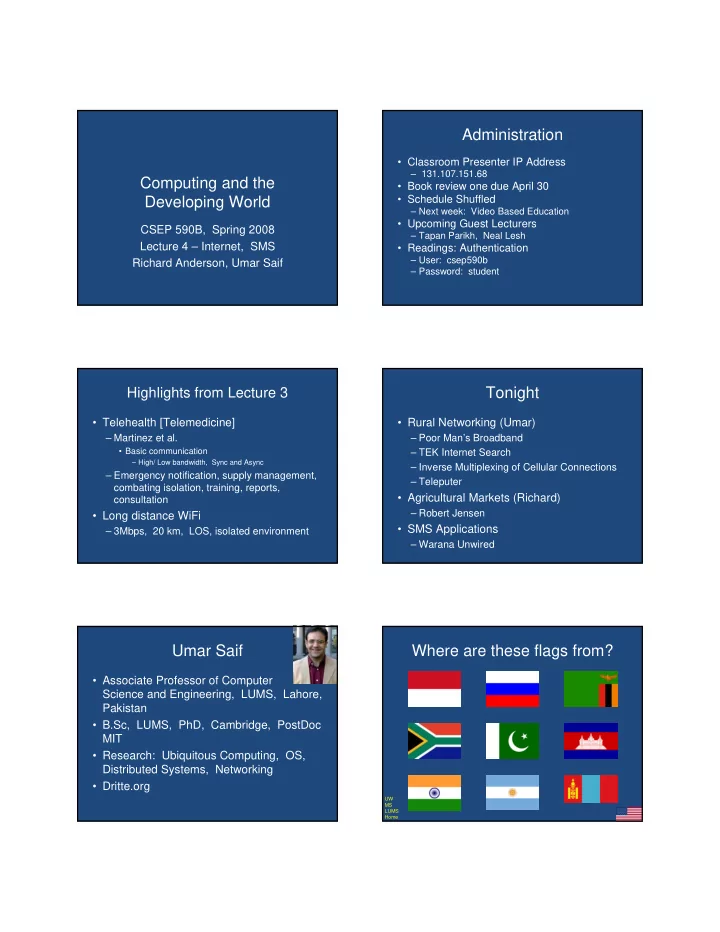
Administration Classroom Presenter IP Address 131.107.151.68 - - PDF document

administration
SMART_READER_LITE
LIVE PREVIEW

Administration Classroom Presenter IP Address 131.107.151.68 - - PDF document

Administration Classroom Presenter IP Address 131.107.151.68 Computing and the Book review one due April 30 Developing World Schedule Shuffled Next week: Video Based Education Upcoming Guest Lecturers CSEP 590B,


slide-1
SLIDE 1

Computing and the Developing World

CSEP 590B, Spring 2008 Lecture 4 – Internet, SMS Richard Anderson, Umar Saif

Administration

  • Classroom Presenter IP Address

– 131.107.151.68

  • Book review one due April 30
  • Schedule Shuffled

– Next week: Video Based Education

  • Upcoming Guest Lecturers

– Tapan Parikh, Neal Lesh

  • Readings: Authentication

– User: csep590b – Password: student

Highlights from Lecture 3

  • Telehealth [Telemedicine]

– Martinez et al.

  • Basic communication

– High/ Low bandwidth, Sync and Async

– Emergency notification, supply management, combating isolation, training, reports, consultation

  • Long distance WiFi

– 3Mbps, 20 km, LOS, isolated environment

Tonight

  • Rural Networking (Umar)

– Poor Man’s Broadband – TEK Internet Search – Inverse Multiplexing of Cellular Connections – Teleputer

  • Agricultural Markets (Richard)

– Robert Jensen

  • SMS Applications

– Warana Unwired

Umar Saif

  • Associate Professor of Computer

Science and Engineering, LUMS, Lahore, Pakistan

  • B.Sc, LUMS, PhD, Cambridge, PostDoc

MIT

  • Research: Ubiquitous Computing, OS,

Distributed Systems, Networking

  • Dritte.org

Where are these flags from?

UW MS LUMS Home

slide-2
SLIDE 2

Umar’s Slides Warana Unwired

  • High profile kiosk project to support agriculture
  • After 7 years, the project had only achieved a

fraction of its goals and had very high maintenance cost

  • Main application was replaced by a cell

phone/sms application

Warana Sugar Cooperative

  • At harvest, farmers send sugar cane to

cooperative for processing

  • Farmers receive reports of the amount of

sugar cane processed by factory

  • Before Kiosk Project

– Farmers visit central processing office

  • After Kiosk Project

– Farmers visit kiosk office – Kiosk operator places request – After one or two days, farmer gets report

Warana: Cell Phone Solution

  • Low cost mobile phone at the kiosk
  • Smart phone running server at processing

plant

– Messages translated into DB query

– “TON 123456 0807”

– Answer sent back to calling phone

  • Farmers would have kiosk operator place the

text message

  • Set up as experiment to evaluate cell phone

against the PC

SMS Applications

UW MS LUMS Home

Country Domain Problem Country Domain Problem

Key ideas for SMS Applications

1. 2. 3.

slide-3
SLIDE 3

Markets and Development

  • The key for solving rural poverty is greater

agricultural income

  • Improved markets are necessary for

increasing income

Market Price Info

  • Agricultural wholesale markets can have

large price swings during the day

  • Transportation costs and perishability limit

producer options

  • Advance notice of price information

– Decision which market to use – Decision whether to bring goods to market – Decision whether to harvest

  • Is there any evidence that this information

actually is of value?

Robert Jensen

  • Study of wholesale

prices of fish markets in Kerala

  • Data covered the time

period when cellular coverage was introduced

Main result Importance of Agricultural Output Markets

  • Significant portion of the worlds poor are in

agriculture, fisheries, forestry

  • Functioning of Markets important for well

being of the poor

  • Markets

– coordinate dispersed consumers and producers – price coordinates allocation of goods

  • Fundamental theorem of welfare economics

– “Law of one price”

Information and Market Functioning

  • Sigler, Economics of Information

– Costly search for information leads to price dispersion – Especially if infrastructure is poor and markets are dispersed

  • Without information, no reason to assume markets

are efficient

– Consumers, Producers, Intermediaries don’t adjust to scarcity

  • Price dispersion reflects inefficiency. Improved

information might improve efficiency and help the poor.

slide-4
SLIDE 4

Information for Fishermen

M2 M1 M2 M1

Welfare Economics Mackerel Economics Economics

  • Welfare theory argues for a net gain for

produces and consumers

  • Gains depend on the shape of the curve

– Price elasticities

  • Reduction in waste potentially benefits

both groups

  • Impact of reduced price variability on

consumers not clear

Study

  • Beach Market Survey (N=15, 15 km

apart)

– Every Tuesday, 7-8 am, 1996-2001 – All transactions

  • Fisherman Survey (weekly, N=15*20)
  • Fishing village survey (monthly, N = 15)
  • Consumer price survey (weekly, N = 15)

Cell phone adoption

  • Fishermen quickly adopted cell phones as

they became available

  • Fishermen would contact a large number
  • f buyers while at see
  • Other benefits of cell phones for fishermen

documented by Abrahim (ICTD 2006)

slide-5
SLIDE 5

Conclusions (Jensen)

  • Poor information limits functioning of

markets

  • Information makes markets work, and

markets help the poor

– It’s the I, not the T

  • Fishing in Kerala probably not a special

case

  • This was not a development project

– People figured it out on their own

SMS (Short Message Service)

  • Protocol for text messages on GSM

phones

– 1120 bit messages

  • 160 7-bit, 140 8-bit, 70 16-bit characters

SMS Costs world wide

Country SMS Cost, Local SMS Cost USD USA $0.10 Pakistan 50 paisa $0.008 India 10 paisa $0.0025 China 0.15 yuan $0.02 South Korea 10 won $0.01 Namibia 0.40 NAD $0.05 Bangladesh 1 taka $0.015 Philippines 1 peso $0.02 Cambodia 150 riel $0.03 Bhutan 1 nu $0.025 Botswana 0.40 pula $0.06

Smart phone vs. Dumb Phone

  • Should ICTD work target “Smart Phones”
  • r “Dumb Phones”.
  • Why?

UW MS LUMS Home

Warana Wired Village (1998)

  • Case study of a failed kiosk project
  • Very ambitious goals
  • Funding split:

– Central: 50%, State: 40%, 10% Cooperative

  • 54 to 70 Village Kiosks
  • Setup

– Concrete building – PC (Pentium, Win95), UPS, Printer – Landline, 10 kbps connection

Planned applications

  • Warana on Internet
  • Database of farmer statistics
  • GIS of 70 villages
  • Local language interface
  • Land record computerization
  • Intranet site about crop pests
  • Agricultural price info
  • Personalized sugarcane information
  • Internet connectivity
slide-6
SLIDE 6

Warana Experiment

  • Question: can the Kiosk functions be replaced by

SMS.

  • Method: have Kiosk operators use cell phones

instead of the PC. Other operations remained the same.

  • Issues:

– Physical space: kiosks and computers left in place – Printouts: handwritten and stamped receipts given by kiosk operator – Security and privacy: not a worry for the farmers. Access restricted to registered phones

Warana Results: Cost Savings

  • Compared to what?

– Existing PC System – New PC System – Mobile SMS with Kiosk – Mobile SMS without Kiosk – GPRS with Kiosk – GPRS without Kiosk

Study results

  • 7 village pilot
  • Training of kiosk operators on SMS

system

  • Usage comparable to kiosk
  • Query time: 2 minutes
  • Favorable response from farmers

– Requests to expand the pilot – Use from phones outside of kiosks

Other SMS based projects Zambian National Farmers Union

  • ZNFU
  • http://www.farmprices.co.zm/prices.php

Market Price Queries

slide-7
SLIDE 7

tradenet.biz

  • Agricultural trading in

West Africa

  • Primarily web based,

but supports sms notifications

www.dam.gov.bd

  • Web portal with price information for

agricultural commodities in Bangladesh

Why things fail literature

  • Richard Heeks

– Information systems and developing countries: Failure, Success, and Local Improvisation

Failures

  • What percentage of startup companies

fail?

  • Leading cause of failure ______________

_________________________________

  • What percentage of IT projects fail?
  • Leading cause of failure ______________

_________________________________

Design-Actuality Gaps

  • Components from the designers’ own

context

  • Conceived assumptions about the

situation of the user

  • “Information systems per se have a

tendency to be designed according to models of rationality”

Hard vs. Soft Models

Dimension “Hard” rational design “Soft” political actuality Information Standardized, formal, quantitative information Contingent, informal, qualitative Technology Simple enabling mechanism Complex, value-laden, status-symbol Process Stable, formal; outcomes as optimal solutions Flexible, complex, constrained, informal Objectives and values Formal organizational

  • bjectives

Multiple, informal, personal objectives Staffing and management Staff viewed as rational beings Staff viewed as political beings Management systems and structures Formal, objective processes Informal, subjective processes Other resources: time and money Used to achieve

  • rganizational ends

Used to achieve personal ends

slide-8
SLIDE 8

KACE: Kenya Agricultural Commodity Exchange

  • Private sector firm collecting and

distributing market information to smallholder farmers

  • Market information to help small holder

farmers

– Reduce power of middleman – Marketplace arbitrage

  • Exchange of goods through offers to buy

and sell

KACE MIS

  • Rural market based Market Information

Points (MIPs)

  • District-level Market Information Centers

(MICs)

  • Mobile Phone Short Messaging Service

(SMS)

  • Interactive Voice Response (IVR) service
  • Internet based database system
  • Mass media (radio)

Mobile Phone

  • Branded service with Safaricom

– 7 Ksh per message ($ 0.10 )

  • Simple SMS interface
  • Prices updated daily
  • Separate voicemail system

– Pre-recorded in English and Kiswahili – Menu based – 20 Ksh

Status

  • 2004 – 2 MICs, 11 MIPs
  • Support from foundations

– USAID, Rockefeller, etc. – Long term model – user fees, revenue sharing with phone companies

  • Moderate SMS, and website use

– End of study an upswing in Voice use

  • Possible improvements in market

conditions

Mobile phone based market information systems

  • How important do you expect these to be?
  • Why?

Worse than useless No impact Minor : niche applications Moderate: multiple locales and crops Significant: widespread use Revolutionary: Will change agriculture

Lecture summary

  • Dealing with networking constraints
  • Asynchronous web access
  • Importance of Markets

– Jensen, Sardine fishing in Kerala

  • SMS based applications

– Agricultural queries for sugar processing

  • Other agricultural deployments unclear
  • Research challenge – expand reach of networking

– Internet and Cellular