Admin If you are taking this course as a visiting undergraduate for - - PowerPoint PPT Presentation

admin
SMART_READER_LITE
LIVE PREVIEW

Admin If you are taking this course as a visiting undergraduate for - - PowerPoint PPT Presentation

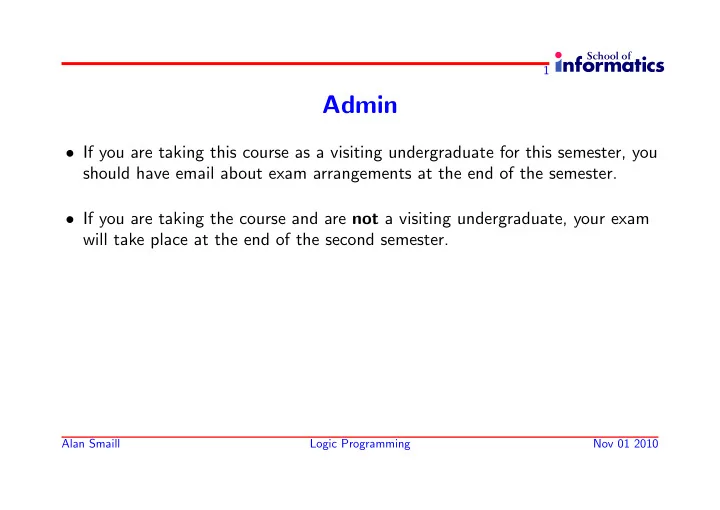
1 Admin If you are taking this course as a visiting undergraduate for this semester, you should have email about exam arrangements at the end of the semester. If you are taking the course and are not a visiting undergraduate, your exam


slide-1
SLIDE 1

1

Admin

  • If you are taking this course as a visiting undergraduate for this semester, you

should have email about exam arrangements at the end of the semester.

  • If you are taking the course and are not a visiting undergraduate, your exam

will take place at the end of the second semester.

Alan Smaill Logic Programming Nov 01 2010

slide-2
SLIDE 2

2

Today

  • Prolog interpreter algorithms
  • Beyond Pure Prolog: “meta”-predicates
  • Closed World Assumption & Negation as Failure.

Alan Smaill Logic Programming Nov 01 2010

slide-3
SLIDE 3

3

Algorithms for definite clause interpreter

We have seen the outline of how inference in definite clause logic can be

  • automated. Let’s spell out a bit more concretely some of the key procedures

involved. These will be given by Haskell functions, with comments. Haskell is a functional programming language – see overview material1. An implementation of a basic Prolog interpreter in Haskell is also available2. Features in common with other languages, such as parsing, pretty printing, input/output must be dealt with, but we concentrate on the key steps in inference and search. Acknowledgements to Mark Jones for the Haskell code.

1http://www.inf.ed.ac.uk/teaching/courses/inf1/fp/#info 2http://darcs.haskell.org/nofib/real/prolog

Alan Smaill Logic Programming Nov 01 2010

slide-4
SLIDE 4

4

Representing statements

For an interpreter, there is no need to make a distinction between function symbols and predicates. Here are the basic data-types:

type Id = (Int,String)

  • - variable identifiers, Int allows renaming

type Atom = String

  • - for constant, fn symbol or predicate

data Term = Var Id | Struct Atom [Term]

  • - Var, Struct are constructors for pattern matching

data Clause = Term :== [Term]

  • Clause is written as " tm :== [tm,tm,...] "

data Database = Db [(Atom,[Clause])]

  • The program

Alan Smaill Logic Programming Nov 01 2010

slide-5
SLIDE 5

5

Substitutions

Since haskell is a functional language, in which functions are first-class objects, substitutions can be treated directly as functions from (some) variables to terms.

  • -- Substitutions:

type Subst = Id -> Term

  • - substitutions are represented by functions mapping variable ids to terms.
  • - apply s

extends the substitution s to a function mapping terms to terms

  • - nullSubst is the empty substitution which maps every identifier to the
  • same identifier (as a term).
  • - i ->> t

is the substitution which maps the variable id i to the term t,

  • but otherwise behaves like nullSubst.
  • - s1 @@ s2

is the composition of substitutions s1 and s2

Alan Smaill Logic Programming Nov 01 2010

slide-6
SLIDE 6

6

Substitution Operations

apply :: Subst -> Term -> Term apply s (Var i) = s i apply s (Struct a ts) = Struct a (map (apply s) ts)

  • - apply the substitution recursively to every argmnt

nullSubst :: Subst nullSubst i = Var i (->>) :: Id -> Term -> Subst (->>) i t j | j==i = t

  • - case j==i

| otherwise = Var j

  • - any other case

(@@) :: Subst -> Subst -> Subst s1 @@ s2 = (apply s1) . s2

  • - "." is function composition; (f . g) x = f(g(x))

Alan Smaill Logic Programming Nov 01 2010

slide-7
SLIDE 7

7

Unification

with occurs check; success is a singleton list with mgu, failure is empty list.

unify :: Term -> Term -> [Subst]

  • - unify takes two terms, and returns a list of substitutions

unify (Var x) (Var y) = if x==y then [nullSubst] else [x->>Var y] unify (Var x) t2 = [ x ->> t2 | not (x ‘elem‘ varsIn t2) ]

  • - [] if x is in t2, otherwise [ x ->> t2]

unify t1 (Var y) = [ y ->> t1 | not (y ‘elem‘ varsIn t1) ] unify (Struct a ts) (Struct b ss) = [ u | a==b, u<-listUnify ts ss ]

  • - [] if a =/=b, otherwise call listUnify on args

Alan Smaill Logic Programming Nov 01 2010

slide-8
SLIDE 8

8

Unification ctd

listUnify :: [Term] -> [Term] -> [Subst] listUnify [] [] = [nullSubst] listUnify [] (r:rs) = []

  • - fail if lists of different length

listUnify (t:ts) [] = [] listUnify (t:ts) (r:rs) = [ u2 @@ u1 |

  • - compose subs u1, u2, where

u1<-unify t r, -- u1 is unifier of t,r u2<-listUnify (map (apply u1) ts) (map (apply u1) rs) ]

  • - apply u1 to all remaining arguments,
  • - and call recursively to get u2

Alan Smaill Logic Programming Nov 01 2010

slide-9
SLIDE 9

The Proof Search Space 9

data Prooftree = Done Subst | Choice [Prooftree]

  • - Done [] is failure, Done [s] suceeds with subsitution s,
  • - Choice is a list of open possible derivations
  • - prooftree constructs a suitable proof search tree for a specified goal
  • - since Haskell is lazy, doesn’t expand trees here!

prooftree :: Database -> Int -> Subst -> [Term] -> Prooftree prooftree db = pt where pt :: Int -> Subst -> [Term] -> Prooftree

  • - proof depth, result so far, list of goals

pt n s [] = Done s pt n s (g:gs) = Choice [ pt (n+1) (u@@s) (map (apply u) (tp++gs)) | (tm:==tp)<-renClauses db n g, u<-unify g tm ]

  • for each clause with head unifiable against first goal,
  • get new goal list: add clause body at FRONT of goals
  • (to get depth first), and apply unifier;

also

  • update accumulated substitution

Alan Smaill Logic Programming Nov 01 2010

slide-10
SLIDE 10

10

Proof Search

  • - search performs a depth-first search of a proof tree, producing the list
  • f solution substitutions as they are encountered.

search :: Prooftree -> [Subst] search (Done s) = [s]

  • - found a solution

search (Choice pts) = [ s | pt <- pts, s <- search pt ]

  • - look successively at each tree in pts,
  • - call search recursively on it

prove :: Database -> [Term] -> [Subst]

  • - initialise the search

prove db = search . prooftree db 1 nullSubst

This is the basic engine to find the first solution to a query. An interpreter that deals with subsequent solutions, and with cuts, is not much more complicated; see Engine.hs for the extended interpreter.

Alan Smaill Logic Programming Nov 01 2010

slide-11
SLIDE 11

11

Meta-language

Thus we get two languages, one describing the other. We say that the meta-language is used to talk about the object language. Examples English as meta-language, with French as object language: The word “poisson” is a masculine noun. English as meta-language, with English as object-language: It is hard to understand “Everything I say is false”.

Alan Smaill Logic Programming Nov 01 2010

slide-12
SLIDE 12

12

Examples ctd

Prolog contains a mixture of object-level and meta-level statements.

father(a,b).

  • bject-level

functor(father(a,b),father,2). meta-level var(X). meta-level

It is better to keep these uses distinct. Notice that var/1 does not function according to Prolog’s declarative semantics:

Alan Smaill Logic Programming Nov 01 2010

slide-13
SLIDE 13

13

Compare: | ?- var(X),X=2. X = 2 ? yes | ?- X=2, var(X). no Remember, Prolog comma is just conjunction – the two queries are logically equivalent, so the answers should be the same. So this behaviour is inconsistent with the declarative reading.

Alan Smaill Logic Programming Nov 01 2010

slide-14
SLIDE 14

14

Prolog in Prolog

Take the program: father(a,b). ancestor(X,Y) :- father(X,Y). ancestor(X,Y) :- father(X,Z), ancestor(Z,Y). We can write a description of Prolog programs in Prolog: clause( father(a,b), true ). clause( ancestor(X,Y), father(X,Y) ). clause( ancestor(X,Y), (father(X,Z), ancestor(Z,Y)) ).

Alan Smaill Logic Programming Nov 01 2010

slide-15
SLIDE 15

15

Status of meta-predicates

This treatment of Prolog in Prolog also breaks the declarative reading. The statement clause( father(a,b), true ) cannot be parsed in definite clause logic so that father is a predicate – it can only be a function symbol. One possibility is to consider that we are dealing with two languages – an object language in which father is a predicate, and a meta-language which talks about the object language, and where clause is a predicate. This make it hard to understand in a declarative way programs where the two languages are mixed. The language Goedel3 developed a systematic approach to logic programming with two interconnected languages.

3http://www.scs.leeds.ac.uk/hill/GOEDEL/expgoedel.html

Alan Smaill Logic Programming Nov 01 2010

slide-16
SLIDE 16

16

Negation by failure

Prolog does not distinguish between being unable to find a derivation, and claiming that the query is false; that is, it does not distinguish between the “false” and the “unknown” values we have above. When we take a Prolog response of no. as indicating that a query is false, we are making use of the idea of negation as failure: if a statement cannot be derived, then it is false. Clearly, this assumption is not always valid! If some information is not present in the program, failure to find a derivation should not let us conclude that the query is false – we just don’t have the information to decide.

Alan Smaill Logic Programming Nov 01 2010

slide-17
SLIDE 17

17

Knowing the answers

A good situation to be in is where we have enough information to answer any possible query. If we know poor(jane) poor(jane) → happy(jane) happy(fred) we do not know enough to answer the query ? − poor(fred)

Alan Smaill Logic Programming Nov 01 2010

slide-18
SLIDE 18

18

Complete Theories

We say a theory T is complete (for ground atoms) iff for every query (like poor(fred)) we can conclude either poor(fred) or ¬poor(fred). A ground atom is a statement of the form P(t1, . . . , tn) where there are no variables in any ti; so it is a basic statement about particular objects. Our example T is not complete in this sense; we can extend it to make a complete T using the Closed World Assumption (CWA). The idea is to add in the negation of a ground atom whenever the ground atom cannot be deduced from the KB. This makes the assumption that all the basic positive information about the domain follows from what is already in T.

Alan Smaill Logic Programming Nov 01 2010

slide-19
SLIDE 19

19

CWA as an augmented T

We can define the effect of the CWA using the standard logic we saw earlier. Given a T written in first-order logic, we augment T to get a bigger set of formulas CWA(T); the extra formulas we add are: XT = { ¬p(t1, . . . , tn) : not T ⊢ p(t1, . . . , tn) } Now we can define what it is to follow from T using CWA: a formula Q follows from T using the CWA iff T ∪ XT | = Q

Alan Smaill Logic Programming Nov 01 2010

slide-20
SLIDE 20

20

Example

In the example, we can now conclude ¬poor(fred), since from the original T we cannot show poor(fred). Thus we have ¬poor(fred) is in XT. In fact, in this case XT = { ¬poor(fred) }, assuming there are no other constants in the language except jane, fred. In this case, we can compute the set XT by looking at all possibilities. One use of CWA is in looking at a failed Prolog query of the form ?- property(t1,t2). as saying that the query is in fact false.

Alan Smaill Logic Programming Nov 01 2010

slide-21
SLIDE 21

21

Summary

  • Prolog interpreter algorithms
  • Beyond Pure Prolog: “meta”-predicates
  • Closed World Assumption

Alan Smaill Logic Programming Nov 01 2010