SLIDE 1
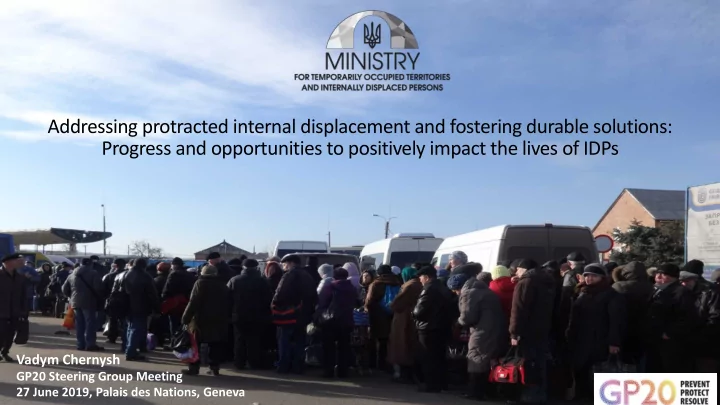
Addressing protracted internal displacement and fostering durable solutions: Progress and opportunities to positively impact the lives of IDPs
Vadym Chernysh
GP20 Steering Group Meeting 27 June 2019, Palais des Nations, Geneva
SLIDE 2 Kyiv region 210.000 Odessa region 35.000 Lugansk region 270.000 Kharkiv region 130.000 Donetsk region 490.000 Zaporizhia region 55.000 Dnipropetrovsk region 69.000
INTERNAL DISPLACEMENT: REASONS AND CHALLENGES
Reasons of internal displacement:
- armed conflict in the eastern Ukraine and occupation of Crimea;
- threat to own life and the life of family members;
- the need for access to social, medical, educational services;
- the activities of the occupying forces of the Russian Federation and the self-proclaimed
authorities in relation to the population;
- non-recognition and rejection of the illegal actions of the self-proclaimed authorities;
- social insecurity;
- the impossibility of the realization of fundamental human and citizen's rights and
freedoms: freedom of movement, forcible involvement in illegal armed groups
1,3 mln IDPS,
SLIDE 3 MEASURES FOR IMMEDIATE RESPONSE
In 2014 Verkhovna Rada of Ukraine adopted the Law of Ukraine “On Ensuring Rights and Freedoms of Internally Displaced Persons”
The law establishes the rights of IDPs for:
- obtaining and recovery of documents;
- employment, pensions, state social
insurance, social services, education;
- realization of voting rights;
- safe living conditions, family unity;
- other rights.
SLIDE 4 RPA has been carried out by STP main thematic components
Infrastructure and social services Economic recovery Social resilience, peacebuilding and public security
In 2017 Government of Ukraine approved the State Targeted Program for Recovery and Peacebuilding in the Eastern Regions of Ukraine
The program provides:
- restoration of housing of communal property for the residence of IDPs;
- raising the level of awareness of IDPs about programs/projects targeted at the development of small and
medium-sized enterprises;
- support of small and medium-sized enterprises in Donetsk and Luhansk oblasts, established by IDPs;
- attracting IDPs to participate in decision-making processes.
IMPLEMENTATION OF DURABLE SOLUTIONS FOR IDPS
Valid for 5 areas that have accepted the highest number of IDPs
SLIDE 5 IMPLEMENTATION OF DURABLE SOLUTIONS FOR IDPS Strategy was supported by:
“Internally displaced persons should be considered as a resource for society, not a burden for members of community and local authorities”
At the end of 2017, the Government adopted the Strategy for the Integration of Internally Displaced Persons and Implementation of Long-Term Solutions to Internal Displacement for the Period until 2020 and the Action Plan for its implementation. The document covers the whole territory of Ukraine. The strategy responds:
ü Standards of the Committee of Ministers of the Council of Europe; ü UN Guiding Principles on Internal Displacement; ü Recommendations and resolutions of the Parliamentary Assembly
- f the Council of Europe on issues that relate to the rights,
freedoms and legitimate interests of internally displaced persons; ü European Union recommendations for developing strategies for internally displaced persons.
SLIDE 6 Strategy Action Plan
Consultations were held with international experts: representatives of UNHCR, World Bank, OCHA and the Council
- f Europe Office in Ukraine.
A high-level seminar "A new principle for solving the problems of the ongoing internal displacement of persons in Ukraine", organized by UNHCR and the OCHA was held on September 25, 2017 The report “Solution in despair” was presented, containing recommendations for Ukraine in the issues of
- vercoming the consequences of internal displacement.
(Professor V. Kelin) The draft Strategy is presented at the “Three Years of Displacement: Challenges and Good Practices
IDPs Integration” forum, organized with the Council of Europe. The Forum participants included more than 100 people from 13 oblasts of Ukraine, representatives of state authorities,
- blast/local social services, institutions and facilities, NGOs,
educational and research institutions, international
- rganizations and the mass media.
The experience of foreign countries on the integration of IDPs and the implementation of long-term solutions for internal displacement (Azerbaijan, Georgia, Bosnia & Herzegovina, Croatia) were used. A public discussion of the draft Action Plan was held with NGOs, international organizations, diplomatic institutions, government bodies, local government. In total the MTOT received 310 comments and suggestions from 27 public authorities, international and national organizations and civil society representatives.
ATTRACTION A VARIETY OF PARTNERS AND IDPs FOR STRATEGY AND ACTION PLAN DEVELOPMENT
SLIDE 7
HEADLINES
The Strategy indicates the overall Government priorities on internal displacement Includes ensuring the rights of people to return to their areas of origin and to get compensation for their lost properties, but also supporting their local integration into society Both the Strategy and the Action Plan are ambitious and aim to ensure a whole-of- Government approach to internal displacement The Action Plan includes measures aimed at specific Ministries, such as the ones dealing with social payment and pensions, housing, employment, education, health, etc The Action Plan also involves local authorities and departments which regularly deal with IDPs, as local ownership is essential
1 2 3 4 5
SLIDE 8 Addressing the needs
development of regional and local programs
STRATEGIC GOALS
Dialogue of state and local authorities on IDPs Proper care in health care facilities Accounting for IDPs in the distribution of medical and educational services Social and temporary housing Participation of IDPs in the local elections Preferential taxation of landlords Support for displaced universities Automatic control over pension and social payments New workplaces Re-qualification, retraining of IDPs Documents recovery Distance education programs Free accommodation in dormitories, provision of textbooks Providing pension and social benefits Inclusion of IDPs in the register of local community members
SLIDE 9 ü Accounting for the number of IDPs in the allocation of state funding of health care in the communities. ü Ability to participate in the national elections under the simplified procedure. ü Simplification of the procedure for entering the higher education institutions:
- creation of educational centers "Crimea - Ukraine" (37) and "Donbas - Ukraine" (24) on the
basis of displaced higher institutions;
- provision of IDPs with hostels, textbooks and internet.
ü Access to medicine with no discrimination of IDPs in comparison with the population of host communities. ü Implementation of the programs to provide IDPs with housing (temporary, credit, social).
STRATEGY IMPLEMENTATION, 2018-2019
Legal regulation
SLIDE 10
ü A mechanism has been implemented for the provision of IDPs’ temporary housing in co-funding from the state (50%) and the local budget (50%), which is valid for the entire territory of Ukraine (cooperation with Donetsk, Luhansk, Kharkiv, Zaporizhzhya, Dnipropetrovsk oblasts) ü The equipment for issuance of passports to Ukrainian citizens with an electronic contactless carrier has been purchased to improve the conditions for the provision of administrative services to IDPs in 13 cities of Donetsk and Luhansk oblasts ü Payment of targeted assistance to pay for utilities for IDPs (more than 120 million US dollars are allocated annually from the state budget) ü The “Affordable housing” program provides IDPs with permanent housing (half of the cost of purchased housing paid by state, loans for IDPs)
STRATEGY IMPLEMENTATION, 2018-2019
State budget funding
ü Ukrainian Social Investment Fund repaired/built the accommodation facilities for temporary residence of IDPs
SLIDE 11 ü placement of information about the rights of IDPs on official web resources
- f state and local authorities
ü operating “hotline” for IDPs for providing legal assistance and consultations for IDPs ü holding joint advocacy activities with UN OCHA, UNHCR, the Council of Europe Office ü conduction of visits to local communities
the purpose to dissemination information about State Policy on issues
- f IDPs and the necessity of integration
- f IDPs into the host communities
ü dissemination of information through non-governmental
and conduction of informational campaigns ü holding meetings with Ukrainian politicians and MPs
COMMUNICATIONS, INCLUSIVENESS AND ADVOCACY SUPPORT OF IDPS
SLIDE 12 ATTRACTING ITA
The MTOT partners
Projects are implemented in the following areas:
- psychosocial support of IDPs
- temporary housing for IDPs
- “hotline” for IDPs (legal assistance, consultations)
- professional integration and retraining of IDPs
- small grant programs for starting your own business
- peacebuilding
- reselience, social cohesion, confidence building
- increasing the economic potential of conflict-affected
communities
- legal protection of IDPs
- national monitoring system on the situation of
internally displaced persons
The MTOT attracted 233.5 million US dollars (2016-2019) The international technical assistance and loan funds raised by the MTOT, which are targeted at integrating IDPs and supporting host communities
SLIDE 13 NATIONAL MONITORING SYSTEM ON THE SITUATION OF INTERNALLY DISPLACED PERSONS National Monitoring System on the Situation with IDPs works in Ukraine since 2016
- IOM adapted the NMS to the Ukrainian context.
- NMS is implemented in cooperation with MTOT, MSP
- The objective of the National Monitoring System (NMS) in Ukraine is to support the Government of Ukraine in
collecting and analyzing information on the socio-economic characteristics of internally displaced persons (IDPs) and IDPs households, as well as the challenges they face with.
- The NMS provides better understanding of the evolving movements and locations, numbers, vulnerabilities
and needs of displaced persons in Ukraine.
- Quarterly the survey collects information on socio-economic characteristics of IDPs at individual and household
levels, including trends and movement intentions, employment, livelihood opportunities, access to social services and assistance needs in 24 oblasts of Ukraine and Kyiv. Main information sources used for NMS
- face-to face interviews (2400)
- telephone interviews (4000)
- key informants via face-to-face interviews (600)
- focus group discussions (6 FG quarterly)
- administrative data and relevant data available from
- ther sources
NMS components § characteristics of IDPs and their households § employment of IDPs § well-being of IDPs § access to social services § IDP mobility § integration into local communities § returnees to the non-government controlled areas
SLIDE 14 WELL-BEING OF IDPS AND LIVING CONDITIONS
IDP accommodation types, %* The most problematic issues for IDP households, %*
April 2017 December 2018 Lack of own housing no information available 37 Lack of money no information available 19 Payment for utilities 20
11
Lack of opportunity to return to the place of permanent residence 9 5 Living conditions 27
5
Payment for rent 23
4
Unemployment 13
3
Access to medicines 3 1 Access to health care 5 1 Suspension of social payments 2 1 Safety 2 1 Other 1 4 April 2017 December 2018
Rented apartment 43 49 Host family/relatives 22 14 Own housing 1 12 Rented house 16 10 Dormitory 3 4 Rented room in apartment 7 4 Collective centres for IDPs 6 3 Other 2 4
*National monitoring system, IOM, December 2018
SLIDE 15 In accordance with National Monitoring System on the situation of IDPs the employment rate among IDPs is 45%
(December 2018). Among them:
48% assess their previous employment to be the same as their current job. 27% believe they had a better job before the conflict. 16% assess their previous job to be worse than their current job. 67% of those IDPs that were working before displacement, found jobs that were the same or similar to their pre-displacement
work. Almost all IDPs have intentions to find a job in Ukraine or have already found a job in Ukraine and have no intentions to find a job abroad
April 2017 March 2018 June 2018 September 2018 December 2018 Have already found a job abroad and are about to move 1 1 1 1 1 Have an intention to find a job abroad soon 4 5 5 5 5 Have nothing against working abroad, but personally I am not going to 45 48 51 52 56
General IDPs’ intentions to find a job abroad
EMPLOYMENT SITUATION OF IDPS
SLIDE 16
11% 15% 11% 5% 19% 1% 15% 8% 7% 1% 7% 13% 24% 12% 6% 20% 0% 9% 5% 7% 0% 5% Managers Professionals Technicians and associate professionals Clerical support workers Service and sales workers Skilled agricultural, forestry and fishery workers Craft and related trades workers Plant and machine operators, and assemblers… Elementary occupations Armed forces occupations DIFFICULT TO SAY, REFUSE Hosts IDPs The current occupation of IDPs and local residents (hosts) in accordance with World Bank report “Conflict in Ukraine : socio-economic impacts of internal displacement and veteran return”
CATEGORIES OF CURRENT JOBS
(% of all employed IDPs and hosts)
SLIDE 17
65% 8% 24% 2% YES NO PARTLY REFUSE
Equal access to the same types of services as local residents (% of all IDPs)
56% 33% 26% 8% 6% 3% 4% 11% Lack of local residence registration Poor financial situation of your household Prejudice due to your IDP status Lack of necessary documents Physical inaccessibility for disabled Poor transportation in the area of your residence Other IT’S DIFFICULT / REFUSES TO ANSWER
The reasons of unequal access in accordance with NMS (% of those IDPs who think they have unequal access)
IDP VIEWS - EQUAL ACCESS TO SERVICES
IDPs’ satisfaction with the accessibility of basic social services December 2018 Possibilities to obtain education and enrol children in schools/ kindergartens 88 Accessibility of administrative services 81 Possibility of receiving a pension or social assistance 79 Accessibility of health-care services 68 Availability of employment opportunities 62
SLIDE 18 LENGTH OF TIME SPENT IN THE CURRENT PLACE OF RESIDENCE
10 20 30 40 50 60 70 80 June,2017 September, 2017 December, 2017 March, 2018 June,2018 September, 2018 December, 2018
The share of IDPs who reported, that they had been staying in their current place
- f residence for over three years reached 69% in 2018*
The share of IDPs who reported that they had been staying in their current place of residence for over three years *National monitoring system, IOM, December 2018
SLIDE 19 IDPS’ SELF-ASSESSMENT OF THEIR INTEGRATION IN THE LOCAL COMMUNITY (COMPLETELY AND PARTIALLY)
– 86%*
INTEGRATION INTO LOCAL COMMUNITIES
*National monitoring system, IOM, December 2018
SLIDE 20 INTEGRATION INTO LOCAL COMMUNITIES
March 2017 June 2017 September 2017 December 2017 March 2018 June 2018 September 2018 December 2018
IDPs’ conditions for integration in the local community, %*
*National monitoring system, IOM, December 2018
SLIDE 21
Ø Even the best strategic decisions may not achieve their goal due to inadequate implementation. Ø Implementation of the Integration Strategy of IDPs can not be the matter for one Ministry - MTOT - even if it is a coordinating body. Ø The lack of budget allocation to specific activities planned in the Action Plan. Ø Action Plan for implementing a strategy shall be the flexible document and based on feedbacks from recipients, civil society. Ø The lack of understanding between different actors (humanitarian/development partners, national/local authorities, NGOs/authorities).
KEY FINDINGS